NY State Supreme Court Judge Rejects Constitutionality of Mask Mandates

The judge ruled the governor lacks the authority to require those aged two and above to mask up in public.

New York Governor Kathy Hochul’s order for everyone to wear masks in public was shut down by a New York State Supreme Court judge, who ruled that such decisions must be passed by lawmakers instead.

Judge Thomas Rademaker ruled on Monday that the New York State Legislature was the only body with sufficient power to pass the mandate, which would force every New Yorker over the age of two to wear a face mask in public places, including schools.

“There can be no question that every person in this State wishes, wants and prays that this era of COVID ends soon and they will surely do their part to see that is accomplished,” the judge noted. “However, enacting any laws to this end is entrusted solely to the State Legislature.”

Judge Rademaker said that “while the intentions” of Governor Hochul and New York Health Commissioner Mary T. Bassett “appear to be well aimed squarely at doing what they believe is right to protect the citizens of New York State,” the two officials “must take their case to the State Legislature.”

“To allow such agency law making would result in laws being changed at the whim of every new Commissioner who could then be said to be beholden to their appointer,” Judge Rademaker noted. “But also it would surely result in a lack of representative government wherein only a select few appointees of the Governor make the laws.”

This is the very antithesis of constitutionally established representative government

Governor Hochul said she would fight to overturn the court’s decision instead of taking the mandate to the State Legislature as advised.

“My responsibility as Governor is to protect New Yorkers throughout this public health crisis, and these measures help prevent the spread of COVID-19 and save lives. We strongly disagree with this ruling, and we are pursuing every option to reverse this immediately,” she said in a statement.

US ‘Toolboxes’ Are Empty

The toolbox is empty. Russia knows this. Biden knows this. Blinken knows this. CNN knows this. The only ones who aren’t aware of this are the American people

by Scott Ritter via Consortium News

Scott Ritter is a former U.S. Marine Corps intelligence officer who served in the former Soviet Union implementing arms control treaties, in the Persian Gulf during Operation Desert Storm, and in Iraq overseeing the disarmament of WMD.

U.S. Secretary of State Antony Blinken met with his Russian counterpart, Sergei Lavrov, in a hastily scheduled, 90-minute summit in Geneva yesterday, after which both sides lauded the meeting as worthwhile because it kept the door open for a diplomatic resolution to the ongoing crisis in Ukraine. What “keeping the door open” entails, however, represents two completely different realities.

For Blinken, the important thing appears to be process, continuing a dialogue which, by its very essence, creates the impression of progress, with progress being measured in increments of time, as opposed to results.

A results-oriented outcome was not in the books for Blinken and his entourage; the U.S. was supposed to submit a written response to Russia’s demands for security guarantees as spelled out in a pair of draft treaties presented to the U.S. and NATO in December. Instead, Blinken told Lavrov the written submission would be provided next week.

In the meantime, Blinken primed the pump of expected outcomes by highlighting the possibility of future negotiations that addressed Russian concerns (on a reciprocal basis) regarding intermediate-range missiles and NATO military exercises.

But under no circumstances, Blinken said, would the U.S. be responding to Russian demands against NATO expanding to Ukraine and Georgia, and for the redeployment of NATO forces inside the territory of NATO as it existed in 1997.

Blinken also spent a considerable amount of time harping on the danger of a imminent military invasion of Ukraine by Russian forces said to be massing along the Ukraine-Russian border. He pointed out that any military incursion by Russia, not matter what size, that violated the territorial integrity of Ukraine, would be viewed as a continuation of the Russian “aggression” of 2014 and, as such, trigger “massive consequences” which would be damaging to Russia.

Blinken’s restatement of a position he has pontificated on incessantly for more than a month now was not done for the benefit of Lavrov and the Russian government, but rather for an American and European audience which had been left scratching their collective heads over comments made the day before by President Joe Biden which suggested that the U.S. had a range of options it would consider depending on the size of a Russian incursion.

“My guess is he [Russian President Vladimir Putin] will move in, he has to do something,” Biden said during a press briefing on Wednesday. While presenting a Russian invasion as inevitable, Biden went on to note that Putin “will be held accountable” and has “never have seen sanctions like the ones I promised will be imposed” if Russia were, in fact, to move against Ukraine. Biden spoke of deploying additional U.S. military forces to eastern Europe, as well as unspecified economic sanctions.

Biden then, however, hedged his remarks, noting that the scope and scale of any U.S. response would depend on what Russia did. “It’s one thing,” Biden said, “if it’s a minor incursion and we end up having to fight about what to do and not do.”

Almost immediately the Washington establishment went into overdrive to correct what everyone said was a “misstatement” by Biden, with Biden himself making a new statement the next day, declaring that he had been “absolutely clear with President Putin. He has no misunderstanding, any, any assembled Russian units move across the Ukrainian border, that is an invasion,” and that there should be “no doubt at all that if Putin makes this choice, Russia will pay a heavy price.”

And just in case the President was not clear enough, Blinken reiterated that point following his Friday meeting with Lavrov.

Immutable

The U.S. narrative about Russia and Ukraine was immutable; Russia was hell bent on invading, and there would be massive consequences if Russia acted out on its intent. This was no idle threat, Blinken said, but rather represented the unified position of the United States and its allies and partners.

Or was it? In a telling admission, CNN’s White House correspondent, John Harwood, stated that the “minor incursions” statement by Biden was harmless, because (Harwood said) Putin already knew through sources that this was, in fact, the U.S. position. As for Europe and Ukraine, their collective confusion and outrage was merely an act, a posture they had to take for public consumption, since the optics of Biden’s statement “sounds bad.”

In short, the lack of an agreed-upon strategy on how to deal with a Russian incursion/invasion of Ukraine was an open secret for everyone except the U.S. and European publics, who being fed a line of horse manure to assuage domestic political concerns over being seen as surrendering to Russian demands.

Biden and his administration are old hands at lying to the American public when it comes to matters of national security. One only need look to Biden’s July 23, 2021, phone call with Afghan President Ashraf Ghani for a clear precedent into this inability to speak openly and honestly about reality on the ground. “I need not tell you,” Biden told Ghani, “the perception around the world and in parts of Afghanistan, I believe, is that things are not going well in terms of the fight against the Taliban. And there is a need,” Biden added, “whether it is true or not, there is a need to project a different picture.”

This, in a nutshell, is the essence of the posture taken by the Biden administration on Ukraine. Blinken has indicated that the U.S. has a toolbox filled with options that will deliver “massive consequences” to Russia should Russia invade Ukraine. These “tools” include military options, such as the reinforcement of NATO’s eastern flank with additional U.S. troops, and economic options, such as shutting down the NordStream 2 pipeline and cutting Russia off from the SWIFT banking system. All these options, Blinken notes, have the undivided support of U.S. European allies and partners.

The toolbox is everywhere, it seems—Biden has referred to it, as has White House Press Secretary Jen Psaki. Blinken has alluded to it on numerous occasions.

There’s only one problem—the toolbox, it turns out, is empty.

While the Pentagon is reportedly working on a series of military options to reinforce the existing U.S. military presence in eastern Europe, the actual implementation of these options would neither be timely nor even possible. One option is to move forces already in Europe; the U.S. Army maintains one heavy armored brigade in Europe on a rotational basis and has a light armored vehicle brigade and an artillery brigade stationed in Germany. Along with some helicopter and logistics support, that’s it.

Flooding these units into Poland would be for display purposes only—they represent an unsustainable combat force that would be destroyed within hours, if not days, in any large-scale ground combat against a Russian threat.

The U.S. can deploy a second heavy armored brigade to Poland which would fall in on prepositioned equipment already warehoused on Polish soil. This brigade would suffer a similar fate if matched up against the Russian army. The U.S. can also deploy an airborne brigade. They, too, would die.

There are no other options available to deploy additional U.S. heavy forces to Europe on a scale and in a timeframe that would be meaningful. The problem isn’t just the deployment of forces from their bases in the U.S. (something that would takes months to prepare for), but the sustainability of these forces once they arrived on the ground in Europe. Food, ammunition, water, fuel—the logistics of war is complicated, and not resolved overnight.

In short, there is no viable military option, and Biden knows this.

Empty Sanctions Too

The U.S. has no sanctions plan that can survive initial contact with the enemy, which in this case is the collective weakness of the post-pandemic economies of both Europe and the U.S.; the over-reliance of Europe on Russian-sourced energy, and the vulnerability of democratically elected leaders to the whim of a consumer-based constituency. Russia can survive the impact of any sanctions regime the U.S. is able to scrape together—even those targeting the Russian banking system—far longer than Europe can survive without access to Russian energy.

This is a reality that Europe lives with, and while U.S. policy makers might think hard-hitting sanctions look good on paper, the reality is that whatever passes for U.S.-European unity today would collapse in rapid order when the Russian pipelines were shut down. The pain would not just be limited to Europe, either—the U.S. economy would suffer as well, with sky-high fuel prices and a stock market collapse that would put the U.S. into an economic recession, if not outright depression.

The political cost that would be incurred by Biden and, by extension, the Democrats, would be fatal to any hope that might remain for holding onto either house of Congress in 2022, or the White House in 2024. It would be one thing if Biden and his national security team were honest and forthright about the real consequences of declaring the equivalent of economic war on Russia. It is another thing altogether to speak only of the pain sanctions would cause Russia, with little thought, if any, to the real consequences that will be paid on the home front.

Americans should never forget that Russia has been laboring under severe U.S. sanctions since 2014, with zero effect. Russia knows what could be coming and has prepared. The American people wallow in their ignorance, believing at face value what they are told by the Biden administration, and echoed by a compliant mainstream media.

Propaganda About ‘Propaganda’

One of the great ironies of the current crisis is that, on the eve of the Blinken-Lavrov meeting in Geneva, the U.S. State Department published a report on Russian propaganda, decrying the role played by state-funded outlets such as RT and Sputnik in shaping public opinion in the United States and the West (in the interest of full disclosure, RT is one of the outlets that I write for.)

The fact that the State Department would publish such a report on the eve of a meeting which is all about propagating the big lie—that the U.S. has a plan for deterring “irresponsible Russian aggression”—while ignoring the hard truth: this is a crisis derived solely from the irresponsible policies of the U.S. and NATO over the past 30 years.

While a compliant mainstream American media unthinkingly repeated every warning and threat issued by Biden and Blinken to Russia over the course of the past few days, the Russian position has been largely ignored. Here’s a reminder of where Russia stands on its demands for security guarantees: “We are talking about the withdrawal of foreign forces, equipment, and weapons, as well as taking other steps to return to the set-up we had in 1997 in non-NATO countries,” the Russian Foreign Ministry declared in a bulletin published after the Lavrov-Blinken meeting. “This includes Bulgaria and Romania.”

Blinken has already said the U.S. will reject this.

The toolbox is empty. Russia knows this. Biden knows this. Blinken knows this. CNN knows this. The only ones who aren’t aware of this are the American people.

The consequences of a U.S. rejection of Russia’s demands will more than likely be war.

If you think the American people are ready to bear the burden of a war with Russia, think again.

COVID:19 Scale of Education Loss ‘Nearly Insurmountable’, Warns UNICEF

via unicef

School closures have led to a loss of basic math and literacy skills and caused an array of mental health issues, the United Nations Children’s Fund said

The damage to children’s education during the Covid-19 pandemic is hard to offset, with many young people losing out on “basic numeracy and literacy skills” due to school closures, UNICEF said.

“Quite simply, we are looking at a nearly insurmountable scale of loss to children’s schooling,” said UNICEF Chief of Education Robert Jenkins in a statement on Monday.

“While the disruptions to learning must end, just reopening schools is not enough. Students need intensive support to recover lost education,” Jenkins claimed, adding that schools “must also go beyond places of learning to rebuild children’s mental and physical health, social development and nutrition.”

UNICEF claimed children have “lost basic numeracy and literacy skills”which they “would have acquired if they had been in the classroom,” while younger children are thought to be the most affected by a lack of in-person schooling.

The number of 10-year-olds in low- and middle-income countries who are unable to read or write rose by a whopping 17%, from 53% to 70%.

The damage is also thought to be universal, affecting children from Ethiopia and South Africa to Brazil and the United States.

UNICEF further warned that the closure of schools during the pandemic “impacted children’s mental health, reduced their access to a regular source of nutrition, and increased their risk of abuse.”

Over 370 million students missed out on school meals due to closures, which provided the only nutritious food to many impoverished children, while “high rates of anxiety and depression” have been recorded among children since the beginning of the pandemic in 2020 – with females most affected.

Too Many Women In The Wrong Places


The KNM Helge Ingstad (Photo: JakobØshthiem/Norwegian Defense)

An Inauspicious Sign For The Ukraine

Last August, a short video clip of armed Afghan women purportedly ready to fight the Taliban went viral on social media. 

A week later, Afghanistan had been retaken by the Taliban, with nary a shot fired. So this tweet by Britain’s ambassador to the Ukraine seems inauspicious:

That second tweet came to mind when reading our friend Emil Kirkegaard’s post about the consequences of shoe-horning women into roles for which they aren’t suited. I’ve posted Emil’s piece in full below.
Now on to Emil’s excellent post. 
Authored by Emil Kirkegaard at Substack

Too Many Women In The Wrong Places

As women increasingly are hired into traditionally male jobs via affirmative action laws or indirect pressure via media, we see more and more incompetence. This is true whether it is academia, the military or the police. Here’s a funny example from Norway a few years ago. The Norwegian navy was recruiting more women and celebrating their great success in their own magazine Forsvarets Forum (Forum of the Defense) in April 2017.

We can read a quote from one female navigator named Emilie Jakobsen Ophus:

– Det er en fordel å være mange kvinner om bord. Det blir jo med en gang en naturlig greie og et ganske annerledes miljø, som jeg ser på som positivt.
– It is an advantage to be many women onboard. It immediately becomes a natural thing and a quite different environment, which I see as positive.

She is named a navigator on the KNM Helge Ingstad, which is, well was, a frigate. You can guess where this is going. The article also mentions that 4 out of 5 navigators onboard are female. Fast forward to only the next year and we see this headline:

You can find many sources about this accident, but the story is quite simple. They sailed into a fucking tank ship due to incompetent navigation:

The collision with the KNM Helge Ingstad left a big enough hole in the starboard side of the frigate for the warship to take on water. The crew has been forced to abandon the vessel, The Barents Observer reported. On Tuesday morning, most of the navy ship was already under water.
The warship, one of Norway’s five top modern frigates, was on her way home to Haakonsvern naval base, but it is still a mystery why the well-equipped warship couldn’t avoid colliding with the 250 meters long oil tanker just north of the oil terminal.
The weather was excellent while the waters in the area offer maritime traffic real-time shipping control. Also, there was radio-contact between the vessels when the accident happened.
The nagging question remains as to why the frigate, with all its radars and sensors, could not change course to avoid the collision.

An English summary of the events can be found here. Interestingly, the apparently only male navigator on board, the commanding officer, was asleep when the mistakes were made. The Navy is hiding the names of who were where, so we can only guess at whether everybody involved was a woman, but according to the numbers above, where 4 out of 5 were women, and knowing the CO was asleep, it would appear 100% were female.
From a HBD perspective, this stuff is gruelingly obvious. Not only are women more less interested in these jobs to begin with, but they obviously lack talent compared to men. We know this because spatial ability — the sine qua non of navigators — shows a large male advantage even from childhood. The same way men also dominate basically all sports relating to spatial ability, even where physical strength is not an advantage (e.g. race car driving). To quote a random meta-analysis A Meta-Analysis on Gender Differences in Mental Rotation Ability Measured by the Purdue Spatial Visualization Tests: Visualization of Rotations (PSVT:R) (2013):

This meta-analysis was conducted to estimate the magnitude of gender difference in three-dimensional (3-D) mental rotation ability and to investigate how factors related to test administration conditions play a role in varying gender difference effect sizes and threatening validity. Individuals’ 3-D mental rotation ability was measured by the Purdue Spatial Visualization Tests: Visualization of Rotations (PSVT:R). We integrated 70 effect sizes of gender differences in mental rotation ability measured by the PSVT:R which were obtained from 40 primary studies. The results indicated that male participants outperformed females on the test (Hedges’ g = 0.57). The I 2 statistic indicated 41.7 % of variation in effect sizes reflects real heterogeneity. The moderator analysis indicated that male superiority on spatial ability tasks measured by the PSVT:R is related to the implementation of time limits. The gender difference became larger when stringent time limits (equal or less than 30 s per item) were implemented.

You can even find a measurement invariance study confirming this is not due to bias, though there was never any reason to think so.
There’s also a meta-analysis on navigation ability specifically A meta-analysis of sex differences in human navigation skills (2019):

There are inconsistent reports regarding behavioral sex differences in the human navigation literature. This meta-analysis quantifies the overall magnitude of sex differences in large-scale navigation skills in a variety of paradigms and populations, and examines potential moderators, using 694 effect sizes from 266 studies and a multilevel analytic approach. Overall, male participants outperform female participants, with a small to medium effect size (d = 0.34 to 0.38). The type of task, the type of dependent variable and the testing environment significantly contribute to variability in effect sizes, although there are only a few situations in which differences are either nonexistent or very large. Pointing and recall tasks (and the deviation scores associated with them) show larger sex differences than distance estimation tasks or learning to criterion. Studies with children younger than 13 years showed much smaller effect sizes (d = .15) than older age groups. We discuss the implications of these findings for understanding sex differences in human spatial navigation and identify avenues for future navigation research.

In general, we expect a general weakening of the job performance of these jobs since the women hired are obviously subpar due to different standards in hiring. For instance, Norwegian police physical tests:

Bench press:
Krav for kvinner: 4 repetisjoner med 32,5 kg
Krav for menn: 4 repetisjoner med 60 kg
Almost 50% lower!
Running:
Krav for kvinner: 704 meter på seks minutter
Krav for menn: 802 meter på seks minutter
Only 12% lower for the 6 minute run.

I am sure the violent criminals — mostly young men — will run slower and only use one arm when faced with female cops. What a joke!
Last year, the US military released their 1000 page report on some trials with women in combat units. The results are what you expect. Some results at distance:

The samples are too small to care about specific areas, but as we can see, basically all the directions are the same.
Of course, as we live in clown world with no adults in charge, the army is going forward with more women in these roles. The women are busy TikTok dancing in the barracks.


The Emergency Must Be Ended, Now

Op-ed authored by Harvey Risch, Paul E. Alexander and Jay Bhattacharya via The Epoch Times via Brownstone Institute

The time has come to terminate the pandemic state of emergency. It’s time to end the controls, the closures, the restrictions, the plexiglass, the stickers, the exhortations, the panic-mongering, the distancing announcements, the ubiquitous commercials, the forced masking, the vaccine mandates.

A voter stands on a social distance marker outside the Washington County Election Center in Hagerstown, Md., on Oct. 26, 2020, for the first day of in-person early voting. (Colleen McGrath/The Herald-Mail via AP)`

We don’t mean that the virus is gone—Omicron is still spreading wildly, and the virus may circulate forever. But with a normal focus on protecting the vulnerable, we can treat the virus as a medical rather than a social matter and manage it in ordinary ways. A declared emergency needs continuous justification, and that’s now lacking.

Over the last six weeks in the United States, the Delta variant strain—the most recent aggressive version of the infection—has according to the CDC been declining in both the proportion of infections (60 percent on Dec. 18 to 0.5 percent on Jan. 15) and the number of daily infected people (95,000 to 2,100). During the next two weeks, Delta will decline to the point that it essentially disappears like the strains before it.

Omicron is mild enough that most people, even many high-risk people, can adequately cope with the infection. Omicron infection is no more severe than seasonal flu, and generally less so. A large portion of the vulnerable population in the developed world is already vaccinated and protected against severe disease. We have learned much about the utility of inexpensive supplements like Vitamin D to reduce disease risk, and there’s a host of good therapeutics available to prevent hospitalization and death should a vulnerable patient become infected. And for younger people, the risk of severe disease—already low before Omicron—is minuscule.

Even in places with strict lockdown measures, there are hundreds of thousands of newly registered Omicron cases daily and countless unregistered positives from home testing. Measures like mandatory masking and distancing have had negligible or at most small effects on transmission. Large-scale population quarantines only delay the inevitable. Vaccination and boosters have not halted Omicron disease spread; heavily vaccinated nations like Israel and Australia have more daily cases per capita than any place on earth at the moment. This wave will run its course despite all of the emergency measures.

Until Omicron, recovery from COVID provided substantial protection against subsequent infection. While the Omicron variant can reinfect patients recovered from infection by previous strains, such reinfection tends to produce mild disease. Future variants, whether evolved from Omicron or not, are unlikely to evade the immunity provided by Omicron infection for a long while. With the universal spread of Omicron worldwide, new strains will likely have more difficulty finding a hospitable environment because of the protection provided to the population by Omicron’s widespread natural immunity.

It’s true that—despite emergency measures—hospitalization counts and COVID-associated mortality have risen. Since mortality tends to trail symptomatic infection by about 3–4 weeks, we’re still seeing the Delta strain’s remaining effects and the waning of vaccine immunity against serious outcomes at 6–8 months after vaccination. These cases should decline over time as Delta finally says goodbye. It’s too late to alter their course with lockdowns (if that were ever possible).

Given that Omicron, with its mild infection, is running its course to the end, there’s no justification for maintaining emergency status. The lockdowns, personnel firings, and shortages and school disruptions have done at least as much damage to the population’s health and welfare as the virus.

The state of emergency isn’t justified now, and it can’t be justified by fears of a hypothetical recurrence of some more severe infection at some unknown point in the future. If such a severe new variant were to occur—and it seems unlikely from Omicron—then that would be the time to discuss a declaration of emergency.

Americans have sacrificed enough of their human rights and of their livelihoods for two years in the service of protecting the general public health. Omicron is circulating but it’s not an emergency. The emergency is over. The current emergency declaration must be canceled. It’s time.

That’s the Way to Fight Back! Boycott!

via RT

Spartak Moscow and Zenit St. Petersburg fans are disgusted by the laws

Russian football fans are protesting that football stadiums are “not prisons” after announcing that they will be shunning their beloved clubs’ matches in opposition to controversial new fan ID requirements which are due to be introduced in summer 2022.

Politicians moved in December 2021 to adopt the third and final reading of the bill to bring in the new system, which will reportedly cost around $10.5 million to implement, on June 1.

Supporters have already carried out protests including mass premature departures from matches over the plan, which includes measures to restrict them to buying tickets via a portal system that will hold their data.

Russian Premier League side Spartak Moscow’s vast Fratria group has announced an immediate boycott of games in response, with followers of reigning champions Zenit St. Petersburg and Rostov, who used to be managed by national team boss Valeri Karpin, said to be following suit.

“We are united in our position. We refuse to accept the rules imposed on us: passports, identifiers and the fan ID law,” Fratria said in a statement, suggesting that supporters who attend games in the league, domestic cup, European competitions and other games where a mandatory ID system is applied will be considered traitors.

“Our boycott starts from now and will last until the complete repeal of the adopted law.

“The boycott applies to all fan associations, organizations and teams that identify themselves with Spartak, Moscow, Russia, the CIS countries and the whole world.

“Not a single law, not a single document and not a single official can deprive a fan of his sacred right: to be close to his club, to be part of its history, to consider the stadium and sector as his home, to openly express his emotions and opinions.

“In our blood, our ideology was, is and will forever remain the main principle – the support of our team.

“At any time, despite the results, restrictions, pressure from law enforcement agencies and other circumstances, we remained close to Spartak.

“However, the current situation and repressive innovations do not leave us the opportunity to make a decision other than this – difficult, but balanced and the only right one in the current situation.”

Individuals could be denied a Fan ID or have their documentation and permissions frozen for public order offenses at matches in Russia and abroad.

Shortly before the bill was passed, an incident at CSKA Moscow saw more than 400 fans detained by riot police after dozens of people set off flares.

Security personnel blocked an entire section of supporters from leaving in an attempt to identify those responsible following the mysterious hacking of stadium CCTV cameras, with fans said to have been led into waiting police vans hours after the final whistle.

Backers of the bill, such as politician and three-time Olympic figure skating champion Irina Rodnina, have argued that it needs to be implemented in order to identify people acting unlawfully and ensure people are safe inside stadiums.

Critics of the legislation have included RPL side Ural’s president, Grigory Ivanov.

Ilya Gerkus, a former president of Lokomotiv Moscow, reportedly called the boycotts “logical based on the dynamics of the situation” because he felt that law-makers had not carried out sufficient discussions with fans.

“This is the correct and almost the only acceptable reaction,” he told RIA. “Now we are waiting for the response of the sports authorities, their words and actions.

The Fratria vowed to continue supporting Spartak by any means available to them beyond attending games.

“The emotions of the sector, the crowded roaring stadium and tens of thousands of hearts beating in unison have always been the most important part of life for us,” they said.

“We consciously give up what was so dear to us in the name of one single goal: to protect the rights of everyone who considers themselves a fan.

“So our position is stated. Everyone who identifies with football must make their choice.

“The system will not stop – having got rid of the fans, having cleared the active sectors from the ‘objectionable’, its mechanism will ruthlessly start in a new direction.

“The law aimed at providing a ‘comfortable and safe environment for football’ will not only destroy the essence of fanaticism and its emotions, but will also cynically – without explanation and in violation of the presumption of innocence – deal with anyone who does not fit into the rules dictated by it, [including] ordinary fans, visitors to the ‘family sectors’ and VIPs.

“We declare that everyone who decides to ignore the declared position and stay at the stadium will no longer be able to look into the eyes of thousands of comrades-in-arms with honor and dignity.

“Anyone, regardless of his status and regalia, having crossed the line of the stadium at the time of our boycott, will momentarily cease to be part of the great Spartak movement and leave our ranks forever. A stadium is not a prison. Football for fans.”

One fan on social media joked: “So to go to football you need a ticket, a QR code, Fan ID showing your location, an agreement from the police, the blessing of the church, a written undertaking not to leave and permission from your wife.”

The protests could have a noticeable impact in the stands: Zenit’s Gazprom Arena home has 68,000 seats to fill at full capcity, while Spartak’s Otkritie Arena can hold 45,360 supporters.

Fan ID systems were used in Russia at the 2017 Confederation Cup, the 2018 World Cup and Euro 2020 matches held in the country.

Was Novak Djokovic a Victim of Anglo-Australian Rio Tinto’s Lithium Grab Failure?

Aleksandar Vucic insists Western governments funded protests that sunk $2.7 bn lithium mine

Serbian President Aleksandar Vucic has brushed aside denials by Western governments that it was they who had funded the environmental protests that forced Belgrade to scrap an ambitious mining project.

He doubled down on the accusations made by his prime minister, saying that those who had provided the funds for the demonstrations through various NGOs had sought to damage his administration.

“Those foreign foundations are helping to topple the government in Serbia,” he said in an interview with local media. “These protests have nothing to do with the environment.”

Vucic was referring to the plans of the Anglo-Australian minerals conglomerate Rio Tinto to build a lithium mine near the city of Loznica, in western Serbia.

Environmental organizations had staged a series of mass protests against the mine since November, closing major highways and otherwise putting pressure on the government. Last week, they secured a victory, when Prime Minister Ana Brnabic announced that the project would be scrapped.

As she announced the change of plans on Thursday, Brnabic denounced the organizers of the protest. She accused them of acquiring money for their activities from foreign funders, whom she called hypocrites.

Most of the funding, she claimed, had come from the US, Great Britain, Germany, and Austria through nonprofit organizations such as the Rockefeller Foundation, USAID, the Westminster Foundation for Democracy, the British Council and the Heinrich Böll Foundation.

The US, the UK, and Germany rejected the allegations, saying that Brnabic’s claims were “damaging” and did not “reflect our partnership with Serbia.”The three nations said in a joint statement on Friday that they had been “among its most generous and reliable partners and friends, providing assistance funding totaling well over €3 billion [$3.4 billion].” They denied having had a hand in “funding or directing actions specifically targeting the Serbian government or any of its policies,” including through the provision of funds for protests.

In an interview on Saturday, Vucic said the prime minister had fought for the wellbeing of the Serbian people by supporting the lithium mine project, but could not overcome the resistance from those who had sought to put a stop to the project by whipping up public opposition. In the end, the government had had to yield to the demands of the people, he said.

Had the project been implemented, the Jadar mine would have been one of the largest of its kind in the world. Rio Tinto had pledged €2.4 billion ($2.7 billion) in investment and promised to use local labor for construction and create around 1,000 permanent jobs that would predominantly go to local workers.

The multinational had expected production to start in 2027, turning Serbia into a major supplier of raw materials for manufacturing lithium-ion batteries – the core element in the global transition to electric vehicles and renewable energy.

The West’s Weapons Won’t Make Any Difference to Ukraine

By Samuel Charap, a senior political scientist at the Rand Corporation, and Scott Boston, a senior defense analyst at the Rand Corp. via ForeignPolicy

U.S. military equipment wouldn’t realistically help Ukrainians—or intimidate Putin.

With Russian forces massed on Ukraine’s borders, the policy discussion in Washington increasingly has focused on what the United States can do to help its Ukrainian partners defend their country. Just this week, the Biden administration has approved deliveries of U.S.-made Stinger shoulder-launched anti-aircraft missiles to Kyiv, in addition to upping provision of other military equipment. Allies, including the United Kingdom, are providing their own assistance, too.

The justification for the aid has varied. Some have made the case that U.S. military assistance to Ukraine can change Russia’s calculus now, possibly deterring Moscow from launching an attack. Others claim that aid to the Ukrainian military can have a real impact on a possible fight with the Russians, making it meaningfully more challenging for the Kremlin to achieve victory and ruling out certain military options Russia might be considering. And there are also voices who call for additional capabilities merely to raise costs for Moscow—that is, to kill more Russian soldiers—so as to create political problems for President Vladimir Putin at home, although without much expectation that Ukraine would prevail.

None of these arguments is convincing. That does not mean security cooperation with Kyiv should cease. It does mean that military assistance is not an effective lever for resolving this crisis.

Since 2014, the United States has provided over $2.5 billion in military aid to Ukraine, following the Russian annexation of Crimea and invasion of the Donbass. U.S. assistance to Ukraine has included the provision of trainers, selected defensive systems (such as counter-mortar radars), and, more recently, Javelin anti-tank missiles. This assistance has principally aimed to improve Ukrainian effectiveness in the relatively static conflict against Russian-backed separatist forces in the Donbass, who are mainly armed with small arms and light weapons, along with some artillery and Soviet-era armor.

Crucially, however, Ukraine has mainly not been fighting Russia’s armed forces in the Donbass. Yes, Russia has armed, trained, and led the separatist forces. But even by Kyiv’s own estimates, the vast majority of rebel forces consist of locals—not soldiers of the regular Russian military. Indeed, the Russian armed forces engaged directly in the fighting only twice—in August-September 2014 and January-February 2015—and with limited capabilities, although both episodes ended in crushing Ukrainian defeats.

Moscow has sought to retain some veil of deniability about its involvement in the conflict, which meant the Russian military never used more than a tiny fraction of its capabilities against the Ukrainians. It applied just enough force to get the job done while avoiding protracted, overt interventions. A wide variety of signature Russian capabilities—including its air force and ballistic and cruise missiles—have not been involved in the fighting at all, even as they have been repeatedly demonstrated in combat operations in Syria.

The nature of the reported Russian buildup suggests the expanded war, if it happens, will differ fundamentally from the past seven years of simmering stalemate. Russia has the ability to carry out a large-scale joint offensive operation involving tens of thousands of personnel, thousands of armored vehicles, and hundreds of combat aircraft. It would likely begin with devastating air and missile strikes from land, air, and naval forces, striking deep into Ukraine to attack headquarters, airfields, and logistics points. Ukrainian forces would begin the conflict nearly surrounded from the very start, with Russian forces arrayed along the eastern border, naval and amphibious forces threatening from the Black Sea in the south, and the potential (increasingly real) for additional Russian forces to deploy into Belarus and threaten from the north, where the border is less than 65 miles from Kyiv itself.

In short, this war will look nothing like the status quo ante of conflict in Ukraine, and that undermines the first justification for U.S. aid: deterring Russia. The Ukrainian military has been shaped to fight the conflict in the Donbass and thus poses little deterrent threat to Russia; provision of U.S. weapons can do nothing to change that. If Moscow is willing to launch a major war, invading the second-largest country in Europe with a population of over 40 million, all while absorbing tremendous economic punishment from the West, then it is unlikely to be deterred by whatever U.S. military assistance can be delivered in the coming weeks. The only weapons systems that could plausibly impose costs that could change Russia’s calculus, such as surface-to-air missiles and combat aircraft, are ones that the United States would be highly unlikely to provide the Ukrainians. And, regardless, they could not be procured, delivered, and be made operational—to say nothing of getting the Ukrainian operators trained up to use them—in time to have an impact on this crisis. Large, modern systems require extensive training and material support.

Once deterrence fails and a war begins, the Ukrainian armed forces will find themselves in desperate circumstances almost immediately. Ukraine does not have anywhere near enough forces to credibly defend against all the potential avenues of attack, which means it would have to choose between defending a select set of fixed strong points—ceding control of other areas—or maneuvering to engage Russian forces that outnumber them. The line of conflict in the Donbass will be but one of many fronts. The Ukrainian fortifications there may well look like a modern-day Maginot Line: prepared for a frontal attack that may never come and bypassed by the mobile forces of an adversary with more advanced aircraft and more mobile land forces.

Ukraine’s great size means that the land forces operating there will be required to move to cover large areas of rural terrain. Mobile engagements would benefit Russian forces, which are far better trained and equipped to conduct coordinated air and land maneuver warfare than their Ukrainian opponents. The Russian military has repeatedly practiced the use of long-range strike and tactical fires cued by drones as well as other means of reconnaissance, both in training and in combat operations in Syria. Russia’s combat aircraft and strategic air defenses give Moscow many more options to control the air and to strike Ukrainian forces, and most Russian pilots have recent real-world experience in Syria. The Ukrainian military also largely operates legacy Soviet weapons; Russian forces have a deep familiarity with the limitations of these systems and know what tactics to employ to further reduce their effectiveness.

In short, the military balance between Russia and Ukraine is so lopsided in Moscow’s favor that any assistance Washington might provide in coming weeks would be largely irrelevant in determining the outcome of a conflict should it begin. Russia’s advantages in capacity, capability, and geography combine to pose insurmountable challenges for Ukrainian forces tasked with defending their country. The second argument for aid—changing the course of the war—thus does not hold water.

The third argument for aid is to provide assistance to enable a Ukrainian insurgency to impose costs on a Russian occupying force. Many have in mind the historical analogy here of U.S. aid to the mujahideen in Afghanistan following the Soviet invasion in 1979. Indeed, some are even recommending providing the same Stinger shoulder-launched anti-aircraft missiles that plagued the Soviet air force at the time.

If Russia attempts a long-term occupation of areas with lots of hostile Ukrainians, these forms of support could, on the margins, complicate matters for Moscow. But U.S. support to a Ukrainian insurgency should be a matter of last resort during an extended conflict, not a centerpiece of policy before it has even started. The prospect of a marginally more costly occupation is unlikely to make a difference to Moscow if it gets to that stage; it will have already absorbed far more significant costs. Russian planners are aware that a lot can go wrong in a large-scale operation, especially an occupation. If Putin takes the decision to occupy large parts of Ukraine, it will not be because he believes it will be easy or inexpensive to Russia.

We should also keep in mind that the costs of a war that lasts to the point of an insurgency campaign in Ukraine will be disproportionately borne by Ukrainians. At that stage of conflict, thousands—or, more likely, tens of thousands—of Ukrainians will have died. For any successes they achieve against the Russian occupiers, Ukrainian insurgents will be made to pay dearly; the experience of the Syrian opposition or the Chechen insurgents is not one Americans should wish on a close partner like Ukraine.

In normal times, there are many good reasons for the United States to provide military support to Ukraine. But these are not normal times. Military assistance now will at best be marginal in affecting the outcome of the crisis. It might be morally justified to help a U.S. partner at risk of aggression. But given the scale of the potential threat to Ukraine and its forces, the most effective way Washington can help is to work on finding a diplomatic solution.

Iran-Russia-China Axis is Shaping Up

by Pepe Escobar via The Cradle

Three ain’t a crowd: The Iran-Russia summit this week, concurrent with RIC military drills in the Sea of Oman, [by Russia, China, Iran] in advance of a Xi-Putin meeting in two weeks, suggests a rapidly-advancing strategic vision for the three Eurasian powers.

The official visit to Russia by Iranian President Ebrahim Raisi, at the invitation of Vladimir Putin, generated one of the most stunning geopolitical pics of the 21st century: Raisi performing his afternoon prayers at the Kremlin.

Arguably, more than the hours of solid discussions on geopolitical, geoeconomic, energy, trade, agriculture, transportation and aerospace dossiers, this visual will be imprinted all across the Global South as a fitting symbol of the ongoing, inexorable process of Eurasian integration.

Raisi went to Sochi and Moscow ready to offer Putin essential synergy in confronting a decaying, unipolar Empire increasingly prone to irrationalism. He made it clear at the start of his three hours of discussions with Putin: our renewed relationship should not be “short-term or positional – it will be permanent and strategic.”

Putin must have relished the torrents of meaning inbuilt in one of Raisi’s statements of fact: “We have been resisting the Americans for more than 40 years.”

Yet, much more productive, was “a document on strategic cooperation” between Iran and Russia that Raisi and his team presented to Russian officials.

Raisi emphasized this road map “can determine the prospect for at least 20 years ahead,” or at least clarify “the long-term strategic interaction between the Islamic Republic of Iran and the Russian Federation.”

Foreign Minister Hossein Amir-Abdollahian confirmed that both presidents tasked their top diplomats to work on the roadmap. This is, in fact, an update of a previous 20-year cooperation treaty signed in 2001, originally meant to last for 10 years, and then twice extended for five years.

A key item of the new 20-year strategic partnership between the two neighbors is bound to be a Eurasian-based clearing network designed to compete with SWIFT, the global messaging system between banks.

Starting with Russia, Iran and China (RIC), this mechanism has the potential to unite member-nations of the Shanghai Cooperation Organization (SCO), the Eurasia Economic Union (EAEU), ASEAN, BRICS and other regional trading/security organizations. The combined geoeconomic weight of all these actors will inevitably attract many others across the Global South and even Europe.

The basis already exists. China launched its Cross-Border Interbank Payment System (CIPS) in 2015, using the yuan. Russia developed its System for Transfer of Financial Messages (SPFS). To build an independent, Russian-Chinese financial system by linking the two should not be a problem. The main question is to choose the standard currency – possibly the yuan.

Once the system is up and running, that’s perfect for Iran, which badly wants to increase trade with Russia but remains handicapped by US sanctions. Iran has already signed trade agreements and is involved in long-term strategic development with both Russia and China.

The new roadmap

When Amir-Abdollahian described Raisi’s visit to Russia as a “turning point in the policy of good neighborliness and looking to the East,” he was giving the short version of the roadmap followed by the new Iranian administration: “a neighbor-centered policy, an Asia-centered policy with a focus on looking to the East, and an economy-centered diplomacy.”

In contrast, the only ‘policy’ de facto deployed by the collective West against both Russia and Iran is sanctions. Nullifying these is therefore on top of the agenda for Moscow and Tehran. Iran and the EAEU already have a temporary agreement. What they need, sooner rather than later, is to become full partners in a free trade area.

While Amir-Abdollahian praised the resolution of disputes with neighbors such as Iraq and Turkmenistan, and a reconfiguration of the diplomatic chessboard with Oman, Qatar, Kuwait, the UAE, and even Saudi Arabia, President Raisi – when addressing the Duma – chose to detail complex foreign plots to dispatch networks of Takfiri terrorists to “new missions from the Caucasus to Central Asia.”

As Raisi said,”experience has shown that only pure Islamic thought can prevent the formation of extremism and Takfiri terrorism.”

Raisi was unforgiving on the Empire: “The strategy of domination has now failed, the United States is in its weakest position, and the power of independent nations is experiencing historic growth.” And he certainly seduced the Duma with his analysis of NATO:

“NATO is engaged in penetration into the geographical spaces of various countries under the pretext of cover. Again, they threaten independent states. The spread of the Western model, opposition to independent democracies, opposition to the self-identification of peoples – this is precisely on the agenda of NATO. It is only a deception, we see the deception in their behavior, which will eventually lead to their disintegration.”

Raisi’s main theme is ‘resistance,’ and that was imprinted in all of his meetings. He duly emphasized the Afghan and Iraqi resistances: “In modern times, the concept of resistance plays a central role in deterrence equations.”

The Islamic Republic of Iran is all about that resistance: “In different historical periods of Iran’s development, whenever our nation has raised the banner of nationalism, independence, or scientific development, it has faced sanctions and pressures of the Iranian nation’s enemies,” Raisi emphasized.

On the JCPOA, with the new round of negotiations in Vienna for all practical purposes still bogged down, Raisi said, “the Islamic Republic of Iran is serious about reaching an agreement if the other parties are serious about lifting the sanctions effectively and operationally.”

University of Tehran Professor Mohammad Marandi, now in Vienna as a high-level advisor to the Iranian delegation, compares his experience with the original JCPOA negotiations in 2015, when he was an observer. Marandi notes that as far as the Americans are concerned, “it’s the same mentality. We’re the boss, we have special privileges.”

514BiChCuYL.jpg

He stresses, “a deal is not imminent.” The Americans refuse to provide guarantees: “The main problem is the scope of the sanctions, they want to keep many of them in place. In fact they don’t want the JCPOA. Basically it’s the same attitude as during Trump.”

Marandi offers practical solutions. Remove all maximum pressure sanctions. Accept “a reasonable verification process if you have no intention of cheating Iranian people again.” Provide assurances so “Iranians know you won’t violate the deal again. Iran won’t accept threats or deadlines during negotiations.” It’s unlikely the Americans will ever accept any of the above.

The contrast between the Raisi and Rouhani administrations is stark: “In the hope of getting something from the West, the previous administration wasted serious opportunities with both China and Russia. Now it’s a completely different story,” says Marandi.

The Chinese angle is quite intriguing. Marandi notes how Amir-Abdolliahan has just returned from China; and how the only nation in West Asia that the Chinese can reliably depend on is Iran. That is inbuilt in their 20-year strategic deal, many positive facets of which should be adopted by the Russia-Iran mechanism.

The lineaments of a new world

The gist of Raisi’s expose to the Duma is that Iran has been winning battles on two different fronts: against Salafi-jihadi terrorism and against the American campaign of maximum economic pressure.

And that places Iran in a very good position as a Russian partner, with its “extensive economic potential, especially in the fields of energy, trade, agriculture, industry and technology.”

Geoeconomically, Raisi noted how “the privileged geographical location of Iran, especially in the North-South corridor, can make trade from India to Russia and Europe less expensive and more prosperous.”

Way back in 2002, Russia, Iran and India signed an agreement to establish the International North-South Transportation Corridor (INSTC), a 7,200 km multi-modal ship/rail/road cargo network linking India, Iran, Afghanistan, Azerbaijan, Russia and Central Asia all the way to Europe as an alternative transportation corridor to the Suez Canal. Now Putin and Raisi want maximum impetus for the INSTC.

Raisi’s visit happened just before a crucial joint drill, codenamed “2022 Marine Security Belt,” started in the Sea of Oman, actually the north of the Indian Ocean, with marine and airborne units of the Iranian, Chinese and Russian navies.

The Sea of Oman connects to the ultra-strategic Strait of Hormuz, which connects to the Persian Gulf. Pentagon denizens of the “Indo-Pacific” strategy will be hardly amused.

All of the above spells out deeper interconnection. The Putin-Raisi meeting precedes by two weeks the Putin-Xi meeting at the start of the Winter Olympics in Beijing – when they are expected to take the Russia-China strategic partnership to the next level.

A new Eurasia-led order encompassing the vast majority of the world’s population is a work in fast progress. China using Eurasia as the larger stage to upgrade its global role, in parallel to the fast-evolving Sino-Russian-Iranian interaction, carry larger than life implications for the Western gatekeepers of the imperial ‘rules-based order.’

The de-Westernization of globalization, from a Chinese point of view, does involve a completely new terminology (“community of shared destiny”). And there are hardly more glaring examples of ‘shared destiny’ than its deeper interconnection with both Russia and Iran.

One of the crucial geopolitical questions of our time is how an emergent, supposedly-Chinese hegemony will articulate itself. If actions speak louder than words, then Sino-hegemony looks loose, malleable and inclusive, starkly different to the US variety. For one, it concerns the absolute majority of the Global South, which will be involved and vocal.

Iran is one of the leaders of the Global South. Russia, deeply implicated in de-Westernizing global governance, holds a unique position – diplomatically, militarily, as an energy provider – as the special conduit between East and West: the irreplaceable Eurasian bridge, and the guarantor of Global South stability.

All of that is at play now. It is no wonder that the leaders of the three main Eurasian powers are meeting, and holding discussions in person, within just a matter of days. As the Atlanticist axis drowns in hubris, arrogance, and incompetence, welcome to the lineaments of the Eurasian, post-Western world.

Republished from The Cradle

New Hampshire Pharmacies To Begin Dispensing Ivermectin Without Doctor’s Prescription

A bill working its way through the New Hampshire legislature would allow residents to receive ivermectin from pharmacies with a prescription of a doctor or an Advanced Practice Registered Nurse (APRN) for the off-label treatment of Covid-19.

House Bill 2011 would allow pharmacists to “dispense ivermectin under the delegated prescriptive authority of the physician or APRN (Advanced Practice Registered Nurses), specify a mechanism to document screening performed and the prescription in the patient’s medical record, and include a plan for evaluating and treating adverse events,” reads the bill. “Any such prescription shall be regarded as being issued for a legitimate medical purpose in the usual course of professional practice.”
Ivermectin, a protease inhibitor (just like Pfizer’s new Covid pill), has come under attack ever since former President Trump suggested it as a potential treatment for Covid-19. Shortly thereafter, a flurry of anti-ivermectin studies came out – the majority of which analyzed already-hospitalized patients, as opposed to its use as an early intervention.

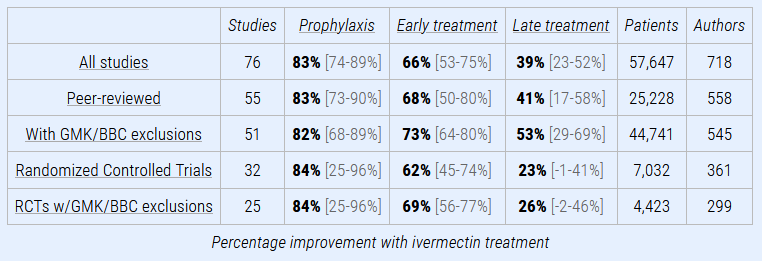
via ivmmeta.com

Indeed, ivermectin already may have saved hundreds of thousands of lives from India to Brazil.
Co-sponsored by Rep. Leah Cushman (R), the New Hampshire bill would require pharmacists to provide patients with a “standardized information sheet written in plain language” that would note the importance of follow-up care.
“Nothing on the information sheet shall discourage the recipient from using ivermectin for the treatment of COVID-19,” reads the bill.
On Tuesday, a state House committee heard arguments for and against the bill.
“Ivermectin is not authorized or approved by the FDA for use in preventing or treating COVID-19,” said Steve Ahnen, president and CEO of the New Hampshire Hospital Association.
Arguing for Ivermectin was Dr. Paul Marik with Front Line COVID-19 Critical Care Alliance, who resigned his position as Professor of Medicine with Eastern Virginia Medical School following a reprimand from the Virginia Board of Medicine for proscribing drugs to people who were not his patients.

Marik has over 400 peer-reviewed journal articles and 50 book chapters under his belt.
Some key excerpts from his testimony can be seen below via Granite Grok:

This is not controversial. It has been made controversial by politics and special interests.
I’ve been practicing critical care for 35 years.
I’ve published over 600 peer reviewed papers.
After penicillin, this is the second most important drug ever produced. It has saved hundreds of thousands of lives across this planet in poor underserved countries. So, we’re just going to talk about Ivermectin.
It is on the WHO’s list of essential medicines.
3.7 Billion doses have been dispensed to humans, to human beings… not horses.
This is a remarkable drug. It has broad spectrum anti-parasitic, effective against a whole bunch of parasites, and as we heard, it is very effective against RNA viruses: HIV virus, zika virus, influenza virus, SARS-CoV-2 virus. In addition, what makes this a truly astonishing drug, and there is no other drug like it, it is a potent anti-inflamatory drug.
And if anybody knows about Covid, Covid goes through stages. A viral replicative phase to a profound inflammatory phase. That’s why Ivermectin is unique in that it treats across the spectrum of SARS-CoV-2.
It’s safe and well tolerated.
Ivermectin acts on a number of different pathways to inhibit viral replication. This is not theoretical. This is shown in the lab and this is shown in patientsit kills the virus. So any assumption that it doesn’t is false propaganda.”
You’ll see an 83% improvement in prophylaxis trials. 66% improvement in early trials. 34% improvement in late trials. A 52% reduction in mortality. It reduces mortality by half.

More via Granite Grok
Dr. Marik left no stone unturned, and addressed the FDA’s propaganda statement, “You are not a horse. You are not a cow. Seriously y’all. Stop it. You should not use Ivermectin to treat or prevent Covid-19 using the drug Ivermectin which can be dangerous and even lethal.”

So that is an outright lie. It’s dishonest and it’s an outrage.
As we’ll see, this is a highly effective drug, and Ivermectin has never killed a single person. It is one of the safest drugs on this planet.
What is really interesting is Ivermectin is safe in 79 countries in the world. Let me say that again… it is approved in 79 countries.
Let’s look at Covid-19 vaccines in one year: 14 thousand deaths and over two million serious adverse events. This does not include the 20,000 deaths in the VAERS database which is probably a tenth of all deaths due to the vaccine. This is their data.

So somehow the SARS-CoV-2 vaccines are safe and effective, yet Ivermectin is a dangerous horse deworming medicine. That is an absolute outright lie. The data speaks for itself. This is not my data. This is from the WHO.
More people have died from Tylenol, which is an over-the-counter medicine, than Ivermectin. As I said, it is one of the safest medications on this planet.

Dr. Marik then compared Ivermectin to Remdesivir (the EUA drug that is pushed on Covid patients in hospitals). There is no comparison…

The cost of Remdesivir: $3,000 a shot. Ivermectin: pennies.
Remdesivir increases the risk of dying by 4%. This is used throughout the entire country as first line therapy for hospitalized patients. It increases the risk of death by 4%, and what is most outrageous is the federal government gives hospitals a 20% bonus on the entire hospital bill for medicare patients if they prescribe Remdesivir.

It is disturbing that our federal government is financially incentivizing the use of an experimental treatment that increases the risk of dying.

Ivermectin reduces the risk by 50%.
This is a cheap drug. It is exceedingly safe. It is exceedingly effective. And patients should be offered the right to use this drug.
If Ivermectin had been promoted at the beginning of this pandemic, we would not be sitting here today.

Dr. Marik’s testimony (cued up below), is very convincing and well worth the watch, as is the Q&A that took place afterwards with the Committee Members.
Watch: