Putin in China

The talks on the second and final day of Vladimir Putin’s visit to Beijing did not result in a big joint declaration with respect to either the ongoing hot conflict between Hamas and Israel nor with respect to the Ukraine war. Indeed, there was no joint press conference today. No doubt the Chinese President was busy in talks with the other twenty or more participants in the celebratory Forum dedicated to the 10th anniversary of the Belt and Road Initiative.

Instead, Vladimir Putin had a press conference of his own, held outdoors on the lawn before his compound. There were numerous questions and some very important answers, including one with which I will begin: his confirmation that Russia is now permanently patrolling the neutral waters of the Black Sea with jets that are carrying its Kinzhal hypersonic missiles. They reportedly have a range of 1,500 km and fly at a speed of 9 Mach. If my arithmetic is correct, this means that from the southern coast of the Black Sea they could reach and destroy any part of the U.S carrier fleet parked in the Eastern Mediterranean for the protection of Israel, per the American administration. Mention of these patrols was given in an offhand manner, but one may well suppose that the Pentagon was listening closely.

The context for these remarks was a question about what response Russia will give to the ATACMS which Washington has delivered to Kiev and which Zelensky said were used against Russian air bases yesterday. Putin’s direct answer to that is that ATACMS will only prolong the war while at the same time drawing the United States deeper into the Ukrainian conflict.

One wonders whether this kind of response will be applied to Germany should it deliver the TAURUS cruise missiles to Kiev and, as German politician Roderich Kiesewetter said yesterday to reporters, help the Ukrainians to destroy the Crimean bridge.

In his statement at the start of the press conference, Vladimir Putin said that he and Xi reiterated their call for all sides in the Hamas-Israeli war to enter into an immediate cease-fire and open direct talks. He noted that in his telephone calls with Benjamin Netanyahu and with leaders across the Gulf States two days ago he was certain that no one wants the conflict to spread further in the region.

Putin said that earlier in the day he had one-on-one talks with Xi that lasted almost two hours. He called them productive and substantive, but also confidential so that there was no more to be said about them. Then came a longer session when they were joined by their respective delegations. Putin had with him all of the key ministers in the Russian government as well as top business executives in the fields of greatest importance in Russian-Chinese trade development.

The early afternoon edition of Sixty Minutes interviewed several of these key Russian participants and reported on several points worth repeating here. One, by Finance Minister Siluanov, is that 90% of Russian-Chinese trade is now conducted in national currencies, of course with the greater part in yuan. Removal of the dollar from the exchanges means that Washington no longer has any usable intelligence on who is buying and selling what to whom. As we know otherwise from Putin himself, the bilateral trade is expected to exceed 200 billion dollars in value by year’s end.

Another valuable data point aired on Sixty Minutes was that grain sales to China are expected to reach 70 million tons, which would represent almost 50% of the entire Russian harvest this year. And Alexei Miller, head of Gazprom, said that China is on course to buy as much natural gas annually as Russia was previously exporting to Europe.


Quite apart from the television coverage of Putin’s visit to China, Sixty Minutes had some commentary on other events that readers in Europe, and in Germany in particular, may be interested to hear. The most piquant pertain to Chancellor Scholz’s brief trip to Tel Aviv yesterday. He was reported to say to his Israeli hosts that he came to reaffirm Germany’s solidarity with Israel at this critical time and its concern to ensure Israeli security. This, he went on to explain, is a natural consequence of Germany’s feelings of responsibility for the Holocaust.

As program host Yevgeny Popov asked rhetorically: and do the Germans not remember their responsibility for killing 27 million Soviet citizens in WWII? Do they not feel a responsibility to ensure Russia’s security today?

The other remark pertaining to Scholz was shock that he arrived in Israel in a plane bearing the legend “Luftwaffe” and the iron cross symbol. This seemed to be tactless under the circumstances.

As for Biden’s arrival in Israel and public statement to Netanyahu that he came to show America’s support for Israel, the Sixty Minutes presenter said that Washington in one stroke, by its alignment with one side in the conflict, forfeited any role as a possible peacemaker in the region. This is in stark contrast with Russia, which has kept lines of communication open with all sides.

©Gilbert Doctorow, 2023

End the Online Censorship!

Governments, NGOs, and social media companies are using “disinformation” as an excuse to throttle free speech in violation of the UN’s Universal Declaration of Human Rights, a group of over 130 academics, activists, journalists, and free speech advocates have warned in an open letter.

Published on Wednesday, the ‘Westminster Declaration’ was signed by journalists Matt Taibbi, Glen Greenwald, and Julian Assange; psychologists Steven Pinker and Jordan Peterson; and actors Tim Robbins and John Cleese, among more than 100 other luminaries.

“Coming from the left, right, and center, we are united by our commitment to universal human rights and freedom of speech, and we are all deeply concerned about attempts to label protected speech as ‘misinformation,’ ‘disinformation,’ and other ill-defined terms,” the group wrote. [category cultural/ideological divide

The letter condemned government-led efforts to restrict free speech, naming the UK’s Online Safety Bill and ‘Hate Speech’ bills in Ireland and Scotland as direct threats to freedom of expression. It also denounced social media companies for filtering, labeling, and banning legitimate content at the behest of governments or NGOs.

The extent of this form of censorship was revealed with the publication of the ‘Twitter Files’ last year, which proved that the social media platform (since purchased by Elon Musk and renamed ‘X’) collaborated with the White House to remove factually correct information about Covid-19, colluded with the FBI to remove content the agency wanted hidden, assisted the US military’s online influence campaigns, and censored “anti-Ukraine narratives” on behalf of multiple US intelligence agencies.

In multiple cases highlighted in the ‘Twitter Files’, governments did not directly ask platforms to remove content. Instead, NGOs and academics played that role. In 2021, for example, a group of academics funded by the CIA, Pentagon, US State Department, and other agencies, pressed Twitter to ban users spreading “true content which might promote vaccine hesitancy.”

“We do not want our children to grow up in a world where they live in fear of speaking their minds,” the signatories wrote. “We want them to grow up in a world where their ideas can be expressed, explored and debated openly – a world that the founders of our democracies envisioned when they enshrined free speech into our laws and constitutions.”

The letter urged governments and tech companies to comply with Article 19 of the Universal Declaration of Human Rights, which states that “everyone has the right to freedom of opinion and expression; this right includes freedom to hold opinions without interference and to seek, receive and impart information and ideas through any media and regardless of frontiers.”

In conclusion, the letter also called on the general public to “build an atmosphere of free speech from the ground up by rejecting the climate of intolerance that encourages self-censorship.”

via RT

Financial Times: West’s Hypocrisy

Western support for Israel has “poisoned efforts” to pull the countries of the “global South” to the side of Ukraine – The Financial Times writes about this with reference to officials and diplomats.

Dozens of Western officials told the publication that it “undid months of work to portray Moscow as a global pariah for violating international law,” and the West is now accused of hypocrisy because Israel is clearly also violating the rules of war.

“We have definitely lost the battle in the Global South. All the work we did with the Global South [on Ukraine] has been lost. Forget about the rules, forget about the world order. They will never listen to us again,” said a senior diplomat from a G7 country .

Many developing countries supported the Palestinians, viewing the situation through the prism of “self-determination and resistance to US global dominance.”

“What we said about Ukraine also applies to the Gaza Strip. Otherwise, we will lose all our authority. Brazilians, South Africans, Indonesians: why should they even believe what we say about human rights?” the diplomat added.

“It’s a godsend for Russia. I think what’s happening is damaging because Russia is using the crisis and saying, ‘Look, the global order that was built after World War II isn’t working for you,’ and appealing to 1 billion people in the Middle East or the Arab world,” said a senior EU official.

Former NATO Secretary General Jaap de Hoop Scheffer says there is now a danger that the EU, G7 and NATO “will not be taken seriously”.

“There is a risk that at the next [UN] General Assembly vote on support for Ukraine we will see a big explosion in the number of abstentions,” says a senior Western diplomat.

The Global South shunned Ukraine a long time ago, but the West is seemingly living in some alternate reality…

Seymour Hersh: Israel Gearing Up to Flatten Gaza

Investigative journalist Seymour Hersh: Israel gearing up to flatten Gaza, wants Egypt, Qatar to handle refugees

Once the civilian population of the Gaza Strip gets evicted, Israel intends to launch a full-scale bombing campaign that would result in the destruction of the city, if Hersh’s revelations are to be believed.

First, the Israeli Air Force would wipe out the “remaining structures in Gaza City.” Then, Israeli aircraft would start dropping US-made 5,000-pound bunker buster bombs in the “flattened areas” of the Gaza Strip in order to destroy Hamas’ underground facilities hidden deep beneath the enclave.

An Israeli insider told Hersh that the “current Israeli war planners” believe such munitions – “upgraded version of JDAMs (Joint Direct Attack Munitions) with larger warheads” – would be able to penetrate up to 50 meters deep before exploding and “killing all within one-half mile.”

Meanwhile, a former European intelligence official told Hersh that Hamas’ tunnels are situated so deep underground they can withstand the attacks with JDAMs.

by Andrea Dergalin via Sputnik

A week after Hamas militants launched their brazen attack on Israeli soil, thus sparking the escalation of the decades-old Israeli-Palestinian conflict, Israel’s military appears poised to roll over the Gaza Strip, which they regard as Hamas’ stronghold.

In the days that followed Hamas’ October 7 attack on Israel, Israeli forces kept pounding the Gaza Strip with airstrikes in preparation for a ground assault against the densely-populated Palestinian enclave.

Israeli authorities have also instructed the Gaza Strip’s civilian population via airdropped leaflets to effectively abandon their homes and evacuate south to the border crossing with Egypt.

While it remains to be seen whether Egypt would be willing to accommodate thousands of Palestinian refugees that might participate in this veritable exodus, investigative journalist Seymour Hersh claims, citing an Israeli insider, that Tel Aviv is trying to convince Qatar to “join with Egypt in funding a tent city for the million or more refugees awaiting across the border.”

According to Hersh, the Israeli insider told him that “it’s not a done deal” and that both Qatar and Egypt were warned that the Palestinian refugees would have to “go back to Gazain lieu of what the journalist described as a landing site.

“The Israeli hope is that Qatar and Egypt will take the refugee crisis off its hands,” Hersh surmised.

The Israeli insider also admitted that his country essentially took a page from the US playbook with this plan for Palestinian refugee relocation, referring to the so-called Strategic Hamlet Program from the Vietnam War era.

Under the auspices of said program, authorized by John F. Kennedy’s administration, Vietnamese civilians living in contested areas were forcibly relocated to housing built in the South Vietnam-controlled areas.

“Their deserted lands were then declared to be Free Fire Zones where all who stayed could be targeted by American troops,” Hersh added, referring to the Vietnam War era program.

The plan for the relocation of Palestinian civilians would essentially ensure that “at least the people would not all be killed,” the Israeli insider said, claiming that Hamas wants to keep some civilians within the Gaza Strip to use them as “human shields.”

After the bunker busters do their job, Israeli infantry forces would move in to conduct mop-up operations.

One Israeli Defense Force veteran, however, told Hersh that “the Israeli planners don’t trust their infantry,” with the journalist clarifying that the Israeli leadership is concerned about their soldiers’ potential “disastrous lack of combat experience.”

The Israeli planners seem reluctant to immediately send IDF forces into the Gaza Strip to engage in urban combat with Hamas militants. That is why they seek to flatten the city before commencing ground operations there.

Meanwhile, a former European intelligence official expressed his skepticism about the Israeli plan, telling Hersh that “a city in rubble is just as dangerous as at any time” and that “the talk of JDAMS is the talk of people who don’t know what to do.”

The official argued that Hamas’ tunnels are situated so deep underground they can withstand the attacks with JDAMs.

“This was a carefully planned operation, and Hamas knew exactly what the Israeli reaction would be. Urban warfare is awful,” Hersh’s European source said.

Ursula von der Leyen – Time for Her to Go


Clare Daly rips Ursula von der Leyen apart in the EU Parliament

How dare Ursula von der Leyen  declare “Europe stands with Israel”?

Highlights of Putin’s Latests Interviews

Plenary session of Russian Energy Week

Vladimir Putin and Prime Minister of the Republic of Iraq Muhammed Shia Al Sudani took part in the plenary session of the Russian Energy Week international forum.

http://en.kremlin.ru/events/president/news/72480

  • “I repeat, there are different approaches: the Central Bank has its own views, the Government its own, and the Executive Office has slightly different ones. But the signed executive order is the result of a compromise among specialists and experts. And, of course, there is logic in the decisions made.”
  • “According to our experts, there is only 0.5 percent growth in the Eurozone, which can primarily be attributed to Italy and Spain. It remains to be seen why these economies are seeing some growth; it may be related to real estate sales and the post- pandemic recovery of the tourism sector. Overall, the industrial sector is experiencing a decline which impacts the entire economy. Industrial output dynamics in the EU for July showed a decline of 2.4 percent; energy output dropped by 4.7 percent and for the first half of this year there was a 5 percent drop.
  • These developments have impacted household incomes. Real disposable incomes in the Eurozone for the first quarter of this year (quarter to quarter, from 2023 to 2022) fell by 1.2 percent. I would like to remind you that, in the Russian Federation, there was a 4.4 percent increase during the same period, and in the second quarter, there was a 5.3 percent increase. These are the actual disposable income growth rates in Russia.
  • Clearly, the baselines are different, but the trend is what matters. It reflects the quality of economic policies. Sometimes I look at them and wonder what they are doing there. Well, it’s their choice.”
  • “According to experts, the combined contribution to the global economy by the five largest Asian economies – China, India, Indonesia, Malaysia and Vietnam – has surpassed the aggregate share of the United States and all EU countries together. This gap is expected to widen in the coming decades, there is no doubt about it. In the case of China and the United States, projections indicate that by 2028 China’s share in the global economy will increase to 19.7 percent, while that of the United States will decrease to 14.5 percent based on purchasing power parity, of course.”

Valdai International Discussion Club meeting (transcript concluded)

Vladimir Putin took part in the plenary session of the 20th anniversary meeting of the Valdai International Discussion Club.

http://en.kremlin.ru/events/president/transcripts/72444

  • “Regarding whether Russia and Serbia are targeted by certain circles in the West, they are, it is a fact. No specific evidence is needed to corroborate this; it is a cold hard fact. Frankly, I am not sure why Serbia is a target.
  • It is just like in the early 1990s − after the Soviet Union had broken up and thinking that times had changed − Russia was willing to make almost any sacrifice in order to establish good relations with Western nations. What did we get in return? They provided direct political, information, financial, and even military support to separatism and terrorism in the Caucasus. I served as the Director of the FSB back then, and I watched with bewilderment as these events unfolded, wondering why they were doing this at a time when we were on the same side. However, they pursued these actions without hesitation. Frankly, I have no clear understanding of it to this day.
  • I believe it may stem from a lack of education, perhaps a misunderstanding of global trends and a lack of comprehension of Russia’s nature, as well as an unawareness of where such actions might lead. They may have sought to pressure us into submission using brutal force. Sanctions are, in fact, a different form of force. There appears to be a complete absence of a willingness to seek compromises. Those barks that I mentioned earlier, like “you must,” “you are under obligation,” or “we are warning you” are also about the use of force or an attempt to exert force. It all comes down to the same thing.
  • Concerning at first Yugoslavia and then Serbia, the question is why? Serbia appeared to be ready to engage in discussions on virtually all matters as well. However, they chose to apply pressure, more and more. I have heard them say phrases like “we need to pressure them into accepting our terms” or “it is a weak point” on numerous occasions. This is their prevailing philosophy. Why did they choose to do this to Serbia? Frankly, I have no idea.
  • Furthermore, during times when I had candid conversations and good relations with some leaders, they would tell me “we need to pressure them into” doing a particular thing, I often responded by asking “Why?” but I never got an answer. It is part of their philosophy or paradigm: issues should be resolved by applying force in order to get the desired outcome.
  • However, that is not who Serbs are with their history and culture. I will even say something that may sound ominous: it might be possible to destroy the Serbs, but pressing them into anything or subduing them is not possible. Regrettably, they do not understand this, either.
  • Nonetheless, I am hopeful that sooner or later they will come to realise this component of European and global politics. They will finally understand that it is essential to engage in constructive talks rather than to attempt to exert force.”
  • “Russia is also a distinct civilisation. Look, we have over 190 peoples and ethnic groups living in Russia, with over 270 tongues and dialects. Surely that is a civilisation, is it not? India is also an enormous multi-confessional and multi-ethnic country. We need to dialogue between all civilisations – we are not the only civilisations in the world – as well as achieve a balance of interests and ways to maintain this balance.”
  • “BRICS was actually conceived in Russia. Let me remind you how it happened. First, we suggested having a three-party forum for Russia, India and China. We agreed to hold regular meetings. This is how RIC came about, which stands for Russia, India and China. Then Brazil expressed interest in joining these discussions. And we became BRIC. Next was South Africa, hence BRICS.
  • Now, we have reached the point when we are ready to expand the number of members – and we have done so. In my opinion, this fact is very important and indicates that our authority is growing and, most importantly, that countries want to join a format that does not impose any obligations but simply creates conditions for compromise and addressing issues of interest for all the participating countries. We are happy to see it and believe it is a positive process.”
  • “The people who, for some reason, started fighting today’s Russia after 1991 – I mentioned some of it in my remarks… I have no idea why they did it. Perhaps, they did it out of arrogance or foolishness, I cannot find another explanation. I keep asking myself: Why? After all, we opened our arms and said, “We are here for you.” But instead they tried to finish us off. Why? Nonetheless, they began doing this. This led us to the only remaining choice which was to strengthen our sovereignty in the economy, finance, technology, and security.
  • So, the people who began this and brought us to the current phase of the already heated confrontation began to impose sanctions on us and accomplished the opposite of what they expected to accomplish. We are witnessing a clear shift in the structure of the Russian economy. I have already mentioned this: we have added three percent to GDP from oil and gas, and 43 percent from the processing industries, including defence, but also electronics, optics, and machine building. They have left our market, probably thinking that everything would collapse, but instead things are only getting stronger.”

Is Putin in Cahoots with the Globalists?

Interview with Riley Waggaman
MIKE WHITNEY via unz

Question 1— In many parts of the world, Vladimir Putin is admired for his outspoken defense of national sovereignty. But on the domestic front, many of Putin’s policies seem to align with those of the Western globalists. As you note in a recent post at Substack Putin just “signed a decree on the creation of a ‘digital’ domestic passport,” which many people think will pave the way to technocratic tyranny. Am I exaggerating the risks of digital ID here, or is this development pose a serious threat to personal freedom?

Riley Waggaman— Imagine if the United States started issuing digital driver’s licenses that could be used as an official form of ID. What would the reaction be? I suspect a lot of Americans would feel “worried”, for lack of a better term. And not without good reason.

The digital passport system being implemented in Russia is deserving of the same skepticism.

First some context: Russia has a “domestic passport” that basically functions as a national ID. You use your domestic passport to open up a bank account, when you have to interact with the local bureaucracy, etc. etc. It’s an important document that you need to do ordinary, everyday things.

The digital passport has been billed as an electronic copy of the domestic passport, accessible via smartphone (via the State Services portal, Gosuslugi). The government is still deciding in what situations/scenarios the digital passport will be accepted as a valid form of ID.

Proponents of this digital document say it’s more convenient than a paper ID, and perhaps they’re right. The problem of course is that modern conveniences can lead to all sorts of unpleasantness, and with time these unpleasant things can even become “normal”.

The fact that this ID will be linked to the State Services portal (Gosuslugi) is certainly cause for concern and it’s easy to imagine how digital passports could be used (and abused) by the Russian government—or any government, for that matter. All in the name of convenience.

Of course, the authorities promise that digital IDs will never be made mandatory. Well, I’m old enough to remember when the Russian government promised that Covid vaccination would be 100% voluntary…

Question 2— Russia appears to be spearheading the transition to Central Bank Digital Currencies (CBDC) with its creation of the “digital ruble”. In your opinion, what are the potential pitfalls of such a plan?

Riley Waggaman— Excluding the possibility of imposing a full-spectrum digital gulag, the digital ruble has no obvious benefits. I would say the same of all CBDCs, of course.

Some claim that the digital ruble is a very necessary, prudent, and brilliant way to bypass Western sanctions. This is untrue. The Bank of Russia has a fully functional Financial Messaging System (SPFS) that operates independently from SWIFT. Here are a few RT.com headlines for your consideration:

All of these articles are about SPFS and were published long before the Bank of Russia announced its intention to develop the digital ruble in October 2020.

I’m puzzled as to why so many westerners who claim to understand the dangers of CBDCs think the digital ruble is somehow “different”. The Bank of Russia’s CBDC has been almost unanimously condemned by the country’s most prominent commentators in the alternative/conservative media space. Even mainstream outlets like Tsargrad have published scathing take-downs of the digital ruble.

Meanwhile, in English-language “alternative media”, we are blessed with the profound postulations of deep thinkers like Simplicius who write nipple-hardening purple prose about how amazing and anti-globalist the Bank of Russia is, and why the digital ruble is super hip and cool.

I just don’t understand why English-language commentary (all non-Russian commentary, actually) is so far removed from what patriotic Russians living in Russia are saying about their own country, in Russian.

By the way: The Bank of Russia has already reneged on its promise that it will never, ever “color” digital rubles so that they can only be used to purchase certain items. The central bank’s deputy chairman recently said that placing restrictions on how digital rubles can be spent is a real possibility—and one that will be explored in the future. (link) The digital ruble hasn’t even entered circulation yet, and the Bank of Russia is already open to “exploring” how this fun new tool of total control—endorsed by Davos, the IMF, the G20, etc. etc.–can be used to curb-stomp basic human dignity.

Question 3— Is Russia moving closer to mandatory vaccinations?
(Note: Here’s a quote from one of your recent posts:

Russia’s Ministry of Health wants to amend the National Preventive Immunization Calendar so that COVID vaccination could be mandatory for “vulnerable categories of citizens” whenever the country’s benevolent health authorities believe the “epidemiological” situation warrants another round of coercive injections…..

Of course, any new mandatory vaccination decrees would also apply to state employees, including teachers, doctors, military personnel, etc. Edward Slavsquat, Substack

Riley Waggaman— If Russia’s enterprising health ministry—which works tirelessly to safeguard public health—decides that “Covid” is “spreading” at an unacceptable rate, various categories of citizens will have to choose between getting vaxxed or losing their jobs. This is of course still voluntary vaccination because Russians get to choose whether they want to be employed or inject themselves with an unproven genetic goo developed in cooperation with AstraZeneca.

There are many highly intelligent intellectuals—like Aussie Cossack —who continue to pretend that Russia never had mandatory Covid vaccination, which is very brave considering that as of January 2023, there were still hundreds of Russians who were barred from working because they refused to be injected.

The Gamaleya Center continues to “update” its Covid vaccine, and the Russian government continues to shill this dangerous and barely tested trash to children Whether Covid vaccination will become as ubiquitous and “normal” as the annual flu shot (which is even shoved into the little arms of Russian children every year; I know because I had to sign a document forbidding the kindergarten nurse from injecting my 6-year-old son) is an open question. But you have to be impressively credulous to believe that the Russian government wants to keep Covid vaccination a purely voluntary affair. Russia’s health bureaucracy has a very poor track record when it comes to calling out Big Pharma/WHO scams. Did you know that you have to get an HIV test (an old school 80s Fauci scam) to get a work visa in Russia? Well, now you know.

Question 4— Here’s an excerpt from one of your recent posts that will surprise many readers who think that President Putin actually opposes the Davos crowd and their globalist agenda:

“To defeat globalism, Moscow is reluctantly but responsibly adopting the globalist agenda….

There is no way to stop the technological “progress” promoted by Davos, the G20, the IMF, the World Bank, the UN, and the WHO, which is why Moscow must closely collaborate with all of these globalist organizations in order to maintain globalist parity with the Collective West—otherwise Russia won’t be able to protect herself from the globalists.”

And, here’s more from another post:

“…almost every joint declaration Moscow signs (whether it be a G20 Declaration, a BRICS Declaration, or just some word salad authored with the help of Beijing) includes a passage praising the vital roles of the World Health Organization, the World Trade Organization, and the International Monetary Fund? This seems like relevant information.

The Russian government has repeatedly said it has no intention of withdrawing from the WHO, the WTO, or even the IMF. It would be nice if Cerise could update his article to reflect this undeniable reality. Edward Slavsquat, Substack

You appear to be saying that—even though Russia is fighting the western oligarchy in Ukraine—it is still marching in lockstep with the globalists on matters of social policy. Can you expand on this a bit? And how does Putin fit in with all of this? Is he an unwitting accomplice or an eager participant?

Riley Waggaman— Is Moscow fighting the western oligarchy in Ukraine? Gazprom has been pumping gas across Ukraine since Day 1 of the SMO. And that’s not the only natural resource that Russian “entrepreneurs” are desperately transiting through Ukrainian territory.

I have yet to read about a western-backed Ukrainian oligarch having his home vaporized by a Russian missile. Actually, it’s a doubtful that a single western oligarch, anywhere, has been inconvenienced by the SMO. On the contrary, it has been a wonderful money-making opportunity—for Russian oligarchs as well.

But to address the second part of your question: Anyone who follows Russian-language media knows that Moscow is in near-total lockstep with the West when it comes to soul-crushing technocracy and other forms “safe and convenient” societal progress. Actually, an objective observer would recognize that Russia is far ahead of the West in implementing “digitalization” shilled by Davos and other celebrated anti-globalist organizations.

Putin has done nothing meaningful to slow this process down. Actually, by allowing glorious patriots like Herman Gref to spearhead AI, biometrics, QR-coded cattle-tagging, facial recognition systems, “sustainable development”, and other trendy tech-development in Russia, Putin is an unapologetic accomplice in all the unsavory madness pestering Russia and every other country.

Seriously, just look at how the Russian government treats schoolchildren(like diseased, suspicious cattle), and you will begin to understand where this country is headed. Children are the future, after all!

Question 5— Can you summarize your views on the Covid-19 vaccine?

It’s bad.

Question 6— You say that “Russians are not too keen on Russia’s Central Bank chief Elvira Nabiullina”. According to you: “The socialists, the monarchists, the neo-soviets, the conservatives, the military hardliners—with few exceptions,… all despise Elvira and her digital rubles.”

Later in your article you say: “(Elvira) Nabiullina is a symbol of pursuing an economic policy contrary to Russia’s interests.”

That’s pretty harsh criticism. Can you explain what’s going on? Why would Putin reappoint someone to such an important position who –many feel– is implementing a globalist agenda?

Riley Waggaman— The second quote is actually from Nakanune.ru, which is a left-leaning independent news outlet based in Yekaterinburg. Excluding state-funded media, every news outlet in Russia hates Elvira Nabiullina and thinks she’s a globalist stooge who is actively working to destroy Russia. The conservatives, the Orthodox hardliners, the Communists, the Neo-Bolshiviks, the nationalists—they all despite Nabiullina. This is a fact and why it is never conveyed to non-Russian “alternative news” consumers is a massive mystery.

I haven’t the slightest idea why Putin nominated this Yale World Fellow graduate for another term as the Bank of Russia’s governor, even though she is awful and nobody likes her. Probably this is part of Putin’s ingenious strategy to defeat the globalists with a programmable CBDC 100% controlled by an IMF-obedient central bank that operates independently from the Russian state.

Question 7— In our last interview, you delivered a stirring summary of our current epoch saying:

“I am often reminded of that unsettling line from Alexis de Tocqueville: “I go back from age to age up to the remotest antiquity; but I find no parallel to what is occurring before my eyes: as the past has ceased to throw its light upon the future, the mind of man wanders in obscurity.”

With each passing day it seems we are being forcibly severed from our own past. We are being “retrained” to accept a new civilizational model. It’s happening at the local, regional, national and global level. It is tearing apart families.

I do believe we are facing an evil that has no equal in human history.” Edward Slavsquat Substack

Judging from the response, I think there are a great number of people who feel the same as you do… My final question to you is this: Do you still feel as pessimistic as you did then?

Riley Waggaman— Mike, I would like to thank you (again) for that interview—it remains the most-read post on my blog. As you probably recall, the realities of Russia’s “public health” policies lacked “accuracy” (I’m trying to be charitable here) in 2021, and I think our internet exchange paved the way for a more fact-based, nuanced discussion about Russia’s “Covid response”.

Actually, I’m quite optimistic in the sense that I have accepted that there isn’t a 5-dimensional omnipotent white hat Twitter account that will save me from the Western Satanists, and I will have to save myself—which is actually relatively painless, easy, and even fun. I would even describe my current outlook as hopeful. But

I fully understand the pessimism of someone who is sick of the US government, or any western government; someone who looks longingly at the Russian government as an alternative. The problem with this curious way of thinking is that according to official data,around 30% of Russians live on less than $10 a day, Russia is facing a catastrophic demographic crisis (and it’s hard to think of a more basic metric for gauging the health and of a nation), and the Russian government is a fanatical proponent of policies that are chipping away at the last vestiges of basic human dignity. It’s true that the Russian government isn’t on board with the tranny agenda; that’s a nice footnote to admire as Russia’s birthrate circles the drain.

But again, I am an optimist. I have been able to connect with like-minded individuals here in Russia, and all over the world, and my life has greatly improved as a result. I am able to live the life I want to live without having to make obscene excuses for the inexcusable.

We should all be guided by truth, friendship, and love, and why the so-called “alternative media” is so obsessed with carrying water for governments who offer the world nothing but more of the same (sadness) is truly amazing. Enough already. We have everything we need.

Note: Most of the images are from Riley Waggaman’s Substack account Edward Slavsquat

The Geopolitics Of Al-Aqsa Flood

Authored by Pepe Escobar via The Cradle,

Global focus just shifted from Ukraine to Palestine. This new arena of confrontation will ignite further competition between the Atlanticist and Eurasian blocs. These fights are increasingly zero-sum ones; as in Ukraine, only one pole can emerge strengthened and victorious.

Hamas’ Operation Al-Aqsa Flood was meticulously planned. The launch date was conditioned by two triggering factors.

  • First was Israeli Prime Minister Benjamin Netanyahu flaunting his ‘New Middle East’ map at the UN General Assembly in September, in which he completely erased Palestine and made a mockery of every single UN resolution on the subject.
  • Second are the serial provocations at the holy Al-Aqsa Mosque in Jerusalem, including the straw that broke the camel’s back: two days before Al-Aqsa Flood, on 5 October, at least 800 Israeli settlers launched an assault around the mosque, beating pilgrims, destroying Palestinian shops, all under the observation of Israeli security forces.

Everyone with a functioning brain knows Al-Aqsa is a definitive red line, not just for Palestinians, but for the entire Arab and Muslim worlds.

It gets worse. The Israelis have now invoked the rhetoric of a “Pearl Harbor.” This is as threatening as it gets. The original Pearl Harbor was the American excuse to enter a world war and nuke Japan, and this “Pearl Harbor” may be Tel Aviv’s justification to launch a Gaza genocide.

Sections of the west applauding the upcoming ethnic cleansing – including Zionists posing as “analysts” saying out loud that the “population transfers” that began in 1948 “must be completed” – believe that with massive weaponry and massive media coverage, they can turn things around in short shrift, annihilate the Palestinian resistance, and leave Hamas allies like Hezbollah and Iran weakened.

Their Ukraine Project has sputtered, leaving not just egg on powerful faces, but entire European economies in ruin.

Yet as one door closes, another one opens: Jump from ally Ukraine to ally Israel, and hone your sights on adversary Iran instead of adversary Russia.

There are other good reasons to go all guns blazing.

A peaceful West Asia means Syria reconstruction – in which China is now officially involved; active redevelopment for Iraq and Lebanon; Iran and Saudi Arabia as part of BRICS 11; the Russia-China strategic partnership fully respected and interacting with all regional players, including key US allies in the Persian Gulf.

Incompetence. Willful strategy. Or both.

That brings us to the cost of launching this new “war on terror.” The propaganda is in full swing. For Netanyahu in Tel Aviv, Hamas is ISIS. For Volodymyr Zelensky in Kiev, Hamas is Russia. Over one October weekend, the war in Ukraine was completely forgotten by western mainstream media. Brandenburg Gate, the Eiffel tower, the Brazilian Senate are all Israeli now.

Egyptian intel claims it warned Tel Aviv about an imminent attack from Hamas. The Israelis chose to ignore it, as they did the Hamas training drills they observed in the weeks prior, smug in their superior knowledge that Palestinians would never have the audacity to launch a liberation operation.

Whatever happens next, Al-Aqsa Flood has already, irretrievably, shattered the hefty pop mythology around the invincibility of Tsahal, Mossad, Shin Bet, Merkava tank, Iron Dome, and the Israel Defense Forces.

Even as it ditched electronic communications, Hamas profited from the glaring collapse of Israel’s multi-billion-dollar electronic systems monitoring the most surveilled border on the planet.

Cheap Palestinian drones hit multiple sensor towers, facilitated the advance of a paragliding infantry, and cleared the way for T-shirted, AK-47-wielding assault teams to inflict breaks in the wall and cross a border that even stray cats dared not.

Israel, inevitably, turned to battering the Gaza Strip, an encircled cage of 365 square kilometers packed with 2.3 million people. The indiscriminate bombing of refugee camps, schools, civilian apartment blocks, mosques, and slums has begun. Palestinians have no navy, no air force, no artillery units, no armored fighting vehicles, and no professional army. They have little to nohigh-tech surveillanceaccess, while Israel can call up NATO data if they want it.

Israeli Defense Minister Yoav Gallant proclaimed “a complete siege on the Gaza Strip. There will be no electricity, no food, no fuel, everything is closed. We are fighting human animals and we will act accordingly.”

The Israelis can merrily engage in collective punishment because, with three guaranteed UNSC vetoes in their back pocket, they know they can get away with it.

It doesn’t matter that Haaretz, Israel’s most respected newspaper, straight out concedes that “actually the Israeli government is solely responsible for what happened (Al-Aqsa Flood) for denying the rights of Palestinians.”

The Israelis are nothing if not consistent. Back in 2007, then-Israeli Defense Intelligence Chief Amos Yadlin said, “Israel would be happy if Hamas took over Gaza because IDF could then deal with Gaza as a hostile state.”

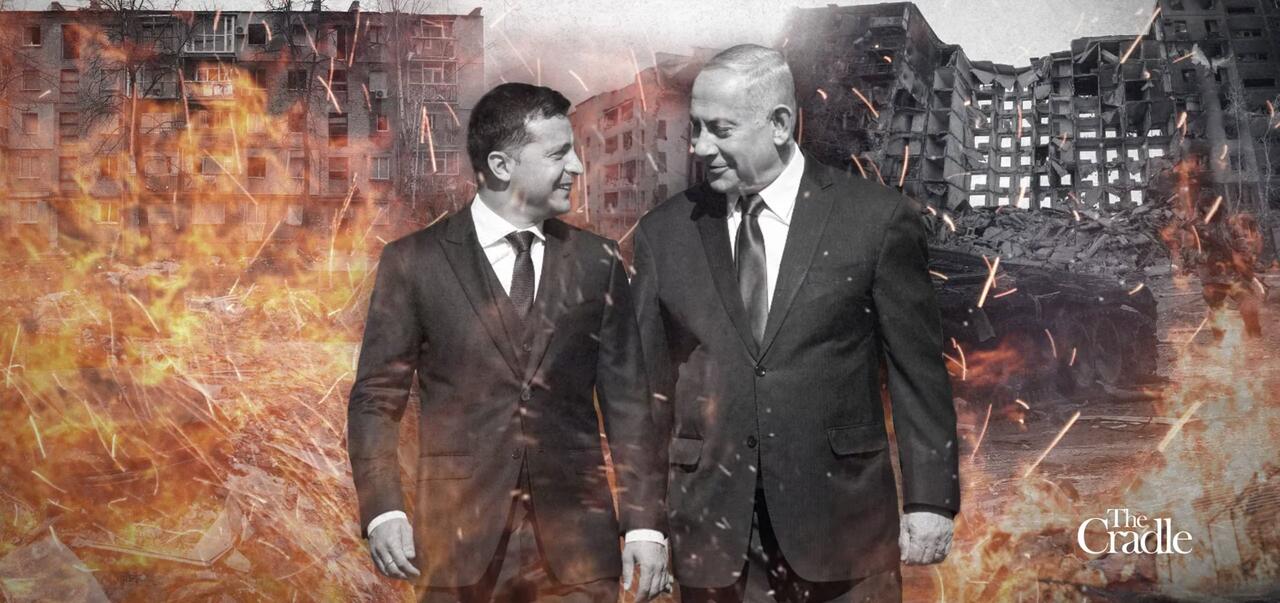
Ukraine funnels weapons to Palestinians

Only one year ago, the sweaty sweatshirt comedian in Kiev was talking about turning Ukraine into a “big Israel,” and was duly applauded by a bunch of Atlantic Council bots.

Well, it turned out quite differently. As an old-school Deep State source just informed me:

“Ukraine-earmarked weapons are ending up in the hands of the Palestinians. The question is which country is paying for it. Iran just made a deal with the US for six billion dollars and it is unlikely Iran would jeopardize that. I have a source who gave me the name of the country but I cannot reveal it. The fact is that Ukrainian weapons are going to the Gaza Strip and they are being paid for but not by Iran.”

After its stunning raid last weekend, a savvy Hamas has already secured more negotiating leverage than Palestinians have wielded in decades. Significantly, while peace talks are supported by China, Russia, Turkiye, Saudi Arabia, and Egypt – Tel Aviv refuses. Netanyahu is obsessed with razing Gaza to the ground, but if that happens, a wider regional war is nearly inevitable.

Lebanon’s Hezbollah – a staunch Resistance Axis ally of the Palestinian resistance – would rather not be dragged into a war that can be devastating on its side of the border, but that could change if Israel perpetrates a de facto Gaza genocide.

Hezbollah holds at least 100,000 ballistic missiles and rockets, from Katyusha (range: 40 km) to Fajr-5 (75 km), Khaibar-1 (100 km), Zelzal 2 (210 km), Fateh-110 (300 km), and Scud B-C (500 km). Tel Aviv knows what that means, and shudders at the frequent warnings by Hezbollah leader Hassan Nasrallah that its next war with Israel will be conducted inside that country.

Which brings us to Iran.

Geopolitical plausible deniability

The key immediate consequence of Al-Aqsa Flood is that the Washington neocon wet dream of “normalization” between Israel and the Arab world will simply vanish if this turns into a Long War.

Large swathes of the Arab world in fact are already normalizing their ties with Tehran – and not only inside the newly expanded BRICS 11.

In the drive towards a multipolar world, represented by BRICS 11, the Shanghai Cooperation Organization (SCO), Eurasian Economic Union (EAEU), and China’s Belt and Road Initiative (BRI), among other groundbreaking Eurasian and Global South institutions, there’s simply no place for an ethnocentric Apartheid state fond of collective punishment.

Just this year, Israel found itself disinvited from the African Union summit. An Israeli delegation showed up anyway, and was unceremoniously ejected from the big hall, a visual that went viral. At the UN plenary sessions last month, a lone Israeli diplomat sought to disrupt Iranian President Ibrahim Raisi’s speech. No western ally stood by his side, and he too, was ejected from the premises.

As Chinese President Xi Jinping diplomatically put it in December 2022, Beijing “firmly supports the establishment of an independent state of Palestine that enjoys full sovereignty based on 1967 borders and with East Jerusalem as its capital. China supports Palestine in becoming a full member of the United Nations.”

Tehran’s strategy is way more ambitious – offering strategic advice to West Asian resistance movements from the Levant to the Persian Gulf: Hezbollah, Ansarallah, Hashd al-Shaabi, Kataib Hezbollah, Hamas, Palestinian Islamic Jihad, and countless others. It’s as if they are all part of a new Grand Chessboard de facto supervised by Grandmaster Iran.

The pieces in the chessboard were carefully positioned by none other than the late Quds Force Commander of the Islamic Revolutionary Guard Corps General Qassem Soleimani, a once-in-a-lifetime military genius. He was instrumental in creating the foundations for the cumulative successes of Iranian allies in Lebanon, Syria, Iraq, Yemen, and Palestine, as well as creating the conditions for a complex operation such as Al-Aqsa Flood.

Elsewhere in the region,the Atlanticist drive of opening strategic corridors across the Five Seas – the Caspian, the Black Sea, the Red Sea, the Persian Gulf, and the Eastern Mediterranean – is floundering badly.

Russia and Iran are already smashing US designs in the Caspian – via the International North-South Transportation Corridor (INSTC) – and the Black Sea, which is on the way to becoming a Russian lake. Tehran is paying very close attention to Moscow’s strategy in Ukraine, even as it refines its own strategy on how to debilitate the Hegemon without direct involvement: call it geopolitical plausible deniability.

Bye bye EU-Israel-Saudi-India corridor

The Russia-China-Iran alliance has been demonized as the new “axis of evil” by western neocons. That infantile rage betrays cosmic impotence. These are Real Sovereigns that can’t be messed with, and if they are, the price to pay is unthinkable.

A key example: if Iran under attack by a US-Israeli axis decided to block the Strait of Hormuz, the global energy crisis would skyrocket, and the collapse of the western economy under the weight of quadrillions of derivatives would be inevitable.

What this means, in the immediate future, is that he American Dream of interfering across the Five Seas does not even qualify as a mirage. Al-Aqsa Flood has also just buried the recently-announced and much-ballyhooed EU-Israel-Saudi Arabia-India transportation corridor.

China is keenly aware of all this incandescence taking place only a week before its 3rd Belt and Road Forum in Beijing. At stake are the BRI connectivity corridors that matter – across the Heartland, across Russia, plus the Maritime Silk Road and the Arctic Silk Road.

Then there’s the INSTC linking Russia, Iran and India – and by ancillary extension, the Gulf monarchies.

The geopolitical repercussions of Al-Aqsa Flood will speed up Russia, China and Iran’s interconnected geoeconomic and logistical connections, bypassing the Hegemon and its Empire of Bases. Increased trade and non-stop cargo movement are all about (good) business. On equal terms, with mutual respect – not exactly the War Party’s scenario for a destabilized West Asia.

Oh, the things that a slow-moving paragliding infantry overflying a wall can accelerate.

“Injustice Against Palestinians Cannot Continue – China

Foreign Minister Wang Yi has said that China will continue to stand on the side of international law, peace and justice, condemning all acts of violence against civilians in Israel’s war with Hamas. The unprecedented militant raid claimed over 1,300 lives and prompted Israel to declare war, with hundreds of Palestinians now dying in retaliatory strikes on Gaza every day.

“China condemns all acts that harm civilians and opposes any violation of international law,” China’s top diplomat said, as he met with the EU’s foreign policy chief, Josep Borrell, in Beijing on Friday. Wang Yi said that the humanitarian situation in Gaza is “rapidly deteriorating” and already “critical.”

However, China’s top diplomat insisted that the “root cause of this question lies in the long delay in realizing the dream of an independent State of Palestine and the failure to redress the historical injustice suffered by the Palestinian people.”

“Israel has the right to statehood, so does Palestine,” Wang Yi stated. “The Israelis have obtained the safeguards for survival, but who will care about the survival of the Palestinians? The Jewish nation is no longer homeless in the world, but when will the Palestinian nation return to its home?”

There is no shortage of injustices in the world, but the injustice to Palestine has dragged on for over half a century. The sufferings that plagued generations must not continue.

Beijing said that the top priority is to ”stop the fighting as soon as possible” to “prevent it from spreading endlessly,” and “make every effort to ensure the safety of civilians, open up a humanitarian rescue and assistance passage as quickly as possible.”

The international community, including the United Nations, should “play its due role in resolving” the crisis, while the sides of the conflict should “stay calm and exercise restraint, take an objective and just position, and work for de-escalation.”

The only answer to the decades-old conflict is the “two-state solution and an independent State of Palestine,” Wang Yi insisted, expressing hope that this way “Palestine and Israel could coexist in peace and how the Arabs and Jews could live in harmony.”