Put ’em in the dock! France’s police raids on politicians over their criminal Covid-19 incom petence should be just the start

by Damian Wilson via RTWith a second wave of coronavirus hitting many countries and new lockdowns achieving little, might we finally see ministers and health officials being held accountable for their dreadful decisions?

As French police investigate the government’s handling of the coronavirus pandemic and launch a series of raids on the homes of leading politicians and senior health officials, elsewhere around the globe Prime Ministers and Presidents should be starting to sweat. Because the people want payback.

Payback for the months of sacrifice they have made of their children’s education, their jobs, their personal freedoms and their mental health. Payback for their losses, of loved ones, of their futures, of hope.

And if that means the police kicking down a few doors and hauling shame-faced politicians and bureaucrats from their beds so that they might be pressed for answers, then so be it.

The upset in France is symptomatic of the worldwide fury at the incompetence shown by our leaders in tackling the coronavirus pandemic and we can only hope that this demand for accountability brings some answers.

Answers as to why 40 million cases of Covid-19 have been recorded in less than a year, why a million people have died so far, and why there is still no solution in sight. And why the so-called solutions to it – lockdowns, shuttering businesses, closing off hospitals to sick and dying patients who don’t have the disease – have not only failed to tackle it, but have made everything worse.

Lockdowns will cause more deaths than Covid ever will, thousands of businesses have crashed, and millions have been thrown out of work.

Have we had any explanation or any apology for all this self-inflicted wreckage? Of course not. In place of answers and admissions that public health efforts have so far proved impotent or worse, we’ve been asked to swallow yet another catchy slogan or accept even harsher restrictions upon the limited personal liberties we are allowed to enjoy.

What has become clear, however, is that our leaders cannot simply keep turning the screw and expect everyone to just fall into line over the common good.

In Britain, the last day that worked was March 23 this year, when the national lockdown was imposed. Now, the UK’s regional leaders are no longer prepared to trash their own local economies by bowing to a central government demand that they enforce local lockdowns when it’s not happening elsewhere. There has already been talk of legal action against the Government, in a bid to avoid being placed in the highest tier of mandatory coronavirus restrictions, essentially Lockdown mark II.

Resistance has been building steadily elsewhere. It has led to mass protests in the US, Spain, Germany, Italy, Ireland, Kenya, Mexico, Israel, the Philippines, Argentina, Australia and just about anywhere else you can find on the globe.

With incompetence, delays and confused messaging the hallmarks of most governments in dealing with the coronavirus pandemic, no one would be surprised to see the police knocking on the doors of the homes and offices of politicians in any of these nations. Surprised? They’d be bloody delighted! It would be a much better use of police time than their fining people for breaking the rule of having just six people in one’s house, or raiding a gym that dares to try to keep people healthy.

Each country has its own horror stories of gross incompetence. While much of that stems from a failure to recognise the pandemic early enough and to do something about it, there is also a criminal neglect of emergency protocols, which have been universally ignored and stripped of funding by complacent governments everywhere.

This has meant not only a lack of interest in research and preparedness, but a deadly shortage of fundamental protective equipment that, surely, has cost lives of many of those working on the frontline across the globe.

Then there are the confusing quarantine rules, which seem to change daily, and the embarrassing squabbles and fortunes squandered over track and trace applications and their efficacy.

Whenever the citizenry manage to have a close look at the way their governments have dealt with these key issues, there will be no shortage of national outrage, public humiliation, legal action, and worse.

While the backlash began some months ago in China, where it followed its own proprietary way of dealing with those it holds responsible for public incompetence, France is choosing a more western-European approach to its investigation. The prime minister, Jean Castex, his predecessor Edouard Philippe, Health Minister Olivier Véran and the director of the national health agency, Jérôme Salomon, should be expected to squirm. Who knew what and when?

With President Emmanuel Macron last night announcing a four-week, 9pm to 6am curfew for Paris and eight other French cities from Saturday and PM Castex declaring a ban on all private festivities, including weddings, the people of La République are in no mood to be fobbed off.

The world is watching to see what price they exact for the incompetence of their leaders and the outrageous demands made upon their prized liberté. Heads may yet roll. Isn’t that old method of dealing with incompetent and wayward leaders, once so belolved of les citoyens, still lying somewhere in the basement of the Musée d’Orsay in Paris?

Tucker Carlson On New CDC Data That Shows Ineffectiveness Of Masks In Preventing Coronavirus

Fatality Rate

Studies on Covid-19 Lethality

Last updated: October 8, 2020; First published: May 12, 2020

Overview

1) Antibody studies ⇓ 2) Immunological studies ⇓ 3) Median age of death ⇓ 4) Hospitalizations ⇓ 5) Nursing homes ⇓ 6) Overall mortality ⇓ 7) Development ⇓ IFR: Infection fatality rate

1) Antibody seroprevalence studies (⇓)

The covid-19 infection fatality rate (IFR) depends on demographics (age and risk structure), public policies (e.g. protection of nursing homes), and medical treatment quality.

Covid-19 IFRs are strongly age-dependent, with a steep increase above the age of 70. The median age of covid-related deaths in most Western countries is 80 to 86 years (see section 3 below). In most Western countries, about half of all deaths occurred in nursing homes (see section 5).

In terms of covid-19 IFRs, an important difference exists between places with and without a partial or total collapse of local health and elderly care, and between the early and late pandemic phase.

A. Places without a collapse of health and elderly care
Country Published Population IFR (%) Source
Global October 5 WHO estimate 0.136 WHO
Japan Sept. 23 Tokyo 0.01 Hibino
USA Sept. 2 Indiana 0.265 AIM
Brazil Sept. 1
Sept. 21
Maranhao
Manaus
0.17
0.28
da Silva
Buss
Iceland Sept. 1 General population
Below 70 years
0.30
0.10
NEJM
Switzerland July 14
August 7
Geneva hotspot
Zurich area
0.32¹
0.30¹
Perez
Aguzzi
India July 31 Delhi
Mumbai
0.07²
0.12²
India
Africa July 29
August 5
Kenya
Malawi
0.01
0.01
Uyoga
Grace
Global July 14 50 studies
Below 70 years
0.24³
0.04³
Ioannidis
Austria June 25 Ischgl hotspot 0.26 von Laer
Slovenia May 6 General population 0.16 GSI
Germany May 4 Heinsberg hotspot 0.364 Streeck
Iran May 1 Guilan province 0.12 Shakiba
USA April 30
April 24
April 21
Santa Clara County
Miami-Dade County
Los Angeles County
0.17
0.18
0.20
Bendavid
Miami
Sood
Denmark April 28 Blood donors (<70y) 0.08 Erikstrup

1) 0.64% and 0.60% including nursing homes; 2) 0.14% and 0.23% assuming 40% missing fatalities (more); 3) median values; 4) the unadjusted IFR is 0.28% (page 9); 5) general population (excl. nursing homes); 6) one million deaths and 760 million infections (WHO global estimate).

Note: The much-cited Meyerowitz-Katz meta-study claiming a global Covid-19 IFR of 0.68% is misleading because it mixes modelling studies and antibody studies, nursing homes and the general population, early and late phase IFRs, and commits several methodological mistakes.

B. Places with a partial or total collapse of health and elderly care

Overview: 1) Spain; 2) Northern Italy; 3) New York City; 4) England; 5) Belgium

Places with a partial or total collapse of local health and eldery care experienced significantly higher and very strongly age-dependent IFR values, especially during the early phase of the pandemic.

However, IgG antibody tests may underestimate the true prevalence of coronavirus infections and may thus overestimate the IFR by a factor of two to five (see section 2 below).

1) Spain
Country Published Population IFR (%) Source
Spain August 7 Covid confirmed
Excess deaths
Below 50 years
Below 40 years
0.82
1.07
<0.10
<0.03
Pollan

A Spanish seroprevalence study found an overall IFR between 0.82% (based on confirmed Covid-19 deaths) and 1.07% (based on excess all-cause deaths). The study didn’t include nursing homes, which accounted for about 50% of all deaths. The IFR was strongly age-dependent, with values below 0.03% until 40 and below 0.1% until 50 but reaching very high levels above 70 years.

The study found a country-wide IgG antibody seroprevalence of just 4.9% (about 12% in Madrid). However, less than 20% of symptomatic people (3+ symptoms or anosmia) had IgG antibodies. This may indicate that infections were up to five times more widespread than detected by IgG antibody tests (see section 2 below on this topic). If so, Spanish IFR values might drop below 0.5%.

Above 60 years, there was a significant difference in lethality between men and women. This might be due to e.g. genetic reasons, cardiovascular health, or certain habits like smoking.


Spain: IFRs by age group and gender in confirmed cases (Source)

2) Northern Italy
Country Published Population IFR (%) Source
Northern Italy August 6 Above 70 years
Below 70 years
Below 50 years
80+, first phase
80+, second ph.
10.5
0.43
<0.01
30.40
8.10
Poletti

An Italian study considered contacts of confirmed Covid-19 cases in the Lombardy region, which includes hotspots like Bergamo and Cremona, to determine their fatality risk and their comorbidities. They found that the overall IFR was 62% lower in the second phase of the pandemic (after March 16) compared to the first, cataclysmic phase (up to March 15).

This was particularly evident in people above 80, where the IFR dropped from 30% in the early phase to 8% in the later phase (4% for women, 16% for men). Below 50 years, IFRs were near 0%; below 70 years, IFRs were 0.43% (both phases combined). More than 80% of deaths occurred in patients with cardiovascular diseases, which are known to be an important risk factor.

Of note, among Italian people with anosmia (temporary loss of the sense of smell or taste), a very typical Covid symptom, only about 25% were found to have IgG antibodies. This could indicate that coronavirus infections are more widespread, and IFRs lower, than assumed.


Northern Italy: IFRs in early and late pandemic phase (Source)

3) New York City
City Published Population IFR (%) Source
New York City June 29 Overall 0.70 Stadlbauer
New York City June 29 Confirmed
Probable
25 to 44 y.
<25 years
1.10
1.45
0.12
0.01
Yang

Until May 2020, New York City counted about 20,000 confirmed and probable Covid-19 deaths among its 8.4 million citizens and registered an antibody prevalence of about 20%. Studies estimating the infection fatality rate (IFR) for New York City found values between 0.7% and 1.1% based on confirmed deaths and up to 1.45% based on confirmed and probable deaths.

About 52% of Covid deaths in NYC occurred in the 75+ age group. This value is lower than in Europe, where about 90% of deaths were 70+. In all of New York State, about 6,300 patients were sent from hospitals into nursing homes, which ultimately registered between 6,600 and 13,000 deaths.

As in Italy and other hard-hit places, the IFR for age groups above 65 dropped by about 50% during the course of the pandemic, possibly due to better medical preparedness and treatment strategies.

Assuming that serological IgG antibody tests do not capture the full extent of coronavirus infections (e.g. due to mild cases without IgG antibodies), the overall IFR in New York City might drop to about 0.50% or below, and the actual spread of the coronavirus might be above 50%.


Covid deaths in NYC by age group (Source: NYC.gov)

4) United Kingdom
Country Published Population IFR (%) Study
England August 21 July 28 (MCT)
July 28 (ONS)
0.30
0.49
CEBM
England August 14 General population
Incl. care homes
45 to 64 years
Below 44 years
0.90
1.43
0.50
0.03
Ward

Until July 2020, England counted about 30,000 Covid deaths in the general population and about 20,000 Covid-related deaths in nursing homes (which had to receive patients). According to the Oxford Centre for Evidence-Based Medicine, the Covid IFR fell by 50% to 80% during the epidemic and reached a value between 0.3% and 0.5% by the end of July.

A study by Imperial College London estimated an IgG antibody seroprevalence of 6% overall and 13% in London by mid-July. However, according to Public Health England, London blood donors had an antibody seroprevalence of 17.5% already in May.

Of note, only about 50% of people with anosmia (temporary loss of the sense of smell or taste), a very typical Covid symptom, had IgG antibodies. Only 35% of people who were suspected to be Covid cases by a doctor, had IgG antibodies. And only 28% of people who self-reported “severe symptoms” had detectable IgG antibodies against SARS-CoV-2.

If some of these people were indeed Covid cases (without detectable antibodies at the time of testing), the overall IFR value in the general population may drop to about 0.50% or below. The overall mortality of 2020 is comparable to the strong flu season of 1999/2000 (see below).


England: Mortality 2020 compared to strong flu wave of 1999/2000 (Source)

5) Belgium
Country Published Population IFR (%) Study
Belgium June 20 General population
Incl. care homes
45 to 64 years
Below 44 years
0.43
1.25
0.21
0.02
Molenberghs

Belgium reported one of the highest Covid death rates in Europe, in part because it always included confirmed and probable Covid deaths. 66% of excess deaths in Belgium occurred in nursing homes. Of these, only about a third were confirmed by a PCR test. It is possible that some of the non-confirmed nursing home deaths were not due to Covid, but due to the extreme circumstances.

Due to the high proportion of nursing home deaths, IFRs differ markedly between the general population and the nursing home population. The IFR for the general population is estimated between 0.30% to 0.62%, while the IFR for the nursing home population is estimated between 28% and 45%. For people aged 45 to 64, the IFR is 0.21, and for people aged 25 to 44, the IFR is 0.02%.

Even without age-adjustment, the number of excess deaths due to Covid in April 2020 is comparable to the number of excess deaths in January 1951 and February 1960 due to strong seasonal influenza.

Belgium reported an overall IgG antibody seroprevalence of about 6% by May 2020. If actual infections are more widespread (including mild cases without IgG), the IFR in the general population might drop below 0.30%. As in other countries, above 65 IFRs are higher for males than females.


Belgium: IFR by gender and age in (non) nursing home population (Source)

2) Immunological studies (⇓)

Immunological research indicates that serological antibody studies, which measure antibodies in the blood (mostly IgG), may detect only about 20% to 80% of all coronavirus infections, depending on the sensitivity of the assay, the timing of the test, and the population tested.

This is because up to 80% of people develop no symptoms or only mild symptoms if infected, as they neutralize the coronavirus with their mucosal (IgA) or cellular (T-cells) immune system. These people may develop no measurable IgG antibodies or may show them only for a few weeks.

Most global Covid-19 hotspots peaked at about 20% IgG antibody prevalence (e.g. New York City, London, Stockholm, Madrid, Bergamo). Moreover, among people with anosmia (temporary loss of the sense of taste or smell) – a very typical Covid-19 symptom – only about 20% to 50% had detectable IgG antibodies, according to surveys in several countries (see below).

See also: Are we underestimating seroprevalence of SARS-CoV-2? (BMJ, 09/2020) and Coronavirus up to five times more common and less deadly than assumed (SZ, 06/2020).

Country Published Focus Factor Source
Switzerland May 23 IgA 5 Report / Study
China June 16 IgG 6 Study¹
Sweden June 29 T-cells 2 Study
Spain July 6 IgG 5 Study²
Germany July 16 IgG 2 Study
Italy August 3 IgG 4 Study²
Brazil August 12 IgG 5 Study²
UK August 14 IgG 2 Study²

1) Only 16% of likely infected HCW had IgG; 2) People with anosmia but without IgG antibodies.

3) Median age of Covid-19 deaths per country (⇓)

Half of all deaths were below, half were above the median age.

Country Median age


Source
Australia 82 years DOH
Austria 80+ years EMS
Canada 86 years HCSC
England 80+ years NHS
France 84 years SPF
Germany 82 years RKI
Italy 82 years ISS
Spain 82 years MDS
Sweden 84 years FOHM
Switzerland 84 years BAG
USA 78 years CDC

Example: Death rate by age group in Massachusetts (Source)

4) Hospitalization rate (⇓)

Initial estimates based on Chinese data assumed a very high 20% hospitalization rate, which led to the strategy of ‘flattening the curve’ to avoid overburdening hospitals. However, population-based antibody studies (see above) have since shown that actual hospitalization rates are close to 1%, which is within the range of hospitalization rates for influenza (1 to 2%).

The US CDC found that Covid-19 hospitalization rates for people aged 65 and over are “within ranges of influenza hospitalization rates”, with rates slightly higher for people aged 18 to 64 and “much lower” (compared to influenza) for people under 18.

In local hotspots like New York City, the overall hospitalization rate based on antibody studies is about 2.5% (19.9% or 1.7 million people with antibodies and 43,000 hospitalizations by May 2).

The much lower than expected hospitalization rate may explain why most Covid-19 ‘field hospitals’ even in hard-hit countries like the US, the UK and China remained largely empty.

5) Percentage of Covid-19 deaths in care homes (⇓)

In many countries, deaths in care homes account for 30 to 60% of all additional deaths. In Canada and some US states, care homes account for up to 80% of all “Covid19-related” deaths. In Sweden, deaths in nursing homes plus nursing apartments account for 75% of all deaths.


Care home deaths: absolute numbers (bars, left scale) and percentages (dots, right scale)

Source: Mortality associated with COVID-19 outbreaks in care homes (LTC Covid, May 21, 2020)

Source: The Covid-19 Nursing Home Crisis by The Numbers (Freopp, June 19, 2020)

6) Overall mortality (⇓)

In countries like the UK (lockdown) and Sweden (no lockdown), overall mortality since the beginning of the year is in the range of a strong influenza season; in the US, mortality is in the range of the 1957 and 1968 influenza pandemics; in countries like Germany, Austria and Switzerland, overall mortality is in the range of a mild influenza season (but antibody levels are still low).

Global covid deaths and cases vs. global all-cause deaths

US: Monthly all-cause deaths since 1960

US: Age-adjusted death rate since 1900

UK: Mortality 2020 (shifted) vs. 1999 and 2000

UK: Mortality 2020 vs. 2000

Sweden: Mortality since 1851

Switzerland: Mortality vs. expected value (2010-2020)

German mortality 2017-20

Belarus monthly mortality (no lockdown)

Sources: USA-1, USA-2, UK-1, UK-2, Sweden, Switzerland, Germany, Belarus

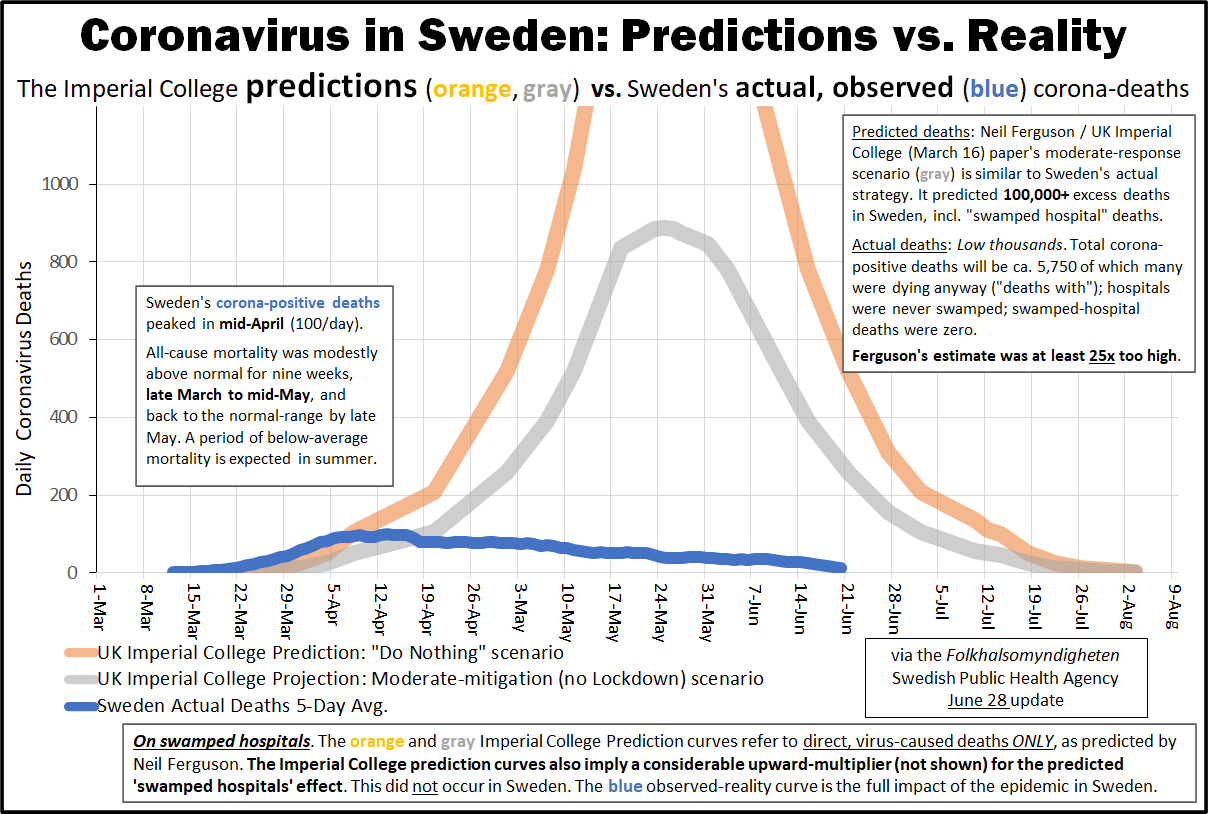
A comparison between the number of coronavirus deaths predicted by the influential model of Imperial College London (no measures or moderate measures) and the actual number of deaths in Sweden shows that the model strongly overestimated the impact of the epidemic:


Sweden: ICL model predictions versus actual Covid-19 deaths (HTY/FOHM)

7) Development of the pandemic (⇓)

Even in states without a lockdown, the epidemic usually reached its peak within a few weeks of the outbreak. However, some reports showed cumulative deaths per day of report (left) instead of daily deaths per day of death (right), falsely implying an ever escalating situation.


Cumulative deaths per day of report vs. daily deaths per day of death. (OWD/FOHM; April 24)

The United States is no exception to this dynamic. Rather, the US has seen several regional waves that were delayed due to lockdowns but then each peaked within a few weeks of the outbreak.


US: Covid cases by region (Source)

See also

1. Facts about Covid-19

2. An overview of the current evidence regarding the effectiveness of face masks.

3. Seven charts showing the covid big picture.

4. Covid-19 infection fatality rates (IFR) based on antibody studies.

5. The WHO-commissioned meta-study on the effectiveness of facemasks is seriously flawed and should be retracted.

6. A Covid-19 early treatment protocol.

7. Already in mid-March, SPR explained that the highly sensitive PCR tests are prone to producing false-positive results and their predictive value may easily drop below 50%.

8. Approximately 10% of people with symptomatic SARS-CoV-2 infection report persistent or recurring Covid symptoms for several weeks or months. This notably includes younger and previously healthy individuals, as well as those whose original covid was mild or moderate (without hospitalization).

Virologist Jonathan Latham and geneticist Allison Wilson have proposed a new hypothesis for the origin of the SARS-CoV-2 virus and the Covid-19 pandemic.

Swiss Policy Research (SPR), founded in 2016, is an independent, nonpartisan and nonprofit research group investigating geopolitical propaganda in Swiss and international media. SPR is composed of independent academics and receives no external funding other than reader donations.


Glaucomic Granny Sets the Pace

Via EricPetersAutos.com,

America is becoming Bergeron – a new country based on the principles laid out in Kurt Vonnegut’s depressingly prescient short story, Harrison Bergeron.

It is a country in which – as in the book – you may not act if anyone of lesser strength or ability or drive cannot act at the same level. You must accommodate yourself to their level.

Everything is leveled – ever downward.

Until all are depressingly . . . equal.

In misery. In poverty. In thrall to suffocating edicts limiting what they are permitted to do – and told they must not do – on the basis of what others can’t do. Or resent you for being able to do, which they can’t.

One of the most obvious expressions of this principle is on the road, where the law punishes competence as a kind of affront to the incompetent. If some people can’t handle making a right turn on red without creeping out in front of right-of-way traffic and causing a wreck thereby, no one else is allowed to make a right-on-red. If someone ignores the law forbidding it and makes a right-on-red safely and competently, by judging the flow of traffic and applying the necessary degree of acceleration to merge with it smoothly, he is punished for being competent.

For having ability – and daring to use it.

Some will say that, no, the offender ignored the law. True – but only superficially.

Consider that the competent execution of the action isn’t a mitigating factor. Just as health is no excuse for not Diapering.

Which is proof positive that the true offense – not mentioned but nonetheless – is lack of obedience premised on the acceptance of incompetence (and sickness) even in its absence.

At the first hint of snow, the roads are now inundated with liquid brine – if they’re not closed outright, as in my part of Virginia – where the Blue Ridge Parkway is closed even before it snows, stays closed if it doesn’t actually snow . . . because it might snow.

Because some people can’t deal with snow.

Highway speed limits are today what they were 60 years go – notwithstanding 60 years of improvements in tire/brake/suspension technology and half a dozen “safety assists” in addition to that.

Glaucomic granny sets the pace.

And now – because granny might die – everyone is treated as if they, too, were a granny and might die.

Healthy people at very little to no risk of death from catching a cold must live in perpetual fear of death. If they don’t fear it, having no reason to – they must be forced to act – and look – as if they did.

For the sake of those who do fear it.

Instead of sequestering granny, everyone else is sequestered.

And Diapered.

Soon, they will be Needled. Not because they need it – being healthy – but because some people aren’t. Everyone must be made unhealthy – by injecting them with substances that make them so, which suppress the competence of their own healthy immune system to ward off colds.

A public sneeze will soon be treated the same as spraying a crowd with machine gun fire – and there are Bergeronites who equate the two. Even if you don’t sneeze. Because you might.

Ergo, the Diaper.

It’s as vindictive a policy as forcing people who can drive to operate at the level of those who can’t – and punishing them if they don’t.

It all flows from the same ugly principle. The Sickness Regime is merely the latest and entirely predictable evolution of least common denominatorism – the Bergeroning of America.

It has been evolving for a long time, gradually – until it reached a critical mass – gesundheit! – this year.

Decades before the locking-down of the healthy population to protect the unhealthy portion of the population, it became common practice – in government schools – to limit the progression of instruction of the bright kids to accommodate the dullest kids.

It was called “mainstreaming.”

When kids played team sports, participation trophies were handed out to everyone in lieu of trophies for winning.

Adults lacking ability were hired for jobs over those with ability. This was called “affirmative action” – and it worked in the same way (and on the basis of the same motives) as forcing a champion sprinter to run in boots so that a mediocre rival could keep up with him.

Because some people can’t use a rearview mirror, everyone must be forced to buy a back-up camera. Because some people are terrible drivers when sober, the slightest amount of alcohol in the system of a good driver subjects him to a charge of “drunk” driving without regard to his actual driving.

Everything has to be idiot-proofed . . . for the sake of the idiots at the expense of those who aren’t.

People with the foresight to live below their means, who set aside money for their own retirement, are punished for their prudence by being forced to “contribute” money to subsidize the retirement of the imprudent, thereby rendering them just as dependent.

People who can competently handle a firearm – having never given reason to believe otherwise – are presumed incompetent to handle a firearm on account of the demonstrated incompetence of other people.

And now, the healthy must pretend they are sick – and be treated as presumptively sick. The fact that they aren’t isn’t a mitigating factor. In fact, it is a kind of perverse crime in that they are punished for living normally – on the basis of the fact that they aren’t sick.

This is being characterized as “selfish.”

It is an actionable offense in many areas.

Granny isn’t forced to enter a restaurant – and can enter wearing a Face Diaper if she likes.That’s not Bergeronic enough. The restaurant must force all of its employees and patrons to wear a Face Diaper.

Every level of American society is being pulled toward the floor like a tablecloth grabbed by a temper-tantruming toddler – who will never be allowed to grow up – by making the adults at the table sit on the floor, amid the spilled soup and broken plates.

ONS Survey: 86% had none of the core symptoms associated with the disease, 75% had none at all

Ian Sample

ONS Survey: 75% of UK “Cases” Between April-June Were People Who Weren’t Actually Ill

The cross-section between those who were ill and those who tested positive isn’t particularly big

More than 80% of people who tested positive in a national coronavirus survey had none of the core symptoms of the disease the day they took the test, scientists say.

…

Researchers at UCL said 86.1% of infected people picked up by the Office for National Statistics Covid-19 survey between April and June had none of the main symptoms of the illness, namely a cough, or a fever, or a loss of taste or smell the day they had the test.

Three quarters who tested positive had no notable symptoms at all, the scientists found when they checked whether people reported other ailments such as fatigue and breathlessness on the day of testing.

Unlike coronavirus testing in the community which focuses on people with symptoms, the ONS infection survey routinely tests tens of thousands of households around the country whether the occupants have symptoms or not.

…

The study, reported in Clinical Epidemiology, analysed the symptoms described by more than 36,000 people who were tested between April and June. Only 115 tests came back positive and of those only 27 people, or 23.5%, had symptoms of any description.

When the scientists narrowed the symptoms down to the main three for coronavirus infections, namely a cough, or a fever, or a loss of taste or smell, the number reporting the ailments fell to 16 or 13.9%.

Source: The Guardian

Thousands of the world’s top scientists are finally speaking out against lockdowns. Let’s pray it’s not too little, too late

More than 7,000 top scientists and doctors have signed a declaration calling for politicians to reconsider their entire approach to Covid, and to adopt a herd immunity strategy. Why didn’t this happen seven months ago?

In its first few days, almost 3,000 medical and public health scientists, over 4,000 medical practitioners, and an astonishing 65,000 members of the public have added their names to a backlash against government state-sanctioned Covid restrictions. If you wish to sign yourself, you can do so here.

The declaration was co-written by Dr Martin Kulldorff of Harvard Professor, Sunetra Gupta of the University of Oxford, and the illustrious Dr Jay Bhattacharya of Stanford.

As infectious disease epidemiologists and public health scientists we have grave concerns about the damaging physical and mental health impacts of the prevailing COVID-19 policies, and recommend an approach we call Focused Protection.

Coming from both the left and right, and around the world, we have devoted our careers to protecting people. Current lockdown policies are producing devastating effects on short and long-term public health. The results (to name a few) include lower childhood vaccination rates, worsening cardiovascular disease outcomes, fewer cancer screenings and deteriorating mental health – leading to greater excess mortality in years to come, with the working class and younger members of society carrying the heaviest burden. Keeping students out of school is a grave injustice.

Keeping these measures in place until a vaccine is available will cause irreparable damage, with the underprivileged disproportionately harmed.

Fortunately, our understanding of the virus is growing. We know that vulnerability to death from COVID-19 is more than a thousand-fold higher in the old and infirm than the young. Indeed, for children, COVID-19 is less dangerous than many other harms, including influenza.

As immunity builds in the population, the risk of infection to all – including the vulnerable – falls. We know that all populations will eventually reach herd immunity – i.e. the point at which the rate of new infections is stable – and that this can be assisted by (but is not dependent upon) a vaccine. Our goal should therefore be to minimize mortality and social harm until we reach herd immunity.

The most compassionate approach that balances the risks and benefits of reaching herd immunity, is to allow those who are at minimal risk of death to live their lives normally to build up immunity to the virus through natural infection, while better protecting those who are at highest risk. We call this Focused Protection.

Adopting measures to protect the vulnerable should be the central aim of public health responses to COVID-19. By way of example, nursing homes should use staff with acquired immunity and perform frequent PCR testing of other staff and all visitors. Staff rotation should be minimized. Retired people living at home should have groceries and other essentials delivered to their home. When possible, they should meet family members outside rather than inside. A comprehensive and detailed list of measures, including approaches to multi-generational households, can be implemented, and is well within the scope and capability of public health professionals.

Those who are not vulnerable should immediately be allowed to resume life as normal. Simple hygiene measures, such as hand washing and staying home when sick should be practiced by everyone to reduce the herd immunity threshold. Schools and universities should be open for in-person teaching. Extracurricular activities, such as sports, should be resumed. Young low-risk adults should work normally, rather than from home. Restaurants and other businesses should open. Arts, music, sport and other cultural activities should resume. People who are more at risk may participate if they wish, while society as a whole enjoys the protection conferred upon the vulnerable by those who have built up herd immunity.

On October 4, 2020, this declaration was authored and signed in Great Barrington, United States, by:

Dr. Martin Kulldorff, professor of medicine at Harvard University, a biostatistician, and epidemiologist with expertise in detecting and monitoring of infectious disease outbreaks and vaccine safety evaluations.

Dr. Sunetra Gupta, professor at Oxford University, an epidemiologist with expertise in immunology, vaccine development, and mathematical modeling of infectious diseases.

Dr. Jay Bhattacharya, professor at Stanford University Medical School, a physician, epidemiologist, health economist, and public health policy expert focusing on infectious diseases and vulnerable populations.

SIGN THE DECLARATION

Wikileaks Bombshell: WHO: Observations on Vaccine Production Technologies and Factors Potentially Influencing Pandemic Influenza Vaccine Choices in Developing Countries, 2009

Unless otherwise specified, the document described here:

  • Was first publicly revealed by WikiLeaks working with their source.
  • Was classified, confidential, censored or otherwise withheld from the public before release.
  • Is of political, diplomatic, ethical or historical

Release date August 3, 2009

Summary

Limited distribution report on pandemic vaccines was prepared for the WHO in early 2009, shortly before the emergence of swine flu. It details tough problems that most of the world’s governments face in acquiring adequate supplies of pandemic flu vaccines, as well as the problems caused by the patent claims of huge corporations.

Possibly because of the frank presentation and potential controversy, the WHO designated the paper “Limited Distribution”, meaning it has only been available to select government officials in paper form. This scanned version makes the paper available electronically and to the general public for the first time.

This is an intergovernmental organization document with no “primary country” of origin. India has been selected as the WHO Regional Office that published the paper is based there.

The full scanned PDF may be downloaded from the “download” link.

A text version (suitable for copy and paste) appears at the end of this page.

Follow the link below.

WHO:_Observations_on_Vaccine_Production_Technologies_and_Factors_Potentially_Influencing_Pandemic_Influenza_Vaccine_Choices_in_Developing_Countries,_2009

Rothschilds Patented COVID-19 Biometric Tests in 2015 and 2017

by Silviu “Silview” Costinescu

It’s not disputable, since the information comes from official patent registries in the Netherlands and US. And we have all the documentation

As we’ve shown in previous exposes, the whole Covidiocracy is a masquerade and a simulation long prepared by The World Bank / IMF / The Rothschilds and their lemmings, with Rockefeller partnership.
Our newest discoveries further these previous revelations.

FIRST REGISTRATION: THE NETHERLANDS, 2015

Source: Dutch Government patent regitry website

Info (verbatim) for more click here

Germany’s Extra-Parliamentary Corona Investigative Commission Launching a Class Action Suit Against Corona Criminals

By Peter Koenig
via Global Research

Germany is again in the forefront in fighting the devastating, unjustified, illegal, economy-destructive, people debilitating and outright genocidal – Corona Measures. The German COVID-19 Extra-Parliamentary Inquiry Committee – in German – ACU – German acronym for Ausserparlamentarischer Corona Untersuchungsausschuss – (see diagram from ACU2020.org website, on the left) is planning to launch a Class Action Suit against not only governments and government officials, but specifically against the manufacturers of the infamous PCR test (PCR – Polymerase Chain Reaction – is a technique used to “amplify” small segments of DNA) which, according to honest virologists all over the world, is absolutely unsuitable for covid-19 testing. It has actually not even been licensed to carry out such tests.

Nevertheless, the PCR test has been and is being touted and promoted by WHO – and by other leading health institutions in the western world, such as the US NIAID / NIH and CDC, as well as by researchers from the German Center for Infection Research (DZIF) at Charité, Hospital, Berlin. It was Dr. Christian Drosten, Director of the Institute of Virology at “Charité”, who propagated this test which eventually was taken over by the German respective Government and health authorities, who made it a mandatory panacea to test and count “cases”, mostly to manipulate statistics – which the media then uses to implant fear in the population.

Other countries followed similar instructions from their highest health authorities and used the test results for the same purpose – planting fear in the clueless population. The media never tell us, for example that the error rate of these tests, the so-called “positive negatives”, can be as high 50%. However, all “positives” are automatically absorbed into the “case” statistics. People get often tested several times and may also be reported several times.

Agenda ID2020: The Diabolical Agenda within the Agenda. “Genetically Modified Humanity”

That’s how the “case” rates can be manufactured and manipulated. FEAR is the Name of the Game. So that the governments are justified in closing their iron fists even stronger around your personal neck; and by cutting the countries’ economic lifeline – causing countless bankruptcies and unemployment in proportions never seen in modern history – and often deadly misery, famine and suicide.

The iron fist around the peoples’ throats include face mask, social distancing, work from home, semi- or full lockdowns, i.e. keeping people purposefully apart (the separate-to-conquer principle), discrimination against the elderly, who in their loneliness get depressed, sick and may die earlier. Yes, elderly people, especially with co-morbidities are in a higher risk group, but in the same as with the common flu every year, which has never been a reason to discriminate them.

The result we are seeing already today. And the worst is yet to come. This fall and winter in the Global North the merging with flu and “covid” may spell even more disaster in data manipulative mastery, and consequential measures that may, wittingly or unwittlingly be copied in the Global South, although the coming warmer summer climate would suggest the contrary. It’s a nasty and criminal Game that, if we don’t stop it, will not end soon.

Enough introduction. Listen for yourself what Dr. Reiner Fuellmich, lawyer of ACU, has to say (8-min video below) about the Class Action Suit, and how it might bring these destructive measures to a halt and reverse them, by compensating the damaged people and small and medium size enterprises that had no choice but to declare bankruptcy and lay off their employees.

As Dr. Füllmich explains, this could happen with what he calls a BANG, if millions around the world join in the Class Action Law Suit. Since in Germany and other European countries, Class Action Suits are not well known, especially because they are complicated, lacking a similar legal basis they have in the US, this Class Action Suit would be filed in the US, representing the world population.

Peter Koenig is an economist and geopolitical analyst. He is also a water resources and environmental specialist. He worked for over 30 years with the World Bank and the World Health Organization around the world in the fields of environment and water. He lectures at universities in the US, Europe and South America. He writes regularly for online journals such as Global Research; ICH; New Eastern Outlook (NEO) and more. He is the author of Implosion – An Economic Thriller about War, Environmental Destruction and Corporate Greed – fiction based on facts and on 30 years of World Bank experience around the globe. He is also a co-author of The World Order and Revolution! – Essays from the Resistance. He is a Research Associate of the Centre for Research on Globalization.

China Still Fears Three Things About America. The Dollar Is One Of Them

Authored by Mark Dittli via TheMarket.ch,

Few Western observers know China better than The Honorable Kevin Rudd. As a young diplomat, the Australian, who speaks fluent Mandarin, was stationed in Beijing in the 1980s. As Australia’s Prime Minister and then Foreign Minister from 2007 to 2012, he led his country through the delicate tension between its most important alliance partner (the USA) and its largest trading partner (China).

Today Mr. Rudd is President of the Asia Society Policy Institute in New York. In an in-depth conversation via Zoom, he explains why a fundamental competition has begun between the two great powers. He would not rule out a hot war: «We know from history that it is easy to start a conflict, but it is bloody hard to end it», he warns.

Mr. Rudd, the conflict between the U.S. and China has escalated significantly over the past three years. To what extent has that escalation been driven by the presence of two strongmen, i.e. Donald Trump and Xi Jinping?

The strategic competition between the two countries is the product of both structural and leadership factors. The structural factors are pretty plain, and that is the continuing change in the balance of power in military, economic, and technological terms. This has an impact on China’s perception of its ability to be more assertive in the region and the world against America. The second dynamic is Xi Jinping’s leadership style, which is more assertive and aggressive than any of his post-Mao predecessors, Deng Xiaoping, Jiang Zemin and Hu Jintao. The third factor is Donald Trump, who obsesses about particular parts of the economy, namely trade and to a lesser degree technology.

Would America’s position be different if someone else than Trump was President?

No. The structural factors about the changing balance of power, as well as Xi Jinping’s leadership style, have caused China to rub up against American interests and values very sharply. Indeed, China is rubbing up against the interests and values of most other Western countries and some Asian democracies as well. Had Hillary Clinton won in 2016, her response would have been very robust. Trump has for the most part been superficially robust, principally on trade and technology. He was only triggered into more comprehensive robustness by the Covid-19 crisis threatening his reelection. If the next President of the U.S. is a Democrat, my judgement would be that the new Administration will be equally but more systematically hard-line in their reaction to China.

Has a new Cold War started?

I don’t like to embrace the language of a Cold War 2.0, because we should not forget that the Cold War of the 20th century had three big defining characteristics: One, the Soviets and the Americans threatened each other with nuclear Armageddon for forty years; two, they fought more than twenty proxy wars around the world; and three, they had zero economic engagement with each other. The current conflict between the U.S. and China on the other hand is characterised by two things: One, an economic decoupling in areas such as trade, supply chains, foreign direct investment, capital markets, technology, and talent. At the same time, it is also an increasingly sharp ideological war on values. The Chinese authoritarian capitalist model has asserted itself beyond China and challenges America.

How do you see that economic decoupling playing out?

The three formal instruments of power in the U.S. to enforce decoupling are entity listing, the new export control regime, and thirdly, the new powers given to the Committee on Foreign Investment in the United States, CFIUS. Those are powerful instruments which potentially affect third countries as well, through sanctions imposed under the entity list. You can take the example of semiconductors, where the recent changes of the entity list virtually limits the exports of semiconductors to a defined list of Chinese enterprises from anywhere in the world, as long as they are based on American intellectual property.

These measures have cut off Chinese companies like Huawei or SMIC from acquiring high-end semiconductor technology anywhere in the world. The reaction in Beijing has been muted so far, with no direct retaliation. Why?

In China there is a division of opinion on the question of how to respond. The hawks have an «eye for an eye» posture, that’s driven both by a perception of strategy, but also with an eye on domestic sentiment. The America doves within the leadership – and they do exist – argue a different proposition. They think China is not yet ready for a complete decoupling. If it’s going to happen, they at least try to slow it down. Plus, they want to keep their powder dry until they see the outcome of the election and what the next Administration will do. That’s the reason why we have seen only muted responses so far.

Isn’t it the case that both sides would lose if they drive decoupling too far? And given that, could it be that there won’t be any further decoupling?

We are past that point. Whoever wins the election, America will resolve in decoupling in a number of defined areas.

  • First and foremost in those global supply chains where the products are of too crucial importance to the U.S. to depend on Chinese supply. Think medical supplies or pharmaceuticals.
  • The second area is in defined critical technologies. The Splinternet is not just a term, it’s becoming a reality.
  • Thirdly, you will see a partial decoupling on the global supply of semiconductors to China. Not just those relevant to 5G and Artificial Intelligence, but semiconductors in general. The centrality of microchips to computing power for all purposes, and the spectrum of application in the civilian and military economy is huge.
  • Fourth, I think foreign direct investment in both directions will shrink to zero.
  • The fifth area of decoupling is happening in talent markets. The hostility towards Chinese students in the U.S. is reaching ridiculous proportions.

Do you see a world divided into two technology spheres, one with American standards and one with Chinese standards?

This is the logical consequence. Assume you have Huawei 5G systems rolled out across the 75 countries that take part in the Belt and Road Initiative, then what follows from that is a series of industry standards that become accepted and compatible within those countries, as opposed to those that rely on American systems. But then another set of questions arises: Let’s say China is effectively banned from purchasing semiconductors based on American technology and is dependent on domestic supply. Chinese semiconductors are slower than their American counterparts, and likely to remain for the decade ahead. Do the BRI countries accept a slower microprocessor product standard for being part of the Chinese technological ecosystem? I don’t know the answer to that, but I think your prognosis of two technology spheres is correct.

China throws huge amounts of money into the project of building up its semiconductor capabilities. Are they still so far behind?

Despite their acts to buy, borrow or steal intellectual property, they constantly remain three to seven years behind the U.S., Taiwan and South Korea, i.e. behind the likes of Intel, TSMC and Samsung. It’s obviously hard to reverse engineer semiconductors, as opposed to a Tupolev, as the Soviets had to find out, which can be reverse engineered over a weekend.

Wouldn’t America hurt itself too much if it cut off China from its semiconductor industry altogether?

There is an argument that 50% of the profits of the US semiconductor industry come from their clients in China. That money funds their R&D in order to keep three to seven years ahead of China. The U.S. Department of Defense knows that, what’s why the Pentagon doesn’t necessarily side with the anti China hawks on this issue. So the debate between the US semiconductor industry versus the perceived national security interest has yet to be resolved. It has been resolved in terms of AI chips, and Huawei is the first big casualty of that. But for semiconductors in general the question is not solved yet.

Will countries in Europe or Southeast Asia be forced to decide which technology sphere they want to belong to?

Until the 5G revolution, they have managed to straddle both worlds. But now China has banked on the strategy of being the technology leader in certain categories, and the one they are in at the moment is in 5G technology and systems. If you look at the next five years, and if you look at the success of China in the other technology categories in its Made in China 2025 Strategy, then it becomes clear that we increasingly are going to end up in a binary technology world. Policy makers in various nations will have to answer questions around the relative sophistication of the technology, industry standards, concerns on privacy and data governance, and of course a very big question: What are our points of exposure to the U.S. or China? What will we lose in our China relationship by joining the American sphere in certain fields, and vice versa? Those variables will impact the decision making processes everywhere from Bern to Berlin to Bangkok.

But in the end, they will have to choose?

Yes. India for example has done it in the field of 5G. For India, that was a big call, given the size of its market and China’s desire to bring India slowly but surely towards its side of the Splinternet.

The third field of conflict after trade and technology lies in financial markets. We know that Washington can weaponise the Dollar if it wants to. So far, this front has been rather quiet. What are your expectations?

Two measures have been taken so far by the Trump Administration. One, the direction to U.S. government pension funds not to invest in Chinese listed companies; and two, the direction to the New York Stock Exchange not to sustain the listing of Chinese firms unless they conform to global accounting standards. I regard these as two simple shots across the bow.

With more to follow?

Like on most other things including technology, the U.S. is divided in terms of where its interests lie. Just like Silicon Valley, Wall Street has a big interest in not having too harsh restrictions on financial markets. Just look at the volume of business. Financial market collaboration between the Chinese and American financial systems in terms of investment flows for Treasuries, bonds and equities is a $5 trillion per year business. This is not small. I presume the reason we have only seen two rather small warning shots so far is that the Administration is deeply sensitive to Wall Street interests, led by Secretary of the Treasury Steven Mnuchin. Make no mistake: Given the serious Dollars at stake in financial markets, an escalation there will make the trade war look like child’s play.

Which way will it resolve?

The risk I see is that if the Chinese crack down further in Hong Kong. If there is an eruption of protests resulting in violence, we should not be surprised by the possibility of Washington deciding to de-link the U.S. financial system from the Hong Kong Dollar and the Hong Kong financial market. That would be a huge step.

How probable is it that Washington would choose to weaponise the Dollar?

We don’t know. The Democrats in my judgement do not have a policy on that at present. Perhaps the best way to respond to your question is to say this: There are three things that China still fears about America. The US military, its semiconductor industry, and the Dollar. If you are attentive to the internalities of the Chinese national economic self-sufficiency debate at present, it often is expressed in terms of «Let’s not allow to happen to us in financial markets what is happening in technology markets». But if the U.S. goes into hardline mode against China for general strategy purposes, then the only thing that would deter Washington is the amount of self-harm it would inflict on Wall Street, if it is forced to decouple from the Chinese market. If that would happen, it would place Frankfurt, Zurich, Paris or the City of London in a pretty interesting position.

Would you say that there is a form of mutually assured destruction, MAD, in financial markets, which would prevent the U.S. from going into full hardline mode?

If the Americans wanted to send a huge warning shot to the Chinese, they are probably more disposed towards using sectoral measures, like the one I outlined for Hong Kong, and not comprehensive measures. But never forget: American political elites, Republicans and Democrats, have concluded that Xi Jinping’s China is not a status quo power, but that it wishes to replace the U.S. in its position of global leadership. Therefore, the inherent rationality or irrationality of individual measures is no longer necessarily self-evident against the general strategic question. The voices in America to prevent a financial decoupling from China are strong at present, but that does not necessarily mean they will prevail.

China’s strategy, meanwhile, is to welcome U.S. banks with open arms. Is it working?

The general strategy of China is that the more economic enmeshment occurs – not just with the U.S., but also with Europe, Japan and the likes –, then the less likely countries are going to take a hard-line policy against Beijing. China is a master in using its economic leverage to secure foreign policy and national security policy ends. They know this tool very well. The more friends you have, be it JPMorgan, Morgan Stanley or the big technology firms of Silicon Valley, the more it complicates the decision making process in the West. China knows that. I’m sure you’ve heard it a thousand times from Swiss companies as well: How can we grow a global business and ignore the Chinese market? Every company in the world is asking that question.

You wrote an article in Foreign Affairs in August, warning of a potential military conflict triggered by events in the South China Sea or Taiwan. Do you really see the danger of a hot war?

I don’t mean to be alarmist, not at all. But I was talking to too many people both in Washington and Beijing that were engaged in scenario planning, to believe that this was any longer just theoretical. My simple thesis is this: These things can happen pretty easily once you have whipped up nationalist narratives on both sides and then have a major incident that goes wrong. A conflict is easy to start, but history tells us they are bloody hard to stop.

Of course the main argument against that is that there is too much at stake on both sides, which will prevent an escalation into a hot war.

You see, within that argument lies the perceived triumph of European rationality over East Asian reality. All that European rationality worked really well in 1914, when nobody thought that war was inevitable. The title of my article Beware the Guns of August referred to the time between the assassination in Sarajevo at the end of June, the failure of diplomacy in July, and then miscommunication, poor signalling and the dynamics of mobilisation in the end led to a situation that neither the Kaiser nor the Czar could stop. Nationalism is as poisonous today as it was in Europe for centuries. It’s just that you’ve all killed each other twice before you found out it was a bad idea. Remember, in East Asia, we have the rolling problems of our own version of Alsace-Lorraine: it’s called Taiwan.

Influential voices in Washington say that the time of ambiguity is over. The U.S. should make its support for Taiwan explicit. Do you agree?

I don’t. If you change your declaratory policy on Taiwan, then there is a real danger that you by accident create the crossing of a red line in Chinese official perception, and you bring on the very crisis you are seeking to avoid. It’s far better if you simply had an operational strategy, which aims to maximally enhance Taiwan’s ability to deter a Chinese attack.

Over the past years, the Chinese Communist Party has morphed into the Party of Xi. How do you see the internal dynamics within the CCP playing out over the coming years?

Xi Jinping’s position as Paramount Leader makes him objectively the most powerful Chinese leader since Mao. During the days of Deng Xiaoping, there were counterweighting voices to Deng, represented at the most senior levels, and there was a debate of economic and strategic policy between them. The dynamics of collective leadership applied then, they applied under Jiang Zemin, they certainly applied under Hu Jintao. They now no longer apply.

What will that mean for the future?

In the seven years he’s been in power so far, China moved to the left on domestic politics, giving a greater role to the Party. In economic policy, we’ve seen it giving less headroom for the private sector. China has become more nationalist and more internationally assertive as a consequence of it becoming more nationalist. There are however opposing voices among the top leadership, and the open question is whether these voices can have any coalescence in the lead-up to the 20th Party Congress in 2022, which will decide on whether Xi Jinping’s term is extended. If it is extended, you can say he then becomes leader for life. That will be a seminal decision for the Party.

What’s your prediction?

For a range of internal political reasons, which have to do with power politics, plus disagreements on economic policy and some disagreements on foreign policy, the internal political debate in China will become sharper than we have seen so far. If I was a betting man, at this stage, I would say it is likely that Xi will prevail.