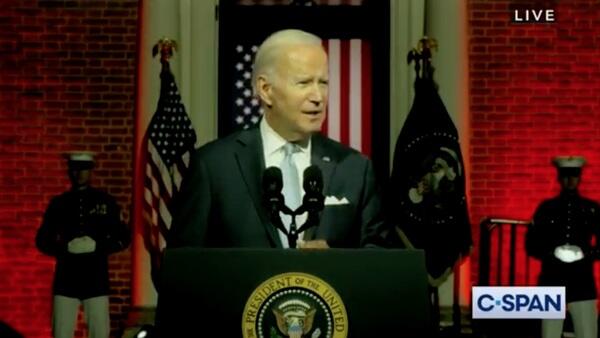
Biden’s Hateful Rhetoric Against Americans Presents GOP With A Sterling Opportunity

Authored by Rajan Laad via American Thinker (emphasis ours),

Whenever political leaders lose all political capital due to their misgovernance and have no real issues to base their campaign on, they often resort to focusing on the symbolic — usually referring to ‘the soul of the nation.’

This happened before in the U.S., it happened in India, it happened in the U.K. and it happened again in the U.S.

This is most typical of the left.

Instead of being humble and conceding their mistakes, they attack voters for thinking of voting against them while overlooking the myriad catastrophes they presided over. 

They often blame their opponents for what they are guilty of — i.e., bigotry and violence, and then end with the ‘soul’ plea.

Biden delivered his ‘soul’ speech at Independence Hall in Philadelphia, the birthplace of both the Declaration of Independence and the Constitution.

The manner of delivery was unhinged; he frequently waved his fists aggressively. His voice was hoarse, perhaps owing to recent bouts with Covid-19, giving the speech a scornful tone. 

Biden spoke flanked by uniformed Marines, while his backdrop was bathed in blood-red hues making it look like an ominous hellscape.

Twitter video screengrab

His speech was a sequel to his recent addresses where he claimed that he doesn’t respect MAGA Republicans and that MAGA philosophy is like “semi-fascism.”

Biden called for Americans to “unite behind the single purpose of defending our democracy regardless of your ideology.”

But Biden added a caveat that this didn’t apply to “MAGA forces’ — i.e., all those scores of millions who voted for and intend to vote for MAGA candidates.

Biden said that “too much of what’s happening in our country today isn’t normal.”

Biden is right here, but the blame for this lies on him.

Never before have government institutions been hijacked and misused to target political opponents.

Never before has a virus been misused to impose lockdowns that infringe on the right to freedom of movement and the right to earn a living.

Never before have vaccines been mandated causing people to be fired from their jobs or suffer from health issues.

Never before has the U.S. government demonized its own citizens, calling them domestic terrorists.

Never before has the U.S. government set up a ‘Disinformation Governance Board’ that sits in judgment of the utterances of citizens.

Never before has the U.S. been subjected to prolonged disinformation campaigns, the Russian collusion hoax, the Ukraine call hoax, and now the insurrection hoax.

Never before has the U.S. had a president whose cognitive abilities are so impaired that he struggles to read off a teleprompter and causes citizens to wonder who is in charge.

Biden continues by claiming that the Republican party is “dominated, driven, intimidated by Donald Trump” and his supporters, calling it “a threat to this country” because “they refuse to accept the results of a free election.”

Perhaps Biden forgot the Russian collusion hoax concocted by the Democrats that baselessly attempted to delegitimize the results of the 2016 presidential election. It was the Democrats who refused to accept the results of a free election.

Perhaps Biden forgot that big media and big tech suppressed the Hunter Biden laptop scandal prior to the 2020 elections. A recent poll shows that nearly four of five Americans believe that “truthful” coverage would have changed the outcome of the 2020 presidential election.

Perhaps Biden forgot about Mark Zuckerberg spending $419 million to infiltrate sacrosanct electoral infrastructure of the 2020 elections and push for mail-in voting.

Perhaps Biden forgot that 69% of voters nationwide cast their ballot nontraditionally i.e., by mail and/or before Election Day for the 2020 elections. Mail votes are highly vulnerable to fraud.

Biden also alleged that the “MAGA forces” are aligned with white supremacists, violent extremists, and other undesirables.

Perhaps Biden forgot violent Democrat extremists threatening Supreme Court Justices, vandalizing Catholic churches, pregnancy centers, and the offices of pro-life groups. There was an assassination plot against Justice Brett Kavanaugh,

Biden also accused “MAGA Republicans” of seeing a country consumed in “darkness.”

Perhaps Biden forgot that his misgovernance is the sole cause of darkness.

The open borders have caused an influx of illegal immigrants, some of whom are violent criminals. More than 4.9 million illegal migrants have crossed the southern border. 

The smuggling of illicit drugs across the border is a regular occurrence. There were an estimated 100,306 drug overdose deaths in the United States during the 12-month period ending in April 2021, an increase of 28.5% during the same period the year before.

Inflation is at a very high 8.5 percent, causing the price of essential items to skyrocket. The price of fuels continues to be high.

The crime wave is ravaging the nation and Democrat judges refuse to prosecute misdemeanors such as drug possession, driving offenses, disturbing the peace, shoplifting, larceny, domestic violence, etc.

None of Biden-backed initiatives such as the Inflation Reduction Bill or the infrastructure bill or his climate initiative or pardoning Student Loans will reduce people’s suffering, in fact, wasteful spending will make inflation worse. 

Biden’s ‘gun safety’ red flag laws allowed instant confiscation of guns on mere suspicion; this endangers lives, especially considering the crime wave.

Biden has thus not only taken the nation into darkness but his misgovernance will blacken the darkness even further.

Biden perfunctorily claimed that “not every Republican, not even a majority of Republicans, are MAGA Republicans; not every Republican embraces their extreme ideology.”

If that were indeed the case, and the MAGA movement was just a small minority, why did Biden base his entire speech on an insignificant minority?

This was an attempt to distinguish between the Good Republicans (Lincoln Project, Liz Cheney, Adam Kinzinger, and company) vs the Bad Republicans (Trump and the MAGA GOP). The truth is the “Good Republicans” are useful idiots, who will instantly become bad if they dare to run against Democrats.

Most Americans disapprove of Biden; that number is likely to rise after his hateful rhetoric.

The purpose of the address was to demonize, dehumanize and otherize Donald Trump and his supporters, which would justify any kind of persecution by government agencies.

This also creates grounds for the Democrats to reject the outcome of the midterms should the GOP, particularly the MAGA GOP win by a landslide. They could claim to stand against fascist forces. The Democrats have broken every immutable norm in recent times; they already attempted to overthrow the 2016 election; they could very well do this for the midterms.

But there is a silver lining.

Despite claims that the speech would be apolitical, Biden delivered a campaign speech.  However, it wasn’t for the Democrats it was instead for the Republicans and Donald Trump.

Even personnel from Democrats’ mouthpieces such as CNN and the Daily Beast weren’t impressed

Upcoming Civil War Gets in High Gear

Biden Attacks ‘MAGA Republicans’ in Angry Speech, Labels Them ‘Threat’ to Democracy | 1 Sept 2022 | Joe Biden attacked supporters of former President Donald Trump in a speech Thursday evening in Philadelphia that many across the political spectrum viewed as divisive, castigating large scores of Republican voters as “extremists” and threats to democracy. “Too much of what’s happening in our country today is not normal,” Biden said. “Donald Trump and the MAGA Republicans represent an extremism that threatens the very foundations of our republic.” “They fan the flames of political violence,” Biden added. Biden’s remarks come after earlier attacks on Trump supporters in which he claimed many Republicans had embraced “semi-fascism” during a Democratic National Committee fundraiser. White House Press Secretary Karine Jean-Pierre has largely doubled down on Biden’s rhetoric, arguing that Biden’s characterization of many Republicans as “extremists” was accurate as they allegedly don’t share the beliefs of the majority of Americans.

Joe Biden Declares War: ‘MAGA Republicans a Clear and Present Danger – MAGA Republicans Embrace Anger, Thrive on Chaos, Live in the Shadow of Lies’ | 1 Sept 2022 | Joe Biden started his speech Thursday night attacking President Trump and his supporters — 75 million Americans. Joe Biden calls MAGA Republicans “a clear and present danger to our democracy.” (Video)

Disgraced Former FBI Official Andrew McCabe Says Joe Biden Didn’t Go Far Enough Threatening MAGA Republicans | 1 Sept 2022| Disgraced former FBI Deputy Director Andrew McCabe on Thursday evening said Joe Biden didn’t go far enough threatening Trump supporters. Joe Biden on Thursday evening declared war on Trump supporters in a divisive prime time speech on the “battle for the soul of America” from Philadelphia. Joe Biden called 75-plus million Trump supporters “a clear and present danger to our democracy.” …This wasn’t enough red meat for the rabid former FBI Deputy Director who got fired for lying to federal investigators. McCabe told a CNN panel that Joe Biden should have talked about what he’s going to do to take care of the problem – the problem being the millions of Trump supporters. “People would like to have seen a bit more references to accountability. There really wasn’t much talk about what we’re doing about those insurrectionists,” McCabe said. McCabe, Biden and leftists like them won’t be happy until every Trump supporter is locked up or dead.

Over 50 Biden Administration Employees, 12 US Agencies Involved in Social Media Censorship Push – Documents | 1 Sept 2022 | More than 50 officials in Joe Biden’s administration across a dozen agencies have been involved with efforts to pressure Big Tech companies to crack down on alleged misinformation, according to documents released on Aug. 31. Senior officials in the U.S. government, including White House lawyer Dana Remus, deputy assistant to the president Rob Flaherty, and onetime White House senior COVID-19 adviser Andy Slavitt, have been in touch with one or more major social media companies to try to get the companies to tighten rules on allegedly false and misleading information on COVID-19, and take action against users who violate the rules, the documents show. In July 2021, for instance, after Biden said that Facebook was “killing people” by not combating misinformation effectively, an executive at Meta reached out to Surgeon General Vivek Murthy, a Biden appointee, to say that government and Meta teams met after the remarks “to better understand the scope of what the White House expects from us on [alleged] misinformation going forward.”

‘Censorship Enterprise’: Emails Reveal Biden Administration Coordinated With Facebook, Twitter | 1 Sept 2022 | Dozens of federal officials across multiple agencies within the Biden administration communicated extensively with social media companies to coordinate censorship of information, according to internal documents released by Republican Attorneys General Eric Schmitt of Missouri and Jeff Landry of Louisiana. Officials within the Department of Homeland Security (DHS) and the Department of Health and Human Services (HHS) sent emails to employees at Facebook and Twitter to flag instances of alleged misinformation and provide talking points to counter allegedly false narratives spreading on the platforms. Government officials would occasionally initiate this activity, with one message from a Centers for Disease Control and Prevention official requesting monthly meetings with Facebook to plan “debunking” strategies, and a White House official requesting the removal of a parody Anthony Fauci account. One collection of emails shows Facebook staff collaborating closely with staff at the the Department of Health and Human Services to remove Facebook groups, with one message describing the collaboration as “critical.” Staff from the CDC discussed setting up “regular chats” with Twitter.

Putin has Pulled off a Shock Win that Could Destroy the Free World

by Allister Health via Telegraph

[ . . . ]

We risk ending up with calamitous poverty, civil disobedience, a new socialist government by next year, a break-up of the UK, nationalisations, price and incomes policies, punitive wealth taxes and eventually a complete economic and financial meltdown and IMF bailout. The situation in the EU is, if anything, worse.

This is not a plea for pacifism, for looking away when Ukraine is being illegally invaded by a savage regime. Britain was – and remains – morally right to back Ukraine in a carefully calibrated way. Instead, this is a plea for an economic counter-offensive, for Liz Truss, the next PM, to tackle Putin’s economic and energy war head-on.

Mass, immediate intervention is inevitable, but must be designed to avoid hastening Britain’s shift into demagoguery, welfarism and socialist central planning, all steps down Hayek’s “road to serfdom” that the Leftist and green elites are longing us to take. The wrong response – because too little is done, or because the wrong solutions are chosen – would merely advance Putin’s masterplan to cripple the West.

Cheap and plentiful energy is essential to our consumerist societies. We cannot be delusional about the scale of the developing catastrophe. Household energy and vehicle fuel costs will jump from 4.5 per cent of household spending in early 2021 to some 13.4 per cent by April next year, much higher than at any time during the past 50 years, including the 1970s, according to Carbon Brief. Households may face a rise in energy costs of £167 billion, or 7 per cent of GDP, taking total expenditure to £231 billion, more than government spending on health, and that is before the hit to business is accounted for. The rise for consumers alone is more than the combined defence and education budgets.

This is equivalent to a Depression-style shock. Pay rises will protect some workers at the expense of investors, but – until and unless energy prices fall again – our national living standards will slump massively. The nation is sending tens of billions more abroad to pay for energy imports.

The state can borrow to cushion the blow, reducing future consumption to prop up current living standards, but our impoverishment cannot be magicked away. Coming after years of QE, there is a real danger of excess borrowing triggering even higher inflation, rocketing interest rates, mass repossessions and a banking crisis, so caution is imperative.

There was little the West could do other than rely on hostile Opec nations in the 1970s, the last time an energy war almost destroyed us; but it was an unforgivable error for Europe to become so reliant on Russian supplies, and to fail so miserably to increase domestic energy production. The French even allowed their nuclear plants to break down.

Putin struck at the right time: the zombified Western economy was in the doldrums. Covid was a disaster of unpreparedness and errors, increasing national debts and inflation and entrenching a dependency culture. But the Russian tyrant’s canniest move was to understand just how suicidal our energy policy had become. A toxic brew of net zero ideology, deep hypocrisy about decarbonising without making the nuclear effort, endemic nimbyism, short-termism and state incompetence had radically weakened the West.

There are four broad emergency options. The first is targeted help: anybody under a certain income gets cash from the state, paid for by borrowing. Some needy cases would be missed, however, and can the benefits system cope? The second is to freeze energy prices for all, with the state subsidising the acquisition of gas: this looks “free”, while in fact it massively increases the national debt, as in France. The third is to cut taxes dramatically, something the Left always rejects as “untargeted” or “regressive”. The fourth is to help some or all firms.

Whenever possible, Truss must cut tax; whenever possible, she should target help on families and companies that need it and avoid bailing out the well off; if she must cap prices, given the total collapse of the system, she needs an exit strategy; and she has to launch the greatest, most urgent energy infrastructure programme in history while suspending as many green rules as possible. She needs to work visibly with business, showing voters they are delivering big investments under warlike conditions, reducing the pressure for confiscatory windfall taxes.

On top of the extra debt, all these options come with downsides. All four are being weaponised by the Left to shift politics permanently in their direction. For many activists, this is a useful crisis. They are calling for wealth taxes and income tax surcharges: they claim that this would be “just” if the “rich” benefit from untargeted handouts or price caps. They demand “social tariffs”, where the rich or bigger users pay crippling surcharges.

But once such taxes are imposed, they never go away. In France, the Left are calling for bans on private swimming pools, private planes and even detached housing: permanent green austerity. The Germans are slashing the cost of public transport, supposedly to save energy but really to undermine the private car. In Britain, there is huge support for nationalisations, even though they wouldn’t increase the supply of energy or reduce its cost. Price caps, made mainstream thanks to Theresa May, are now the norm: ever more wages and prices are set by civil servants. Will supermarkets be next?

One paradox of Putin’s neo-Soviet revanchism is that it is strengthening America’s position as leader of the West. The US emerged better from Covid. Its interest rates have gone up faster, bolstering the dollar. Its health care system hasn’t fallen over like the NHS. But it is its energy policy – “Frack, baby, frack”, as the Republicans advocated in the early 2000s – that has been the real triumph. Tyler Cowen, the George Mason University polymath, argues in a Bloomberg piece that “2022 may be remembered as the year when living standards in the US truly pulled away from those in Western Europe”.

Why, oh why, did Britain and Europe allow themselves to become Putin’s hostage?

Putin’s Next Weapon: A Submarine Drone ‘Aircraft Carrier’?

By Brent M. Eastwood

via https://www.19fortyfive.com

The image above is of a Yasen-class Russian Submarine.

[ . . . ]

The Russian navy lacks dependable aircraft carriers. It makes up for this grave disadvantage with a diverse and robust submarine force. Now the Russians have a sub that might soon launch nuclear-tipped torpedoes while equipping the most modern missiles available to a submarine.

The nuclear-powered K-329 Belgorod is an Oscar II-class guided-missile fast attack boat. The submarine was introduced into full-time service with the Russian fleet at a

public event at the Sevmash shipyard in Severodvinsk on July 8.

Carrying Nuclear Doom

Russia planned the Belgorod to feast on American and NATO shipping – especially aircraft carriers. The new submarine is assigned to the innocuous sounding Main Directorate of Deep Sea Research, and the Russian navy said it will conduct underwater scientific experiments.

Don’t let that fool you. This boat is highly dangerous. The weapon American naval strategists fear most is the planned Poseidon nuclear-armed and nuclear-powered torpedo, which functions as an underwater combat drone with seemingly unlimited range. There are plans for six Poseidons to be onboard the Belgorod.

Russian television news programs, generally recognized as wretched hives of blustery propaganda, claim the Poseidon could “wipe Britain off the map … in a radioactive tsunami.” The doomsday weapon is 80 feet long and can speed along at 108 knots, while reaching as deep as 3,200 feet. The autonomous underwater drone could create up to a two-megaton blast.

Thankfully, the Poseidon is still a few years away from deployment. But it could indeed be capable of destroying coastal cities in Britain, the United States, or other NATO member-states. There is nothing in adversaries’ arsenals that could stop such a nuclear torpedo. Maritime Executive magazine said a nuclear device detonated by the torpedo would be devastating: “The real objective would be to coat wide swathes of the surrounding coastline with radioactive fallout – an enduring and difficult-to-remediate hazard of underwater nuclear detonations. The submersible delivery method would circumvent (American) missile-defense capabilities.”

Quarterback for Smaller Subs

The Belgorod has another intriguing and worrying feature. The sub can serve as a quarterback of sorts for a small, nuclear-powered spy submarine that would allow the craft’s sailors to work on or even sabotage undersea Internet cables, as well as other objects on the seafloor. Other sources indicate that the sub can be used as a “carrier” for autonomous underwater vehicles, a big deal if accurate.

However, this program might be on hold due to a past tragedy – the Russians have tried the mini-sub concept before. The Losharik (A-12) was “a deep diving manned submersible that suffered a battery explosion in 2019 that killed 14 Russian submariners,” according to USNI News.

The Belgorod is the biggest submarine the Russians have built in 30 years. It is 549 feet long and 49 feet across, has two nuclear reactors, and displaces 24,000 tons. It has been undergoing sea trials since 2019.

What Should We Believe?

All of this news is difficult to parse. I believe the submarine is ready to embark on patrols. The nuclear torpedo sounds optimistic, but U.S. Navy leadership has testified on Capitol Hill that it could be a reality someday. Adm. John Aquilino, the commander of Indo-Pacific Command, disclosed in House testimony in May that the Belgorod would be equipped with the Poseidon. Until it is ready, the nuclear-equipped drone serves as useful propaganda.

As for the midget sub destroying undersea Internet cables – that seems far-fetched. This is another shiny object for hawks in Russia to squawk about on television newscasts. I grade the whole package a seven out of ten, because it rests on unproven technology. As we get more information on the development of the Poseidon, that grade might rise. Let’s hope U.S. Navy intelligence keeps a close eye on that nuclear-tipped and nuclear-powered doomsday torpedo.

Now serving as 1945s New Defense and National Security Editor, Brent M. Eastwood, PhD, is the author of Humans, Machines, and Data: Future Trends in Warfare. He is an Emerging Threats expert and former U.S. Army Infantry officer.

Is the United States Headed for Civil War?

via Washington Post

Fighting words and extremism are on the rise. We are not yet in ‘Turner Diaries’ territory, but that doesn’t mean the country will avoid violent conflict.

It’s easy and logical to conclude that the United States today stands as close to the edge of civil war as it has since 1861. A broad variety of voices — including Republican and Democratic politicians, academics who study civil strife, and extremists on both ends of the spectrum — now accept the idea that civil war is either imminent or necessary. They point to evidence that can seem persuasive: a blizzard of threats against FBI agents, judges, elected officials, school board members and elections supervisors; training camps where heavily armed radicals practice to confront their own government; and polls showing that many Americans expect violent conflict.

But it’s also easy and logical to conclude that the florid rhetoric from right-wing extremists, the worried warnings in mainstream media, and the hail of threats and individual attacks after this month’s surprise FBI search of Donald Trump’s South Florida mansion add up to something well short of the frightening prospect of civil war.

People who track such threats say this summer’s violent outbursts against federal officials and government institutions amount to one more concerning surge of rage in a pattern that has persisted throughout the pandemic, spiking after the murder of George Floyd two summers ago. But the Anti-Defamation League and other watchdog groups are not seeing the kind of specific planning by private militias and online assemblages of radicals that was evident before last year’s Jan. 6 insurrection and the white-supremacist march in Charlottesville in 2017.

“We are living in a country where disinformation, conspiracy thinking and lies have resulted in deadly attacks,” said Oren Segal, vice president of the ADL’s Center on Extremism. “It’s not exactly kumbaya in this society. But we have been going through this for a long time now, and I don’t see people coming together in the more coherent organizing we saw prior to Jan. 6.”

Contrast that perspective with that of Stephen Marche, author of “The Next Civil War: Dispatches From the American Future,” who posits that as extremists’ threats have become more lurid and specific, their rhetoric has leached into the mainstream — leading, for example, the Texas state government to spell out instances in which it would defy federal authority and the Texas Republican Party to declare President Biden the “acting president” and seek a voter referendum on seceding from the United States.

When he sees small groups of armed men training for combat against government agents, Marche, a Canadian novelist, wants to ring warning bells. “The alarm is getting much more serious, and it’s accelerating very quickly,” he said. “The kind of chaos I’m describing is like internet rage: You could take it as playacting or it could be deadly serious. It could be weekend fun or actual military preparation.” He, along with some other analysts on the left, right and in between, thinks the current noise is a strong indicator that a hot civil war — one likely to feature bombings, assassinations and other assaults on federal institutions and officials — may be imminent.

This split over how seriously to take the threat of civil war is not just another example of America’s deep divisions: It has the great benefit of existing on a foundation of shared facts. Both sets of analysts — those who say we’re heading toward civil strife and those who say the threat matrix is largely limited to lone rangers and small, disorganized groups whose dangerous but scattered acts don’t constitute a civil war — agree there is little chance of an organized, violent attack on the government, or of local or state authorities taking up arms against their federal counterparts. But there remains a sharp divide over whether a mounting series of individual and small-group attacks could add up to a warlike conflict that destabilizes the country.

What both sides in the civil war debate do agree on is that a more disturbing trend — at this point more dangerous than the sporadic bursts of violence in recent years — is the pervasive loss of trust, hope and sense of belonging in a severely damaged society.

And both sides agree we have been here before.

A quarter-century ago, after the bombing of the Oklahoma City federal building, I interviewed William Pierce, the physics professor turned neo-Nazi organizer whose novel “The Turner Diaries” had been taken by the bomber, Timothy McVeigh, as a planning document for launching civil war. In the book, white supremacists conspire to bomb FBI headquarters and spark a wider war against the government. McVeigh had excerpts from the book in his getaway car when he killed 168 people and injured hundreds more.

Pierce, a provocateur who took great pride in his book’s popularity among white supremacists and other extremists, told me that his aim — and that of those he hoped would read his book — was to overthrow the government and rid the country of Jews and Blacks.

“People don’t use the book as a blueprint, but as inspiration,” Pierce told me. “I don’t have the time to write just for entertainment. It’s to explain things to people. I’d like to see North America become a white continent.” He wrote that “if we don’t destroy the System before it destroys us — if we don’t cut this cancer out of our living flesh — our whole race will die.”

Pierce, who died in 2002, told me he expected individual violent acts inspired by his book to become more frequent. “Terrorism only makes sense if it can be sustained,” he said. “One day, there will be real, organized terrorism done according to plan, aimed at bringing down the government.”

For several decades, “The Turner Diaries” has remained a go-to text for violent extremists, showing up frequently in online chatter by participants in and supporters of the Jan. 6 attack. In the meantime, the internet has blossomed into a far more insidiously efficient tool for those who seek to foment discord and terrorism. Yet although Pierce’s work still inspires single actors and small groups, his wider war has never come close to fruition.

Jan. 6 wasn’t an insurrection. It was vigilantism. And more is coming.


Today, “civil war” is a rallying cry that some Americans wear on T-shirtsand others openly train for with assault weapons. Since the Mar-a-Lago search on Aug. 8, “lock and load” and “civil war” have trended on pro-Trump social media such as Gab and Telegram.

Belligerent rhetoric has also become part of everyday campaigning among some Republicans. A GOP candidate in Florida’s 11th House District, Laura Loomer, who narrowly lost her primary Tuesday, wrote on Telegram on Aug. 8 that it’s “time to take the gloves off. … If you’re a freedom loving American, you must remove the Words decorum and civility from your vocabulary. This is a WAR!” Conservative YouTuber and podcaster Steven Crowder tweeted on the day of the FBI’s descent on Mar-a-Lago that “tomorrow is war.” “It’s time to fight for every square inch,” he reiterated the next day. “It’s time to fight fire with fire.” The pro-Trump Gateway Pundit site wrote “This. Means. War.” On various pro-Trump social media platforms, people talked about buying ammunition and drilling for confrontation with federal agents. “Civil war! Pick up arms, people,” one agitated person tweeted.

Such talk has been a mainstay of the Trump years. Last summer, Rep. Madison Cawthorn (R-N.C.), an election denier, alleged that U.S. election systems are “rigged,” which he said would “lead to one place, and that’s bloodshed.”

In a new book, “We’ll Be Back: The Fall and Rise of America,”conservative writer Kurt Schlichter games out a civil war and concludes that blue states face a challenge. “It’s nice to hold cities, but if you do not also hold all the rural territory between the cities, as well as the routes to the places where you are getting your food and fuel,” he wrote, “you have a real problem.”

Trump himself, speaking against the teaching of critical race theory at a South Carolina rally this spring, said America’s fate “ultimately depends upon the willingness of its citizens to lay down — and they must do this — lay down their very lives to defend their country.”

One of Trump’s leading critics in his own party, Rep. Adam Kinzinger (Ill.), said early this year on ABC’s “The View” that civil war could erupt. “We have to warn and talk about it so that we can recognize that and fight hard against it,” said Kinzinger, one of two Republicans on the House committee investigating the Jan. 6 attacks.

But Kinzinger has also warned against embracing civil war rhetoric, tweeting in May: “How bout we stop the ‘civil war’ lust. Buy some GI Joes or something.”

In a nation where firearms purchases have almost doubled since the start of the pandemic — driven mainly by fears of rising crime, political unrest and the insecurity of life in the age of covid-19 — appeals like Kinzinger’s have fallen all too flat.

When the Rev. Sun Myung Moon sought to win Americans to his political and spiritual cause, the Unification Church, in the 1970s, he recruited people to sell flowers and ginseng door-to-door. Now, his son Hyung Jin Moon seeks to win followers for his Rod of Iron Ministries by sponsoring training sessions at his compounds in Texas and Pennsylvania — practice, he says, for a coming “patriots’” war against the “deep state.”

The Moons’ churches are both fringe groups, but Hyung Jin’s organization has hosted Trump’s former chief strategist Steve Bannon and current Pennsylvania Republican gubernatorial candidate Doug Mastriano at its “Freedom Festival” events.

Moon’s group is one of the many radical organizations that are increasingly open about their plans. A Brookings Institution studytracked several hundred private militia groups that use anti-government rhetoric to attract Americans worried “about changing demographics, stagnating wages, and how the shift to a multi-racial and multi-ethnic America will affect them.”

But such groups remain disparate and disjointed.

Many activists who have called for confrontation with the government now claim they meant no such thing; they have flipped the accusation, saying leftists or government agents are out to smash conservative opposition by kindling fear of a civil war launched by right-wingers. Crowder, the YouTube host, called media reports about his tweets an intentional smear.

“Decrying the weaponization of a once-professional FBI, and the scandals among its wayward Washington hierarchy is not insurrectionary,” Victor Davis Hanson, a fellow at Stanford’s Hoover Institution, wrote in American Greatness, an online journal generally supportive of Trump. “Those who warn most of some mythical civil war are those most likely to incite one.”

Does all the noise add up only to vigorous opposition to the government, or is it evidence of concerted preparation for open warfare? The answer depends in part on what you think modern civil war would look like: Would large militias attack government institutions, or would a war be limited to haphazard acts by individuals and small guerrilla factions?

A new book imagines a looming civil war over the very meaning of America

Some say a war of sorts has begun: “The second American civil war is already occurring,” Robert Reich, labor secretary under President Bill Clinton, declared in the Guardian. “But it is less of a war than a kind of benign separation analogous to unhappily married people who don’t want to go through the trauma of a formal divorce.”

Reich foresees not a violent division of the country but rather something “analogous to Brexit — a lumbering, mutual decision to go separate ways on most things but remain connected on a few big things (such as national defense, monetary policy and civil and political rights).”

Still, many Americans believe that a true, violent civil war is coming. About half of those surveyed this spring by the University of California at Davis’s Violence Prevention Research Program said they expected civil war in the next few years. Another poll, by the Survey Center on American Life, a nonpartisan project affiliated with the conservative American Enterprise Institute, found more than one-third of Americans agreeing that “the traditional American way of life is disappearing so fast that we may have to use force to save it.”


Groups seeking to battle the government have popped up regularly throughout American history.

To determine when such movements around the world have exploded into real civil wars, Barbara Walter, a political scientist at the University of California at San Diego and the author of “How Civil Wars Start: And How to Stop Them,” points to two predictive factors: Countries stuck in an unstable zone between democracy and autocracy are more susceptible to armed conflict. And countries with weakened governments and a population deeply divided by identity — by race, ethnicity or religion — can fall into civil war. Walter sees the Republican Party embracing an “almost white supremacist strategy” that attracts far-right activists eager to fight the federal government.

But other scholars look at the same evidence and see the potential for violence stabilizing or diminishing. Juliette Kayyem, who heads the homeland security program at Harvard’s Kennedy School of Government, argues that violent movements either grow or shrink. As Trump increasingly looks to his supporters like a loser, she sees them wandering away. The “ideology is not defeated; it simply stops motivating people to action,” she wrote in the Atlantic this month.

The rhetoric of war is vastly more common than war itself. Violent and dark language has been at the core of Trump’s appeal for many years. Trump’s choice for governor of Arizona, former TV news anchor Kari Lake, for instance, tells crowds that the government is “rotten to the core,” meaning “America is dead.”

That kind of end-times speech strikes some disturbed or radicalized people as an invitation to uprising. But historians and security analysts who’ve studied the latest evidence of civil war planning mainly foresee the kinds of scattered terrorism that the country experienced in the late 1960s and early 1970s, not anything like the buildup to 1860.

Marche has dug into prepper conferences, far-right gatherings and the darkest of online rabbit holes, trying to discern whether their war plans are “weekend fun or actual military preparations. It’s hard to distinguish the fantasists from the people who actually are going to do it,” he said in an interview. In the end, he pronounces himself “really scared.”

No one would call the strife of the 1960s civil war, but “there was enormous violence in that time,” Marche said. “One hundred and forty cities burned, and that’s in a time when you still had a level of institutional trust that could mitigate the violence.”

Now, however, collapsed trust in institutions such as the police, news media, churches and government makes the country more vulnerable to internal attack, he argues. Add this year’s Supreme Court decision on abortion rights, and “you now have another situation like in 1860 where you have two legal statuses of people in different parts of the country, and it just can’t hold,” he said.

Still, Marche notes that “America changes all the time. Reinvention is in the absolute DNA of the country.”

Segal, who tracks extremism for the ADL, sees this month’s burst of war threats as one more sign that “the system is ripe for targeting,” with the FBI now the focus of violent rhetoric and attacks, like school boards, election workers and medical professionals before it. This may not trigger a wider rash of violence, but the danger has not passed. “Based on what happens in the November elections, extremists will adjust and find a boogeyman,” he said.

Segal retains hope that holding the Jan. 6 perpetrators to account and investigating Trump’s role in fomenting that attack “will somehow round the edges of the situation.”

It’s hard to see a civil war emerging from the current mess, but as Segal said, “I’m more concerned about what we can’t see.”

Russian Corporate Profits Jump 25% as Sanctions Hit Muted

  • Net income gain came despite economic contraction, inflation
  • Data are latest sign of economy’s resilience amid sanctions
Moscow's International Business Center. 
Moscow’s International Business Center. 
Source: Bloomberg
Russian corporate profits jumped 25% in the second quarter, even as sweeping US and European sanctions imposed over the Kremlin’s invasion of Ukraine pushed the economy into recession.
Profits jumped to 9.5 trillion rubles ($144 billion at the average rate for the period), with the year-on-year increase outpacing the 17% rise in consumer prices over the period, according to Sberbank CIB calculations based on data from the Federal Statistics Service. 

“The second quarter results were very good, demonstrating the resilience of the Russian economy,” analysts at the state-owned lender wrote. “The solid profit growth provides hope for a revival in corporate investment.”

Profits Surge

Russian corporate profits jumped in 2Q, defying sanctions

Source: SberCIB, Rosstat

Percentage increase from previous year

The manufacturing sector, which was hit especially hard as sanctions cut off key imported components, still managed a 44% profit gain, while transportation and storage were up 168%. Profits in real estate and construction surged, as did earnings in hotels and catering, as Russians stayed home as international air service was limited. 

Putin’s War Sends Russian Economy Back to 2018 in Single Quarter

Wholesale and retail trade suffered with the drop in sales, with profits off 13%, the report said, while earnings in mining were down 51% as sanctions hit key producers. In the tech sector, where western companies pulled out en masse, profits were down 48%.

— With assistance by Benjamin Harvey

Toxic, Metallic Compounds Found in All COVID Vaccine Samples Analyzed by German Scientists

via The Epoch Times

A group of independent German scientists found toxic components — mostly metallic — in all the COVID-19 vaccine samples they analyzed, “without exception” using modern medical and physical measuring techniques.

The Working Group for COVID Vaccine Analysis says that some of the toxic elements found inside the AstraZeneca, Pfizer and Moderna vaccine vials were not listed in the ingredient lists from the manufacturers.

The following metallic elements were found in the vaccines:

  • Alkali metals: caesium (Cs), potassium (K)
  • Alkaline earth metals: calcium (Ca), barium (Ba)
  • transition metals: cobalt (Co), iron (Fe), chromium (Cr), titanium (Ti)
  • Rare earth metals: cerium (Ce), gadolinium (Gd)
  • Mining group/metal: aluminum (Al)
  • Carbon group: silicon (Si) (partly support material/slide)
  • Oxygen group: sulphur (S)

These substances, furthermore, “are visible under the dark-field microscope as distinctive and complex structures of different sizes, can only partially be explained as a result of crystallization or decomposition processes, [and] cannot be explained as contamination from the manufacturing process,” the researchers found.

They declared the findings as preliminary.

The findings “build on the work of other researchers in the international community who have described similar findings, such as Dr. Young, Dr. Nagase, Dr. Botha, Dr. Flemming, Dr. Robert Wakeling and Dr. Noak,” Dr. Janci Lindsay, Ph.D., a toxicologist not involved in the study, told The Epoch Times.

“The number and consistency of the allegations of contamination alone, coupled with the eerie silence from global safety and regulatory bodies, is troublesome and perplexing in terms of ‘transparency’ and continued allegations by these bodies that the genetic vaccines are ‘safe,’” Lindsay added.

crystals blood comirnaty vaccineComparison of crystals in the blood and in the vaccine; on the left, crystalline formations are found in
the blood of test subjects vaccinated with Comirnaty (BioNTech/Pfizer), the images on the right show that these
types of crystals are also found in Comirnaty vaccines. Image credit: Helen Krenn

Helena Krenn, the group’s founder, submitted the findings to German government authorities for review.

“We had submitted it to the participants of the government and further addresses from newspapers with the platform open-debate.eu, only in Germany, Austria and Suisse,” Krenn told The Epoch Times.

Two other important findings were that blood samples from the vaccinatedhad “marked changes” and that more side effects were observed in proportion to “the stability of the envelope of lipid nanoparticles.”

A lipid nanoparticle is an extremely small particle, a fat-soluble membrane that is the cargo of the messenger RNA (mRNA).

Methodology

“Using a small sample of live blood analyses from both vaccinated and unvaccinated individuals, we have determined that artificial intelligence (AI) can distinguish with 100% reliability between the blood of the vaccinated and the unvaccinated. This indicates that the COVID-19 vaccines can affect long-term changes in the composition of the blood of the person vaccinated without that person being aware of these changes,” the study states.

The findings of acute and chronic physiological changes to the blood of those inoculated with the vaccines, consistently discerned via AI software, “also echoes the findings of many other researchers and support the contentions of contamination and/or adulteration,” Lindsay said.

“We have established that the COVID-19 vaccines consistently contain, in addition to contaminants, substances the purpose of which we are unable to determine,” their study says.

The group consists of 60 members, including physicians, physicists, chemists, microbiologists and alternative health practitioners, supported by lawyers and psychologists.

anomalous objects janssen vaccineAnomalous objects in Johnson & Johnson’s Janssen vector vaccine. It should be noted that objects of this type were not found in all of the samples. Image credit: Helen Krenn

The scientists claim that their results have been cross-confirmed using the following measuring techniques: “Scanning Electron Microscopy, Energy Dispersive X-ray Spectroscopy, Mass Spectroscopy, Inductively Coupled Plasma Analysis, Bright Field Microscopy, Dark Field Microscopy and Live Blood Image Diagnostics, as well as analysis of images using Artificial Intelligence.”

The analysts explain that they have been cooperating with other groups in different countries that have been executing similar investigations and have obtained results consistent with their own.

“The results from our analysis of the vaccines can, consequently, be regarded as cross-validated,” the summary report of their findings states.

“It should be acknowledged of course that [German Working Group’s] work is described as ‘Preliminary Findings,’ not yet published in a peer-reviewed journal and that chain of custody as well as the identity of many of these scientists is unknown.”

“However, in this heavily charged and censored climate when it comes to any challenges to the ‘safety and efficacy’ of the genetic vaccines, I myself can attest to the difficulties in conducting the basic research, much less publishing that same research in a peer-reviewed journal, in order to get at these questions as well as disseminate the findings,” Lindsay said.

pfizer comirnaty vaccine unusual objectsThe Comirnaty vaccine from BioNTech/Pfizer exhibits a diversity and large number of unusual objects.
The vast number of crystalline platelets and shapes can hardly be interpreted as impurities. They appear regularly and in large numbers in all samples. Image credit: Helen Krenn

Astra Zeneca, Moderna, Pfizer and J&J did not respond to a request for comment.

Reprinted with permission from The Epoch Times.

“The more Russians we kill now, the less our children will have to kill”

“The more Russians we kill now, the less our children will have to kill,” said the Ambassador of Ukraine to Kazakhstan.

This can only be said by the ambassador of the terrorist regime, commented the representative of the Russian Foreign Ministry.

“For 8 years, the Kiev Nazis killed in silence, blaming Moscow for everything, now they are openly talking about plans for national cleansing,” Maria Zakharova wrote on her TG channel.

Geopolitics: The World Is Splitting In Two

Authored by Alasdair Macleod via GoldMoney.com,

While we are being distracted by Ukraine, President Putin has advanced his geopolitical goals materially. Aided and abetted by President Xi, Putin is taking the Asian continent into his control. That mission is well on its way to being achieved. He now awaits the winter months to finally force the EU to reject America’s hegemony. Only then, will the western end of the Eurasian continent be truly free of American interference.

This article explains how he is achieving his strategic goals. It examines the geopolitics of the Asian landmass and the nations tied to it, which are commercially and financially turning their backs on the US-led western alliance.

I look at geopolitics from President Putin of Russia’s viewpoint, since he is the only national leader who seems to have a clear grasp of his long-term objectives. His active strategy conforms closely with Halford Mackinder’s predictive analysis of nearly 120 years ago. Mackinder is regarded by many experts as the founder of geopolitics.

Putin is determined to remove the American threat to his Western borders by squeezing the EU to that end.But he is also building political relationships based on control of global fossil-fuel supplies — a pathway opened for him by American and European obsessions over climate change. In partnership with China, the consolidation of his power over the Eurasian landmass has progressed rapidly in recent weeks.

For the Western Alliance, financially and economically his timing is particularly awkward, coinciding with the end of a 40-year period of declining interest rates, rising consumer price inflation, and a deepening recession driven by contracting bank credit.

It is the continuation of a financial war by other means, and it looks like Putin has an unbeatable hand. He is on course to push our fragile fiat currency based financial system over the edge.

Mackinder’s legacy

In a paper presented to the Royal Geographic Society in 1904, the father of geopolitics, Halford Mackinder, effectively predicted what is happening today. In his presentation, he asked:

“Is not the pivot region of the world’s politics that vast area of Euro-Asia which is inaccessible to ships, but in antiquity lay open to the horse-riding nomads, and today is about to be covered with a network of railways?

“Outside the pivot area, in a great inner crescent, are Germany, Austria, Turkey, India, and China. And in an outer crescent, Britain, South Africa, Australia, the United States, Canada, and Japan.”

This is shown in Figure 1, taken from the original paper presented to the Society.

In 1919 after the First World War, in his Democratic Ideals and Reality he summarised his theory in slightly different language thus:

“Who rules East Europe commands the Heartland;

Who rules the Heartland commands the World-Island;

Who rules the World-Island commands the world.”

This is Putin’s destiny. In conjunction with China (rather than a united Germany, which is what worried politicians such as Balfour before the First World War), Russia appears to be successfully pursuing her goal of control of Mackinder’s World Island. Today, we can expand on the inner crescent concept to include Iran, the Middle East, as well as the new nations spun out of the old Soviet Union. Of Mackinder’s original inner crescent, only Germany and Austria are omitted today. Austria was the centre of the Hapsburg Empire at that time and so is no longer geopolitically important.

Of the outer circle, we can now include most of Africa and some of South America, which are increasingly dependent on the World-Island for demand for their commodities. Without the West’s media and public seeming to realise it, there has been and continues to be an extension of Russian power through Asian partnerships which now eclipses America’s in terms of the global population covered. And if we add in China’s diaspora in South-East Asia, America and her NATO allies look like a somewhat isolated minority.

As well as political power ebbing away from the West, economic power is as well. Hampered by increasingly expensive and anti-capitalist democratic socialism, their economies are struggling under the burden of their governments. And as the West declines, the World-Island is enjoying its own industrial revolution. The network of railways, to which Mackinder referred in 1904, has expanded from the trans-Siberian railway to China’s new overland silk roads, linking China with Western Europe and the great nations south of the original silk road.

Russia and its ex-Soviet satellites occupy half the Eurasian continent. The Eurasian continent is 21 million square miles, or more than three times the size of all North America. Central and North America together measure some 9 million square miles, more than twice the area of Europe. Even without its ex-Soviet satellites, Russia is still by far the largest nation by land area. And together with China, Russia is nearly three times the size of the United States.

Russia is the world’s largest single source of energy, commodities, and raw materials and as we now see can control the prices the West pays for them. As a consequence of recent sanctions, the west is paying top-rouble, while Russia’s Asian allies have energy and commodities offered at a discount payable in their own currencies, undermining the West’s relative economic position even more.

As to whether Putin has studied Mackinder, this must be supposition. But there is no doubt that if he is not so guided, Putin is following the same predicted course. As Russia’s undisputed leader, he has played the geopolitical game masterfully. He does not fall into the traps which bedevil Western socialism. He follows foreign guidelines in the mould of the British at the time of Lord Liverpool’s Prime Ministership two hundred years ago, when the policy was not to interfere in the domestic affairs of foreign nations, except to the extent that they affected British interests.

It is a fact of life for Putin that his allies include some very unpleasant regimes. But this does not concern him — their domestic affairs are not his business. His business is Russia’s interests, and like the British in the 1820s, he pursues them single-mindedly.

The rationale behind Ukraine

Ukraine was an unusual instance of Putin taking the initiative in acting against the American-led NATO alliance. But in the run-up to Ukraine, he had seen Britain leave the EU. Britain was America’s vicar on the EU’s earth, so Brexit represented a significant decline in the US’s ability to influence Brussels. Following Brexit, President Biden precipitously exited Afghanistan, taking the rest of NATO with him. Therefore, America was on the run from the Heartland. The way was open for Putin to push further and expel America from Russia’s western borders.

To do this, he needed to confront NATO. And there is little doubt this was on Putin’s mind when he escalated his “special military operation” against Ukraine. He must have anticipated NATO’s reaction to impose sanctions, from which Russia has profited greatly. At the same time, it is the EU which has been badly crushed, a squeeze which he can intensify at will.

The drama is still playing out. He needs to keep up some pressure on Ukraine to keep the squeeze going. He is not ready to compromise. Winter in the EU will be tougher still, with energy and food shortages likely to lead to increasing riots by the EU’s citizens. Putin will only stop when the Europeans realise that America is sacrificing them in the pursuit of its hegemony. Zelensky is little more than a puppet in this drama.

With respect to the war on the ground, Russia has already secured its access from the Black Sea by cultivating her relationship with Turkey. As a NATO member, Turkey is hedging its bets. The Black Sea is vital to her economic interests. For this reason, Turkey is maintaining her relationship with Russia, while cooling down her antipathy to Israel (President Herzog visited Ankara in March) and mending her fences with the UAE — it’s all part of the World Island coming together.

For the US, Erdogan is an unreliable NATO partner. Allegedly, the US tried to remove him by instigating a failed coup attempt in 2016, when he was tipped off by Russian intelligence and the coup failed. While he owes a favour to Putin, Turkey’s NATO membership leads him to be cautious. And as a born-again Sunni, he appears keen to extend Turkish influence into the Moslem nations in Central Asia, dreaming perhaps of the glory days of the Ottoman Empire.

To further Russia’s power over energy sources upon which the Western belligerents depend, Putin has cultivated Iran, and has also made welcoming overtures to Saudi Arabia and the UAE. Sergei Lavrov, Putin’s foreign minister, took care to fully brief members of the Arab league of Russia’s energy policy in Cairo last month. The argument is simple: the West has turned its back on fossil fuels, planning to phase them out entirely in a decade or so. As producers of oil and gas, their future is to stick together with Mackinder’s World Island and its Inner Crescent. This is so obviously the case, that even Saudi Arabia is said to be seeking an association through the BRICS group.

Whatever the merits of climate change driven policies, with respect to energy the West seems to be hell-bent on a suicide mission. But Russia’s message to its partners is that you can have oil and natural gas at a discount to what Europe has to pay. Putin is offering to release them fully from the West’s climate change ideology.

With the pressure he is applying on Western Europe, Putin almost certainly assumes European politicians will be driven from supporting US sanctions to a more neutral position. And Russia probably expects that non-aligned nations suffering from grain shortages will also pressure the West to bring sanctions to an end. But before Putin relinquishes the pressure on EU nations, he is still likely to insist that American influence from Western Europe is withdrawn, or at the least it is withdrawn from Russia’s western borders.

Phase 1 has concluded. Let Phase 2 begin

We must now turn from Putin’s supposed megalomania to the conditions faced by his Western enemies, particularly the nations in Europe and the Eurozone. Figure 2, which is of a basket of commodities and raw materials priced in euros, shows that after a significant rise, for Europe prices have eased in recent months.

For the beleaguered Europeans, the pause in a substantial rise in commodity prices since the Fed’s introduction of zero interest rates in March 2020 has given them temporary and minor relief from an escalating inflation headache. Perhaps it is premature, but investors in western markets are taking the pullback in commodity prices as evidence that the commodity squeeze is probably over, and that with it the problem of consumer price inflation will diminish as well.

Indeed, in his 1 August report for Credit Suisse, Zoltan Pozsar reported that he had visited 150 investment managers in eight European cities recently, and the consensus was just that: they think inflation is licked, recession is due, and therefore interest rates will shortly decline.

But so long as he holds the pricing reins for energy, Putin can play with the euro to his heart’s desire. By manipulating his quasi-monopoly on energy, grains, and fertilisers he can increase pressure on the EU’s leaders to reject US hegemony. And to fully appreciate the power in Putin’s hands, it is important to understand the true relationship between fiat currencies and commodities.

The evidence is that the volatility of commodity prices is in the fiat currency they are priced in, and not the commodities themselves. Figure 3 shows this relationship, by comparing the price of oil measured in legal money (gold) and the fiat euro currency.

The most the price of oil in gold has varied on the upside is double at the time of the Lehman failure, whereas in euros at that time it was sixteen times. So far this year, it has been even more volatile when the price in gold fell to 70% of the 1950 price, while in euros it hit 15 — that’s 21 times as volatile.

This finding turns all energy pricing assumptions upside-down. The chart shows that what was true before the ending of Bretton Woods was no longer true after 1971. [The euro only commencing in 2000, the currency taken before then was the German mark]. Since oil prices are wholly determined in markets whose participants all assume price volatility is in the commodity, the entire basis of price forecasting becomes undermined. That being so, if an analyst gets a forecast half right it is more by luck than judgement.

This is the whole point behind sound money. With sound money, dealers in commodities and all other goods justifiably assume that the intermediating medium is a constant. They assume that when they receive payment, its utility is invariable. But with unbacked fiat it is different. For individual transactions, while we still assume a dollar is a dollar and a euro is a euro we all know that a currency’s utility varies. Why, then, for analytical purposes do forecasters always assume it does not? Why do analysts never take this into account in their forecasts?

Figure 3 above proves that conventional approaches to pricing and economic forecasts involving them are nonsensical. The same is demonstrably true for all other commodities, not just oil. In current circumstances, the basis for an incorrect analysis is being used to support expectations that prices are beginning to reflect an increasing prospect of recession, which to a Keynesian or monetarist mind, means falling demand for commodities and energy leads to lower prices. But the fact remains that overnight, Putin can put the squeeze on the EU again. And armed with the knowledge that price volatility is in the currency, we know that the falling euro will do most of his work for him.

As we approach Europe’s winter, it will not take much to drive energy prices in euros considerably higher. Putin is unlikely to make the mistake of being seen to do this deliberately. But in all probability, he need not take any significant action at all to see Western currency prices for energy and food rise again as winter approaches.

There is a further misjudgement common to Western capital markets: this time over interest rates. In almost every piece of analysis forecasting recession, the underlying assumption is that with economies turning down demand for goods, services and credit will diminish. For these reasons, interest rate pressures are expected to decline.

This misunderstands the nature of credit. Almost all circulating media is commercial bank credit. Consequently, GDP is simply the sum of all bank credit used for qualifying transactions. Therefore, nominal GDP is set by the availability of bank credit, and not, as commonly supposed driven by a slowdown in economic activity. When the banking cohort contracts its collective balance sheet, interest rates initially rise because of a shortage of credit.

These conditions are now faced by financial markets. Commercial banks are bound to seek ways to protect themselves in uncertain times. They are already looking to reduce the ratio of their assets to equity before bad debts really escalate. Banks in the Eurozone are not alone with this change in outlook. The so-called global recession is not being driven much by other economic factors, but mainly by the tendency for bank credit to be withdrawn from both financial and non-financial economic sectors.

It is a problem poorly understood and never mentioned by analysts in their economic forecasts. But in the current economic and financial environment, the consequences lead to a conclusion about interest rates the opposite of that commonly supposed.

We can see from the foregoing that contrary to expectations expressed everywhere by western governments and their central banks along with the whole investment establishment, the inflation and interest rate problem is not going away. Because interest rates had been suppressed and could go no lower and for no longer, there has been a fundamental shift from a long-term decline in them, to what is increasingly sure to turn out to be a long-term trend for interest rates to rise. As it is elsewhere, the bank lending environment in Europe is deteriorating for obvious reasons. Furthermore, it comes at a time when bank balance sheet leverage is at record levels, leaving banks badly exposed to the change.

A severe contraction in bank credit is only in its initial stages. A second phase in the economic and financial war against Putin’s Russia will shortly emerge. Currently, we appear to be in a summer pause after the first, indicated by consolidating commodity prices. Government bond yields have declined from earlier highs. Stock markets have rallied. Bitcoin has rallied. Gold, which is the only legal money from which to escape from all this, has declined. It all indicates a false optimism, vulnerable to the rudest of shocks.

China may be Putin’s only wildccard

With its economy based on commodities whose values are aligned with gold and so long as the current geopolitical situation does not escalate into a wider military conflict, Russia appears to be in a strengthening economic position while her adversaries are in decline. If there is a threat to its position, it probably comes from her alliance with China, which is exposed to the West’s follies through trade. China has some wildcard problems.

Since the death of Mao, in its rapid development China has relied on the expansion of credit through state owned banks. Bank executives are state functionaries, instead of managers on behalf of profit-seeking shareholders. It is this difference which has insulated the domestic economy from the cycles of bank credit which have plagued the West’s economic model with repetitive credit crises.

While this lack of destructive cyclicality might be seen as a good thing, it has allowed malinvestments to build up uninterruptedly over recent decades. So, while the Chinese authorities still exercise significant control over lending, the degree of economic distortion has become a threat to further progress.

This is being manifest in a growing property crisis, with developers going to the wall in droves. It’s not that there is unlikely to be demand for commercial and residential properties in the future: the savers are there to buy, the middle classes are growing in number, and the economy has some way to go in its development. The problem is that the property market has got ahead of itself.

As a sector, property and related activities make up an estimated one-third of China’s economic activity. Developers have suspended completions of pre-sold properties, which citizens have bought on a pre-payment basis. Consequently, mortgage payments are being suspended by angry purchasers. Private banks have been affected, with bank runs against some of them. Some thirty real estate companies have missed foreign debt payments, with Evergrande being the most high-profile defaulter on $300bn of debt.

Problems in property were and are still being compounded by Beijing’s zero tolerance covid policy. More so than in other jurisdictions, strictly enforced clampdowns have hit production and undermined logistics, factors that have inevitably undermined economic performance. While exports to other nations have held up well — mostly due to foreign governments’ spending deficits escalating and not being matched by increased personal savings — China’s exporters’ profits are bound to become squeezed by the West’s deepening recession. Unless, that is, China’s foreign exchange policy is to deliberately weaken the yuan against western currencies. But that will only end up destabilising the domestic economy as consumer price increases accelerate.

And lastly, if Beijing follows up on its threats to annex Taiwan — if only to detract from domestic economic failures — a train of events is likely to be set in motion which could escalate tensions with America and its defence allies to the detriment of everyone.

But despite the headlines from China’s property crisis, it is too early to assume China is descending into much deeper trouble. It must abandon macroeconomic policies driven purely by statistics and ensure its citizens and their business have a stable currency. Whether this is understood in Beijing is not clear.

The fundamental difference from its Russian partner is its greater economic dependence on consumption of commodities as opposed to their production. The consequences of western economic policies set to undermine their own currencies’ purchasing power will be felt more by China than Russia. Nevertheless, an increasingly likely banking and currency crisis in the West can be weathered by China with the correct economic approach.

The era of the dollar is ending

While Putin appears to be gaining control of the World Island, leaving a few nations on its fringes adhering to the US and its currency’s hegemony, much of what he has achieved is through the abject failure of the West in playing this greatest of great geopolitical games. A notable feature of the West’s decline is in its embrace of anti-capitalistic and woke cultures. In this article, it would lose our focus if we drifted into the climate change debate, other than to point out that by seeking to eliminate fossil fuels in the next decade or so, the West is on a course of economic self-destruction relative to Russia’s partners, who are being offered discounted oil, gas, and coal for the foreseeable future.

When President Nixon turned the dollar into an entirely fiat currency in August 1971, he set off a train of events which is now ending. From establishing the dollar as the world’s reserve currency, and his agreement with Saudi Arabia which led to the creation of the petrodollar, global fiat currency instability commenced as shown in Figure 3 to this article. But the fiat dollar gave both the US Government and the American banking system enormous power. That was effectively wielded, forcing recalcitrant nations to kowtow to the mighty dollar.

The power was not used judiciously, leading to an alliance between Russia and China to protect themselves from US actions. The lessons they learned from American imperialism were not lost. Despite earlier promises to Russia not to do so, the US military directly threatened her western border. For China, though her economic and industrial revolution having been initially praised, she began to be seen as a threat to the American interests.

This imperialism has made America few friends and many latent enemies. With repeated failures in US foreign policy in the Middle East, North Africa, Ukraine, and most recently Afghanistan, the US can now count on nations representing only about 19% of the world’s population of 8 billion people, compared with 54% allied to the World Island. This is shown in Figure 4.

While allocating nations into these categories is somewhat subjective, it gives an approximation of the relative power of the World Island partnership compared with that of US/NATO. As the US-led partnership’s grip slackens, vested interests are sure to drive non-aligned nations towards the World Island camp, particularly when they have commodities to sell.

Before Russia’s invasion of Ukraine and the sanctions that followed, none of the 170 nations in the table could do without the dollar. Russia has been forced to find alternative settlement currencies and its close allies in the Eurasian Economic Union are planning a new trade settlement currency to cut out the dollar. But the international pricing of commodities and raw materials in dollars is impossible to overcome, even for Russia.

The World Island cannot side-line the dollar completely — it is too entrenched. While the dollar’s power is declining, the destruction of its virtual monopoly in international trade will have to come from US monetary policy itself, a process that is arguably under way.

Since the financialisation of Western economies in the mid-eighties, the dollar has retained its credibility as the world’s reserve currency. It was achieved by ensuring a ready supply for international use, as forecast by Robert Triffin by his description of the dollar’s dilemma in the late fifties. The demand side was bolstered by the development of regulated and unregulated derivative markets, which forced foreigners to purchase dollars in order to purchase derivatives. Essentially, it was synthetic dollar demand created to satisfy speculator demand for commodities, including precious metals, by creating synthetic supply.

When this concept is grasped, the importance of the ending of the long-term trend of interest rate suppression becomes better understood. The suppression of commodity prices by increasing synthetic supply became part and parcel of interest rate declines. Interest rates are no longer declining but rising. There will be unexpected consequences for commodity prices, which we will come to in a moment.

There are two immediate consequences for bank lending: their lending margins improve, and the incidents of bad and doubtful debts increases. Consequently, overleveraged bank balance sheets are being cut back by banks no longer having to work them so hard to maintain bottom-line profits. And with lending risk escalating, this is a further reason to contract bank credit overall. Credit is going to be in increasingly short supply.

There are the consequences for financial markets, including synthetic commodity supply, to be considered as well. Under the new Basel 3 regulations which were recently introduced, trading and market-making in derivatives is an inefficient use of balance sheet capacity, so these activities are bound to be reduced over time under pressure from banks’ treasury departments. In effect, the conditions that allowed banks to expand credit to finance the increase of derivative trading activities between 1985 and 2021 are being reversed.

According to the Bank for International Settlements, the notional value of global regulated futures totalled $40. 7 trillion last March, and in options totalled a further $54 trillion. To this must be added over $610 trillion in over-the-counter derivatives. For now, it is variations in this synthetic supply which drive pricing relationships between fiat currencies and commodities. But the impact of contracting bank credit will almost certainly lead to higher commodity prices, as this synthetic supply dries up and is increasingly withdrawn.

Furthermore, contracting bank credit invariably leads to banking failures. And with the Eurozone’s and Japanese global systemically important banks leveraged over 20 times on average, the scale of banking failures is likely to be significantly larger than that of Lehman when it failed fourteen years ago next month.

And finally, as insurance against a widespread fiat currency catastrophe, both Russia and China have stockpiled physical bullion. Russia is known to have about 12,000 tonnes, of which 2,300 tonnes are held as monetary reserves. It mines 330 tonnes annually, which it is now adding to its hoard. Having accumulated the bulk of its hoard before permitting the Chinese public to buy gold, China’s state probably has over 30,000 tonnes, of which only 1,776 tonnes are declared official reserves. Since its inception in 2002, China’s citizens have taken delivery of a further 20,000 tonnes from the Shanghai Gold Exchange, some of which will have returned as scrap.

Therefore, the Russian and Chinese states between them command over 40,000 tonnes, which compares with America’s reserves, officially listed as 8,133 tonnes. As nations, they are also the two largest gold miners by output.

There can be no doubt that both China and Russia have a better understanding than western central banks of the relationship between money, which legally and in actuality is gold, and credit. They can only have built their reserves and mining capacity in anticipation that their currencies will need, one day, protection from a fiat currency crisis. First it was China, which accumulated most of her stash during the 1980-2002 bear market at prices as low as $275, before letting her citizens buy gold. With Russia, the accumulation has been more recent, undoubtedly seen by Putin as an essential part of his geopolitical ambitions. Both countries have concealed their true gold position, presumably so as to not threaten the dollar’s hegemony directly and to allow them to secretly add to their hoards.

In the event of a fiat currency crisis for the dollar, both the rouble and yuan have more monetary projection backing them than in any of the currencies of their adversaries. And while the jury might be out with respect to President Xi’s geopolitical nous, there can be little doubt that Putin will do whatever it takes to protect Russia, the rouble, and his geostrategic plans from any crisis which might envelop the West.

US Political Violence is Surging. Talk of Civil War.

The Guardian: Half of Americans expect civil war within the U.S. over the next few years

The Americans are very disappointed with democracy in the U.S. and do not think that it works.

Dr Garen Wintemute used to laugh off warnings of a civil war coming to America as “crazy talk”. Then the emergency room doctor in California saw the figures for gun sales.

Wintemute, who founded a centre to research firearms violence after years of treating gunshot wounds, had long observed that the rush to buy weapons came in waves, often around a presidential election. Always it fell back again.


Joe Biden
President Joe Biden smiles as he speaks in the Rose Garden of the White House in Washington, Tuesday, May 17, 2022, during a reception to celebrate Asian American, Native Hawaiian, and Pacific Islander Heritage Month. At right is Vice President Kamala Harris. (AP Photo/Susan Walsh)
How a wild week in Washington changed the game for Biden and Trump

Read more

“Then in January of 2020 gun sales took off. Just an unprecedented surge in purchasing and that surge continued,” he said. “We were aware that, contrary to prior surges, this one wasn’t ending. People are still buying guns like crazy.”
Many were buying a weapon for the first time.

Wintemute wanted answers and they stunned him. A survey for his California Firearm Violence Research Center released last month showed that half of Americans expect a civil war in the United States in the next few years. One in five thought political violence was justified in some circumstances. In addition, while almost everyone said it was important for the US to remain a democracy, about 40% said that having a strong leader was more important.

“Coupled with prior research, these findings suggest a continuing alienation from and mistrust of American democratic society and its institutions. Substantial minorities of the population endorse violence, including lethal violence, to obtain political objectives,” the report concluded.

Suddenly Wintemute didn’t think talk of a violent civil conflict was so crazy any more.

The doctor is quick to note that large numbers of those people expecting a civil war say it is only “somewhat likely”. But half of the population even considering such a possibility reflects the failing confidence of large numbers of Americans in a system of government under assault by Donald Trump and a good part of the Republican party.

The FBI’s search of Trump’s Mar-a-Lago residence earlier this month for classified documents removed from the White House unleashed the latest barrage of threats of violence, this time directed at an institution widely regarded as a bastion of establishment conservatism.

The Florida senator Rick Scott likened the FBI to the Gestapo. In Ohio, the police killed an armed US navy veteran who attacked an FBI office. In Pennsylvania, a man with a history of vaccine denial was charged with threatening to “slaughter” federal agents he described as “police state scum”, and compared to the Nazi SS and the Soviet secret police.

In the days after the search of Mar-a-Lago, the FBI and Department of Homeland Security warned of a surge in threats of violence against federal agents, their families and the judge who issued the search warrant. The FBI said these included calls for “civil war” and “armed rebellion”. Read more.