All posts by Algora Blog

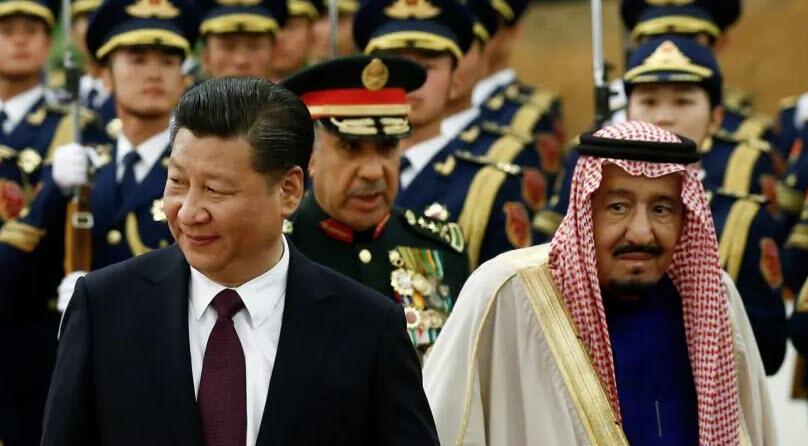
China Ready to Defeat the Dollar War Against the Saudis

by Tom Luongo via Gold, Goats, ‘n Guns blog,

Excerpts

It was announced the other day that Saudi Arabia and China are opening a $7 billion local currency swap line.

[ . . . ]

Moves that occurred 10 years ago are instructive of why we are where we are today and where we may be headed.

The announcement of the swap lines is likely a pre-announcement of an Economic Hitman-style attack on Saudi Arabia by the US. It’s not really that difficult to foresee.

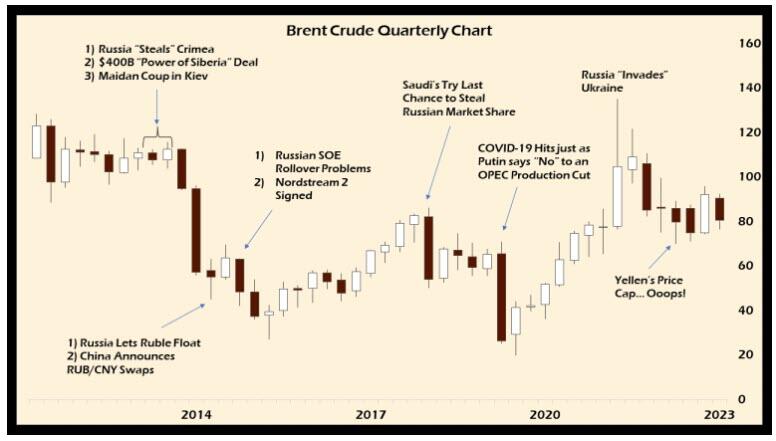
For historical context, Russia was hit hard in 2014/15 by the collapse in oil prices. In retaliation for “stealing Crimea” an attack on oil prices was organized by President Obama and the gaggle of usual suspects to trash the oil price.

In June of 2014 oil closed at $112.36. And the price began dropping the first trading day of July 2014 and didn’t stop until the end of 2015.

Saudi Arabia helped that process by expanding production, thinking they would take Russia’s market share as the Russian ruble collapsed and Russia’s foreign exchange reserves were drained.

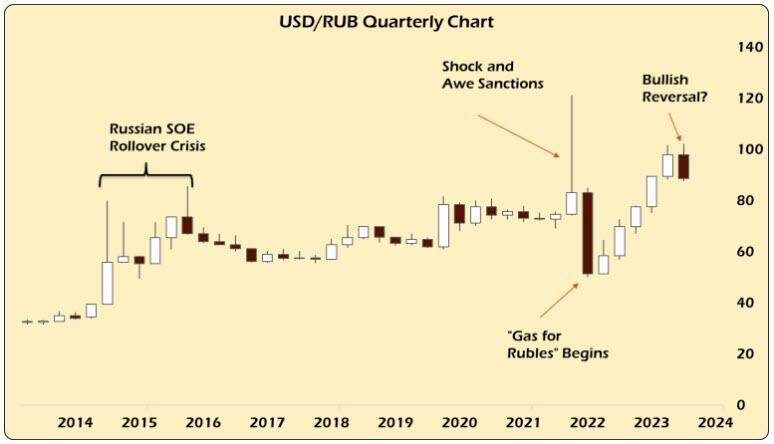
The key to the anticipated win was that Russian companies, mostly the big State Owned Enterprises like Gazprom and Rosneft, had a lot of dollar-denominated debt which was about to mature and needed rolling over. So, the US sanctioned Russia such that companies like Gazprom couldn’t roll the debt over, because they couldn’t sell the bonds to US or European investors anymore. The current bondholders had to be paid off… to the tune of north of $50 billion in Q4 of 2014, and another $50 billions in Q1 2015.

This “rollover risk” would plague the Russian government’s finances for the next 18 months as the price of oil dropped relentlessly.

The Russian ruble dropped from the high 20’s/low 30’s versus the dollar rose to a high above 80 in late November, but it only happened after Putin personally ordered Bank of Russia President Elvira Nabiullina to let the ruble float. Before that there had been a soft peg to the US dollar in place, which was easy to maintain while oil was trading above $100 per barrel.

China stepped in at the height of the ruble’s collapse to give Russia a swap line between yuan and rubles. China paid off Gazprom’s debt. Russia paid them back in yuan, which they were going to get freely because of these swap lines then and Power of Siberia in the future.

The US didn’t dare sanction China for this because of both the blowback onto our economy and would have been tantamount to declaring war. It’s also why China didn’t get even threatened with sanctions after Russia “invaded” Ukraine last year.

That sweetheart deal for the gas now flowing to them through the Power of Siberia pipeline now makes a lot more sense. Personally I had misremembered it being signed in 2015, as a response to the crisis, but it was before the crisis even broke out.

That implies a few things: 1) the combination of of events of early 2014 prompted the formulation of a coordinated attack on oil prices aimed at Russia for later that year and 2) that Putin anticipated it and opened up negotiations with Xi Jinping to get Power of Siberia built quickly.

Nearly everything that’s happened since then is downstream of the events tracing back to early 2014

Russia survived that period of ‘rollover risk’ and in doing so created the blueprint for other countries to do the same.

[ . . . ]

Et Tu, Riyal?

So, now, start thinking about what the US and Davos will do to the Saudis in a similar scenario. The Saudis have been defiant of the US’s demands to go along with US foreign policy excursions like Ukraine and Gaza while simultaneously working in tandem with Russia to keep OPEC+ together in the face of the West’s full court press to what….? Bomb the price of oil.

What most folks do not understand is that the Saudis have a similar problem today (and have had for over a decade), that while their costs of pulling oil out of the ground are extremely low, the amount of money Saudi-Aramco has to pay to the government to cover the government budget balloons that price.

[ . . . ]

Every year Thanksgiving week here in the US is marked by some kind of volatility in oil prices because OPEC+ holds their winter meeting this week every year. Thanksgiving week is a great time to screw with markets because the US is really distracted by holiday travel and logistics.

So, the other day infighting within OPEC+ by African nations including the dutiful Davos-controlled nation of Nigeria postponed the meeting and was met with a washout in oil prices.

The Saudis need/want a put under the oil price of $80 per barrel. They need that to maintain their budget (see above).

China offers the Saudis a swap line to ensure breaking the peg goes smoothly. In other words, China will loan the Kingdom dollars to be repaid in yuan, just like they did for Russia and are currently doing today for their Southeast Asian trading partners trying to defend their currencies against the Dollar’s milkshake suction.

If we look back to history with Russia and Power of Siberia guaranteeing a big flow of yuan and rubles between Russia and China, might we see something that would grease the skids of riyal/yuan flow?

[ . . . ]

This OPEC+ meeting meant [to fight against] a whole lotta schmoozing by Davos through the Biden administration to break the cartel and let the price of oil drop. It’ll be the same tired ploy as what they pulled with a willing KSA in 2014 and Trump worked them over for in 2018:

“We’re taking oil lower. Everyone else will suffer unless you pump like mad to us and we’ll reward you with increased market share in the US. After we let the price rise, you’ll be the new king.”

In the end all 2018’s attack did was finally get Crown Prince Mohammed bin Salman (MbS) to realize that the US is an unreliable and vindictive partner. He hitched the KSA’s and OPEC’s future on Putin and the Russians. He’s been rewarded for that choice to date.

The Saudis are preparing for an attack on the oil price to punish them for their lack of vision by the Neocons who never learn anything from their past failures.

Guess what? If Nigeria, Angola and Congo are hearing the sweet nothings of the West today I’d say they about to get rolled by Russia and China, but this time they will be joined by MbS and the Saudis, who are getting ready for the inevitable.

The Hidden Reasons Behind the War on Gaza (Part I)

by Richard Medhurst via: Al Mayadeen

Either the Resistance Axis and the Global South decolonize the Middle East, or “Israel” and the US will continue occupying the region, choking off the New Silk Road, plundering Syria’s oil, and keeping Russian, Iranian, and Arab gas cut off from the world market.

Illustrated by Arwa Makki; Al Mayadeen, English
Two weeks before Hamas’ Operation Al-Aqsa Flood on October 7, Netanyahu went to the United Nations General Assembly, held up a map, and declared his plan for a “New Middle East”: an economic corridor, stretching from India to the UAE, Saudi Arabia, Jordan, “Israel”, and finally to Europe.

This is one of the main geopolitical reasons behind “Israel’s” massacre in Gaza.

Link to graphic: https://english.almayadeen.net/articles/analysis/the-hidden-reasons-behind-the-war-on-gaza–part-i
The United States, “Israel’s” main backer, is desperate for a way to try and contain BRICS, and more specifically, to counter China’s New Silk Road. Building a rival corridor would hit two birds with one stone: contain China, Iran, and Syria and help “Israel” and the United States maintain economic and political dominance against a multipolar world.

It was a rough year for Washington and “Tel Aviv” as sanctions against Russia failed miserably. Saudi Arabia made peace with Iran and Syria and held talks with Yemen – countries the US and “Israel” have tried isolating for years. After seeing the US steal $300bln from Russia’s Central Bank, not only did the Dollar’s relevance begin to recede, but dozens of countries applied to join BRICS, the group of emerging economic giants, with its membership doubling from 5 to 11 members, to include Iran.

The ancient Silk Road was the most important trade route in human history, stretching all the way from China to Syria and into the Mediterranean Sea. China and 150 other countries understand its importance and seek to revive it. It is the future of world economics and politics.

In the weeks leading up to Netanyahu’s announcement, Iran and Iraq signed a railway deal, and President al-Assad of Syria visited China to sign a strategic partnership with the world’s largest economy. This is pivotal. Not only has the West failed in isolating these countries, but now the New Silk Road has expanded its rail infrastructure and obtained access to the Mediterranean Sea through Syria’s Latakia port; crucial goals for land and maritime trade.

As important as these developments are, they are just one aspect. You then have the gas.

Cutting off Russian Gas to Europe

When the United States instigated the Maidan Coup in Ukraine in 2014, it wasn’t just about NATO expansion and encirclement of Russia. It was also about surrounding, controlling, and cutting off Russian gas to Europe. Russia is the country with the largest proven reserves of natural gas. Control Ukraine and you control the pipelines that supply Russian gas to Europe.

There was, however, another major route for Russian gas into Europe, but from the north: the Nordstream pipelines.

For decades, US politicians from every administration have said repeatedly how much they dislike the Nord Stream pipelines. In 2022, before the war in Ukraine exploded, Biden delivered an ominous threat that he would “bring an end” to Nordstream – despite the pipeline being a Russian-German project, and the German Chancellor Scholz standing next to him, silently.

Then, all of a sudden, Nord Stream 1 and 2 were conveniently blown up in 2022. This remains, without question, one of the largest, most egregious terrorist attacks on European infrastructure in modern history. Only three countries in the world can pull off such an operation: Russia, Britain, and the United States– and it certainly wasn’t Russia, who owns the pipeline and had already turned the gas off anyway.

This attack, in addition to sanctions banning Russian oil and gas, made sure that no more Russian gas could flow to Europe. And just like that, the United States achieved a longstanding foreign policy objective: keep the Russians out and the Germans down.

Next objective: Iranian gas and oil

The only other country with enormous gas reserves – the second largest in the world – is Iran. The Iran Nuclear Deal was signed in 2015. Iran complied in every way, and the International Atomic Energy Agency (IAEA) couldn’t be happier. However, the United States went back on its word, reimposed sanctions on Iran, and violated the agreement. This effectively barred Iran from selling oil and gas to Europe and others.

Now with both Russia and Iran out of the picture, “Israel” suddenly proposes itself as a solution to the European Union’s gas shortages, signing a gas deal with the bloc in June 2022.

Ursula Von der Leyen, President of the EU Commission, June 14, 2022: “To break free of our dependency of Russian fossil fuels, for instance, we are now exploring ways to step up our energy cooperation with Israel […] a gas and clean hydrogen pipeline in the eastern Mediterranean.”

The Leviathan gas field

A geological survey conducted in 2010 found a monstrous gas field in the Middle East: the Leviathan, located in the Levantine Basin, off the coast of Palestine, Lebanon, and Syria.

Link to the graphic: https://upload.wikimedia.org/wikipedia/commons/8/82/Levant_Basin.png

Ultimately, Syria would not allow Western corporations to extract its gas, nor would Qatar’s ambitious oil pipeline, meant to pass through Syria, ever materialize. Coincidentally, soon after, war broke out in Syria, with Qatar and “Israel” being two of many parties funding terrorist groups to try and overthrow Damascus.

Today, the United States, who also worked to inflict harm on Syria, controls all of Syria’s oil fields, and “Israel” has bombed Syria’s most vital port, Latakia, several times. All this was done to cut off oil revenue and cripple maritime activity, including gas exploration.

‘Israel’ putting rival ports out of action

Another major port on the Levantine coast is the Beirut Port, which mysteriously exploded in 2020. Then “Israel” showed up in 2022 with an enormous vessel to try and extract gas from the Karish gas fields in Lebanon, reigniting a dispute about maritime borders with Lebanon. Only after Hezbollah threatened to fire on the ships did “Israel” back off and get the US to settle the issue on its behalf.

Gaza, a coastal enclave, also with its own unexplored gas fields, has been under an Israeli and Egyptian naval blockade since 2007. The siege and numerous wars “Israel” launched against Gaza make sure that Palestinians can’t even fish properly, let alone extract gas.

So now, with all the Lebanese, Syrian, and Palestinian ports out of action, the only working port left on the coast is the port in Haifa, controlled by “Israel”.

The hidden reasons behind the war on Gaza

This makes “Israel” the only one able to extract gas and implement an economic corridor. In other words, “Israel” and the United States killed off all the competition (Iran, Russia, Syria, Lebanon, Palestine) stole their goods, and cornered the market.

Lo and behold, while “Israel” was bombing Gaza, on October 29, it handed out 12 licenses to companies to begin gas extraction in the Leviathan basin in the Mediterranean Sea.

No stability in the region without solving the Palestinian question

As winter approaches, “Israel” desperately needs to deliver on its promise of gas to Europe. And the United States is growing desperate as BRICS and China’s Belt and Road Initiative grow ever more popular. However, there can be no stability in the region without solving the Palestinian question.

When Netanyahu announced his plan at the UN, the Israelis thought it was a done deal by getting Saudi Arabia to normalize ties, and thereby, extinguishing the Palestinian issue once and for all. But it isn’t over, and the Palestinians aren’t going anywhere.

This explains why “Israel” is slaughtering Palestinians in such a hysterical, maniacal fashion. “Israel” occupied and attacked Gaza many times before, but the current level of violence surpasses anything we’ve ever seen. “Israel” is trying to kill as many Palestinians as it can in Gaza and scare the rest into abandoning their homes and going to Egypt. A recently leaked document from the Israeli Ministry of Intelligence confirms that “Israel” is trying to ethnically cleanse Gaza by pushing Palestinians into the Sinai Desert. The United States even offered to wipe Egypt’s national debt, in exchange for allowing Palestinians to live in make-shift tents in the desert; an insulting and outrageous proposal.

Leaked document from the Israeli Ministry of Intelligence says that “Israel” is trying to push Gazans into Sinai

“Israel” seeking to push Palestinians in Gaza into the Sinai Desert and those in the West Bank into Jordan

This is genocide and ethnic cleansing without question. Hundreds of lawyers are currently trying to prosecute “Israel” at the International Criminal Court for what it is doing in Gaza – a sight reminiscent of the Nakba in 1948.

Yes, Zionism is anti-Semitic and racist, but there are also huge economic and geopolitical implications behind “Israel” and the United States’ genocide in Gaza.

When Hamas and the collective Resistance found out about Netanyahu’s plan for a “New Middle East” and Saudi Arabia’s wishes to normalize ties with “Israel”, they understood that this would destroy any hope of a Palestinian state. It forced their hand and they understood they must act immediately, or Palestine would be lost forever.

For the Palestinians, it is a matter of life and death. To be or not to be.

Either the Resistance Axis and the Global South decolonize the Middle East, or “Israel” and the United States will continue occupying the region, choking off the New Silk Road, plundering Syria’s oil, and keeping Russian, Iranian, and Arab gas cut off from the world market.

Indefatigable Palestinian People Return to Gaza for Another Fight

THE PALESTINIAN SPIRIT encapsulated in high morale of elderly Gazan man in above video, 4th time his home is leveled by IDF but he’s still full of determination to rebuild it as he sees nothing but victory against the “mighty” occupier.

I WILL BUILD A TENT AND LIVE HERE – Fiery-spirited Palestinian lady in above video stands on top of pile of rubble that was once home – flattened for the 3rd time by IDF in Gaza’s Khan Yunis – refusing to be displaced once more, she returns iron-willed to stay in tent until house is up again.

LIFE OVERCOMES DEATH in the video below from a flattened Gaza Strip on morning of truce, mothers entertain happy babies on top of massive piles of rubble, sound of their sweet laughter echoes through and spreads joy after weeks of devastation.  


The Doomed Debt-Based Western Model

Recommended: the prolific work of Prof. Michael Hudson. His early seminal work ‘Super Imperialism’ was ignored by the left (its intended audience) and instead was adopted by the CIA as a manual on how to drive its hegemony. It made him the highest paid analyst on Wall St and, among other things, he showed how the US Global Military Industrial Empire expenditure exactly mirrored the US Current Account Deficit.

Further study with Harvard Anthropology Department placed his work within a broader context and a much longer timescale, examining the history of debt and financial organization in the Ancient Near East. There autocratic rulers were established to protect the 95% from the inevitable emergence of a wealthy oligarchy who would expropriate and turn them into debt-slaves. As no economy on the planet has ever managed to grow faster than compound interest on debt, regular ‘debt jubilees’ or wiping the slate clean of private debt obligations, kept the oligarchs down and the state functioning long-term. With the population both able and willing to transfer resources to the centre for infrastructure and self-defense, the Debtors Rights were paramount, based on ability to pay.

This changed in the Hellenic and Roman Empire which provide the foundations of Western Law. Creditors Rights became paramount, and oligarchies emerged which, once they had exploited the 95%, dispossessing them and forcing them to work as serfs on their latifundia (plantations), then needed to look to move beyond the domestic frontiers.

Until eventually the oligarchs found that everyone, including the mercenaries hired to defend the Empire, hated them. So much so that the Roman Senate itself ended up supporting the so-called ‘barbarians’ to come and destroy these oligarchs.

It is no coincidence that the Western elite and their public architecture, White House, Capitol etc. mirror the creditor-based Roman Imperial models.

https://michael-hudson.com/2023/05/the-arc-of-time-pro-creditor-history/

https://michael-hudson.com/2019/06/food-blackmail-the-washington-consensus-and-freedom/

The michael-hudson.com site is a goldmine, maintained by his students, is extremely searchable using tags.

Hamas Winning Battle for Gaza

by Scott Ritter via Sputnik

The recently announced ceasefire is a blessing for Palestinians and Israelis alike—a chance for prisoners to be exchanged, humanitarian aid to be distributed to those in need, and for emotions on both sides of the conflict to cool down.

While the ceasefire, negotiated between Israel and Hamas by Qatar, was mutually agreed between the two parties, let no one be fooled into thinking this was anything less than a victory for Hamas. Israel had taken a very aggressive position that, given its stated objective of destroying Hamas as an organization, it would not agree to a ceasefire under any conditions.

Hamas, on the other hand, had made one of its primary objectives in initiating the current round of fighting with Israel the release of Palestinian prisoners, and in particular women and children, held by Israel. Seen in this light, the ceasefire represents an important victory for Hamas, and a humiliating defeat for Israel.

One of the reasons Israel eschewed a ceasefire was that it was confident that the offensive operation it had launched into northern Gaza was going to neutralize Hamas as a military threat, and that any ceasefire, regardless of the humanitarian justification, would only buy time for a defeated Hamas enemy to rest, refit, and regroup. That Israel signed on to a ceasefire is the surest sign yet that all is not well with the Israeli offensive against Hamas.

This outcome should not have come as a surprise to anyone. When Hamas launched its October 7 attack on Israel, it initiated a plan years in the making. The meticulous attention to detail that was evident in the Hamas operation underscored the reality that Hamas had been studying the Israeli intelligence and military forces arrayed against it, uncovering weaknesses that were subsequently exploited. The Hamas action represented more than sound tactical and operational planning and execution—it was a masterpiece in strategic conceptualization as well.

One of the main reasons behind the Israeli defeat on October 7 was the fact that the Israeli government was convinced that Hamas would never attack, regardless of what the intelligence analysts charged with watching Hamas activity in Gaza were saying. This failure of imagination came about by Hamas having identified the political goals and objectives of Israel (the nullification of Hamas as a resistance organization by undertaking a policy built on “buying” Hamas through an expanded program of work permits issued by Israel for Palestinians living in Gaza.) By playing along with the work permit program, Hamas lulled the Israeli leadership into complacency, allowing Hamas’ preparations for their attack to be carried out in plain view.

The October 7 attack by Hamas was not a stand-alone operation, but rather part of a strategic plan possessing three main objectives—to put the issue of a Palestinian state back on the front burner of international discourse, to free the thousands of Palestinian prisoners held by Israel, and to compel Israel to cease and desist when it came to its desecration of the Al Aqsa Mosque, Islam’s third holiest place. The October 7 attack, on its own, could not achieve these outcomes. Rather, the October 7 attack was designed to trigger an Israeli response which would create the conditions necessary for Hamas’ objectives to reach fruition.

The October 7 attack was designed to humiliate Israel to the point of irrationality, to ensure that any Israeli response would be governed by the emotional need for revenge, as opposed to a rational response designed to nullify the Hamas objectives. Here, Hamas was guided by the established Israeli doctrine of collective punishment (known as the Dahiya Doctrine, named after the West Beirut suburb that was heavily bombed by Israel in 2006 as a way of punishing the Lebanese people for Israel’s failure to defeat Hezbollah in combat.) By inflicting a humiliating defeat on Israel which shattered both the myth of Israeli invincibility (regarding the Israel Defense Forces) and infallibility (regarding Israeli intelligence), and by taking hundreds of Israelis hostage before withdrawing to its underground lair beneath Gaza, Hamas baited a trap for Israel which the government of Israeli Prime Minister Benjamin Netanyahu predictably rushed into.

Hamas has prepared a network of tunnels underneath the Gaza Stripthat, in total, stretch for over 500 kilometers. Nicknamed the “Gaza Metro,” these tunnels consist of interconnected deep underground bunkers used for command and control, logistical support, medical treatment, and billeting, along with other tunnel networks dedicated for both defensive and offensive operations. The tunnels are buried deep enough to avoid destruction by most bombs in Israel’s possession and have been provisioned to withstand a siege of up to three months (90 days) in duration.

Hamas knows that it cannot engage Israel in a classic force-on-force encounter. Instead, the goal was to lure Israeli forces into Gaza, and then subject these forces to an endless series of hit-and-run attacks by small teams of Hamas fighters who would emerge from their underground lairs, attack a vulnerable Israeli force, and then disappear back underground. In short, to subject the Israeli military to what is the equivalent of a death by a thousand cuts.

And it worked. While Israeli forces have been able to penetrate into the less urbanized areas of the northern Gaza strip, taking advantage of the mobility and firepower of its armored troops, the progress is illusory, as Hamas forces harry the Israelis continuously, using deadly tandem-warhead rockets to disable or destroy Israeli vehicles, killing scores of Israeli soldiers and wounding hundreds more. While Israel has been reticent in releasing the figures of armored vehicles lost in this fashion, Hamas claims the number is in the hundreds. Hamas’ claims are bolstered by the fact that Israel has halted the sale of older Merkava 3 tanks, and instead has organized their inventory of these vehicles into new reserve armor battalions to make up for the heavy losses being sustained in both Gaza and along the northern border with Lebanon, where Hezbollah forces are engaged in a deadly war of attrition with Israel in operations designed to support Hamas in Gaza.

But the main reason for Israel’s defeat to date is Israel itself. Having taken the bait, and fallen into the Hamas trap, Israel went on to execute its Dahiya Doctrine against the Palestinian population of Gaza, carrying out indiscriminate attacks against civilian objects in blatant disregard for the law of war. An estimated 13,000 Palestinian civilians have been killed by these attacks, including more than 5,000 children. Many thousands more victims remain buried under the rubble of their destroyed housing.

While Israel may have been able to garner the support of the international community in the aftermath of the October 7 attack by Hamas, its gross overreaction has instead turned world public opinion against it—something Hamas was counting on. Today, Israel is increasingly isolated, losing support not only in the so-called Global South, but also in traditional strongholds of pro-Israeli sentiment in the US, UK, and Europe. This isolation, combined with the kind of political pressure Israel is unaccustomed to receiving, helped contribute to the Netanyahu government’s acquiescence regarding the ceasefire and subsequent prisoner exchange.

Whether the ceasefire will hold or not remains to be seen. So, too, the question of turning the ceasefire into a lasting cessation of hostilities remains an open question. But one thing is certain—having declared that victory is defined by Hamas’ total defeat, the Israelis have set the stage for a Hamas victory, something Hamas achieves simply by surviving.

But Hamas is doing more than surviving — it is winning. Having fought the Israel Defense Forces to a standstill on the battlefield, Hamas has seen every one of its strategic objectives in this conflict reach fruition. The world is actively articulating the absolute necessity of a two-state solution as a prerequisite for a lasting peace in the region. Palestinians held prisoner by Israel are being exchanged for the Israelis Hamas took hostage. And the Islamic world is united in condemning Israel’s desecration of the Al Aqsa Mosque.

None of these issues were on the table on October 6. That they are being addressed now is testament to the success Hamas enjoyed on October 7, and in the days and weeks that followed, as Israeli forces were defeated by a combination of Hamas’ tenacity and their own predilection for indiscriminate violence against civilians. Far from being eliminated as a military and political force, Hamas has emerged as perhaps the most relevant voice and authority when it comes to defending the interests of the Palestinian people.

Israel’s Darkest “Hour” Can Last Years

by Amarjit Singh Dulat via RT
Amarjit Singh Dulat is a former head of the Research and Analysis Wing (R&AW), India’s external intelligence agency. After retirement, he was appointed adviser on Kashmir in the Prime Minister’s Office and served there from January 2001 to May 2004. He authored several books, including “Kashmir: The Vajpayee Years”, published in 2015.

Every Palestinian killed by the IDF is a martyr to rile up the Arab world

Not since the founding of Israel in 1948 had Tel Aviv suffered as audacious an assault on its soil as the one carried out by the Palestinian Islamist militant group Hamas on October 7, which was more shocking than the Yom Kippur War of 1973.
The fact that Hamas had planned such a massive assault by land, sea and air and managed to avoid detection points to a massive intelligence failure by Israel.

Hamas appeared to have better knowledge about goings-on inside the country than the famed Israeli intelligence agency Mossad did about what was happening in Gaza. Israel’s Prime Minister, “Mr. Security” Benjamin Netanyahu, has certainly suffered a blow from which he may not be able to recover in the long run.

When Netanyahu came to power for the third time last December with the support of the country’s right-wing parties, both serving and retired Israeli Army generals expressed apprehension that such a coalition could lead to civil war in the country. That has not happened so far, but the division and months of protests against Netanyahu’s policies certainly emboldened Hamas to carry out its lightning strikes.

The very fact that Israel had to formally declare war was a morale booster for Hamas, which has been at war with the Jewish state ever since its inception when the first intifada, or Palestinian uprising, started in Gaza in December 1987. The world may be shocked by the unspeakable cruelty of the October attack by Hamas, but the Palestinian group is most likely proud of its accomplishment.

The fact that thousands of Palestinian civilians have lost their lives in the conflict probably doesn’t worry Hamas too much. They are likely to be declared martyrs – and when you are prepared to die for your cause, you are automatically bigger than your enemy. As of now, Palestinian authorities say they’ve lost count of the dead, but it’s above the 11,000 mark, of which well over half are believed to be women and children.

Efraim Halevy, whose career as the ninth Mossad director stretched from 1998 to 2002, urged caution as Israel stepped out to destroy Hamas. He warned that while Israel was entering a heightened state of emergency, the reservists were within their rights to refuse to serve in protest against PM Netanyahu’s planned judicial reforms.

Halevy, who was a confidant of the assassinated Israeli PM Yitzhak Rabin and played a key role in the Israel-Jordan peace treaty in October 1994, has always been in favor of negotiating with Hamas. He has consistently maintained that Hamas could neither be demolished nor wished away. Halevy, a nephew of the 20th century philosopher Isaiah Berlin (1909-1997), refused to accept Netanyahu as the leader of the country. Israel’s security chiefs also realize that destroying Hamas is beyond their abilities. As Israeli journalist and author Gideon Levy said, violence will never end Israeli problems.

Not much is known about the internal workings of Hamas, which remains extremely secretive. What is known, however, is that its goals are retaliation against Israel and its punishment, as well as the freeing of Palestinians languishing in Israeli jails. However, one of the key objectives of the October Hamas attack was the scuttling of the Abraham Accords, diplomatic normalization roadmaps signed between Israel and the Arab world in 2020 and brokered by the US.

Palestine remains a key sensitive issue in the Arab world. Even before the October 7 attacks and the ongoing retaliation, hostilities had been growing between Israel and the West Bank, particularly at the Al-Aqsa Mosque in Jerusalem, the third holiest site in Islam, where Palestinians are regularly assaulted and mistreated by the Israeli security forces. Issues like the killing of Al Jazeera journalist Shireen Abu Akleh by Israeli forces have kept widespread resentment simmering.

The Arab countries immediately banded together following Israel’s indiscriminate bombing of Gaza. Even Queen Rania of Jordan has accused the West of war crimes. The conflict has also brought together Muslims elsewhere in the world. Hamas takes pride in representing the Palestinian cause and considers itself as a growing power in the Arab world.

During his whirlwind trip to Israel soon after the start of the war, US President Joe Biden appealed to the Israelis not to be “consumed” by rage in response to the attack by Hamas. Even if this never translated into him making any attempt to restrain Israel’s actions, the US president knows what he is talking about. After the September 11, 2001 terrorist attacks, Washington launched wars in Afghanistan and Iraq, which turned out to be massive blunders. More than 30,000 US troops took their own lives after serving in Iraq and Afghanistan, over three times the number killed in battle.

The social wreckage caused by the wars the US fought after 9/11 led to the rise of President Donald Trump in 2016. An extended conflict in the Middle East may help him return to power in next year’s US presidential elections.

The current Israel-Hamas war has all the makings of such a long-term conflict – or a new, long-term stage of a conflict that has been simmering and flaring up for decades. In the past few weeks, Israel has claimed the killing of three Hamas commanders. In Afghanistan, too, the West kept claiming that it had killed Taliban commanders but fresh faces kept emerging. The US went into Afghanistan in 2001 with the goal of toppling the Taliban, but when they left 20 years later, the Taliban took power, more powerful than ever. Hamas, too, may end up more powerful 20 years from now.

Political issues cannot be swept under the carpet and must be dealt with politically. Governments around the world proclaim that they will never negotiate with evil. And yet they always have and always will, most of all Israel. No conflict, however bloody, ancient or difficult, is unstable.

Most recently, Israel and Hamas have struck a hostage release agreement, under which 50 people abducted during the October 7 attack will be released during a four-day humanitarian pause.

Key to that deal was the mediation by Qatar, an ally of the US and in a sense, the conscience-keeper of the Arab world. In the past, Doha had worked out the deal with the Taliban and helped US forces move out of Afghanistan before the Taliban arrived. More recently, Qatar was instrumental in a prisoner swap between the US and Iran.

After the four-day pause, the IDF has vowed to continue its attacks on Gaza, but if a longer-term peace deal is to be achieved, Qatar is likely going to play a vital role in it.

The US has always supported Israel, but has no great respect for PM Netanyahu. Biden has been disappointed that Netanyahu went back on the 1993 Oslo Accords and reneged on the two-state formula to resolve the Palestinian issue. Today, the Oslo Accords are long dead and may no longer be relevant.

The great Palestinian thinker, Edward Said (1935-2003) always saw the fate of Jewish and non-Jewish inhabitants of Palestine inextricably linked. We need to listen to Said today.

British Humor

“Stand behind the yellow line, please. The next train will be here soon. Could the passenger with the juicy melons please step away from the yellow line? Passenger with juicy melons, please step away from the yellow line”: A fruit and vegetable incident on the London Underground.

It’s such a form of British real-life humor, yes.


The US is Leading its Allies into Collapse

Uncritical support for the American stance on the Israel-Hamas war will prove to be some Western governments’ downfall

by Graham Hryce via RT
Graham Hryce is an Australian journalist and former media lawyer, whose work has been published in The Australian, the Sydney Morning Herald, the Age, the Sunday Mail, the Spectator and Quadrant.

Rishi Sunak’s Conservative Party is on the verge of splitting, as yet another political crisis has engulfed Britain – and over the past few weeks it has become apparent that major political parties in the West are paying a heavy price for uncritically supporting America’s latest proxy conflict in Palestine.

Prime Minister Sunak sacked Home Secretary Suella Braverman because she sought to ban pro-Palestinian protest marches. Her disagreement with the PM over this issue came hard on the heels of serious disagreements between them over other “culture war” issues, namely immigration policy and multiculturalism.

Sunak’s dismissal of Braverman and his appointment of David Cameron (now Lord David) as Foreign Secretary were desperate and ill-judged acts, of the kind to be expected from a fourth-rate politician like Sunak.

Braverman has not gone quietly. Her resignation letter accuses Sunak of incompetence, treachery and lack of principle, amongst other failings, and some Conservative MPs have already fired off letters to the 1922 Committee expressing their lack of confidence in Sunak.

The prime minister’s extraordinary decision to bring back Cameron from his richly deserved political exile simply beggars belief.

Cameron created the entire Brexit debacle, led the unsuccessful Remain campaign, helped turn Libya into a failed state, and was hell bent on invading Syria until the UK parliament stopped him. Since petulantly retiring from politics after the Brexit referendum succeeded, he has occupied his time by getting involved in shady financial deals.

Peter Hitchens, the conservative commentator, described Sunak’s actions as “an open declaration of defeat and purposelessness” – and journalist John Crace characterised Sunak and the Conservatives as “a Prime Minister and a government in a death vortex”.

Surely Sunak cannot remain prime minister for much longer, and a split within the Conservative Party now seems inevitable – with Braverman and her right-wing supporters leaving the party at some point to perhaps join forces with Nigel Farage and the Reform Party to form a new Trump-like populist movement.

Nor has Kier Starmer’s Labour Party escaped unscathed from the acute emotive divisiveness engendered by the Israel-Palestine conflict that has torn the Conservative party apart over the past week.

Starmer has had to endure a revolt from 56 of his MPs (including a number of shadow cabinet members) who strongly disagree with his unwavering support for America’s refusal to accept an immediate ceasefire in Gaza.

These Labour MPs openly defied their leader, and voted in the House of Commons in favour of a failed motion brought by the Scottish National Party (SNP) – yet another major UK party recently rent asunder by internal divisions and corruption – calling for an immediate ceasefire in Gaza.

In Australia, bitter political divisions have also emerged over the conflict in Palestine, with Prime Minister Anthony Albanese’s Labor government deeply divided over the ceasefire issue (even though it formally supported America’s opposition to a truce) and coming under concerted attack from the conservative opposition parties, who uncritically support America’s position on Gaza.

The opposition has branded Labor politicians who have called for a ceasefire as antisemites, and insisted that pro-Palestinian protest marches – there have been many in major Australian cities over the past few weeks – be banned.

PM Albanese, who won an election in May last year, now finds himself in charge of a fractured government that appears increasingly unlikely to win a second term in office.

There seems to be a very strict correlation between craven support for American foreign policy and political incompetence amongst politicians in the West.

Similar bitter political divisions, accompanied by mass pro-Palestinian protest marches, have emerged recently in most Western countries, including America – and Germany, France, Austria and Hungary have now banned pro-Palestinian rallies altogether.

It is a curious circumstance that purportedly liberal democratic governments that uncritically support America’s foreign proxy conflicts find themselves curtailing free speech and the right to protest in their own countries.

Be that as it may, it is clear that the Hamas terrorist attacks on 7 October, and the Netanyahu government’s ongoing response to them, have deeply destabilised Western democracies and exacerbated deep-seated, pre-existing ideological and political divisions within them.

How has this self-destructive political chaos come about?

Palestine, unfortunately, has now become a classic “culture war” issue in the West, as a result of almost all Western governments uncritically supporting the blank cheque that the Biden administration has given to Prime Minister Netanyahu’s right-wing coalition government in respect of Gaza.

Rational debate on the topic has become virtually impossible in the West, with both sides hurling emotive charges of ”antisemitism” (redefined so as to encompass any support for the Palestinian cause or any criticism of Netanyahu’s actions) and “genocide” at each other, whilst at the same time ignoring the complex historical context that gave rise to the current phase of the conflict.

In fact, when the UN secretary general recently pointed out that the October 7 attacks had an historical background – a demonstrably true statement – the Israeli Ambassador to the UN demanded that he be sacked immediately. So much for rational debate.

It is inevitable that a ceasefire in Gaza will have to take place, and a political settlement will have to be negotiated at some point. It is most unlikely, however, that the Netanyahu government will be in power long enough to negotiate such a settlement.

Recent polls in Israel show that support for Netanyahu is collapsing, and media outlets within Israel that previously supported him are now calling for him to step aside – not only because he failed to prevent the Hamas terrorist attacks on October 7, but because he has no realistic strategy for negotiating a peaceful resolution to the conflict.

Former Israeli prime minister Ehud Olmert – who, unlike Netanyahu, is committed to a two-state solution to be negotiated between the Palestinian Authority and the Israeli government – said recently in an interview with ABC in Australia that Netanyahu “has to be fired… he is not fit to govern, and has no strategy to work towards peace”.

Olmert – who is a fierce opponent of Hamas – has accused Netanyahu of empowering the militant group since becoming prime minister by refusing to negotiate with the Palestinian Authority – on the grounds that Netanyahu, just like Hamas, refuses to accept that a negotiated settlement between Israel and the Palestinians is possible.

Olmert has also condemned Netanyahu for refusing to distinguish between Hamas terrorists and innocent civilians in Gaza, and causing international support for Israel (he means in the West because such support does not exist elsewhere) to rapidly dissipate since the October 7 terrorist attacks.

Olmert’s criticisms of Netanyahu are substantially correct. Members of Netanyahu’s government have recently stated that Israel intends to occupy Gaza after the present conflict ends, and that the two million Palestinians that reside in Gaza should be driven out of the territory.

And behind this unedifying global spectacle stands a bloated and declining American empire, still committed to promoting proxy foreign conflicts – notwithstanding the debacles it has created in Iraq, Afghanistan, Libya and Syria in recent decades.

Major Western political parties and politicians now have a clear choice: they can stop uncritically supporting America’s disastrous proxy foreign wars, or risk being torn apart by the bitter internal conflicts that such ill-judged backing inevitably gives rise to.

President Macron of France is the only Western leader who seems to appreciate this.

Recently Macron bravely called for an immediate ceasefire in Gaza, and strongly condemned Netanyahu’s ongoing killing of innocent civilians and blatant disregard for international and humanitarian law.

Whether or not other political leaders in the West will have the courage and intelligence to heed President Macron’s example is extremely doubtful. But events in the UK last week make perfectly clear the fate that awaits those politicians who refuse to do so.

How Israel Lost All Credibility

by Ramzy Baroud and Romana Rubeo via Antiwar

On Saturday, November 11, Israeli military spokesman Daniel Hagari claimed in a press conference that Israel had killed a “terrorist” who had prevented 1,000 civilians from escaping the Shifa Hospital.

The allegations made little sense. Even by the standards of Israeli propaganda, falsifying such a piece of information while providing no context and no evidence, further contributes to the deteriorating credibility of Israel in international media and image worldwide.

Just one day earlier, an unnamed US official was cited by CNN as saying, in a diplomatic cable, “we are losing badly on the messaging battlespace”.

The diplomat was referring to American reputation in the Middle East – in fact, worldwide – which now lies in tatters due to blind American support for Israel.

Roles Reversed

This credibility deficit can be witnessed in Israel itself. Not only is Israeli Prime Minister Benjamin Netanyahu losing credibility among Israelis, according to various public opinion polls, but the entire Israeli political establishment seems to be losing the trust of ordinary Israelis as well.

A common joke among Palestinians these days is that Israeli leaders are emulating Arab leaders in previous Arab-Israeli wars, in terms of language, phony victories and unsubstantiated gains on the military front.

For example, while Israel was quickly pushing Arab militaries back on all fronts in June 1967, with full US-Western backing, of course, the leadership of Arab armies were declaring through radio that they had arrived at the “gates of Tel Aviv”.

Fortunes seem to have been reversed. Abu Obeida and Abu Hamza, military spokesmen for the Al-Qassam Brigades and the Al-Quds Brigades respectively, provide very careful accounts of the nature of the battle and the losses of advancing Israeli military forces in their regular, much-anticipated statements.

The Israeli military, on the other hand, speaks of impending victories, killing of unnamed “terrorists” and destruction of countless tunnels, while rarely providing any evidence. The only “evidence” provided is the intentional targeting of hospitals, schools and civilian homes.

And, while Abu Obeida’s statements are almost always followed by well-produced videos, documenting the systematic destruction of Israeli tanks, no such documentation substantiates Israeli military claims.

Beyond the Battlefield

But the issue of Israeli credibility, or rather, the lack of credibility, is not only taking place on the battlefield.

From the first day of the war, Palestinian doctors, civil defense workers, journalists, bloggers and even ordinary people filmed or recorded every Israeli war crime anywhere and everywhere in the besieged Strip. And, despite the continuous shutting down of the internet and electricity in Gaza by the Israeli military, somehow, Palestinians kept track of every aspect of the ongoing Israeli genocide.

The precision of the Palestinian narrative even forced US officials, who initially doubted Palestinian numbers, to finally admit that Palestinians were telling the truth, after all.

Barbara Leaf, assistant Secretary of State for Near Eastern Affairs, told a US House panel on November 9 that those killed by Israel in the war are likely “higher than is being cited.”

Indeed, every day, Israel loses credibility to the point that the initial Israeli lies of what had taken place on October 7, eventually proved disastrous to Israel’s overall image and credibility on the international stage.

Rape, ISIS, and Mein Kampf

In the euphoria of demonizing the Palestinian Resistance – as a way to justify Israel’s forthcoming genocide in Gaza – the Israeli government and military, then journalists and even ordinary people, were all recruited in an unprecedented hasbara campaign aimed at painting Palestinians as “human animals” – per the words of Israeli Defense Minister Yoav Gallant.

Within hours of the events and, before any investigation was conducted, Netanyahu spoke of “decapitated babies”, supposedly mutilated at the hands of the Resistance; Gallant claimed that “young girls were raped violently”; even former military chief rabbi, Israel Weiss, said he had “seen a pregnant woman with her belly torn open and the baby cut out.”

Even the supposedly ‘moderate’ Israeli President Isaac Herzog made ludicrous statements on the BBC on November 12. When asked about Israeli airstrikes on Gaza, Herzog claimed that the book Mein Kampf, written by Adolf Hitler in 1925, was found “in a children’s living room” in northern Gaza.

And, of course, there were the repeated references to the ISIS flags that, for some reason, were carried by Hamas fighters as they entered southern Israel on October 7, among other fairy tales.

The fact that ISIS is a sworn enemy of Hamas and that the Palestinian Movement has done everything in its power to eradicate any possibility for ISIS to extend its roots in the besieged Gaza Strip seemed irrelevant to Israel’s unhinged propaganda.

Expectedly, Israeli, US and European media repeated the claim of the Hamas-ISIS connection, with no rational discussion or the minimally-required fact-checking.

But, with time, Israeli lies were no longer able to withstand the pressure of the truth emanating from Gaza, documenting every atrocity and every battle, and obfuscating any drummed-up Israeli allegations.

Perhaps, the turning point of the relentless series of Israeli lies was the attackon the Al-Ahli Baptist Hospital in Gaza City on October 17. Though many adopted, and still, sadly, defend the Israeli lie – that a Resistance rocket fell on the hospital – the sheer bloodiness of that massacre, which killed hundreds, was, for many, a wake-up call.

One of the many questions that arose following the Baptist Hospital massacre is: If Israel was, indeed, honest about its version of events regarding what took place at the hospital, why did it bomb every other hospital in Gaza and continues to do so for weeks?

Israeli Hasbara Canceled

There are reasons why Israeli propaganda is no longer able to effectively influence public opinion even though mainstream media continues to side with Israel, even when the latter is committing a genocide.

Firstly, is that Palestinians and their supporters have managed to ‘cancel’ Israel using social media which, for the first time, overwhelmed the organized propaganda campaigns often engineered on behalf of Israel in corporate media.

An analysis of online content on popular social media platforms was conducted by the Israeli influencer marketing platform, Humanz. The study,published in November, admitted that “while 7.39 billion posts with pro-Israeli tags were published on Instagram and TikTok last month, in the same period 109.61 billion posts with pro-Palestinian tags were published on the platforms.” This, according to the company, means that pro-Palestinian views are 15 times more popular than pro-Israeli views.

Secondly, independent media, Palestinian and others, offered alternatives to those seeking a different version of events to what is taking place in Gaza.

A single Palestinian freelance journalist in Gaza, Motaz Azaiza, has managed to acquire more than 14 million followers on Instagram over the course of a single month because of his reporting from the ground.

Thirdly, the ‘surprise attack’ of October 7 has deprived Israel of the initiative, not only regarding the war itself, but also the justification for the war. Indeed, their genocidal war on Gaza has no specific objectives, but also has no precise media campaign to defend or rationalize these unspecified objectives. Therefore, the Israeli media narrative appears disconnected, haphazard and, at times, even self-damaging.

And, finally, the sheer brutality of the Israeli genocide in Gaza. If one is to juxtapose Israeli media lies with the horrific Israeli crimes committed in Gaza, one would find no plausible logic that could convincingly justify mass murder, displacement, starvation and genocide of a defenseless population.

Never has Israeli propaganda failed so astoundingly and never has the mainstream media failed to shield Israel from the global anger – in fact, seething hatred – for Israel’s ugly apartheid regime. The repercussions of all of this will most certainly impact the way that history will remember the Israeli war on Gaza, which has, so far, killed, and wounded tens of thousands of innocent civilians.

A whole generation, if not more, has already built a perception of Israel as a genocidal regime and no number of future lies, Hollywood movies or Maxim Magazine spreads will ever lessen that in any way.

More importantly, this new perception is likely to compel people, not only to re-examine their views of Israel’s present and future, but of the past as well – the very foundation of the Zionist regime, itself predicated on nothing but lies.

Dr. Ramzy Baroud is a journalist, author and the Editor of The Palestine Chronicle. He is the author of six books. His latest book, co-edited with Ilan Pappé, is Our Vision for Liberation: Engaged Palestinian Leaders and Intellectuals Speak Out. His other books include My Father was a Freedom Fighter and The Last Earth. Baroud is a Non-resident Senior Research Fellow at the Center for Islam and Global Affairs (CIGA). His website is www.ramzybaroud.net.

Romana Rubeo is an Italian writer and the managing editor of The Palestine Chronicle. Her articles appeared in many online newspapers and academic journals. She holds a Master’s Degree in Foreign Languages and Literature and specializes in audio-visual and journalism translation.

After Its Failing Diplomacy in SF, China Turns to Russia

Algora Analysis:

Having failed to persuade the Biden neocon team of the disastrous consequences of the policy of confrontation, President Xi returns to China and reaffirms his commitment to stand firmly by President Putin in the unfolding confrontation with the West. In response, Putin welcomes Xi, in a way reminding him: “I told you so”.

This set of unexpected events, Xi’s sudden visit to the US and his big effort to overcome the breakdown of the relationship with the US appears to be a last ditch effort to convince the US’s political leadership of their wrong path of enmity and invite the American business leaders to share in the fruits of cooperation, rather than confrontation. He resolutely failed. His last meeting with President Biden ended on a deeply negative note given that at a wrap-up press conference Biden called Xi a “dictator” in response to a reporter’s question.

Most likely however was the demand from the US that China accepts American rule and follows the sanctions imposed on Russia and Iran, defers to Israel genocide in Gaza and in general toes the US line as events develop. However, it could be inferred that Xi demurred to subscribe to American demands and was left with some unfriendly words of advice in the sense that China is now in uncharted waters at its own peril. What followed was a public kabuki theater when Biden answered a prearranged question, while cameras were focusing on the facial expression of Blinken. – Should Xi reconsider his refusal, it was an easy way out, as Biden’s gaffe could be explained as the old man’s dementia and not the US policy.

Some of Xi’s words given before US CEOs on foreign investment in China certainly suggested that Beijing is ready for a reset. Below is a section of Xi’s speech.

This part of Xi’s speech to US CEOs (full speech here) is interesting and worth reflecting on: “The number one question for us is: are we adversaries, or partners? This is the fundamental and overarching issue. The logic is quite simple. If one sees the other side as a primary competitor, the most consequential geopolitical challenge and a pacing threat, it will only lead to misinformed policy making, misguided actions, and unwanted results. China is ready to be a partner and friend of the United States,” President Xi began, and continued…

“The fundamental principles that we follow in handling China-U.S. relations are mutual respect, peaceful coexistence and win-win cooperation. Just as mutual respect is a basic code of behavior for individuals, it is fundamental for China-U.S. relations. The United States is unique in its history, culture and geographical position, which have shaped its distinct development path and social system. We fully respect all this.”
“The path of socialism with Chinese characteristics has been found under the guidance of the theory of scientific socialism, and is rooted in the tradition of the Chinese civilization with an uninterrupted history of more than 5,000 years. We are proud of our choice, just as you are proud of yours. Our paths are different, but both are the choice by our peoples, and both lead to the realization of the common values of humanity. They should be both respected.”
“Peaceful coexistence is a basic norm for international relations, and is even more of a baseline that China and the United States should hold on to as two major countries. It is wrong to view China, which is committed to peaceful development, as a threat and thus play a zero-sum game against it. China never bets against the United States, and never interferes in its internal affairs. China has no intention to challenge the United States or to unseat it. Instead, we will be glad to see a confident, open, ever-growing and prosperous United States.
“Likewise, the United States should not bet against China, or interfere in China’s internal affairs. It should instead welcome a peaceful, stable and prosperous China.”

In short, he essentially argued against self-fulfilling prophecies, making the point that one’s view on the other defines the actions towards them, which in turn often validates the biased view even though it might have been wrong. As such the question “are we adversaries, or partners?” has no correct answer: if the US views China as an adversary it will lead them to “misinformed policy making [and] misguided actions”, which in turn will produce “unwanted results”, i.e. turning China INTO an adversary when it needn’t be.

[ . . . ]

Having failed in the US, now the Chinese President Xi Jinping has hailed “firm” ties between China and Russia just days after his trip to San Francisco.

Xi said that positive Russia ties will “inject more stability into the world,” according to China Central Television. He affirmed that Beijing stands ready to work with Moscow “resolutely” on bilateral relations and building a permanent friendship.

In response, President Putin sent Xi a congratulatory letter marking the 10th meeting of the dialogue mechanism between the ruling parties of China and Russia, per Bloomberg.

Xinhua summarized Putin’s letter as follows:

Putin said in his congratulatory letter that the Russia-China comprehensive strategic partnership of coordination is at the highest level in history, and the two countries are working together to advance a number of large-scale cooperation projects in the fields of economy, transportation, energy and culture, among others.
 
The two countries are coordinating positions through bilateral channels and multilateral mechanisms such as the Shanghai Cooperation Organization and BRICS to resolve major international issues and promote the building of a more just and democratic international order.

Are we now going to see a more concerted action by Russia and China concerning the Middle East? Is this the moment of the direct cofruntation between the emerging axes of rivalry, the Western Axis lead by the US, Europe and Israel on the one hand and Russia, China, Iran and the Global South, on the other hand? Quite possible.