Very Bleak Assessment of Russia’s Prospects by Igor Strelkov

IGOR STRELKOV /letter fragment/ (machine translation)

Of course, I was extremely worried about the messages about the events of the first half of January, which were sent to me on the 15th-16th (before that there was no mail for over two weeks). On the one hand, nothing unexpected happened – all the actions of recent “partners” and “friends” were predicted in advance. On the other hand, it is one thing to talk about the inevitability of a “volcanic eruption”, and quite another to “get caught in it”… Analytical “foresight” is of little help here, if there are no means to correctly and promptly respond to the “elements” (and I have not had and do not have anything like that, unfortunately).

So, on to the main news:

— I consider the most important news to be that China has shown its readiness to comply with US sanctions against our tanker fleet (blocking 5 tankers with Russian oil in Chinese territorial waters). It has been clear to me for a long time that China is far from supporting Russia in the current NWO and (at best) was ready to “benevolently tolerate” all the inconveniences associated with it for some time. It has also been clear for a long time that “China’s patience” in connection with the said inconveniences is either running out or has expired completely: the SMO has lasted for almost three years, and Russia’s victory (and the end of the military conflict on terms that suit Moscow) is not even on the horizon. Accordingly, Beijing is demonstrating its irritation and “transparently hinting” to Moscow that “it’s time to end it on any terms, otherwise…” It is not clear to me how to “get out” of this wonderful situation (having only North Korea as an ally). Especially considering that society is not mobilized at all, and is already very tired of the war and does not feel any enthusiasm for its further continuation.

However, Moscow is somehow unable to leave the SMO “under any conditions” (as they already tried to do in 2022 during the so-called “Istanbul agreements”). – I think I wrote somewhere before that the situation is almost like the joke about the hunter who climbed into the bear’s den: – “Kum! I caught a bear here!” – “Then drag him here!” – “I can’t – he’s holding me!” Kyiv will not submit to “Russian conditions” (i.e., the separation from “Ukraine” of not only Crimea and Donbass, but also Zaporozhye and Kherson) now (while its front is generally strong). It is even doubtful that it will “agree to the loss” of Donbass and Crimea. But how – even if Zelensky (suddenly) agrees to “make a deal” – how to “foist” on the Russians the return to the so-called “Ukraine” of the Kherson and Zaporizhia regions, already constitutionally annexed to the Russian Federation – I can’t imagine. No, of course, with certain propaganda efforts, the majority of the populace (under the slogan “as long as there is no war”) will “swallow” this, too, but two problems remain: 1) How will the army react to this? 2) (This is most important) Who will guarantee that – having occupied the south of the said regions, the “Kyiv partners” will not immediately “spit” on these very guarantees? – Personally, I believe that this is the only way it will be, and, as they say, “further everywhere”. The worst thing for “conditional Moscow” is for the population not to understand (in the indicated scenario) that: a) we lost the war; b) the war, although lost, is not over, “not even for now”. And that, in all likelihood, is how it will be, if we do not radically change our own (I emphasize) attitude to this very SVO and the confrontation with NATO / USA / the West as a whole.

In general, sitting in the Penal Colony, it would be difficult for me to give any recommendations on how to “return the favor of the Celestial Empire” – to develop such recommendations, I need a deep and comprehensive immersion in the history and practice of interstate relations for about 15 years (and this is the “very minimum”). Unfortunately, no one will give me such an opportunity in the near future. And without further at least “friendly neutrality” of China, the continuation of large-scale military actions seems very problematic to me. Well, unless we undertake (suddenly – with a delay of 3 years) sharp, fast and (most importantly) successful “super-efforts”. Which the Kremlin categorically did not want to undertake for the past 10 years.

Whether “crawling to Beijing on my knees and back” with the aim of “begging to wait a little longer” will produce any effect – I honestly don’t know – I’m not competent enough. Although I would probably “humble my pride and crawl – not for the sake of vanity, but for Russia.”
Very briefly – the situation at the front:

Our purely tactical successes (important only on the scale of Donbass, and not on the scale of the strategic goals of the SMO) are NO MORE THAN UNPLEASANT for the enemy: “Have they surrendered Kurakhovo and Toretsk? – so what… Will they surrender Pokrovsk / Krasnoarmeysk? – Also, as they say, “not a great loss.” – These are not even prerequisites for the Ukrainian Armed Forces to begin to fall apart and “open the front.” The enemy’s slow and organized retreat in the south of the DPR only shortens the front line, and is very “expensive” (for our troops). At this rate, we can “crawl” “to the Dnieper” for another 5-10 years. What am I getting at? – Because the enemy does not consider these territorial losses as something “irreparably important.” He continues to “trade territory for time” in Donbass, implementing the enemy strategy of “wearing down Russia”, drawn up for Kyiv from NATO headquarters. In the areas that are truly important to the enemy (Kharkov, Kursk, etc.), the Ukrainian Armed Forces are “hanging on by the skin of their teeth” and our offensive there is not even “crawling”, but frankly “stalling”. At the same time, we (with the persistence of clinical idiots) continue to “grind down in meat storms” those who are still (by the end of the 3rd year of the war!) still capable of moving forward in them and even winning at the cost of their lives (at least – health). But this is not an endless resource! Instead of “spending” it on a real breakthrough / breakthroughs of the enemy front with strategic goals – we generously “flood with blood” patches of land, “unknown heights”, forest belts and villages in areas that are purely secondary even for the enemy. And at the same time, he is accumulating his new strategic reserves for the spring…

I. V. Girkin
17.01.2025

How To Stop The BRICS Nations From Abandoning The Dollar

Authored by Patrick Barron via The Mises Institute,

The US government is aghast that there is a new grouping of nations that seeks to form an alternative to the US trade bloc and trade settlement system that uses the dollar. These nations have been driven to this extreme, time-consuming, and difficult project by clueless US leaders who have imposed sanctions on Russian assets (literally stealing them) and have denied Russia and other nations from using the SWIFT messaging system for trade settlement.

In this way, the US hopes to preserve the dollar’s premier status as the world’s reserve currency and its world leadership based upon the dollar and its military might.

I have a better, cheaper, and more peaceful way to accomplish these US goals (i.e., remove every incentive to leave). It’s as simple as that. At a minimum that means preserving the purchasing power of the dollar and ending the policy of confiscating the assets of other nations, even those with whom the US has serious disputes.

In other words, end coercion and begin real world leadership based on trust and fair dealing.

This will be a tall task, because what nation today would believe in America’s honesty, integrity, and commitment to international law? Nevertheless, it is the only way that the American-led West can find its place in a new world.

There is a new world coming and the US must be a part of it if it wishes to prosper well into the future and not just through the current election cycle.

Here’s a short list of actions that the US should consider adopting:

  1. Return all stolen assets to Russia and other nations.
  2. End blackballing Russia and other nations from using the SWIFT trade messaging system.
  3. Turn the ownership and running of SWIFT to neutral hands, perhaps the Swiss or some combination of nations that cannot be sanctioned by America.
  4. Stop inflating the dollar, which of course is the main cause of its loss of purchasing power, in order to balance an out-of-control budget.
  5. Return all gold held in American vaults (the New York Fed/Fort Knox) to its rightful owners as quickly as possible.
  6. Place the dollar on a true gold standard by shipping American gold to neutral hands where it can be exchanged on demand for dollars. In other words, make the dollar “as good as gold.” (This is the most difficult and contentious action, but it is the only way that the world will accept dollars in the future when there is an alternative through membership in BRICS.)

American attempts to preserve its leadership status in the world will fail unless it enacts reforms such as these, which really are nothing more than behaving in a legal and honorable way.

What American would not desire this? But who will believe that America will honor its commitments for the long term?

That is why the SWIFT messaging system and its gold reserve must be placed in neutral hands abroad.

We have destroyed our reputation and this is the price we must pay.

Otherwise, we will watch one former ally after another slip away to join BRICS, which is certain to adopt protective measures for its participants so that no one nation, no matter how large and powerful, can game the system for its own unearned advantage.

Real leadership is bestowed upon leaders by willing followers, not taken or preserved at the point of a gun.

Thoughts on what would be good not to come true (as of 2025)

Igor Strelkov (machine translated)

Thoughts on what would be good not to come true (as of 2025)

So, the situation for the Russian Federation is characterized negatively: by the end of the third year of the war, none of the tasks previously declared as “goals of the SVO” have been accomplished or are close to being accomplished:

1) The “Zelensky regime” has not been overthrown, but is holding on stronger than in 2022. “Under the war”, the “derussification” of Ukraine continued at an accelerated pace, the UOC of the Moscow Patriarchate was reformed, Nazi propaganda “brainwashed” the population, hatred of Russia not only did not decrease, but also increased many times over.

2) No “demilitarization of Ukraine” was achieved. On the contrary, there is a huge (several hundred thousand) group in front of our front, armed perhaps better than before the start of the Special Military Operation, well organized, experienced, resilient and (despite war fatigue) showing no signs of imminent disintegration. Part of this group is conducting military operations on the territory of the “old regions” of the Russian Federation – in the Kursk region, from where our troops have not been able to dislodge the enemy for more than 4 months. The Armed Forces of Ukraine are increasing missile and drone attacks on the deep rear of our troops, reaching the Volga and further, hitting industrial and infrastructure facilities on a scale that is increasing month by month.

3) The territories of the “new regions” (except for the Luhansk People’s Republic) have not been liberated from the enemy: the enemy continues to firmly hold the capital and the right-bank part of the Kherson region, the capital and a significant part of the Zaporizhzhya region, significant territories of the DPR. Our successes in the Kharkov region are insignificant and have not gone beyond the purely tactical. There is no chance that all the “constitutional” territories of the Russian Federation can be liberated by military means in the near future.

To sum it up – the SVO, in the form in which it began, failed (did not achieve the set goals).

At one time, one general, looking at the field of an already lost battle, said to Napoleon: “The battle is lost, but we still have time to win the second one.” (This was in the battle of Marengo, which ended with the defeat of the seemingly victorious Austrian army). The fact is that General Desaix brought reserves with him and they completely changed the course of the battle.

Do we and the enemy have reserves?

In the first case, the answer is ambiguous. Theoretically, “yes!” There are, and very significant ones. Our country is still not at war, only the army is. The mobilization of the armed forces and industry (rear, the entire economy, etc.) has not been carried out, except for individual (non-comprehensive) measures of a “one-off” nature. As a result, we still have a significant mobilization potential, which, theoretically, could be used.

But “in practice” we have a completely opposite and depressing picture: the army, which did not receive timely and sufficient means to achieve a decisive victory, is exhausted and bled dry. Its forces are still sufficient to hold the front and even in places (“at a snail’s pace”) to move forward with difficulty, achieving purely tactical (but very “costly”) successes. But the prospects for achieving a strategic victory – to defeat the opposing enemy forces and force him (at least!) to sign peace “on our terms” are more than doubtful. Simply put – our troops can “drag out time in the hope of a lucky break” for quite a long time, but not to win. At least in their current form.

Will general mobilization help us now (I emphasize!)? – But I find it difficult to answer this question unequivocally. On the one hand, Napoleon (as in the battle of Marengo) would have been able to masterfully use all the reserves that had arrived. On the other hand, we don’t seem to have any “Napoleons” here.

The country, the army and the population are already very tired of the three-year bloody and, to put it mildly, not very successful military campaign. The industry is acutely feeling the lack of technical resources, and the reserves of military equipment, in all likelihood, are close to exhaustion (“thanks” to the “Syrian adventure”, “sales” for free/on credit from Rosoboronexport, “gifts” to “our African friends”, etc., etc.). I am not sure (I do not have the information, but I have doubts): can the Ministry of Defense now arm, clothe, shoe, train, organize, feed, form into units and formations, and then introduce into battle at least another half a million fighters? And for a strategic victory over just “Ukraine” (I emphasize!) no less is needed (and certainly not one and a half to two times more), and these half a million need to be “delivered to the front” not “by bringing water in glasses,” but immediately or (in extreme cases) in two or three stages.

In addition to the “technical issues”, a second question arises: how will the country/people react to this very general mobilization now – after “three years of bloody drudgery”? Will we not receive, instead of the long-awaited large reserves for the front, “fuel” for a revolt of the mobilized? Similar to what happened in Petrograd in February 1917? But the prerequisites for this exist, as there are (I am more than sure of this) forces ready to initiate such a revolt in the so-called “elite”, the discontent of the “liberal-Western” part of which is hardly a secret for the country’s leadership and the special services. It seems that such negative options come to my mind not only … They are possibly taken into account when determining the already openly declared (I just heard it spoken by the patriarch today) “course towards a speedy peaceful settlement”: “Peace, you say? – Well, as is well known. “A bad peace is better than a good war.”

But will Moscow live to see this “bad peace”? – I personally doubt it… And to demonstrate the validity of my doubts, I will move on to characterizing the situation (according to my estimates, of course) in the enemy camp. And I will state: while waging a total war, the Ukrainian Armed Forces have reserves. They have them now and in the near future. According to various data (that have reached me), from 150 to 300 thousand newly mobilized servicemen are undergoing combat training in EU countries. Plus, some of the military are training in the so-called “Ukraine” itself. Let’s subtract (for the sake of accuracy) 100 thousand deserters, “draft dodgers”, etc. – and still “at the end” we will get another 200 thousand enemy soldiers at the front by the spring of 2025. Let’s assume that half of them will go to replenish the broken and battered units and formations. But even 100 thousand soldiers are, in fact, 3-4 full-fledged corps (or two armies). Which the enemy is preparing (receiving equipment from the USA and Europe, which are the “inviolable rear” of the Ukrainian Armed Forces) not at all for a “truce”, but, of course, for its new offensive. And until it “burns” these (and newly created) reserves in a new attempt to break through our front – the so-called “Ukraine” will not agree to any truce. Even if it is suddenly “cut off” from the supply of weapons and equipment from the USA (from Britain, France and Germany, supplies will continue this year with a probability of 99%).

That is, there will definitely be no ceasefire in the next 4-6 months, and what happens next depends solely on how successfully and effectively our Armed Forces will repel another “attack” by a strong, experienced and well-armed enemy. I would like to believe that we will be able to repel the “offensive” as successfully as in the summer of 2023, but even when this becomes a fact rather than an assumption, the question of “what to do next?” will remain on the agenda. Since today “Ukraine” is the only one fighting against us, and who might join it tomorrow is an unclear question. But there are “candidates” – “limited participation” of NATO troops is already being discussed and has even been put on the agenda at the highest level in the EU countries. Romania’s participation in the liquidation of unfortunate Transnistria is very likely, and it is somehow even awkward to talk about the “reliability of the Turkish friend” after the events in Syria…

In order for the vultures to be afraid of “flying down on the corpse of their prey” – we must be able to show that we are “still very much alive”. And for this, again, real successes at the front are needed. And they cannot be achieved unless large and well-trained (and also controlled!) reserves are prepared.

“Our song is good – start over…”. Perhaps these words can be put in the title of this letter. If it reaches you, of course.

Igor Strelkov
07.01.2025

Cost of Potatoes, Cost of Blood – When Inflation is Lethal  

This image has an empty alt attribute; its file name is twee-3-1024x831.pngby John Helmer, Moscow
@bears_with

No government can survive when it fails to control the cost in blood on the battlefield and the cost of potatoes, butter and bread on the home front. The combination at the same time is politically lethal.

US President Lyndon Johnson learned this between 1965 and 1968, when the rate of domestic inflation was quadrupling and the Killed in Action (KIA) numbers in the Vietnam War jumped ninefold. On March 31, 1968, Johnson announced he was withdrawing from the presidential election later that year.*

President Vladimir Putin has managed the KIA half of the lethal equation by fighting a limited expeditionary campaign in the Ukraine, restricting the General Staff’s resources, plans, targets and operations; attacking with standoff, mostly airborne weapons; shifting the casualty burden of ground fighting to socially marginal groups; and keeping the majority of voters out of the line of fire. His success is in high and stable voter support.

For the time being, the president has escaped public blame for the inflationary surge in food prices over 2024. According to one report, beets were up by 71%; potatoes by 65.4%; eggs by 48.5%; garlic by 41%; salt by 27%; vegetable oil by 24%; butter by 22%. According to the AB Centre calculation, the price of potatoes jumped 65.2%; olive oil, 35.5%; butter, 35.2%; garlic, 24.7%; beets, 22.7%.

The state statistics agency Rosstat claims that the overall, official inflation rate for the country was 8.6% for 2024, while retail food price inflation, according to Rosstat was 9.5%. No one believes this, according to consumer polling and expert analyses. Consumer anticipation and expert forecasts are for the surge in food prices to continue this year at rates, depending on the food item, of between 50% and 100%.

Sergei Glazyev, a well-known public economist, presidential candidate in 2004, and a senior official of the Eurasian Economic Commission, is blunt on his attack. “Rising prices are hitting everyone’s pockets and making everyone poorer. Both citizens and businesses. Only banks are swollen with money.

“The Bank of Russia’s policy is driving the economy into a stagflationary trap, in which falling production, devaluation of the ruble and rising inflation are mutually reinforcing: an increase in the key rate [21%] compresses production lending, which leads to lower volumes and higher production costs, the technical level and production efficiency decline, the competitiveness of the economy decreases, which is offset by the devaluation of the ruble. That then causes a new surge of inflation, which the Bank of Russia is trying to pay off with another increase in the key rate. After ten years of ineffectual targeting of inflation, it is clear that the continuation of this insane policy has no prospects.” https://t.me/glazieview/6705

Mikhail Delyagin, deputy chairman of the State Duma Committee on Economic Policy, is just as scathing. He says the official rate of inflation for 2024 was not 8.5%, as the government insists, but closer to 19%; he warns it may reach 29% this year. The Central Bank interest rate of 21% is to blame: “this, in my opinion, is more destructive than the use of tactical nuclear weapons. But there is some good news. If tactical nuclear weapons are suddenly used against us, it will certainly be a severe shock and many people will die, but for the economy as a whole it will not be a greater shock than the policy of Elvira Sakhipzadovna Nabiullina. And [Finance Minister] Anton Germanovich Siluanov, who should also not be forgotten.”

“However, as we know, at the December 20 [2024] meeting, the Central Bank did not raise the key rate to 23 percent once again, as many, including me, expected. This is probably a good signal, because by raising the key rate in conditions of a shortage of money supply, the Bank of Russia thereby accelerates inflation. So far, Elvira Sakhipzadovna has refused to further accelerate inflation, but there is no guarantee that she will not return to this practice at the beginning of next year.”

So serious has been the failure of Central Bank Governor Nabiullina to halt inflation, and so widespread is public suspicion of her competence and intentions, on January 13 the Central Bank issued a public release denying that Nabiullina is planning a freeze on Russian individual savings by blocking withdrawals from bank accounts. “It is quite obvious that in any market economy, of which bank lending is an integral part, such a step is unthinkable,” the Central Bank has announced on Telegram. “Firstly, it will immediately undermine confidence in the banking system and put an end to lending to the economy. Secondly, freezing deposits will not help reduce inflation. People will rush to invest money not in deposits, but in goods and real estate with the corresponding sad consequences for rising prices.”

National polling of public attitudes towards leading officials has never identified Nabiullina positively. In open-ended questioning of those whom voters trust, Nabiullina’s name has not come up. Instead, she appears fifteenth on the countrywide list of officials and politicians who are distrusted – she ranks equal to the Kremlin spokesman, Dmitry Peskov; State Duma Speaker Vyacheslav Volodin, and the Mayor of Moscow, Sergei Sobyanin.

No critic of the domestic inflation and Central Bank policy mentions President Putin. He is understood, however, to be Nabiullina’s protector against her domestic critics. In the past month, however, he has been pressed to qualify this.

At his press conference on December 19, the day before the Central Bank met to decide whether to raise the interest rate to 23%, Putin said: “Only yesterday, while preparing for today’s event, I talked to the Central Bank Governor, and Elvira Nabiullina told me that the inflation rate has already reached about 9.2–9.3 percent year-to-date. That said, salaries have increased by 9 percent, and I am talking about an increase in real terms, minus inflation. In addition, disposable incomes have also increased. So, the overall situation is stable and, let me reiterate, solid.”

The Kremlin record claims there has been no official meeting between Putin and Nabiullina since September 2019.

At his December press conference, Putin acknowledged “there are certain challenges with inflation and with the economy heating up. Therefore, the Government and the Central Bank have been seeking to ensure a soft landing.” Asked by a reporter what the interest rate decision would be, Putin added: “she does not tell me what the rate will be. Perhaps she does not know this yet, because they discuss it at the board meeting, their Komsomol cell, and make the final decision in the course of the discussion. I hope that it will be balanced and will meet today’s requirements.”

“Balance” is Putin’s term for satisfying each of his oligarch, military, and voter constituencies at the same time as they contradict and oppose each other.

For timely release of data on Russian inflation with accurate analysis, follow the Sovereign Economy Telegram platform:

Source: https://t.me/suverenka/12754

Source: https://t.me/suverenka/12974
The top chart illustrates runaway food price inflation which the Central Bank has been unable to control. The bottom chart shows the impact of the Central Bank’s key interest rate depressing new credit for all categories of borrowing except car loans.

The gap between the government’s inflation target and the year-end outcome is obvious. So too is the gap between the impact of the Central Bank’s 21% interest rate and food price inflation which is not responding to credit controls. The vigorous domestic debate on what and who is to blame, and what is to be done, has not been suppressed.

President Donald Trump tried to exploit this by announcing this week: “Russia is kinda in big trouble. You take a look at their economy, you take a look at their inflation in Russia. I got along with [Putin] great, I would hope he wants to make a deal.”

Nabiullina (right) has blamed the rise of Russian incomes for stimulating demand faster than producers can supply their products. Her critics, including liberal market think tanks like the Gaidar Institute, point out that the food price explosion is responsible for about 40% of the rising inflation rate. For that reason, the Gaidarites acknowledge that consumer inflation is at least 40% impervious to the measures of the Central Bank because the latter aim at reducing credit-fuelled demand, when food is purchased from salary, not on credit from banks.

According to the data reported by RANEPA, a government economic policy think tank, “after utility tariffs were indexed by 9.9% in July, their contribution to annual inflation began to exceed the contribution of non-food products. Although if we consider the situation as a whole for 2024, the weight of non–food products in the consumer basket is still higher (34%) than services, about 28%. But both fall short of eating.”

Nabiullina was opposed to the Special Military Operation (SVO) from the beginning. Reportedly, she tried to resign in protest in March 2022 as the deadline for her retirement or reappointment approached. Putin then “balanced” her third-term reappointment with restrictions on the General Staff’s operations in the Ukraine.

Since 2022 Nabiullina and her supporters have blamed the war for the demand push on prices. This has turned the domestic policy debate on inflation into a fight over defence spending and the objectives of the war. In this fight, US warfighters in Washington view Nabiullina as a useful advocate of the end-of-war terms which Trump is proposing to Putin – she is one of the reasons for Washington’s confidence Trump will succeed.

Source: https://www.chathamhouse.org/

A paper published on January 10 by Chatham House, the British warfighter, advises Trump to exploit the Nabiullina opportunity. “The consequence of such high interest rates is that the economy will slow, perhaps very sharply. Putin therefore faces an acute dilemma: to back the central bank’s effort to keep inflation low at the risk of a recession; or to keep the economy on fire and let inflation rip. It is this dilemma that gives leverage to the incoming Trump administration. By acting to restrict Russia’s access to foreign exchange, the US can heap more pressure on the rouble and make Putin’s choice a more painful one.”

At the State Duma, Nabiullina’s line that the war is the cause of inflation is repudiated by Delyagin. “The share of residents with incomes of 150-200 thousand rubles increased by only 1.1%, and with earnings over Rb200,000, by no more than 0.5%. At the same time, to the contrary, the number of the group which receives Rb100,000-Rb150,000 monthly decreased by 1.8%. At the same time, the majority of our compatriots — 66% of them — earn up to 40,000 rubles a month.”

“Generally speaking, people who participate in the Special Military Operation, as we are told, receive more than 150,000 rubles a month. With a small caveat. They use this money to buy the necessary equipment for themselves — let’s say it’s politically correct. In some cases, at least… In other words, many of them have significantly increased their expenses. Therefore, the increase in welfare in their case may not be so noticeable. These words are confirmed by many soldiers who are on the line of contact today: ‘We mainly buy generators, gasoline, tools, building materials, uniforms (it doesn’t always) happen — we burned out in position, literally and figuratively; we buy more food, cigarettes; we discount for battery needs every month. There are no canteens at the front, we get canned food and each squad cooks for itself…They probably tell you beautiful things on TV, but there’s not much that’s beautiful here,’ says one of the combat commanders.”

In Delyagin’s analysis, “in general, at least two-thirds of the country’s population does not have significant savings, and therefore they are completely defenceless against any negative development. And, of course, there will be more and more of them in the conditions of military operations. 5% of Russians are poor: they don’t even have enough money for food…16% is enough for food…even buying clothes is a problem. 40% have money for food and clothes, but face difficulties when buying durable goods. Both of these categories live in poverty: its level is 56%. Such data come from two years ago. And it seems that they are most likely still relevant. If the situation hasn’t worsened.”

A month ago, Delyagin escalated his attack on Nabiullina. “It is impossible to slow down the car by stepping on the gas. Similarly, it is impossible to stop inflation by actions which only accelerate it. Nabiullina herself admits that inflation is caused by non-monetary reasons which have nothing to do with the key interest rate. And raising the key interest rate to combat inflation today is the same as giving one person a pill to make another person’s headache go away. She herself admits the absurdity of her policy.”

“One of the government agencies has reported that a reduction in inflation to [the Central Bank target of] 4% was possible with a key rate of 52%. But then, then, of course, they denied all that. But this fully characterizes the Central Bank’s policy…it’s clearly about slowing down the economy, not inflation. The fact is that an increase in the interest rate in conditions of a shortage of money accelerates inflation, rather than slows it down. When the rate rises, inflation accelerates, which is statistically well confirmed. It is very difficult to slow down the car by accelerating it at the same time.”

“In order to really limit the growth of inflation, it is necessary to ensure the growth of business activity so that goods are produced in Russia, and not in China. To do this, we need to lower the interest rate by making credit available, as well as limit financial speculation.”

Left: Mikhail Delyagin; right, Sergei Glazyev.

Glazyev, who led and lost the fight to replace Nabiullina at the Central Bank in March 2022, has retained his post as the minister-level commissioner for integration and macronomies at the Eurasian Economic Commission. That too is a Putin appointment; it keeps Glazyev out of direct involvement in Russian economic policymaking.

Notwithstanding, Glazyev continues in speeches, papers, and social media appearances to target Nabiullina and exploit Putin’s worry at the rise of voter hostility. There have been multiple failures of state regulation and not only at the Central Bank, Glazyev has argued. Accordingly, he advocates much more state action than he knows Putin is willing to accept. Full mobilization of the war economy, in fact.

“The main factors of inflation,” Glazyev has written, “ranking them by their contribution, are:
1. Cost inflation due to faster growth of transport and energy tariffs (the area of responsibility of the Federal Antimonopoly Service of the Russian Federation) amounts to at least 60% of the growth in the consumer price index (CPI). Thus, the increase in the cost of freight transportation in 2022-2024 is more than 20% per year, the increase in the cost of fuel and electricity exceeds 12% per annum.
2. The devaluation of the ruble in 2024 is responsible for 30% of the CPI growth, as technological and consumer imports account for up to 40% of the turnover. It is estimated that a 10 ruble depreciation to the dollar leads to a 2% increase in inflation.
3. An increase in the key rate of the Central Bank of the Russian Federation by 1% leads to an increase in cost inflation (forced price and tariff increases) by 0.24%, reducing demand-side inflation by only 0.2%, that is, the net effect of a further increase in the key rate is negative. The increase in the rate from 7.5% to 21% led to an additional increase in prices of at least 0.6%.
The contribution of the consolidated budget deficit, which is within the generally accepted norm, is much less than these three factors.”

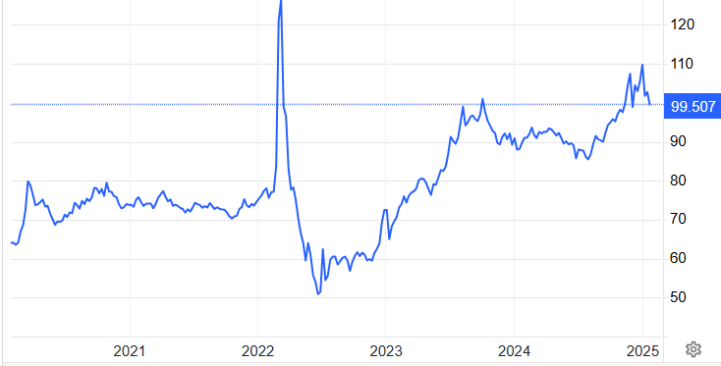
FIVE-YEAR TRAJECTORY OF THE CENTRAL BANK’S KEY INTEREST RATE, 2020-25

Source: https://tradingeconomics.com/russia/interest-rate

Glazyev’s analysis of the causes of rouble devaluation accuse Nabiullina of encouraging currency speculation and the drain of Russian capital offshore. “The main factors of devaluation (ranking by contribution):
1. The refusal of the Central Bank of the Russian Federation to protect the stability of the ruble, prescribed by Article 75 of the Constitution of the Russian Federation. The Bank of Russia has placed the ruble’s exchange rate in the hands of speculators, both our banks and Western players (Forex market). The manipulative nature of trading is proved by the difference between the Forex and interbank market rates, which reached 6 rubles (5%) on November 27, 2024.
The contribution of this factor is 60%.
2. Export of private capital (absence of currency control), first of all, reduction of external corporate debt (by $200 billion over three years). Reduction of the standard for the mandatory sale of foreign currency earnings. The contribution of the factor is 30%.
3. Valuing the savings of businesses and the public. The contribution of the factor is 10%.”

FIVE-YEAR TRAJECTORY OF THE ROUBLE-USD EXCHANGE RATE, 2020-25

Source: https://tradingeconomics.com/russia/currency

Glazyev and Delyagin both advocate the state takeover of commercial banking by a new scheme of regulation and state bank operations: “To get out of the stagflationary trap, it is necessary to stabilize the ruble exchange rate and deploy targeted lending channels for the manufacturing sector, as well as suppress non-monetary causes of inflation by immediately taking the following measures:
1. Fix the currency position of commercial banks by blocking their speculative game against the ruble.
2. Restore the mandatory rule for 80% sale of foreign exchange earnings by exporters.
3. Cancel insurance of foreign currency deposits by the Deposit Insurance Agency, switching from the population’s demand for foreign currency to its sale.
4. Stop quoting the dollar and the euro by the Bank of Russia and the Moscow Stock Exchange, nationalize it, cracking down on speculative hype and manipulation of the ruble exchange rate.
5. To introduce a direct quotation of the ruble to the yuan and the currencies of other major partners, and to set the limits of fluctuations in the ruble exchange rate by the decision of the Central Bank. Create a distributed foreign exchange reserve in quoted currencies.
6. Resume the currency and credit swap between the central banks of Russia and China, and agree on the same with India.
7. Complete the transition to national currencies in foreign trade.
8. Include a special instrument for refinancing banks in order to lend exports at a rate of no more than 5%.
9. Block the channels of capital outflow for non-trading operations, including capital withdrawal in the interest of non-residents from unfriendly countries in accordance with the decrees of the President of Russia on the protection of the country’s financial system.
10. Fill the NWF [National Wealth Fund] with gold and other inflation-proof assets.”

“The launch of a refinancing mechanism for the manufacturing sector requires:
1. Deployment of special bank refinancing tools for lending purposes: investments provided for by national projects and state programs; expenses incurred by enterprises in order to fulfill government orders; expenses of the Russian Government for the purchase of goods of domestic production in the State Reserve; working capital of enterprises for the purchase of domestic equipment; leasing of machinery and equipment of domestic production; mortgages and housing construction; investments in the creation of import-substituting industries; investments in deepening the processing of raw materials; investments in infrastructure development;
investments under the SPIC and other investment agreements with the participation of the state;
innovative projects; investments in the creation of new technological industries; state development institutions.”

“The rate for final borrowers on these refinancing instruments should not exceed 2%, and for banks – from 0.5% to 1.5% – the administration by banks should apply the intended use of loans. Participating banks should be fully responsible for the targeted use of allocated loans and monitor their spending by borrowers.
2. The introduction of the digital ruble for foreign trade and credit transactions, including those carried out through the above-mentioned special refinancing instruments in order to automatically monitor the targeted use of loans.
3. Termination of the Central Bank’s deposit operations and issuance of bonds, which suck money out of the economy and cut off bank credit from the manufacturing sector.”

The Communist Party (KPRF), which currently holds most of the opposition seats (57) in the State Duma, has been more reluctant than Delyagin and Glazyev to attack Nabiullina directly, and also less capable of producing for voters an alternative plan for state action to cover the entire economy. Compared to the non-communist opposition, the KPRF is more timorous as nationalizers and state planners. In November, for example, Sergei Obukhov called for state price regulation for “essential products, such as bread, milk, sugar, and baby food.”

Left, source: https://kprf.ru/activity/prices/230255.html ;
right, KPRF deputy Dr Sergei Obukhov. He is Deputy Chairman of the State Duma Committee on the Development of Civil Society, and Secretary of the Central Committee of the KPRF.

Obukhov has echoed Delyagin and Glazyev in attacking monopoly manipulation of the retail prices for foodstuffs, but he has directed his remedy at urging the government to intensify the efforts of the Federal Antimonopoly Service (FAS) to combat cartel pricing.

“A gentleman’s agreement has been concluded with the heads of the retail chains not to raise retail prices for bread too much. It would seem that the problem has been solved? Unfortunately not…Based on the same answer, it follows, literally, that ‘… the food retail markets are generally competitive with a large number of participants.’ In other words, in order not to be defeated in a tough competition, companies which have concluded such ‘gentlemen’s agreements’ can break them at any time. This is the macroeconomic landscape we currently have. Everything is more or less fine in it, except for inflation, which is a catastrophic situation.”

“Why the president considers the fight against inflation a priority and why he gave the regulator full carte blanche is understandable,” Obukhov says. “We don’t want to end up like in Turkey. Recall that after an unsuccessful experiment with low rates and high inflation, they have been keeping the rate at 50% for almost a year and have so far only been able to reduce inflation from 70% to 50% in annual terms. So Turkey still has a long period of extremely tough PrEP ahead of it.”

“It is also appropriate to recall the price that had to be paid for stopping inflation in the United States in the early 1980s. Inflation there was comparable to ours in terms of level, but it lasted longer, so high inflation expectations managed to gain a foothold (this has not happened in our country yet, but it is about to happen if inflation is not stopped soon)… It is clear that we certainly do not need to bring our inflation to the state of the USA in the 1970s or of modern Turkey: we do not want a 50% rate for years or a recession with 10% unemployment. The longer the decisive fight against inflation is delayed, the more costly it will be. But it’s not just that. Right now, the president has other reasons for resolutely fighting inflation, including political ones.”

“After all, in the near future – in the autumn of 2026 – we will have elections to the State Duma, and with such inflation, it will be very problematic for the ruling party to successfully participate in these elections. People feel inflation in their refrigerator, and economic growth figures, even if they are very impressive, are still a feature from the TV. No slowdown in economic growth or even a recession will worry the population if it is not accompanied by mass unemployment, but this certainly does not threaten us in the foreseeable future. So the authorities may well go to the polls with a high key rate and low economic growth rates, but not with such inflation as it is now. After all, in the end the refrigerator always wins over the TV in shaping public opinion.”

[*] The lead image is a cartoon by John Fischetti in the Chicago Daily News, September 9, 1969. Richard Nixon had won the election of November 1968, but a year into his term he was facing the same lethal combination as President Johnson the year before of mounting war casualties and rising consumer inflation.

Did Trump Just Drop Some Hints About His Peace Plan?

By Andrew Korybko

Moscow-based American political analyst with a PhD from MGIMO.

Trump’s known for his capriciousness, however, so it might be that he either didn’t mean to hint at anything at all in his latest remarks about Russia or he might unexpectedly change his mind about the compromises that he considers to be acceptable for each party during his upcoming call with Putin.

Trump said a few words about Russia shortly after his reinauguration while signing Executive Orders in the Oval Office. They’re important to interpret since they might hint at his peace plan, which he’s yet to officially reveal, but reports have circulated claiming that he’ll “escalate to de-escalate” through more sanctions against Russia and armed aid to Ukraine if Putin rejects whatever deal he offers. He’ll likewise allegedly cut Ukraine off if Zelensky rejects the same deal. Here’s what he said on Monday afternoon:

“Zelenskyy told me he wants to make a deal, I don’t know if Putin does … He might not. I think he should make a deal. I think he’s destroying Russia by not making a deal. I think, Russia is kinda in big trouble. You take a look at their economy, you take a look at their inflation in Russia. I got along with [Putin] great, I would hope he wants to make a deal.

“He’s grinding it out. Most people thought it would last about one week and now you’re into three years. It is not making him look good. We have numbers that almost a million Russian soldiers have been killed. About 700,000 Ukrainian soldiers are killed. Russia’s bigger, they have more soldiers to lose but that’s no way to run a country.”

Starting from the beginning, his claim that Zelensky “wants to make a deal” coupled with his uncertainty about Putin’s willingness might be meant to portray the latter as an obstacle to peace, thus possibly setting the stage for the previously mentioned punitive measures. As for his opinion that Putin is “destroying Russia”, that’s hyperbole but frames his counterpart as the weaker of the two, especially when contrasted with Trump’s declaration earlier that day about the start of an American Golden Age.

He then elaborated by pointing to Russia’s inflation rate, which is implied to be the result of the West’s unprecedented sanctions and correspondingly hinting at the possibility of some relief in exchange for Putin agreeing to compromise instead of continuing to pursue his maximum goals. Building upon that, citing Ukraine’s grossly inflated estimate of Russian losses might belie ignorance of the facts if he truly believes their numbers, but it could also reaffirm his expectation that Putin must compromise.

To explain, Trump seems to believe that Western sanctions’ effect on the Russian economy and the battlefield losses that Russia has suffered (both of which are exaggerated in the context that he referred to them) justify proposing compromises from Putin, not giving into his demands. For this reason, it’s likely that the earlier reports about him planning to propose something less than what his counterpart signaled would be acceptable are true, after which he’ll “escalate to de-escalate” if it’s rejected.

Observers can only speculate about the substance of his envisaged proposal, but it might look something like what was suggested at the end of this analysis here, particularly with regards to the proverbial carrots that Trump might offer Putin with regard to Ukraine’s neutrality and phased sanctions relief. As for the compromises that might be requested of Russia, these could include freezing the Line of Contact while being asked to accept only the partial demilitarization of Ukraine and practically no denazification.

Trump’s known for his capriciousness, however, so it might be that he either didn’t mean to hint at anything at all in his latest remarks about Russia or he might unexpectedly change his mind about the compromises that he considers to be acceptable for each party during his upcoming call with Putin. Nobody can therefore say with certainty what he had in mind, let alone what he’ll ultimately do, but this analysis is premised on the assumption that he might have even subconsciously let part of his plan slip.

Putin and Netanyahu Connection

by Claudiu Secara

Aristotle said: Amicus Plato, sed magis amicus Veritas est.
“Plato is my friend, but Truth is an even better friend.”

What are we to make of the nonsense of world events these days? Israel is winning the war against the defenseless Hamas, and Netanyahu gets the order from Trump to grab his army in 6 hours and move out of Gaza or else – just like some Western movie, “Get outta Dodge before sundown!” Russia is winning the war in Ukraine, but suddenly the only option it has is to halt its takeover and allow NATO troops to occupy positions in what once were Russian provinces, Odessa, Kharkov, along the Dnieper.

Europe is pushed to start peace negotiations, but at the same time it doubles its military spending, shifting to a war-economy footing. Do we expect peace? Or more war?

In Syria, according to Mr. Putin himself, a band of 350 lightly-armed desert marauders sends panic into the 30,000-strong and seasoned Syrian army, which throws away its weapons and tanks and artillery and disbands into thin air. The fiery Russian defenders of Syrian sovereignty drop bombs on the open desert so as not to inconvenience those 350 guys in pickup trucks. They even turn off their radars, making sure the Israelis can move deep into Syrian territory risk free. Assad calls Putin on the phone for 3 days, while Putin is ‘on break’ and cannot take his call.

But even more interesting, something unheard of in modern times: the chiefs of two of the most powerful countries in the world are on the wanted list, in a newly designated category of “war criminals.”

Is there some way to connect all these dots? Or is it possible these are all just random coincidences?

Why Netanyahu? Why Putin? Do they have something in common? Do they have some common enemy, someone that doesn’t like them both?

Well, let’s think a bit. Who could that be? China? Oh, no, there’s no evidence of that! Canada? I don’t think so. Maybe Mr. Soros? Yes, it’s true that Mr. Soros has been declared persona non grata in both Russia and Israel. And by the way, in Hungary as well. Is that what connects all three countries?

But who is Mr. Soros? And why was he declared persona non grata?

We don’t know what we don’t know: Who is the ultimate decision maker. But we see that country after country is being forced into submission to some higher order. And we see that the the recalcitrants are isolated and under duress. There are very few holdouts and those are Russia, Israel, North Korea, Iran, Venezuela. That’s just about it. Turkey is borderline, flip-flopping as long as it can. The US itself is a complicated mix. Too much of a maverick but at the same time fully belligerent when it comes to attacking the noncompliants.

China is a special case. It doesn’t take an anti-Globalist stand, but by the sheer size and the industriousness of its people it is a globalist power in itself. China can be seen as small and vulnerable only when it is compared to the rest of the world. On its own, it is the winner against any combination of existing groupings and various alignments, whether NATO, EU, British Commonwealth, etc.

Obviously, for the Atlanticits the big headache is how to tackle China. And the only realistic way is to corral every other nation to its agenda. Except that Israel and Russia have been a formidable axis of resistance. That’s what explains Russia’s respect for Israel’s sacrosanct interests in Syria, or against the rest of its neighbors. Russia under Putin has tied its policy of national sovereignty to the Jewish oligarchic elite, which is fully integrated with the Israeli elite. In fact they are almost one and the same. Russia is so much subordinated to the Israeli connection that it would rather send its own nationalists (see Strelkov) to prison, and impose exemplary punishment on any Muslim dissent (see the airport rioters in Dagestan), than leave any appearance of disloyalty to Israel.

So, long story short, where would the Globalists start to unravel the tangled web of dissidents and recalcitrants? It tried with Russia. But Russia managed to thumb its nose militarily and economically. Russia had a good network of support from the Russian Jewish connection in the West. It worked through the mass media and it worked by finding loopholes in the regime of endless sanctions. So many loopholes that Russia managed to grow its economy and its world influence beyond its size and position. On top of that, the war in Ukraine has turned into a total disaster for the Globalists.

A new plan was needed. The insubordinate Israel’s Netanyahu is the problem. But Netanyahu outplayed the weak American president, and Israel’s control over the US Congress guaranteed it full immunity from any “restraining order.” In fact, it looked as if Israel got the best of all the opportunities. Russia was at its feet and the US Congress was subservient to the point of servility. Why not take the opportunity and fulfill the dream of Greater Israel?

Although Biden’s presidency was bankrolled by the Globalists, it was also infiltrated by the Zionists, who hijacked any attempt at restraining Netanyahu and his gang of extremists. A totally dysfunctional family. A totally unmanageable situation. And besides anything else, the West could not rally the suport of the Muslim world in support of its next crusade against the rising China. The Saudis alone could no longer manage the Arab street revolt against the genocide perpetrated on the Palestinians. And the Arab support remains critical as much financially, in support of the Dollar, as politically, in terms of the forces of insurgency throughout Central Asia.

And then there is Trump. His political agenda? A big narcissistic “me”. Yes, a good friend of Netanyahu, well connected with AIPAC, fully in bed with the Israel lobby, etc. But besides anything else, it is all about Me.

So what does a man do, who wants to be bigger than George Washington, or bigger than Jesus Christ, but is faced with imminent jail time and bankruptcy? What would that be? Better sign on with the highest bidder. And get back on top of the world. The Axis of the Rebellious that linked Putin to Netanyahu and Orban, and ultimately to Trump, would be broken in an instant.

And it was broken the moment Trump was reelected.

The Gaza Agreement.
1. Half of Israel is outraged by it.
2. The agreement was prepared by Biden’s team and is not politically advantageous to Israel.
3. Netanyahu wanted to reject any such agreements.
4. However, Trump joined the negotiations and sent his man, who harshly demanded that Netanyahu sign it. Otherwise, it would be worse.
5. Netanyahu turns out to be afraid of Trump. And he signed it.
6. The mystery is why Trump, who is considered to be entirely on Israel’s side, is forcing Israel to sign an agreement that many Israelis consider disadvantageous?
7. So ending the war is more important to Trump than the conditions for ending the war for an ally?

But now that leaves the other three co-conspirators out in the cold. They were counting on the heavy support from Trump overturning the “Deep State,” draining the swamp. But what happens if instead he turns against his friends? Two of whom are wanted by Interpol?

Now, that would clear the path to discipline Israel and remove the last leg from Mr. Putin’s chair. And that brings us to the conclusion that after some chaotic theater, Russia is bound to succumb to the Globalists’ demands. How badly will Russia be punished? That depends on how much it continues to resist. The faster it agrees to the conditions laid out by the Globalists the better terms it gets away with. The more it resists, the more severe the outcome and misery could be.

The Globalists are in a hurry. They need to focus on China before the horse is out of the barn, and China is no longer defeatable.

Available also on Telegram:


The Waltz-Bessent-Hegseth Axis

Will Trump Blow Up Another Russian Pipeline?

by Tarik Cyril Amar via RT

Should TurkStream go the way of Nord Stream, it will prove that it doesn’t matter who is in the White House

On January 11, nine Ukrainian drones attacked the Russkaya compressor station near the town of Anapa in Russia’s Krasnodar Region. The station, situated on the north-eastern coast of the Black Sea, is a key installation in the TurkStream gas pipeline that crosses the Black Sea’s seabed to emerge on land again north of Istanbul.

To be precise, TurkStream consists of two parallel pipelines, just like the Nord Stream 1 and 2, which used to link Russia and the EU. Most of these two trans-Baltic pipelines were destroyed in a massive act of eco-terrorism; the perpetrators are certain to have included Ukraine and the US, in one way or another.

The attack on the compressor station did not achieve its aims. Russian air defenses shot down the drones, and despite some minor damage, the station remained intact. However there were important consequences, and this story is far from over.

Three days after the Ukrainian strike, Russia’s Foreign Minister Sergey Lavrov accused Washington of being behind Kiev’s assault. In particular, Lavrov charged that the US is seeking to demolish TurkStream, just as it made sure Nord Stream was taken out of commission. If Lavrov is right, the unsuccessful January 11 drone attack could turn out to have only been the beginning: Further attacks may follow, perhaps including an underwater bombing of the pipelines, as was carried out against Nord Stream in September 2022.

Context is essential here: At the beginning of this year, pipelines carrying gas from Russia via Ukraine to the EU were switched off after Kiev refused to prolong a transit agreement.

That has left TurkStream the only remaining pipeline sending gas from Russia to, ultimately, the EU, in this case mostly Hungary. Importantly, Lavrov believes that the US is aiming to have its Ukrainian clients sabotage this last remaining link, not only to hit Russia but also in order to fulfil the broader strategy of disrupting the EU’s economies.

It is true that we won’t know for certain whether there is a dedicated US project to sabotage TurkStream and, if so, how far it will go – unless, of course, we wake up one morning to learn that “mysterious” explosions have occurred at the bottom of the Black Sea. In any case, Lavrov’s reading of the situation and warnings – not made for the first time – are plausible and should be taken seriously as a matter of due diligence, especially by Washington’s so-called European partners, that is, vassals.

This is so for several reasons: First, what happened to Nord Stream showed that the US and Ukraine accept no limits, even and perhaps especially among “allies.”Even more important is what happened after their Nord Stream attack, namely, in essence, nothing, at least to them. Instead, there was a prolonged period of falsely (and absurdly) blaming Russia, while the Europeans frantically helped cover up their “friends’” assault as best they could.

When that strategy of denial and disinformation became untenable, some Ukrainians were officially blamed but, as it happens, never apprehended – with the convenient side effect of letting Washington off the hook entirely. It’s a story that makes no sense, but then, making sense is not a thing Western elites and mainstream media consider obligatory. In any case, their failure to defend national interests and retaliate against a brutal attack on those interests can only have emboldened the perpetrators.

Then there is Donald Trump, of course. The returning US president’s explicit policy of making the US energy dominant has various domestic aspects, from privileging the fossil fuel industry, which has contributed greatly to his campaign funds, to degrading environmental standards. But it also has foreign policy implications. One is the fact that Trump is continuing and escalating his predecessor Joe Biden’s policy of making the European vassals buy expensive American liquefied natural gas (LNG).

Trump wants them to take even more LNG, using the threat of punitive tariffs as a very American-style sales argument. In essence, this is just the latest phase of that other economic war that Washington has waged: While the one against Russia has backfired quite spectacularly, leaving Moscow stronger and more resilient than before, this one, against Washington’s own NATO-EU vassals has been successful.

Comparatively inexpensive Russian energy has been replaced with expensive American (and other) substitutes – as of 2021, 47 percent of the EU’s gas supplies still came from Russia, for instance. The Europeans have submissively crippled themselves economically and greatly reinforced their dependency on the US. From Washington’s brutally selfish perspective, what’s not to love? At least as long as the Europeans do not rebel. And it seems they never will, astounding as that is.

Finally, there is a broader but no less pertinent context. Lavrov made his remarks about the danger to the TurkStream pipelines at a much longer press conference, which was dedicated to a review of Russian diplomacy in 2024. Against that backdrop, he also restated his views on Washington’s general approach to other countries and, really, the world as such. His crucial point in this regard was that America is not interested, in principal, in equality between sovereign states, balance between their interests, or fair competition between their economies.

Instead, we can add, it keeps pursuing what Americans themselves call “primacy” and what the rest of the world experiences as a relentless policy of domination, intimidation, interference, and continual, usually extremely destructive, warfare. The US, Lavrov summed it up, does not accept any “competitor in any sphere.” We might add again, under any conditions, except when it is compelled to do so.

Washington’s ruthlessness – and lawlessness – in controlling energy resources and infrastructure and, if necessary, in destroying them, too, is merely one aspect of this strategy. A strategy that seems so deeply ingrained in the collective mind of America’s elite that they cannot even imagine a less confrontational approach to their neighbors on planet Earth anymore. If Trump intends to “make America even greater,” Lavrov warned, the world will have to pay close attention to the methods he will employ to do so.

One test will be what will happen – or not – to TurkStream under Trump. If it should go the way Nord Stream went under Biden, that would be more – if unsurprising – evidence that, ultimately, it makes little difference to the rest of us who is in the White House. Because in America you can have any foreign policy – as long as it’s bossy.

Read more here

Sent from my iPad

Full Defeat of Israel !

Even Israeli media is very clearly attributing achievement of the Gaza ceasefire deal to President-elect Donald Trump and his team. President Biden too at one point in an afternoon press conference hailing the deal acknowledged that he spoke as ‘one team’ with Trump on the Gaza deal. According to The Times of Israel:

A “tense” weekend meeting between Prime Minister Benjamin Netanyahu and incoming Mideast envoy Steve Witkoff led to a breakthrough in the hostage negotiations, with the top aide to US President-elect Donald Trump doing more to sway the premier in a single sit-down than outgoing President Joe Biden did all year, two Arab officials told The Times of Israel on Tuesday.
Witkoff has been in Doha for the past week to take part in the hostage negotiations, as mediators try to secure a deal before Trump’s January 20 inauguration. On Saturday, Witkoff flew to Israel for a meeting with Netanyahu at the premier’s Jerusalem office.
During the meeting, Witkoff urged Netanyahu to accept key compromises necessary for an agreement, the two Arab officials on Monday told The Times of Israel on condition of anonymity. Neither Witkoff nor Netanyahu’s office responded to requests for comment.

Meanwhile, the uber genocider Israeli Finance Minister, Bezalel Smotrich said:

‘It seems as if everyone suddenly found out that you cannot defeat terrorist movements by fighting a war or eliminating them.
The only solution to secure Israel is settling in Gaza & expelling the inhabitants to Sinai or Jordan. But now, we have signed our defeat.’

While a High-ranking IDF Official, speaking on the condition of anonymity said:

‘This is an absolute disaster deal. For over a year, we resisted against a deal like this. It renders any progress we made in Gaza as useless and in vain. 
There is no mechanism to remove Hamas from power. According to this deal, the way it is structured now, Hamas will keep ruling the Gaza Strip. They will likely rearm and recruit more fighters than before. 
I tell you one word: Embarassment. We surrendered to the terrorists of Hamas.’ 

Congratulations to the sacrifices by one people, the Palestinians of Gaza, who died horrific deaths to save us all from the Specter of Beast.

And what Happens to Odessa, Transnistria?