The Nature of Women and the ‘Woke’ Problem

by ROCKABOATUS via The Occidental Observer

Anyone who is perceptive of current social and political trends in America knows that women — especially White liberal women — play an inordinate role. They are almost always at the forefront of any protest lecturing others about ‘systemic racism,’ ‘white privilege,’ ‘toxic masculinity,’ and the need for ‘equity’ in every sphere of life.

These same women are given every conceivable platform to spew their revolutionary rhetoric. They demand to be heard, and they haven’t the slightest hesitancy to confront and shout down their opponents. The prevailing attitude among them best fits the popular quote attributed to the late Harvard professor, Laurel Thatcher Ulrich, who wrote in 1976 that “well-behaved women seldom make history.” This was apparently taken out of its context and given the new meaning that if women are to make an impact on society for good, they must rebel against the norm and be disruptive. The notion of a woman who is gracious and well-mannered as she protests is anathema to the thinking of most contemporary liberal female activists.

All of this, of course, is not a recent phenomenon. It has its roots in the women’s suffrage movement beginning in the nineteenth century and increasing in influence ever since. The most notable modern feminists were Jews such as Betty Friedan, Naomi Klein, Gloria Steinem, and the late Supreme Court judge, Ruth Bader Ginsburg, can be named among them. In fairness, there are plenty of gentile women who have also played a significant role in feminist history. Yet it would be hard to deny that Jewish feminists have played a more influential and disproportionate one. I suspect this is due in large part to Jews controlling news corporations, print media, Hollywood, and much of academia.

Feminist women have always created scenes for their cause. They have always engaged in public antics. They have always been vocal and confrontational. What we are witnessing today, then, is not necessarily new, but it is different in its degree and scope.

The contemporary feminist woman of today is not just passionate about what she believes, she is uber-passionate about it. She’s not just a believer, she’s a fanatic. She’s not just on a mission, she sees herself as a revolutionary bent on transforming the world. She cannot be reasoned with. She’s not just ready to argue, but ready also to brawl. She doesn’t just lecture, she screams her message at others. She demands that you listen to her, and if you don’t, she’ll force you to listen. She invades public spaces demanding to be heard.

The modern ‘woke’ feminist is consumed with her own self-righteousness. She is obsessed with virtue signaling before others. She hasn’t the faintest doubt about the rightness of her cause. And anyone who opposes her or even tries to temper her opinions is no different than the most deplorable humans we could imagine. Restraint and moderation aren’t permitted among today’s feminists. Like the most rabid religious fundamentalist, there is no reasoning with them. It is an all or nothing proposition.

The new and hard-core feminists of today are not limited to a few cranks who are childless and have never been married. A good many of these women, instead, are married and have children. They are part of mainstream society. Other than the ‘pussy hats’ they might wear to some rallies, they wouldn’t necessarily stand out all that much from ‘normie’ women.

Nevertheless, leftist women have a number of differences, as revealed by a recent U.K. survey.

  • The most popular LGBT identity is bisexual, which is significantly more common among women than men.
  • When we look at homosexual behavior, we find that it has grown much less rapidly than LGBT identification. Men and women under 30 who reported a sexual partner in the last five years dropped from around 96% exclusively heterosexual in the 1990s to 92% exclusively heterosexual in 2021. Whereas in 2008 attitudes and behavior were similar, by 2021 LGBT identification was running at twice the rate of LGBT sexual behavior.
  • Because the rise in LGBT identity is so heavily concentrated on the political left, its influence on the balance of power between the two parties is likely to be limited.
  • College students majoring in the social sciences and humanities are about 10 points more LGBT than those in STEM. Meanwhile, 52% of students taking highly political majors such as race or gender studies identify as LGBT, compared to 25% among students overall.
  • Various data sources indicate that gender nonconformity – trans and non-binary identity – reached its peak in the last few years and has started to decline.
  • Overall, the data suggest that while there has been an increase in same-sex behavior in recent years, sociopolitical factors likely explain most of the rise in LGBT identity.

Yet this is where the potential of their destructive message and influence could be greater than feminists of previous generations. They may not necessarily look like the traditional feminist with their short, cropped hair, tattoos, piercings, blue hair, and the like (there are plenty of modern feminists, admittedly, who still appear as I have described). Instead, they physically appear to be no different than every other adult woman. This gives the feminist message of today a less threatening appearance and, thereby, more acceptable to the gullible women who might entertain such notions.

The question naturally arises why women are so seemingly susceptible to such radical social and political movements? Why do women so often comprise the shock troops and first ranks of any Leftist political protest?

I think there are reasons for this, none of which are accidental.

The first reason lies in a woman’s nature. Women are nurturers. They are disposed to care for, treat and help others. They are natural do-gooders. They have an innate pull to help and ease the suffering of the less fortunate. Their inclination is to make things better. They are helpers at heart. These are not necessarily bad qualities, but they must be kept in check lest it morph into the kind of militant ‘woke’ women who have taken hold in our society.

The collective insanity of our women is perhaps no more perfectly illustrated in the massive numbers of American women who are rabidly pro-abortion. If women do indeed possess nurturing qualities when it comes to babies and children, why are so many of them willing to terminate their pregnancies — even to the point of supporting partial-birth and after-birth abortions?

These same women must literally suppress their most natural instincts in order to support abortion. Spiraling to this level of evil doesn’t occur overnight. No, it occurs incrementally until one completely sears and deadens their moral conscience. What accounts for this other than a nationwide mass delusion of our women? What sort of wickedness has crept into their hearts and minds for them to celebrate laws that permit the deaths of millions of unborn and partially born babies?

The second reason lies in the emotional nature of women. They tend to think from the heart and not so much from the head. Women, generally, tend to be less critical and cautious in their thinking than men. They are often reactionary, and their heartstrings can be more easily pulled than their male counterparts.

Obviously, there are exceptions to what I’m saying. There are plenty of women who are careful thinkers and who are not as easily manipulated emotionally as other women. But in my estimation these kinds of women are the exception and not the norm. They are the outliers. I don’t even think it comes natural to them. They must fight against their more trusting and emotional natures in some way.

Bear in mind that I’m not saying that men are completely free of emotionalism and less critically minded in the way women generally are. There are plenty of men who can be just as irrational at times and emotionally driven. But overall males tend to be different in this realm than females. Men are not so easily emotionally manipulated as women, and in this sense the two sexes really are different from each other.

It should surprise no one, then, why religious charlatans and radical Marxist groups have so easily preyed on females. They too understand the nature of females, and they exploit it for all it’s worth. Most churches are filled with women, and they often lead the various committees and church ministries. Even cosmetic manufacturers target women in their advertisements in ways that comport with the nature and unique proclivities of females.

They know good-and-well that most women are gullible and can be easily manipulated. They would never admit it, of course, but they would not have had the same level of marketing success if these fundamental distinctions were not kept in mind.

Go to any Leftist protest, and you will witness crowds of angry women with posters and picket signs on behalf of their political cause. The sheer numerical dominance of female protesters, in fact, often serves as the impetus for some men to join the cause so they can have easy access to all the women. The point being that women are the ‘weaker sex’ and not just physically, but emotionally and in terms of critical awareness.

I would add that the presence of large numbers of women at Marxist and feminist political rallies serves also to disarm any political opponents who may be in attendance. Who would, after all, like to be surrounded by throngs of hostile and screeching women? Any male who sought to engage them would be drowned out with a barrage of epithets and the vilest profanity. Today’s loud-mouthed ‘pussy hats’ are not ashamed to say what they really think. Even if a melee broke out, what man would want to be filmed fighting a woman? Women, then, are used by Leftist activist groups to intimidate and demoralize any male opposition that might be present.

The third reason lies in what women are told about themselves by those who control the messaging. Women in America are told they can do anything a man can, and even better too. Women are portrayed in the media, television and Hollywood as practically super-heroes. These are lies, of course, but we’re not allowed to say so. Expect consequences if you do.

Turn on any television commercial and the woman is always portrayed as smarter and more quick-witted than any man. Males are portrayed as clueless and dull-minded. Whether it’s working as a police officer or in combat infantry, females can do it all. There are no intellectual or physical barriers, and anyone who suggests there might be is a backward patriarchal fool.

Anyone who appeals to the physical limitations of women compared to men in the realm of sports, is immediately denounced. No amount of reality and facts will persuade the feminist mindset.

For example, during a CBS This Morning interview, the once great professional tennis player (now retired), John McEnroe, tried to talk some sense into host Gail King when he stated in a 2017 NPR interview that if Serena Williams “played the men’s circuit she’d be like 700 in the world.” She wouldn’t accept it even though McEnroe admitted that Serena was “the greatest female tennis player that ever lived.” Gail wanted so badly for McEnroe to say that Serena was the greatest tennis player among both men and women. To his credit, he wouldn’t say it because it wasn’t true.

At one point, McEnroe was asked by one of Gail’s co-hosts, “Would you like to apologize?” Thankfully, he refused to cave to such pressure. Yet it serves to illustrate that fundamental and biological differences between men and women, including differences in physical abilities, cannot be admitted even when the facts are readily available.

Also, why must people apologize for an opinion they have, especially if it is sincerely held and can be proven? The question reveals more about the mindset of the person asking for the apology than the opinion of McEnroe.

The reality of innate male and female differences and their physical abilities should be patently obvious to anyone, but is now denied so as not to arouse the displeasure of today’s feminists. We must pretend that men and women are the same. We must deny what our lying eyes see and what we instinctively know.

Any man who dares to publicly challenge the reality-denying worldview of ‘woke’ feminism will soon find himself de-platformed and likely unemployed. A voice free to express itself, personal dignity, and even employment cannot be given to society’s ‘heretics.’ The very things that feminists demand and force upon society they quickly deny to anyone who challenges their dogma. It only serves to prove just how disingenuous and intellectually dishonest they are at their core.

The fourth reason lies in the breakdown of the family and society. Feminism did not arise in a vacuum. There were an array of historical events and influences that contributed to its development. Like most misguided political movements, especially those that had strong Jewish and Marxist influences, it was just a matter of time before what seemed like a well-intentioned movement for ‘equality’ turned into a nation destroying agenda led largely by crazed women bent on imposing their Utopian values on the rest of us.

It has been said that when even the women of any society become as debased as the men of that same society, you can rest assured that its days are numbered. Surely America’s days are numbered if one considers how far too many of our women conduct themselves, especially when given a platform. Just look at how they dress. You can’t go to any store or public event without seeing an enormous ham-beast wallowing about attired in the tightest and most revealing clothes imaginable. Jiggles and cellulite for all to see. Tatted sleeves on every arm. Pierced like an African tribesmen, and a foul mouth to boot. She has no sense of shame. No self-awareness. God help the man who’d dare to suggest that she’s not the Greek goddess she imagines herself to be!

There is nothing gracious or even feminine about them. Nothing that could be deemed dignified or classy. They are not soft-spoken nor reasonable — the very qualities that might attract more men to their cause!

This is what our American women have morphed into. This is what ‘woke’ feminism does to the women of any society stupid enough to tolerate it. Is it any wonder why so many American men are turning to Asian and Eastern European women who possess the slimness, femininity, grace, and traditional values they want?

Our women, in truth, have abandoned the natural order of things. They are in complete rebellion, but they are too brainwashed and self-righteous to see it. At least two generations of American women have been duped into believing that causal sex, abortion, and climbing the corporate ladder will bring them happiness. A good many of them have discovered it doesn’t. They are now in their late 30s and 40s, and they want to get married and have children. But for most of them, it’s too late.

Some of them have only recently discovered what they were intended to be all along — namely, mothers and homemakers. Instead of saving themselves sexually for their husbands, partnering with those same husbands, and rearing responsible children possessing real values and character, they opted for a corporate career with no husband and no children. They spent their best years pursuing a worthless college degree (at least in most cases) and partying. Having hit the wall by the time they reached thirty, and having gone through multiple sexual partners, there remains few marriageable men and those who are single may not necessarily want a woman who has a host of bed notches to her name.

The fifth reason is because men have largely abdicated their role as leaders in the home, church, and society. Women have rebelled against the natural order of things, no doubt, but men have also allowed it to happen. They have remained content to do nothing about it. They have become passive. Some of these same men have aligned with feminists in order to have access to them and to gain their approval. Other men have done it because like so many feminists they too have a need to virtue-signal.

When our men refuse to take their leadership roles in society, there will arise plenty of women who will be glad to do it for them. And this is where the problems begin.

Far too many men do not have their lives together. They have no framework or worldview in which to interpret the society around them. They have not developed a practical philosophy of marriage and child-rearing. Most men do not even think in such terms. It’s completely foreign to them. Their fathers never taught nor modeled before them how a husband and father is to conduct himself. There is a complete absence on the part of these same fathers of imparting values and practical wisdom to their sons. They either haven’t considered it or don’t think it’s important to do so. Their own fathers may have never addressed such subjects. And so whatever knowledge is gained by our young men is almost always based on a liberal and materialistic worldview — which will always prove detrimental to the lives and future of Whites.

I know this will be difficult for many to accept, but the dominance of women in almost every realm of our society is not a good indicator of our national health. When women and transexuals are promoted to important and even strategic positions within our military, this is not a good sign. It certainly signals to our enemies that we are weak, that we are driven more by popular ‘woke’ rhetoric and artificial constructs than by the safety of our countrymen. Any nation, such as the U.S., that exalts and virtually deifies women sets itself on a course that will surely collapse under the weight of its own stupidity. This is not to say that honorable and virtuous women should not be honored by society, but only that national and social policies should not be determined by what women ‘feel’ nor by any false or inflated views of what they can do.

In other words, when women rule a nation’s most important institutions — especially if its foundation are ideologically ‘woke’ — it will inevitably self-destruct. Consider, for example, Germany’s former Chancellor, Angela Merkel, and the problems she saddled her nation with because of her bleeding heart for Islamic migrants. In Sweden, 47% of its Riksdag (parliament) is comprised of women. Switzerland’s Federal Assembly has 41.5% females. It should surprise no one that these same countries also have extremely liberal social policies and permit large numbers of Islamic people to immigrate.

While there may be some historical exceptions to what I have written, the point remains: Women in national leadership roles generally tend to weaken a nation because of their sympathetic natures, their susceptibility to social contagion, and poor discernment.

The same thing could be said about the presence of women in the police profession. Although women do well in support roles (e.g., dispatchers), they do not have the natural physical traits and upper body strength that’s required to do the job. Most male cops will admit this, albeit privately. Is it any wonder why so many female officers are injured in the course of their duties? Most male felons will comply with a female officer only when she’s accompanied by stronger male officers.

When women are given endless platforms to spew the sappiest political drivel, including the most nation-destroying social ideas, and then celebrated for it, this too is not a good thing. It is a sign that we are done with as a nation since only a people bent on national suicide would permit it. And it’s not because there aren’t any intelligent and perceptive women because there surely are. But when a society tolerates only one viewpoint — a liberal feminist one — there is little hope that that same society will turn out wiser and stronger in the end.

The old 1968 Virginia Slims cigarette TV commercial used to say, “You’ve Come A Long Way, Baby” — but for great numbers of American women, it’s been a self-imposed disaster for themselves and the nation at every step.

(Republished from The Occidental Observer

US Wants the European Vassals to Do Its Bidding Against China

European nations need to join forces with the US to help it face the growing challenge to the existing world order posed by China, US Deputy Secretary of State Wendy Sherman told journalists via a video link on Thursday. Countering Beijing’s influence is important for preserving, what she called, the European way of life, the official claimed.

Earlier, Washington called China the only nation that has both the will and ability to reshape the world order and threaten Western nations’ “shared vision” of the future. Sherman now says China was a threat to Western values long before it supposedly aligned itself with Russia, which currently dominates the headlines in the West due to Moscow’s ongoing military operation in Ukraine.

“Even before President Xi [Jinping] and President [Vladimir] Putin declared their ‘no limits’ partnership in February, the PRC [People’s Republic of China] has challenged Europe’s security, Europe’s economy and Europe’s values,” Sherman told journalists in Washington, DC.

“While Beijing may be thousands of miles away… the PRC’s actions matter just as much for the future of Europe,” she said, adding that Washington does not seek a new cold war with Beijing.

While the US does not plan to “sever [its] economy from the PRC,”Washington cannot simply “rely on Beijing to change its behavior,” Sherman continued, while calling on European nations to align their approaches with Washington, primarily on issues such as supply chains.

Her words come one week after Secretary of State Antony Blinken said, “China is the only country with both the intent to reshape the international order – and, increasingly, the economic, diplomatic, military and technological power to do it.”

Blinken warned that Beijing’s idea of the future “would move us away from the universal values that have sustained so much of the world’s progress over the past 75 years,” adding that US President Joe Biden “believes this decade will be decisive” in the standoff between Washington and Beijing.

He also said the US seeks to “shape the strategic environment around Beijing to advance our vision for an open and inclusive international system.” America has been rallying support among Pacific nations and Western allies amid heightened tensions with China, which have been on the rise due to issues surrounding Taiwan.

Russia Responds to West’s Hypocrisy


The West ought to condemn its own military adventures and pay out compensation to those who have suffered from its actions, Vasily Nebenzya, Russia’s permanent representative to the United Nations, said on Thursday, according to news agency TASS.

“I would recommend to the collective West this one thing. If you want to condemn aggression — start with yourselves. Set an example by condemning your own military adventures, illegal economic restrictions, deadly colonial and neo-colonial wars, genocide, and robbery of indigenous peoples,” he told the UN Security Council, commenting on the accusations regarding Russia’s military operation in Ukraine.

“Start paying off compensations to states and nations that suffered from you. Such a step would indeed bring us closer to having a more just world order that would have no place for anyone’s self-proclaimed exceptionalism,” the diplomat added.

According to Nebenzya, in recent months, Russia has witnessed “a transcendent degree of hypocrisy” coming from the West. During the Ukraine conflict, Western countries “suddenly recalled that there is such a thing as the international law,” Russia’s UN envoy argued.

“When NATO was attacking Yugoslavia, Iraq, Afghanistan, Libya, Syria, international law was perceived only as an annoying impediment. In futile attempts to justify their aggression against sovereign states, the collective West had to come up with exotic concepts, such as ‘humanitarian intervention’, ‘war on terror’, ‘preventive strikes’,” Nebenzya continued.

He said that Moscow had no information on whether US, UK or other military officers that are allegedly responsible for war crimes in Iraq, Afghanistan and Syria have faced charges. “The outcome is always the same: lots of casualties, and no one held accountable (even in disciplinary terms, to say nothing of criminal liability),” he added, referring to what he called “NATO atrocities.”

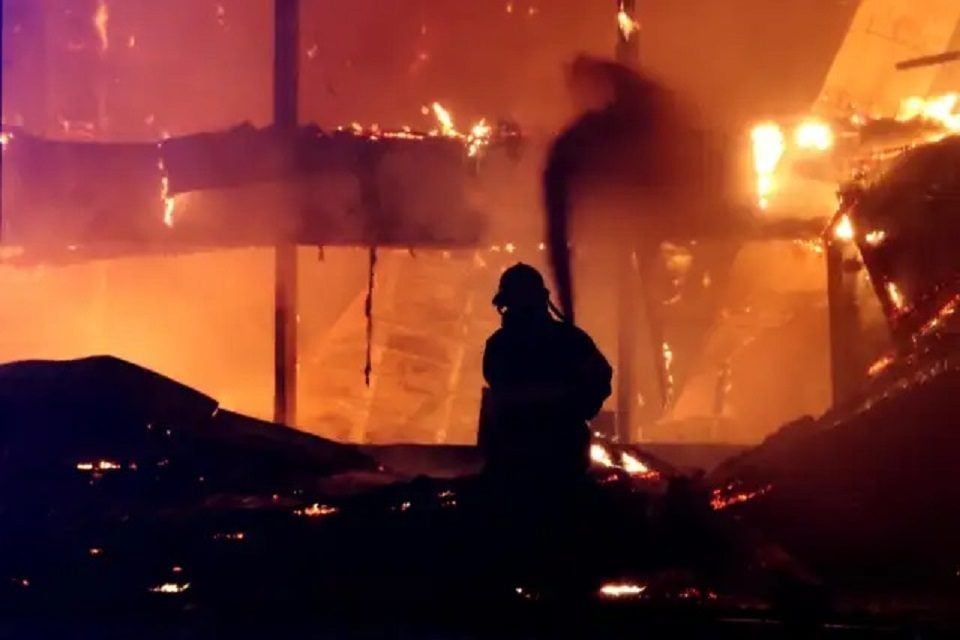
One of the Largest Egg Factories in the U.S. Torched at Night Amid Outbreak of Fires in Food Processing Facilities Across the Nation


A barn that housed tens of thousands of chickens on Forsman Farm in Howard Lake, Minnesota, one of the nation’s largest egg producers, was set aflame late Saturday night.
According to Forsman Farms, which provides more than three million eggs to the largest retailers in the country, the cause of the fire remains a mystery as investigators evaluate the scene to determine how the barn was set ablaze.
“Overnight, a fire destroyed one of our barns at our Howard Lake farm. No one was injured and we are grateful that first responders were quickly on the scene to put out the fire. Unfortunately, chickens were lost because of the fire. We are evaluating the extent of the damage – which appears to be confined to a single structure – as well as investigating the cause of the fire,” a Forsman Farms told Minnesota’s local CBS affiliate.
Law enforcement officials estimate at least 200,000 chickens were killed in the massive flame.
While the fire left extensive damage to the property, no injuries were reported.
The Wright County Sheriff’s Office maintains the fire was likely accidental.
More from Fox 9:

The fire at the commercial egg farm in Minnesota is the latest food production facility to mysteriously go up in smoke over the past year as inventory on store shelves across the United States become increasingly bare amid a fertilizer and food shortage and historic inflation.

Henry Kissinger is Trying to Warn Westerners that They Are Running Out of Time in the Fight for Russia

By Valdai Club Programme Director Timofei Bordachev

If the acute phase of the conflict in Ukraine turns out to be lengthy, which now seems likely, then basic survival will force Russia to cut ties with Western-aligned Europe

In the event that the growing conflict in, and around, Ukraine doesn’t lead to irreparable consequences on a global scale in the near future, its most important outcome will be a fundamental demarcation between Russia and the Western-aligned states of Europe.

This will make it impossible to maintain even minor neutral zones and will require a significant reduction in trade and economic ties. Restoring control over the territory of Ukraine, which, most likely, is to become a long-term goal of Russian foreign policy, will solve the main problem of regional security – the presence of a “gray zone.” The management of which inevitably became the subject of a confrontation and was dangerous from the point of view of escalation.

In this sense, we can count on a certain stabilization in the long term, although it will not be based on cooperation between the main regional powers. However, it is already obvious that the road to peace will be long enough and will be accompanied by extremely dangerous situations.

In his speech to the participants of the Davos forum, Henry Kissinger, the grand patriarch of international politics, pointed to just such a prospect as the least desirable from his point of view, since Russia then “could alienate itself completely from Europe and seek a permanent alliance elsewhere,” which would lead to the emergence of diplomatic divides on the scale of the Cold War.

In his opinion, peace talks between the parties [Moscow and Kiev] would be the most expedient way to prevent this; these would result in Russian interests being taken into account. For Kissinger, this means that in some respect, Russia’s participation in the European “concert” is an unconditional value, and the loss of this must be prevented as long as some chance remains.

However, with all due respect to the merits and wisdom of this statesman and scholar, the impeccable logic of Kissinger faces only one obstacle – it works when the balance of power is has been determined and relations between states have already passed the stage of military conflict.

In this sense, he certainly follows in the footsteps of his great predecessors – Chancellor of the Austrian Empire Klemens von Metternich and British Foreign Secretary Viscount Castlereagh, whose diplomatic achievements were the subject of Kissinger’s own doctoral dissertation in 1956. Both of them went down in history as the creators of a new European order, established after the end of the Napoleonic era in France and which persisted, with minor adjustments, for almost a century in international politics.

Like those illustrious figures, Kissinger appears on the world stage in an era when the balance of power between the most important players is already being determined by “iron and blood.” The time of his greatest achievement was the first half of the 1970s – a period of relative stability.

However, one cannot ignore the fact that the ability of states to behave in that way, back then, was not due to their wisdom, or responsibility to future generations, but down to much more mundane factors. The first being the completion of the “contraction” of the order which obtained its outline characteristics as a result of World War II. Over the next 25 years (1945 to 1970), this state-of-affairs was “finalized” during the war in Korea, the US intervention in Vietnam, the USSR’s military actions in Hungary and Czechoslovakia, several indirect wars between the USSR and the US in the Middle East, the completion of the process of disintegration of the European colonial empires, as well as a significant number of smaller but also dramatic events.

Thus, at the present time, it would be difficult to expect diplomacy to be able to take first place in world affairs at the initial stage of the process, which promises to be very long and, most likely, quite bloody.

The material basis of that order, which was given its final polish by Kissinger’s diplomacy, the policy of “détente” with the USSR and the 1972 reconciliation with China, was the strategic defeat of most of Europe as a result of two world wars in the first half of the 20th century. The collapse of the European colonial empires and the historic rout of Germany in its attempt to take center stage in world affairs brought the United States to the forefront, which made it possible to make politics truly global.

As a result of the self-destruction of the USSR, this order turned out to be short-lived. We see now that this situation was a great tragedy, since it led to the disappearance of the balance of power in favor of the dominance of only one power.

Now we can assume that the emancipation of mankind from Western control is of central importance, and the most important factor in this process is the growth of China’s economic and political power. If China itself, as well as India and other major states outside the West, cope with the task entrusted to them by history, in the coming decades the international system will acquire features that were completely uncharacteristic before.

Most of the significant events that are taking place now, both globally and regionally, are connected with the objective process of the growth in the importance of China and, following it, other large Asian countries. The determination Russia has shown in recent years, and especially months, is also associated with global changes. The fact that Moscow so purposefully stood up to protect its interests and values was due not only to domestic Russian reasons, although they are of great importance. Nor were they predicated upon expectations of direct material assistance from China, which could compensate for the losses during the acute phase of the conflict with the West.

The main external source of Russian self-confidence has been an objective assessment of the state of the international political and economic environment, in which even a complete break with the West would not be mortally dangerous for Russia from the point of view of pursuing its main development goals. Moreover, it is precisely the need for a more active rapprochement with other partners, which Russia has not experienced until recently, that may turn out to be a much more reliable way to survive in a changing environment.

This is what is understood in the US and Europe with the greatest concern. In the event that Russia, during the years of the emerging disengagement from the rest of Europe, creates a comparable system of trade, economic, political, cultural and human ties in the South and East, the return of this country to the Western realm will become technically difficult, if perhaps not even possible.

So far, such a course of events is hindered by a colossal number of factors, among which, in the first place, is the passive stability of close interaction with the rest of Europe and the mutual dealings accumulated over the past 300 years. Moreover, it was other European powers that were the only constant partners of Russia after the appearance of this nation in the arena of international cooperation.

However, in the event that the acute phase of the conflict in Ukraine really turns out to be very long, which, apparently, is the case, then the elementary needs of survival will force Russia to get rid of what binds it to Europe. This is exactly what those Russian scholars and public figures are calling for, who in every possible way emphasize the existential nature of the confrontation taking place on our western borders.

Therefore, it is the understanding by the US, and its allies, that the movement towards a new world order lies on a firm foundation that is the most important source of their struggle with Russia.

The inevitable redistribution of resources and power on a global scale cannot happen in a completely peaceful manner, although the irrationality of an offensive war between the great powers, given the nuclear deterrence factor, provides us with some hope for the preservation of humanity.

Amid the struggle now gaining momentum, Russia, like the rest of Europe, is, despite its military capabilities, a participant inferior in strength to the main warring parties – China and the United States. Therefore, there is a struggle for Russia, and there is a dwindling opportunity for the West to win, and this is what Henry Kissinger is trying to articulate.

This article was first published by Valdai club

Scamdemic II Launched

by Brian Shilhavy, Health Impact News

Don’t miss the full report by Polly St. George.

After weeks of indicating that perhaps the Bird Flu hoax was going to be recycled again as a new “pandemic” to instill fear and continue the state of “emergency” the entire country has been under since 2020 that has resulted in $trillions given over to Big Pharma for their products, mainly the COVID-19 “vaccines,” it appears now that plans are in place to actually use the “monkeypox” as the new “pandemic” to further the goals of the Globalists to create new vaccines and control the population.

The World Health Organization just announced that they are “convening an emergency meeting on the alarming spread of monkeypox around the world.” (Source.)

Just how bad is this new “outbreak” which now threatens the world in a similar way to how COVID threatened to wipe out humanity?

Cases of monkeypox in the UK doubled this week – to an “alarming” 20 cases. And it is now spreading to the U.S. at an alarming rate, as one person has reportedly now tested positive for it (determined by the PCR test apparently) in New York City. (Source.)

It appears that worldwide this “alarming spread” of monkeypox is well below 100 cases at this point, which means it would probably not even break into the top 1000 list of current infectious diseases spreading around the globe.

So why the media hype and sudden attention by government health organizations like the WHO and the CDC?

The first clue that this is a new “plandemic” is to see how Big Pharma is setup to profit from it, because disease management is first and foremost a marketing opportunity, and to create to the proper fear factor, one has to advertise a “new” and “deadly” disease to start the funds flowing through emergency use authorizations.

And sure enough, that first criterion for identifying a “plandemic” has been met this week, as Whitney Webb reported:

Two corrupt companies were in rocky financial territory just a few weeks ago. Now, with concerns over a global monkeypox outbreak being hyped by media and global health organizations alike, the worries – and sins – of these two firms are quickly being forgotten.

In recent days, concern over a global outbreak of monkeypox, a mild disease related to smallpox and chickenpox, has been hyped in the media and health ministries around the world, even prompting an emergency meeting at the World Health Organization (WHO). For some, fears have centered around monkeypox being the potential “next pandemic” after Covid-19. For others, the fear is that monkeypox will be used as the latest excuse to further advance draconian biosecurity policies and global power grabs.

Regardless of how the monkeypox situation plays out, two companies are already cashing in. As concern over monkeypox has risen, so too have the shares of Emergent Biosolutions and SIGA Technologies. Both companies essentially have monopolies in the US market, and other markets as well, on smallpox vaccines and treatments. Their main smallpox-focused products are, conveniently, also used to protect against or treat monkeypox as well. As a result, the shares of Emergent Biosolutions climbed 12% on Thursday, while those of SIGA soared 17.1%.

For these companies, the monkeypox fears are a godsend, specifically for SIGA, which produces a smallpox treatment, known by its brand name TPOXX. It is SIGA’s only product. While some outlets have noted that the rise in the valuation of SIGA Technologies has coincided with recent concerns about monkeypox, essentially no attention has been given to the fact that the company is apparently the only piece of a powerful billionaire’s empire that isn’t currently crumbling.

That billionaire, “corporate raider” Ron Perelman, has deep and controversial ties to the Clinton family and the Democratic party as well as troubling ties to Jeffery Epstein. Aside from his controlling stake in SIGA, Perelman has recently made headlines for rapidly liquidating many of his assets in a desperate bid for cash. (Full article.)

The second sign to look for, is if this “new outbreak” has already been predicted beforehand, and even simulated in an effort to predict how to “contain the outbreak,” much as COVID-19 was weeks before the first alleged cases even showed up, with the pandemic simulation called Event 201.

Fictional news broadcast in simulation about a monkeypox pandemic. Source.

And thanks to some investigations by Polly St. George, there was indeed a simulation of a “monkeypox” pandemic simulated in March of 2021 hosted by the Nuclear Threat Initiative with the Munich Security Conference to “conduct a tabletop exercise on reducing high-consequence biological threats.” (Source.)

Here is their “Executive Summary“:

In March 2021, the Nuclear Threat Initiative (NTI) partnered with the Munich Security Conference (MSC) to conduct a tabletop  exercise on reducing high-consequence biological threats. Conducted virtually, the exercise examined gaps in national and  international biosecurity and pandemic preparedness architectures and explored opportunities to improve capabilities to prevent  and respond to high-consequence biological events. Participants included 19 senior leaders and experts from across Africa, the  Americas, Asia, and Europe with decades of combined experience in public health, biotechnology industry, international security,  and philanthropy.

The exercise scenario portrayed a deadly, global pandemic involving an unusual strain of monkeypox virus that emerged in the  fictional nation of Brinia and spread globally over 18 months. Ultimately, the exercise scenario revealed that the initial outbreak  was caused by a terrorist attack using a pathogen engineered in a laboratory with inadequate biosafety and biosecurity provisions  and weak oversight. By the end of the exercise, the fictional pandemic resulted in more than three billion cases and 270 million  fatalities worldwide.

In this fictional simulation conducted in March of 2021, the first outbreak of this “new” deadly strain of monkeypox was to happen in May of 2022, which is exactly the same month when the current news cycle began about the current “alarming rate” of monkeypox “outbreaks.”

Many of the same players involved in Event 201 predicting the COVID-19 outbreak were also involved in this simulation, including Bill Gates.

But of course that is just a “coincidence,” and to suggest otherwise is to be a crazy “conspiracy theorist.”

At least that is what those who choose to believe this narrative will say as they line up to receive their emergency use authorized rushed-to-market new monkeypox vaccine (once they sell millions of doses of the current vaccine already approved for monkeypox), which is now being prepared as COVID-19 vaccine distribution begins to wane.

And why not? This business model worked so well beginning in 2019 when preparing for the yet-to-happen COVID-19 “pandemic,” why wouldn’t they try to replicate it since it was so successful?

Russian MoD Presents New Documents on Dozens of Pentagon-Backed Bioweapons Projects in Ukraine and Nigeria

via @sputniknewsus

Official documents have been published by the Russian MoD confirming that the US Department of Defence Threat Reduction Agency (DTRA) is working in Ukraine with a specific military-biological focus:

▪The memorandum regarding the UP-2 project was prepared by the office of the US Secretary of Defence: according to the document, the mapping of especially dangerous pathogens in Ukraine should have been held;

▪The document notes that the main task of this project is to collect information on the molecular composition of pathogens that are typical in Ukraine and to transfer samples of strains;

▪A similar memorandum was prepared as part of the UP-1 project, aimed at studying rickettsia and other diseases spread by arthropods. The document noted the need to transfer all collections of especially dangerous pathogens to the central reference laboratory, which would make it possible to facilitate the process of exporting them to the United States;

▪The large-scale UP-4 project was carried out to study the possibility of spreading especially dangerous infections through migratory birds. The documents show that for the period from November 2019 to January 2020, 991 biological samples were collected;

▪There is information about the implementation of 10 such projects (including UP-3, UP-6, UP-8, UP-10), which included work with pathogens of especially dangerous and economically significant infections. Among them are the Crimean-Congo haemorrhagic fever, leptospirosis, tick-borne encephalitis, African swine fever

The Russian MoD has commented on documents found in Ukraine regarding American instructors’ data on training Ukrainian specialists in emergency response to smallpox outbreaks:

▪The interest of the Pentagon in this infection is far from accidental: the return of the causative agent of smallpox will be a global catastrophe for all mankind. So, compared to COVID-19, this pathogen is just as contagious, but its lethality is 10 times higher;

▪Back in 2003, the US Department of Defence developed the Smallpox Vaccination Program, according to which all US military personnel are subject to mandatory vaccination. Vaccination in the US is also mandatory for diplomatic and medical personnel. This indicates that the United States considers the causative agent of smallpox as a priority pathogenic biological agent for combat use, while these vaccination measures are aimed at protecting US military personnel;

▪The lack of proper control, as well as violations of biosecurity regulations in the US, could lead to the use of this pathogen for terrorist purposes. In the period from 2014 to 2021, unaccounted ampoules with the virus were found in laboratories of the Food and Drug Administration, the US Army Research Institute of Infectious Diseases (Maryland), and the Vaccine Research Centre (Pennsylvania).This fact constitutes a violation of World Health Assembly resolution number 49.10 of 1996, according to which the causative agent of smallpox can be stored in only one American laboratory (the Centres for Disease Control and Prevention in Atlanta);

▪Smallpox vaccination, which is currently not available in many countries, provides protection against monkeypox;

▪To date, 98 percent of people infected with monkeypox have been homosexual males older than 20 years old. Dr David Hermann, who previously headed the WHO’s emergency department, said that the main reason for the spread of the disease is the sexual transmission of the virus;

▪According to a WHO report, the spread of the West African strain of the causative agent of monkeypox originated in Nigeria, a country where the United States has placed its biological infrastructure;

▪According to European and American media reports, in the materials of the Munich Security Conference in 2021, a simulated scenario to counter an outbreak caused by a new strain of the monkeypox virus was carried out;

▪Amid the numerous cases of US violations of biosecurity regulations, the Russian MoD calls on the leadership of the World Health Organisation to investigate the activities of US-funded Nigerian laboratories and inform the international community about the results

Subscribe to @sputniknewsus

The Chinese Slave Alternative to the Western Slave Model

China is currently implementing a medical police state in their largest cities, including Shanghai, many parts of Beijing, and other large cities.

News reports have stated that restrictions have eased in Shanghai, but people on the ground are reporting that not much has changed with measures that have kept residents of China’s largest city locked down like prisoners since early April.

Shanghai “reopens” but the buses are all empty

by Austrian China

Excerpts:

No, contrary to the headlines broadcast all around China and around the world, Shanghai has not reopened. Despite multiple promises, even residents whose compounds have been without cases for over 14 days remain for the most part stuck inside their gates. Most stores including supermarkets remain closed.
Shanghai, like Beijing and several other provinces, is back to doing daily PCR tests. An exception applies to people who already got infected and have recovered. The current policy seems to be that the latter should NOT participate in mass tests.
Four out of 20 subway lines and 273 bus lines have allegedly reopened, but seem to be all but empty. Private cars without special permits remain banned from the streets. Describing this as ‘reopening’ seems like a stretch.

Full article here.

Robots have been reportedly deployed in Shanghai to conduct “nucleic acid sampling.”

From Global Times:

Unmanned nucleic acid sampling robot debuts in Shanghai

An unmanned nucleic acid sampling robot had been developed in Shanghai, equipped on a portable sampling vehicle and can replace human medical workers to reduce the risk of infection, media reports claimed on Sunday.
The 2.0 version of portable sampling vehicle “Sairi” and the sampling robot were co-developed by Shanghai Artificial Intelligence Research Institute (SAIRI) along with Chinese car maker Chery Automobile Co and high-tech company JAKA Robotics, which is equipped with a visual detector to locate the participants’ oral cavity and finish sampling within 30 seconds.
SAIRI said 80 of the previous version of “Sairi” equipped with driver and medical workers have been deployed in six districts of Shanghai so far. The production speed of “Sairi” 2.0 with unmanned sampling robot will be fully accelerated after local pandemic was bought under control. (Source.)

Residents of Shanghai have to take a PCR test every 48 hours to enter public transportation, offices, shopping malls, etc.

A man who is a teacher in Shanghai with a Chinese wife and son has an active YouTube channel (Teacher Mike) and recently published how he and his family tested positive for COVID, and the ordeal they went through to be brought to a quarantine camp.

Meanwhile, speaking at the World Economic Forum in Davos, Switzerland earlier today, Alibaba Holdings President J. Michael Evans unveiled their plans to launch an app that could track an individual user’s “carbon footprint.”

We’re developing, through technology, an ability for consumers to measure their own carbon footprint. What does that mean? That’s where are they travelling, how are they travelling, what are they eating, what are they consuming on our platform. So: An individual carbon footprint tracker.

As Kit Knightly reports at Off-Guardian, this is HUGE news as Alibaba is the second largest ecommerce company in the world, second only to Amazon.com.

The Chinese company is the second-largest e-commerce company in the world after Amazon, with revenues in excess of 715 billion Yuan in 2021 (that’s over 110 billion USD).
And they’re not just an e-commerce platform. Through their financial and technological service companies, Alibaba runs the largest domain name market, email provider and cloud storage services in China, and the largest payment platform in the world.
Through Alihealth they supply online pharmacy services, as well as providing computer technology to hospitals and clinics. Since they bought AutoNavi in 2014, they own the biggest e-map navigation company in China too.
Essentially, in China if you want to pay for something on the internet, you probably use Alibaba. If you want to order something online from a small business, you probably use Alibaba. If you want to sell your stuff second hand, you probably use Alibaba.
If you want to register a domain, go to a pharmacy, check into a hospital, send an email, use a map or GPS…you get the idea.
Alibaba’s computing sector is also a market leader in AI services, being the first payment platform to start using facial recognition technology to confirm payments in 2017.
It seems Alibaba currently has apps, either being used or in development, that:

  1. Monitor travel routes and methods and “reward” users for making the “correct choice”.
  2. Can track an individual’s “carbon footprint”, including what they eat and where.
  3. Have users can “earn points” for “earth-friendly habits”.

Even individually these functions are worrying enough, but they combine to paint a very concerning picture of the future.
Further, combine that with what we know of the company’s reach through its subsidiaries: Smart Cities, banking, healthcare records, emails, internet activity and more.
How long before Alibaba decides to “reward” other “correct choices” that have nothing to do with the environment? Like vaccination, for example.
How long after that do they start punishing incorrect choices?
They already technically have access to the data they would need to construct this system. It would be naïve in the extreme to not see where this leads.
And, of course, it won’t just be China. If Alibaba is doing this then Google, Amazon, Apple and all the rest of them won’t be far behind. (Full article.)

It remains to be seen yet if Americans will be as complying to these medical police state tactics as people living in China.

Compiled by Brian Shilhavy

International Opposition Grows To Biden Granting WHO Pandemic Powers

Authored by Mark Tapscott via The Epoch Times

Opposition from African delegates to the 75th World Health Assembly (WHA) in Geneva, Switzerland, has forced hours of informal dickering on possible revisions to President Joe Biden’s proposals to grant new powers to the World Health Organization (WHO) to deal with viral pandemics.

The flag of the World Health Organization (WHO) at their headquarters in Geneva on March 5, 2021. (Fabrice Coffrini/AFP via Getty Images)

As previously reported by The Epoch Times, Biden’s 13 proposed amendments to the UN’s International Health Regulations (IHR) that govern WHO operations grant broad new powers to Director-General Tedros Adhanhom Ghebreysus, a former Ethiopian government minister who has been in the role since 2017.

Earlier this week, Tedros was confirmed for a second term by the assembly, which is WHO’s decision-making body.

The United States provides more than $150 million in assessed contributions to fund the organization and has given, on average, an additional $262 million in annual voluntary funding since 2012.

World Health Organization Director-General Tedros Adhanom Ghebreyesus attends a press conference at the WHO headquarters in Geneva, on July 3, 2020. (Fabrice Coffrini/Pool/AFP via Getty Images)

Under the proposed amendments, the director-general could declare a public health emergency in any country regardless of whether local officials agree with the declaration.

Tedros also would be authorized to rely on evidence from sources other than those approved by the affected country as the basis of such a declaration.

Neither the organization’s media office nor its counterpart at the U.S. Department of Health and Human Services(HHS) responded to The Epoch Times’ request for comment.

The WHA’s business is being conducted by two committees consisting of delegates from 194 member nations. The Biden proposals were first considered earlier this week by Committee A, presided over by Japanese delegate Hiroki Nakatani.

The assembly’s process is to allow delegates to comment on and debate proposals, then if no objections are heard, the proposals are considered approved. But when the Biden proposals were first discussed earlier this week in Committee A’s third session, objections were voiced by African delegates.

The African region shares the view that the process should not be fast-tracked,” Moses Keetile, deputy permanent secretary in Botswana’s health ministry, reportedly told the assembly on behalf of the African region.

During May 25’s sixth meeting of Committee A, Nakatani told the delegates that “progress was made during the informal discussions … but further discussion seems to be needed” and he said talks would continue.

James Rogulski, an independent journalist and researcher, who is closely following the assembly livestream, said “for some reason, they [assembly officials] could not reach a consensus, so it seems like they are not even going to bring it to the floor,” pending the outcome of the informal negotiations.

Rogulski added that “what they have done is they are setting up another bureaucracy. They are going to have a working group for the [IHR]. They are going to be taking submissions from around the world for their ideas on how these things should be amended.

“That will go into September and then it looks like they are apparently going to be having another meeting in November.”

A logo is pictured outside a building of the World Health Organization (WHO) during an executive board meeting on update on the coronavirus disease (COVID-19) outbreak, in Geneva, Switzerland, April 6, 2021. (REUTERS/Denis Balibouse/File Photo)

More details about the working group were contained in Tedros’ report to the world assembly on “Strengthening WHO Preparedness for and Response to Health Emergencies,” including a recommendation for the international health agency to proceed as described by Rogulski.

The report said the new working group will “invite proposed amendments to be submitted by 30 Sept. 2022. All such proposed amendments to be communicated by the director-general to all state parties without delay; (d) request the [Working Group on International Health Regulations] WGIHR to convene its organizational meeting no later than 15 November 2022.”

Earlier this week, HHS assistant secretary for global affairs Loyce Pace alluded to the Biden amendments without acknowledging the necessity for the informal negotiations.

Pace told the assembly that the Biden “administration believes in the need for strong global relationships to combat COVID-19 and to prevent and prepare for future health emergencies.”

Pace said U.S. officials are “pleased” that the WHA is moving “to strengthen existing tools available to the WHO and to all member states.

“This includes strengthening the international health regulations from 2005 to clarify roles and responsibilities, increase transparency and accountability, share best practices, and communicate in real-time with our global partners.

We are also committed to an intergovernmental negotiating body process that engages external stakeholders and develops an international instrument on pandemics that enables meaningful, inclusive action.”

But the Biden proposals have sparked a growing furor in the United States among critics who contend the amendments would amount to ceding of some portion of American sovereignty to WHO in the event of another pandemic like the one that has killed more one million Americans and in excess of six million people worldwide.

President Joe Biden pauses while speaking during a cabinet meeting in the Cabinet Room of the White House in Washington on Nov. 12, 2021. (Drew Angerer/Getty Images)

Rep. Ralph Norman (R-S.C.), the first member of Congress to comment critically on the amendments, told The Epoch Times on May 26 that, “Of course the amendments should be withdrawn, but the bigger issue is how we got to this point in the first place. Why is this administration apparently willing to cede any authority to an international body, particularly the WHO?”

Norman added that “given the public outrage over this issue, you’d think we’d be hearing directly from the White House concerning the status of these amendments, or at least our delegation to the World Health Assembly. It makes you wonder what’s coming next.”

The Biden amendments are being defended by FactCheck.org, a media organization at the Annenberg Public Policy Center at the University of Pennsylvania that claims to “monitor the factual accuracy of what is said” by political and other figures on the issues of the day.

FactCheck.org said, “conservatives in the United States falsely claim … the amendments will threaten U.S. sovereignty.

The media organization then cited as an example the Biden proposal to delete an existing requirement that WHO consult with officials in a nation with a suspected pandemic before acting.

But FactCheck.org then noted that “the proposal eliminates the requirement of consulting and obtaining verification of those third-party reports before taking action, and adds a deadline for the WHO to seek verification of the third-party report.”

Critics of the amendment claim removing the organization’s requirement to consult with an affected nation before taking action—such as declaring a public health emergency in that country—amounts to a unilateral grant of power to the international health body.

The Historical Roots of Present-Day Ukraine

By Egor Kholmogorov, a Russian historian and journalist, via RT

Monument of Prince Vladimir in Moscow, Russia @ Andrew Surma / NurPhoto via Getty Images

Centuries of shared history mean that the fate of Kiev will always remain Moscow’s core interest

In August 1948, the US National Security Council issued memorandum (NSC 20/1 1948), requested by then Defense Secretary James Forrestal. The document described American objectives with respect to the Soviet Union.

A significant part of the memorandum focused on Ukraine. American analysts were convinced that the territory was an integral part of greater Russia, and it was highly unlikely that Ukrainians could exist as an independent nation. Most importantly, it noted, any support given to separatists would be met with a strong negative reaction by Russians.

“The economy of the Ukraine is inextricably intertwined with that of Russia as a whole … To attempt to carve it out of the Russian economy and to set it up as something separate would be as artificial and as destructive as an attempt to separate the Corn Belt, including the Great Lakes industrial area, from the economy of the United States…

Finally, we cannot be indifferent to the feelings of the Great Russians themselves … They will continue to be the strongest national element in that general area, under any status … The Ukrainian territory is as much a part of their national heritage as the Middle West is of ours, and they are conscious of that fact. A solution which attempts to separate the Ukraine entirely from the rest of Russia is bound to incur their resentment and opposition, and can be maintained, in the last analysis, only by force,” read the report.

It seems like today’s American establishment and media have forgotten something that was obvious to US analysts and politicians at a time when America was the only superpower with nuclear weapons. It would appear that the White House and EU now believe they can make Russians think of Ukraine as a different country through force and sanctions threats.

If the West is successful in its attempts to “deter” Russia, it will get its reward – long-lasting resentment from Russians, who will view the US-led West as a force that prevents them from managing a big chunk of their historic land.

Why do Russians think of Ukraine as part of Russia?

The first important factor is personal ties.

Many Russian citizens were born in Ukraine, but they don’t think of themselves as Ukrainians – especially not in the sense understood by the Kiev government today. Even more Russians have relatives in Ukraine. It would be almost impossible to find a Russian citizen without any family ties to Ukraine.

Russians see it as the land of their forefathers – quite literally, as they can show you the graves of their ancestors and the land where their houses stood.

When the administrative boundaries between the republics of the USSR turned into real borders in 1991, eight million ethnic Russians became ‘Ukrainians’ on paper. Kharkov in Ukraine and Belgorod in Russia, for example, are essentially twin cities that were founded by Russian tsars as frontier fortresses against the Crimean Tatars in the mid-17th century. After the Soviet Union’s collapse, they ended up on the opposite sides of the border. Country houses belonging to residents of the Russian city were now in Ukraine and vice versa. People from Kharkov would now have to travel to a different country to get to their dacha.

Today, Russians in Russia are puzzled – why does the regime in Kiev think it has the right to make decisions about their land?

As a result, many support the so-called separatists in what was the east of Ukraine. The term is a tricky one though, as a Russian may consider the regime in Kiev to be separatists, while activists in Crimea or in the Donbass have actually separated themselves from the separatists and, by that logic, could be considered unionists. Activism in Crimea, the movement in the Donbass, and the protests in Odessa that were brutally repressed, back in 2014, are part of unionism in the context of one greater Russia, not separatism.

Many Russians not only lived but also worked in Ukraine, which was a key industrial area in Russia. Its industrial development can’t be attributed to Ukrainian national character – it was the tsars and then the Soviet authorities that focused on this region’s growth. The industrial density of eastern Ukraine could only compare to that of Germany’s Ruhr.

There are a significant number of Russians who worked for Ukrainian plants and factories at one point or another – manufacturing aircraft carriers, helicopters, spacecraft components, etc. These were elements of the complex economic system of the huge Soviet superpower. Independent Ukraine didn’t need any of that.

The political and economic elites of independent Ukraine treated the industrial ‘dowry’ they inherited not as a complex system in need of maintenance, but as wild walnut trees that they should harvest while the nuts still hung on the branches.

The Ukrainian leaders’ attitude towards the powerful gas transportation system that had been left to them by the USSR was characteristic – they perceived it as a tool for blackmail. Unable to create or improve the system, they threatened to block or destroy it if they did not receive more money for the right to pump gas through ‘their’ territory.

Hence the hysterical reaction of the Ukrainian elites to the construction of the Nord Stream 2 gas pipeline, linking Russia directly to Germany. The fact that the Western powers have supported this view has led to the largest gas crisis in European history.

Russians living in Russia, as well as those living in Ukraine, cannot understand why Ukrainian land should be used by NATO. In Russia, Ukraine’s possible accession to the US-led military bloc is not construed as a free choice made by the country in its own security interests, but as a means for the West to build advance bases for launching a direct attack on Moscow.

Do the Russians have historical grounds for considering this land their own, and for seeing the Kiev regime and NATO as the actual occupiers of this land? Definitely, in my view.

Kiev in modern Ukraine, Polatsk in contemporary Belarus, and Novgorod, Smolensk, and Rostov in today’s Russia were one state in ancient times – Rus.

Though Kiev, the ‘Mother of Russian cities,’ was the capital of this state, Novgorod, which is now part of Russia, played no lesser a role. Amazingly, anthropologists in northern Russia’s Arkhangelsk Region have recorded epic ballads about Prince Vladimir and his warriors, who baptized Rus, which are similar in many ways to legends about King Arthur and the knights of the round table. It is therefore obvious that the local population retained a direct cultural connection with the population of ancient Kiev and Russia. At the same time, no similar ballads have been preserved in modern Ukraine.

Kiev was almost destroyed as the result of the Mongol invasion by Genghis Khan’s grandson, Batu Khan, in 1240, and the fate of the inhabitants in different parts of Rus was divided after that. The eastern regions became vassals of the Mongols (Tatars) but continued to be ruled by direct male descendants of Prince Vladimir. The city of Moscow, with princes from this house, gradually gained hegemony and created a state that managed to gain independence.

A different fate awaited the inhabitants of Western Russia. The cities there lost the power of Prince Vladimir’s descendants, as well as their historical connection to ancient Kiev. They were conquered by Lithuania, which soon merged with Poland to form a single state – the Polish-Lithuanian Commonwealth. Since these lands were cut in half by the practically impassable Polesie Marshes, two different groups of Russian origin emerged there during the Middle Ages: Belarusians to the north of the marshes, and ‘Little Russians’ to the south.

The Muscovite princes, who became tsars in 1549, always proclaimed their right to these lands and demanded their return from Poland, leading a slow kind of ‘Reconquista’. Poland lost the support of its Little Russian and Belarusian subjects in this struggle after it announced the religious Union of Brest in 1596 and began persecuting the Orthodox Church and its adherents. An Orthodox resistance movement emerged in the territories of Little Russia shortly thereafter.

The resistance’s strike force was the Cossacks – a community of free warriors that assembled in the steppe for battles with the Tatars and Turks. A Cossack could be a native of any country who professed Orthodox Christianity and was ready to fight for it. As Poland progressively persecuted the Orthodox religion, the Cossacks increasingly raised their sabers against it. One of the episodes in this struggle was described in a historical novella entitled ‘Taras Bulba’ by Nikolai Gogol. Although he was born in Poltava, which is now in modern Ukraine, the great author always wrote in Russian and criticized acquaintances who tried to create a separate ‘Ukrainian’ language.

In 1648, the leader (hetman) of the Cossacks, Bogdan Khmelnitsky, sparked a great uprising against Poland in defense of oppressed Orthodoxy. After winning a number of victories, he triumphantly entered Kiev and was met by church leaders. He then created a state – the Zaporozhian Host – which in many ways resembled the rebellious republics of the Donbass now recognized by Russia.

In 1654, after the resolutions of a Zemsky Sobor (a kind of parliament representing feudal classes) in Moscow and a Rada (a kind of people’s assembly) in Pereyaslavl near Kiev, Khmelnitsky’s state became part of Russia.

RT
Livadia Palace created as a summer retreat for Tsar Nicholas II and served as the location for the Yalta Conference in 1945, Yalta, Crimea. © DeAgostini / Getty Images

Tsar Aleksey Mikhaylovich was declared ‘Tsar of All Great, Little, and White Russia’ and began a grueling 13-year war with Poland, which ended with a partial victory – the lands on the left bank of the Dnieper were ceded to Russia, and the Russian Tsardom bought Kiev, the ancient capital of Rus on the right, for 146,000 silver rubles and seven tons of silver, which the richest Polish families divided among themselves.

Subsequently, many Little Russians from the territory of modern Ukraine moved north and settled throughout the vast reaches of Russia, making careers both in the church and at court. The word ‘Ukraine’ was not used as a place name at all during this period – in both Russian and Polish it meant ‘borderland’ or ‘frontier’. Its use as a name referring to the territories around Kiev only began in the 18th century, when these lands really did become a borderland during the constant wars between Russia and Turkey.

The integration of Little Russians into Russia was not even disrupted by the adventure of Hetman Mazepa, who betrayed Peter the Great out of personal interests and sided with the Russian leader’s enemy King Charles XII of Sweden. Mazepa was abandoned by everyone except his personal guards, and a fierce guerrilla war began against the Swedish troops that entered the territory of modern Ukraine. The first attempt to exploit the concept of ‘Ukrainian separatism’ ended in disaster for the party that tried to employ it.

By the middle of the 18th century, the integration of Little Russians and Russia was extremely tight. Singer and musician Alexey Razumovsky, born near Chernigov, became the secret husband of Peter’s daughter, Empress Elizabeth Petrovna. Moreover, the brother of this ‘Night Emperor’, Kirill, was simultaneously the hetman of the Zaporozhian Host and president of the St. Petersburg Academy of Sciences. Later, his numerous legitimate and illegitimate descendants formed an influential clan in the aristocracy of the Russian Empire.

The new empress, Catherine II, abolished the Zaporozhian Host and relocated the remnants of the Cossacks to the Kuban, in the North Caucasus. She also decisively conquered the steppes of southern Russia from the Tatars and Turks and, along with her secret husband, Prince Potemkin, founded a new part of Russia there – Novorossiya. The population of this area was extremely diverse. First of all, there were peasant and ‘Great Russian’ parts of the country, but there were also Greeks, Serbs, and a lot of Germans invited by the Empress, who were born in a small German principality. In fact, Novorossiya bore little resemblance to old Little Russia.

Novorossiya was the Russian equivalent of the New World, except that it wasn’t separated by an ocean. In the 19th century, industry was actively developed in the city now called Donetsk, commerce blossomed in Odessa, which was founded by a Spanish nobleman in the Russian civil service named De Ribas, and resort areas began to sprout up in Sevastopol and Crimea, bizarrely mixed with naval bases.

During the three partitions of Poland, which Russia participated in along with Prussia and the Austrian Empire, Catherine II finally finished the work begun by Aleksey Mikhaylovich. Russia reunited almost all the lands belonging to ancient Rus, along with their peasant populations, which had preserved the Russian language and maintained Orthodox Christian traditions.

The inhabitants of these territories began to return to their Russian identity. The fate of the family of the great Russian writer Dostoevsky can be taken as an example. The writer’s grandfather was a ‘Uniate’ priest at a Catholic Church near Vinnytsia, which is located in modern Ukraine, but returned to Orthodoxy after Russia annexed the territory. The writer’s father went to Moscow and made a brilliant career as a military surgeon. And Dostoevsky himself became a great writer who once penned: “The master of the Russian land is solely Russian (Great Russian, Little Russian, Belarusian – it’s all the same).”

In the partition of Poland, Russia did not go beyond the borders of ancient Rus and even ceded the Old Russian city of Lvov to Austria. However, all the members of the privileged classes on these lands considered themselves Poles, and the land to be Polish, so they waged a stubborn struggle against the Russian government, both openly and clandestinely. As part of this battle, they began to spread the idea that the peasant population of western Russia was not Russian, but ‘Ukrainian’, a separate people that was closer to the Poles. Therefore, Russia had no right to these territories, the propaganda claimed.

Some young Russian intellectuals embraced this idea during the ‘Springtime of the Peoples’, a series of revolutions that shook Europe in the mid-19th century, when original nationalities were discovered, and even sometimes invented. Ukrainophiles like the acclaimed genius of Ukrainian literature, Taras Shevchenko, collected Little Russian songs and wrote poems in a similar style.

Ukrainophile propaganda was met with hostility by both Russia’s imperial government and Russian society, which hadn’t felt any difference at all between the lands of Little Russia and the rest of Russia for a long time. The life of Little Russians did not seem to be anything extraordinary in light of the much more colorful lives of the Don, Kuban, and Terek Cossacks. And most importantly, the majority of those pushing this propaganda ended up disappointed in it themselves – when they realized that this idea primarily served the interests of the Poles, the enthusiasm for Ukrainophilism cooled considerably.

However, the Ukrainian idea survived thanks to Austria, which provided an academy dedicated to Ukrainian studies in the city of Lvov, as well as a generous subsidy to Ukrainophile historian Mikhail Grushevsky. Torn apart by ethnic conflicts, the Austrian Empire had two primary objectives. Firstly, to prove that those living in Galicia and its capital, Lvov, which belonged to it at the time, were not Russian, but Ukrainians, who were an entirely different people, because this would mean that Russia had no right to claim this land. Secondly, to prove to the Poles living in Lvov that they had no right to this city either. Grushevsky began to construct a Ukrainian historical myth revolving around Galicia. He also published a Ukrainian language newspaper, inventing several new ‘Ukrainian’ words for each issue.

The moment of truth came during the First World War, when Austria committed real acts of genocide against those in Galicia who displayed a political or cultural orientation towards Russia. More than 30,000 Galician ‘Muscovites’ and representatives of small ethnic groups who spoke their own Russian dialects – Rusyns and Lemkos – were thrown into the Thalerhof and Terezin concentration camps, the predecessors of Auschwitz. Thousands of people there were tortured by Austrian guards and died of hunger or disease.

The inhabitants of southern Russia captured by the Austrians during the war were placed in special camps where Grushevsky’s followers tried to inspire them with the belief that they were Ukrainians. This attempt ultimately failed, however. In a letter to his friend Inessa Armand, Vladimir Lenin, who himself maintained close contacts with Austrian and German special services, described an escaped prisoner’s account of this “experiment,” in which 27,000 people forcibly participated, as follows: “Ukrainians were sent clever lecturers from Galicia. Results? Only 2,000 were for ‘independence’ … after a month’s efforts by the propagandists!! Others flew into a rage at the thought of separating from Russia and going over to the Germans or Austrians. A significant fact! It’s undeniable that … the conditions for Galician propaganda are most opportune. And yet the proximity to the Great Russians prevailed!”

Nevertheless, after seizing power in Russia, Lenin recognized the self-proclaimed Ukrainian People’s Republic headed by Grushevsky in Kiev. Then, during the civil war against the White defenders of ‘a united and indivisible Russia’, he demanded that his comrades in arms emphasize – or at least pretend – that an “independent communist Ukraine” existed.

RT
Protesters hammer at the toppled statue of Lenin on Kiev’s Bessarabska Square. © Sputnik / Andrey Stenin

Perfectly aware of how unacceptable Ukrainian propaganda was to the masses, Lenin, nevertheless, insisted on creating a ‘Ukraine’ in order to weaken “the Great Russian oppressor,” as he called the Russian Empire’s leading ethnic group. It was to protect Ukraine from ultimately dissolving into Russia that Lenin rejected Stalin’s plan to turn peripheral areas into autonomous regions within Soviet Russia. Instead, he insisted on creating a Union of Soviet Socialist Republics, which is described in its statutory documents as a rather loose confederation with a right to exit. Current Ukraine dates back to the ‘Ukrainian Soviet Socialist Republic’ (Ukrainian SSR) that was created within the framework of this Leninist project.

The problem was, there were practically no Ukrainians in Soviet Ukraine, so the Soviet government took an unheard-of step – it invited its ideological enemy, Grushevsky, the former president of the Ukrainian People’s Republic, to the Ukrainian SSR and entrusted him with carrying out the ‘Ukrainization’ of public education. For a decade and a half, schoolchildren there could only receive a school education in Ukrainian, using Grushevsky’s textbooks.

The campaign in government ministries and departments was no less tough. Officials, including those with no ideological bent – who dealt with agriculture, for example – were required to study the Ukrainian language and use it at work. Moreover, they were dismissed from the service for displaying an ignorance of the language or an unwillingness to learn it. Interestingly, the number of those sacked was quite large, which demonstrates that many people were still resisting Ukrainization at the time.

But, of course, not everyone resisted. There were many ‘chameleon’ officials in the Communist Party. For example, the future leader of the USSR, Leonid Brezhnev, who led the nation during the Cold War, listed his ethnic origin as ‘Ukrainian’ in some forms, and ‘Russian’ in others. This goes to show that, in fact, there was no clear way to distinguish a ‘real Ukrainian’ from a ‘real Russian’.

Convinced that Ukrainization made it impossible for schools to produce literate people who were well-versed in technology (most of the USSR’s literature on science and technology always remained in Russian), Stalin began to limit the process. Subsequently, learning Russian became mandatory, and enthusiastic advocates of Ukrainism began to be persecuted as ‘bourgeois nationalists’.

However, even after this about face, the official Soviet regime diligently pretended that Ukraine was a ‘fraternal’ state, independent and separate from Russia. Ukraine was granted its own seat in the UN, separate from the USSR’s (the Russian Federation was not). The mosaics created in the Moscow Metro’s Kievskaya station presented a kind of iconography of the ‘history of Ukraine’.

However, Soviet Ukraine faced a new problem. In 1939, Stalin annexed the regions of Western Ukraine that had been captured by Poland after the collapse of the Russian Empire and assigned them to the Ukrainian SSR. And with them came Lvov and Galicia, which had never been part of Russia. As a result of Poland’s strict national policy, a radical political movement emerged in this area led by Stepan Bandera dubbed the ‘Ukrainian Insurgent Army’. This group’s political structure greatly resembled that of Pol Pot’s Khmer Rouge, only under a nationalist rather than communist banner. The Poles were the first object of Bandera’s hatred – in 1942, with support from Hitler, his group organized the terrifying Volhynia Massacre of the Polish population.

As German collaborators, Bandera and his comrades in arms committed many crimes against Jews, Poles, and Russians during the Second World War. While the Red Army advanced against the Germans, Bandera’s people increasingly turned their weapons against it and shifted the hatred they harbored against the Poles and Jews to Russians and Communists. The Banderists waged a fierce guerrilla-terrorist war in the western part of the Ukrainian SSR for many years after the Second World War ended. When the partisans were finally defeated, they went underground, but passed their radical ideology on to the younger generation of Ukrainian nationalists.

When the Soviet Union weakened and collapsed in 1991, three factors came together in Ukraine. Firstly, the official communist government in Kiev was given the opportunity to take advantage of the constitutional opportunities left by Lenin to create its own state. Secondly, amidst the complete ideological vacuum in this post-communist Ukraine, it was the heirs of Bandera, with their rabid racism directed at Russians, who took up the new country’s ideological banner.

At the same time, the majority of Ukraine’s population fell victim to this process, both those officially listed as ‘Ukrainians’ and ‘Russians’. Most had seen the USSR as a Greater Russia, and the Ukrainian SSR where they lived as one of the corners within it. They did not know and did not want to learn any language other than Russian. If their grandmothers had taught them to speak the rural Ukrainian dialect in childhood, they saw it as a way of making a joke. And suddenly, through schools, propaganda, and political speeches, these people were hit by powerful pressure to become ‘Ukrainian’ from what had recently been a totalitarian communist state.

The Russian Federation had been experiencing a long crisis with respect to national identity and сconsciousness, and it was Ukraine that pulled it out of this muddle. As predicted in 1948 by US National Security Council analysts, the Russians became enraged on learning that propaganda was being used to make some Russians see themselves as ‘non-Russian’.

The first wound to Russian pride was inflicted back in Soviet times, when Malenkov and Khrushchev transferred Crimea from the RSFSR (Russia) to the Ukrainian SSR (Ukraine) in 1954. Russians considered this peninsula to be their own land, steeped in the blood of two heroic defenses of Sevastopol (1854-55 and 1941-42). Though the outward manifestation of this transfer was limited to changing the color of Crimea on maps from pink to green, it was perceived as an ethnic insult by Russians in the USSR. Sevastopol was the ‘city of Russian sailors’ (as was sung in a famous song) and no one dared argue with this. Russian indignation reached a boiling point after the peninsula became part of an independent Ukraine in 1991, and the government began to ban the Russian language there. The phrase “You will still answer for Sevastopol” from the popular movie ‘Brat 2’ became a nationwide meme.

Several waves of forced Ukrainization in the 20th century have convinced Russians that Ukrainian identity is not something stemming from ancient history and culture, but something that is instilled by propaganda. Like it or not, Russians in Russia see modern Ukraine’s hostility towards the Russian part of its population not as a free choice of ethnic identity, but as a disease that has arisen under the influence of propaganda that must be cured. The more assertively some Ukrainians declare that they are not brothers to Russians, but enemies, that they want to be with NATO, and not Russia, the greater the desire on the other side is to save and cure them, whatever that means.

The trick of the West – to appeal to the population of modern Ukraine’s sense of unique identity – is even more dangerous in terms of provoking conflict. The reaction of Russians to these appeals is similar to that of the parents of a kidnapped child who has been turned against them. It’s better not to get in their way.

To sum up: Russians have many vital and historical reasons to consider Ukraine their land, and to see Ukrainians, even those most hostile to Russia, as their own people, who are in need of protection (including from brainwashing). The West’s claims that it has a right to exercise hegemony over Ukraine because ‘Ukraine is not Russia’ is seen by Russians in Russia as false and predatory.

RT

Lenin Square and the monument to Taras Shevchenko in the town of Kramatorsk, Donetsk Region. © Sputnik

Moreover, they consider this attitude a land grab directed at territory Russians consider their own. One of the decisive factors in Russians’ ethnic awakening during the Putin era has been the resistance to this attempt to tear Ukraine away. The president himself was not the initiator of this process but reflects the national mood.

There is no way to get Russians to accept that Ukraine is somehow separate, except by brutal force. Russians will always see any world order that involves the separation of Ukraine from Russia as hostile. By supporting an ‘independent Ukraine’, the West will always have a tireless and relentless enemy in Russia and the Russians.

The question is why does it need this, and who benefits?