The US Army’s Modus Operandi – Top Secret

One thing that seems to be missed by some commentators, is that the US military is extremely good at killing people, on or off the battlefield.  They suck at nation building, or more likely, use peacekeeping and nation building as a low intensity way to prop up the MIC.  Just a note, as some equate the failure in Afghanistan and Iraq to lack of lethality.

What’s Wrong with WhatsApp

What’s wrong with WhatsApp (hereafter WA)?

  • It’s giving away your data to US intelligence agencies. And these are not mere words, on November 29, 2021, the US media declassified a document on what kind of data is given away by which messenger.

WA gives away your metadata every 15 minutes, including who you’ve texted, or called. Who is in the same chats with you and when you text there. That’s a lot even without the content of the messages themselves. In fact, the intelligence services can monitor you online, who you text and when, and if you back up your WA to iCloud or Google Drive, they get all your messages too. As the cooperation on warrants is established with them too. Yes, everything is on warrants, but writing a warrant for an enemy of the state? Not a problem.

What about Telegram? Terrorism warrants will only give away your phone number and IP address. Much more modest, not critical.

  • WA is leaky. There was a great story in the media about how the Israeli commercial company NSO Group sold a special spy virus (Pegasus) to intelligence agencies around the world, working through hacking of WA. It targeted prominent journalists, politicians, and businessmen, including the world’s richest man at the time, Jeff Bezos. The CIA and NSA try to look for such vulnerabilities themselves, and if they find them, they try to keep them secret. If they repeat the successes of their Israeli colleagues, the WA on your phone will turn into a full-fledged spy, and leak all the data they have access to (geolocation, photos, correspondence, files).

WhatsApp may agree to “not shut down the vulnerability for a while due to a requirement of the authorities”, they are affiliated. The hacking story is real, the vulnerability was fixed after the scandal, and the author of these lines read the technical details of how this spyware works.

No such serious vulnerabilities were found in Telegram. No spyware was spread through it. Telegram’s code is open and has been scrutinized more thoroughly by experts around the world.

  • When there’s nothing to lose and the White House’s pressure on the company is exceptionally strong, WA could be turned into full-fledged spyware. To do that, just release an update. Yes, it will be seen all over the world by researchers, but a lot of invaluable data will be collected in the meantime. WA will lose its reputation in individual countries, but the western media will support its “help against dreaded Russia”. It’s entirely possible, it won’t ruin the company, but it’s far from a core product.

Telegram? The White House has no such leverage on them.

https://t.me/NeoficialniyBeZsonoV/18048

Must Watch – Jordan Peterson

Popular conservative political commentator Jordan Peterson has tried to get into Russian President Vladimir Putin’s head and predict how Russia’s conflict with the West in Ukraine will unfold. Peterson said that if he were the Russian president he would leave the EU without energy supplies in the winter.

“I know what I’d do in his shoes,” he said on the Piers Morgan Uncensored show on Thursday. “I’d wait till the first cold snap and shut off the taps.”

Peterson was referring to supplies of Russian natural gas to EU nations. He argued that Moscow indirectly warned that a full shutdown would happen when Russian gas giant Gazprom started curtailing deliveries through the Nord Stream pipeline to Germany, citing maintenance issues.

The political commentator declined to endorse a notion popular in the West that Putin resembles Adolf Hitler or Josef Stalin in his thinking, calling the claim “foolish” and not backed by any actual evidence.

Putin “is a lot more like everybody else than anyone thinks,” Peterson argued. He added that “there is a bit of Hitler and Stalin in everyone,” before going into an explanation of how accepting government-imposed lies under pressure was part of human nature.

“The totalitarian state is actually the grip of the lie. And people would certainly go along with that. We’ve seen this emerge with [the] cancel culture. It’s like ‘Lie! Or else!’,” he said.

He mocked the idea that Ukraine and its Western backers could “win” against Russia as “naïve.”

“I just don’t understand that. What do you mean we are going to win? What are we going to win exactly?” he demanded.

The Russian government, Peterson believes, would consider simply devastating Ukraine an acceptable outcome, if no better alternative can be achieved. And the West would not be able to stop it due to Russia’s role as a global supplier of energy, he argued.

“We can’t win against Vladimir Putin in any way because you cannot win against someone you cannot say ‘no’ to. Period. And we can’t say ‘no’ to Putin because we sold our soul for his oil and gas,” he said.

“And we did that to elevate our moral stature in relation to ‘saving the planet.’ And here we are, facing a very dire winter, hoisted on the petard of our very own foolishness and moral presumption,” he added.

Peterson was referring to the concern that humanity was facing an existential threat due to climate change, a threat that he believes to be exaggerated. The unintended consequences of the West’s conflict with Russia are a far more imminent and real threat to humans, he pointed out, as “the World Bank already estimated that we’ve put 350 million people into what they call ‘food insecurity’.”

“But the planet has too many people on it anyway, so, you know… It’s just poor people,”he added.

Peterson is a Canadian psychology professor who rose to international prominence over his commentaries on various contemporary issues, such as transgender acceptance policies in the West, the role of Christianity in cultures originating in Europe, and geopolitical conflicts. His YouTube channel has over 5.5 million subscribers.

A Look at History of DPR, LPR, Kherson & Zaporozhye Regions

via A Look at History of DPR, LPR, Kherson, Zaporozhye Regions

7edc91ec93ba21b983597.png

The Donetsk and Lugansk People’s Republics, which proclaimed their independence from Ukraine in 2014, announced their plans to hold referendums to join Russia on September 19. The administrations of the Russian-controlled parts of Kherson and Zaporozhye regions announced similar plans the following day.

Referendums on accession to Russia in the Donetsk and Lugansk People’s Republics (DPR and LPR), as well as Russian-controlled parts of the regions of Kherson and Zaporozhye are to run from 23 to 27 September.

On February 21, Russia recognized the DPR and LPR as independent states. Russian president Vladimir Putin announced the start of a special military operation in Ukraine on February 24 in response to calls for help from the two breakaway republics, whose predominantly Russian-speaking population faced intensifying attacks on the part of Kiev. The nationalist regime that came to power on the back of a West-backed coup in 2014 had killed thousands of civilians over the course of eight years, with all attempts to resolve the conflict peacefully, promoted by Russia, foiled by Ukrainian officials.

In the course of the operation, significant areas of the DPR and the entire territory of the LPR were liberated. Russian forces also took control of the Kherson region and the Azov part of the Zaporozhye region, with new administrations formed in both regions. Since then, Russian TV channels and radio stations have begun broadcasting there, and trade and transport links with Crimea are being restored.

The DPR and LPR announced their plans on September 20 to simultaneously hold referendums to join Russia following the respective requests from their Civil Councils. The Russian-controlled parts of the regions of Zaporozhye and Kherson also announced plans for holding similar referendums, hoping that the initiative would result in securing the territories of the region, opening “new opportunities for a return to a full-fledged peaceful life.”

According to Volodymyr Rogov, a member of the civic council of the Zaporozhye region, the area of the liberated territories where the referendums will be held is about 113,000 square kilometers. After the accession referendums held by the LPR, DPR, Kherson and Zaporozhye regions, the population of Russia could potentially increase by five to six million people.

Here is a detailed look at the areas, which are determining their future.

Donetsk People’s Republic (DNR)

The Donetsk People’s Republic (within the borders of the Donetsk region) is situated in the south of the East European Plain. Washed by the Sea of Azov from the south, it borders on Ukraine (Dnipropetrovsk, Zaporozhye and Kharkov regions), Russia and the Lugansk People’s Republic.

The area of the territory (within the borders of the Donetsk region) is 26.5 thousand square kilometers. According to the Main Department of Statistics of the DPR, as of March 1, 2022, the population is estimated to be about 2.198 million people. The DPR is a presidential republic, with Donetsk, Makeevka, Gorlovka its three largest cities.

The city of Donetsk grew from a mining settlement in the early 1860s. It received city status in May 1917, and at the end of that year, Soviet power was established in the city during the revolution.

From January / February – March 1918, Donetsk was part of the Donetsk-Krivoy Rog Soviet Republic within the Russian Soviet Federative Socialist Republic (RSFSR). At the second All-Ukrainian Congress of Soviets on March 17-19, 1918, it was incorporated within the Ukrainian Soviet Republic. After the signing of the Brest-Litovsk Treaty on March 3, 1918, between the new Bolshevik government of Russia and the Central Powers (German Empire, Austria-Hungary, Bulgaria, and the Ottoman Empire), that ended Russia’s participation in World War I, Donetsk was occupied by German troops at the end of April 1918. Until the end of 1918 the city remained part of the Ukrainian state of Hetman Pavlo Skoropadsky. In December 1919, during an offensive launched by the Red Army, Soviet power was restored in Donetsk.

76adf67edeccf21c143d2.png
Ruins at the WWII memorial on Saur-Mogila hill in Donetsk. The memorial was destroyed in heavy fighting between Donbass militias and Ukrainian forces in 2014.

From the end of the 19th century, the region experienced an industrial boom, with metallurgical and machine-building plants, railways, and mines built. On July 2, 1932, the Donetsk region was formed as part of the Ukrainian SSR. On June 3, 1938, it was split into the Stalin and Voroshilovgrad (now Lugansk) regions.

During World War II (The Great Patriotic War), on October 20, 1941, Donetsk was occupied by German troops. 92,000 people are estimated to have died in the three concentration camps set up by the fascists in the city and surrounding areas. On September 8, 1943, Donetsk was liberated by Soviet troops during the Donbass offensive operation.

After the collapse of the USSR in 1991, the territory that is now the Donetsk People’s Republic found itself a part of Ukraine.

However, in 2014, protests began to erupt in the southeastern regions as people became increasingly dissatisfied with the new leadership of Ukraine, after then-President Viktor Yanukovych was overthrown in a coup d’etat orchestrated by Washington and Brussels, giving rise to the Ukrainian crisis and sparking a civil war in Donbass.

On April 13, 2014, Acting President of Ukraine Oleksandr Turchynov announced a “large-scale anti-terrorist operation” involving the army against the predominantly Russian-speaking south-eastern regions.

On May 11, 2014, a referendum on self-determination was held in the Donetsk region amid fears that new nationalist politicians would infringe on their rights to freely use the Russian language. On May 12, on the basis of the declaration of sovereignty of April 7, DPR proclaimed its independence. Besides Russia, the independence of the DPR was recognized by the Lugansk People’s Republic, the Republic of Abkhazia, the Republic of South Ossetia, North Korea and Syria.

Since February 24, 2022, most of the DPR within its administrative boundaries, including the large port city of Mariupol, has been liberated from forces of the Kiev regime.

Throughout its history as a part of Ukraine, the economy of the Donetsk region was predominantly focused on the metallurgical industry, mechanical engineering, chemical and coal industries, electric power, food and light industries.

The DPR has deposits of coal; rock salt; limestones and dolomites; refractory and ceramic clays; kaolin; mercury; asbestos; gypsum; chalk; building and facing stone.

In 2020, the basis of the DPR economy was metallurgy (36%) and electricity generation (27%). The food industry accounted for 12%, resource extraction – for 9%. According to the DPR Ministry of Industry and Trade, the republic’s economy is export-oriented, with its enterprises exporting pig iron, rod iron, rolled steel, coke, pipes, cable and wire. Among the main enterprises are the Yenakievsky Metallurgical Plant, Makeevka Metallurgical Plant, and Yasinovatsky Coke and Chemical Plant.

Lugansk People’s Republic (LPR)

The Lugansk People’s Republic (within the borders of the Luhansk region) is located in the south of the East European Plain, bordering on Ukraine (Kharkov region), Russia and the DPR. The area of the territory is 26.7 thousand square kilometers. The population of the LPR (as of May 1, 2022, according to the State Statistics Committee of the LPR) is about 1.39 million people. The republic’s largest cities are Lugansk, Krasny Luch, Alchevsk.

The city of Lugansk was founded in 1795-1796 as a settlement at the Lugansk iron works, being built by decree of Empress Catherine II. The enterprise was created to provide the Black Sea Fleet and coastal fortresses with guns and shells.

In 1882, the Lugansk Plant was merged with the village of Kamenny Brod into the city of Lugansk – the center of the Slavyanoserbsky district of the Yekaterinoslav province (1882-1920).

On November 8, 1917, Soviet power was established in Lugansk. During the revolution and the Civil War (1917-1922) in April-November 1918, the city was occupied by German and Austrian troops. On December 24, 1919, units of the Red Army finally liberated the city. Over the years, Lugansk has been an administrative, county and district center of the Donetsk province, subsequently the Donetsk region of the Ukrainian SSR.

0758f544eba5f99e6b056.png
Lugansk People’s Republic troops in Kharkov region, April 2022

The Lugansk region was formed on June 3, 1938 as the Voroshilovgrad region after it was separated from the Donetsk region. In 1958 it was renamed into Lugansk.

During World War II, on July 17, 1942, Lugansk was occupied by German troops. It was liberated on February 14, 1943 during the Voroshilovgrad offensive operation. After the collapse of the USSR, the territory of what is now the Lugansk People’s Republic became part of Ukraine.

In 2014 the actions of the new leadership of Ukraine stirred the same sentiments across Lugansk territory as in that of Donetsk region, with protests erupting in the southeastern regions of the country. On May 11, 2014, a referendum on self-determination was held in the Lugansk region, and independence was proclaimed on May 12, 2014.

As a result of the Russian special operation launched on February 24, the entire territory of the republic within its administrative boundaries was liberated.

The industrial potential of the Lugansk People’s Republic hinges on heavy industry branches, such as mechanical engineering, chemical, petrochemical, food, woodworking, textile and building materials industries.

In 2021, 73% of LPR exports were metallurgical products, with Krasnodonugol, Rovenkianthracite, and Alchevsk Metallurgical Plant some of the leading enterprises.

Kherson Region

Kherson region, located in the steppe zone, geographically borders in the north with the Dnepropetrovsk region of Ukraine, with the Crimean peninsula in the south, the Zaporozhye region in the east, and the Nikolayev region of Ukraine in the west.

The total area is 28.5 thousand square kilometers.

The territory is divided by the lower reaches of the Dnieper River into two parts – right-bank and left-bank. Kherson region has access to the Sea of ​​Azov from the southeast and to the Black Sea from the southwest. The Black Sea ports are Kherson and Skadovsk.

Kherson, New Kakhovka, Kakhovka are some of the area’s largest cities.

Empress Catherine II decided to found the city of Kherson on June 29, 1778, on the site of a fortification built by Russian troops during the Russian-Turkish war (1735-1739). In 1785-1794, the administration of the Black Sea Fleet was located in Kherson (in 1794 it was transferred to Nikolaev along with military shipbuilding).

After the revolution, from November 1917 to January 1918, the city was under the control of the authorities of the Ukrainian People’s Republic. Soviet power was established at the end of January 1918. During the Civil War of 1917-1922, on March 9-10, 1919, Kherson was captured by the detachments of Ataman Nikolai Grigoriev. On February 3, 1920, it was taken over by units of the Red Army.

Kherson was a county town of Kherson (1920), Nikolaev (1920-1922) and Odessa (1922-1923) provinces of the Ukrainian SSR. Subsequently, Kherson became the district center of the Nikolaev (1937-1944) region of the Ukrainian SSR. During the Great Patriotic War, Kherson was occupied by German troops on September 19, 1941. It was liberated by Soviet troops on March 13, 1944.

The Kherson region was formed on March 30, 1944 by a decree of the Presidium of the Supreme Soviet of the USSR “On the formation of the Kherson region as part of the Ukrainian SSR.”

In pre-revolutionary times, the territory was a typical agrarian region, with industry represented mainly by processing of agricultural raw materials, small shipbuilding and the production of agricultural implements. During the socialist years, Kherson region developed into both an industrial and agrarian region, boasting highly developed machine building, oil refining, light and food industries. The region was provided with electricity by the Kakhovskaya hydroelectric power station and the Kherson thermal power plant.

In the course of the Russian special military operation in Ukraine Russian troops took control of the Kherson region.

Zaporozhye Region

Zaporozhye region borders on Kherson, Dnepropetrovsk, and Donetsk regions, spanning a territory of 27.2 thousand square kilometers. It is divided into three natural and agricultural zones: the steppe zone (50.8%), arid steppe (34.8%) and dry steppe (14.4%) zones.

The southern borders of the region are washed by the Sea of ​​Azov, the coastline of which within the boundaries of the region exceeds 300 kilometers.

The large cities of the region are Zaporozhye, Melitopol, Berdyansk, Tokmak, and Energodar.

The history of Zaporozhye dates back to the 18th century. In 1768, Russian Empress Catherine II launched a war against the Ottoman Empire and in 1770 decided to build the so-called Dnieper defensive line. Seven fortresses from the Dnieper rapids to the Sea of ​​Azov were to offer protection against attacks of the Crimean Tatars.

The northernmost and largest Aleksandrovskaya fortress was named in honor of the commander of the 1st Russian army, Alexander Golitsyn.

After the construction in 1873 of a branch of the railway to Yekaterinoslav (now Dnieper), and then to Sevastopol. Thus, Aleksandrovsk became a hub for the transit of grain through Odessa to Europe.

In the late 19th and early 20th centuries Aleksandrovsk became a center of mechanical engineering.

During the Civil War (1917-1922) in April-November 1918 Aleksandrovsk was occupied by German-Austrian troops. The city changed hands successively, and in 1919-1920 was captured several times by detachments of Ukrainian anarchist revolutionary Nestor Makhno.

In January 1920, Aleksandrovsk was taken over by units of the Red Army and by 1921 was renamed Zaporozhye. In 1921-1922 it became the center of the Zaporozhye province of the Ukrainian SSR. In 1939 the city became the center of the newly formed Zaporozhye region.

After the construction in 1927-1932 of the DneproGES, the Dnieper Hydroelectric Station, the largest hydroelectric power station on the Dnieper river, Zaporozhye became one of the largest centers of ferrous, non-ferrous metallurgy and energy in the USSR.

With the beginning of the Great Patriotic War, the enterprises of the city switched to military production. In 1941-1943 the city was occupied by the German army. During the occupation, over 44 thousand residents died and all industrial buildings were destroyed. The city was liberated from fascists by Soviet troops in 1943. Since 1991, after the dissolution of the USSR, Zaporozhye has been a region of Ukraine.

Zaporozhye region is one of the largest producers of agricultural products and food industry products. At least 12% of wheat and 16% of Ukrainian barley have been cultivated in this region, rich in chernozem, or black soil, containing a high percentage of humus.

Ferrous and non-ferrous metallurgy, mechanical engineering, energy, chemical and petrochemical, food and light industries, agriculture, and pharmaceutical production are developed in the region. More than 160 large industrial enterprises operate here, including the steel and iron producer “Zaporozhstal.” The region also produces about 25% of Ukraine’s electricity.

The Zaporozhye Nuclear Power Plant (NPP) is located in the city of Energodar. Zaporozhye NPP was built in the 1980s. Since the commissioning of the sixth power unit in 1996, the nuclear power plant has become the largest nuclear power plant in Europe and the third in the world.

The NPP has been under shelling by Kiev’s troops for almost two months, despite calls from Moscow to stop to avert a nuclear disaster. Kiev shelled the facility in a bid to stage a provocation and pin the blame for it on Russia.

A recent IAEA report on the situation at the Zaporozhye NPP called on shelling of the facility to end amid international concerns over a possible nuclear accident.

During the military operation in Ukraine, launched by Moscow on February 24, the nuclear plant and surrounding area fell under the control by the Russian forces. The Russian military also claimed control of the Azov part of the Zaporozhye region, which accounts for over 70% of the territory of this region.

US is Prime Criminal Violator of UN Charter


via Sputnik 

During his speech at the United Nations General Assembly, Joe Biden accused Russia of violating the organization’s charter by launching a special military operation in Ukraine and called the upcoming referendums to join Russia in the Donbass republics, Kherson and Zaporozhye regions a “sham.” 
The US president “completely suppressed” Washington’s role in fanning the flames of the Ukraine conflict, ignoring the fact that his administration helped stage a coup in Ukraine in 2014, argued Christopher C. Black, international criminal lawyer with 20 years of experience in war crimes and international relations, and a commentator on international affairs, in an interview with Sputnik. According to Black, the US is “the prime criminal and violator of international law,” and doesn’t “care about anybody’s sovereignty.”
Sputnik: Joe Biden dedicated the first part of his UNGA speech to Ukraine. Do you think the US’ role in fueling this conflict was reflected in his address?
Christopher C. Black: No, it was completely suppressed. He blamed everything on Russia and totally ignored the fact that Russia had to act to stop an invasion by the Ukrainian forces in February-March, that the Americans and NATO overthrew the elected government in Ukraine in 2014 and have been promoting war there ever since. That was all suppressed.
Sputnik: Biden said that Russia “shamelessly violated” the UN Charter. Does the US itself practice what it preaches in that regard?
Christopher C. Black: No. This is another set of astonishing lies by the president of the United States, which is not uncommon for them in these speeches. The United States is the prime criminal and violator of international law. They invaded, they attacked Yugoslavia for three months in 1999. They threatened to wipe out Belgrade and kill 500,000 people unless President [Slobodan] Milosevic surrendered.
Screengrab of 2002 Joe Biden address to an Albanian American civic group.  - Sputnik International, 1920, 24.03.2022

‘We Should Go in on the Ground’: Watch Biden Complain NATO Bombing of Yugoslavia Not Ruthless Enough
Sputnik: He mentioned both the G7 and G20 in his speech. Do you think that when it comes to international security, there is as much support within the G20 as he’s getting within the G7 for his opinions?
Christopher C. Black: No, it’s quite clear that the larger world community supports Russia and China, and Iran, all of whom he attacked, and the DPRK and Venezuela. It is strange that he said that the world should have a chance to develop and yet any country that develops, they attack. So no. And then he talked about adhering to the UN charter and all international law and then immediately referred to the sanctions against Russia not causing a great problem, but those sanctions themselves are a violation of the UN Charter and are completely illegal. And nobody laughed. I was surprised that nobody stood up and just laughed outright in his face when he said that. It’s just amazing.
Sputnik: Do you think that the grain problem that he mentioned is really as big as it is? Is Russia really responsible for the big problem here or are we dealing with kind of a PR stunt on Biden’s part?
Christopher C. Black: That’s basically a public relations stunt because it’s quite clear that Russia has done everything along with Turkey to try and assist exporters of grain to get the grain out of Ukraine. There have been all sorts of tricks blocking that or redirecting the shipments from third world countries, so-called South countries, to Europe and so on. Even in Canada, farmers are complaining to the government that they can’t get fertilizer because most of it comes from Russia, which surprised me.
But it’s true. And the government says, well, “too bad for you.” But it’s not Russia blocking them is, it’s Canada blocking the entry and the shipping of those things.
Sputnik: Besides Biden, there were numerous leaders at today’s UN General Assembly. There was the Iranian president, there were African leaders, and they mentioned problems that he was also talking about, but in a different light, namely international security, food security, health, and environment. Do you think their speeches will get as much attention in the mainstream media as Biden’s speech?
Christopher C. Black: No, especially the Iranians will be totally ignored here. The only thing they mentioned today on CNN, I noticed, was Iran’s statement that they want to get justice for the murder by the United States of General Soleimani in Iraq a couple of years ago. And that’s a murder that Biden didn’t apologize for.
The statements by other world leaders will be suppressed and Biden’s will be promoted as another example of American so-called democracy, which doesn’t really exist in the United States any longer.

⚡️ Russia’s Defense Minister Shoigu: Russia is at War with the Collective West

Touching upon the issue of the military costs of the armed conflict in Ukraine, Sergei Shoigu estimated that Kiev has lost half of its army, which originally had about 200,000 troops at the initial stage of Moscow’s special operation.

▪️ Over 2,000 foreign mercenaries were eliminated in Ukraine in the past months by Russians, the minister said, adding that 1,000 remain at the combat zone.

▪️ Russian losses, Shoigu noted, amount to 5,937, noting that the servicemen were “courageously fulfilling their duties.”

Highlights from Russia’s Defense Minister Sergey Shoigu during today’s address on Donbass:
▪️ Ukraine using West-supplied weapons against civilian population more and more often;
▪️ Over 150 western military experts are operating in Kiev;
▪️ Over 2,000 mercenaries killed in Ukraine, more than 1,000 remain.
▪️ Ukraine lost half of its military; casualty count amounts to more than 100,000 people: 61,207 dead and 49,368 wounded;
▪️ The loss of the Russian Armed Forces totals 5,937 dead;
▪️ Partial mobilization is primarily needed to control the contact line of 1,000 km and the liberated territories.

Why is War Not Declared?

Why is war not declared?

From the point of view of international law, in “official war” the UN launches automatic “war prevention” procedures in accordance with General Assembly resolution 3314 (XXIX) of December 14, 1974.

▪️In accordance with Article 41 of the UN Charter, the severance of diplomatic and economic relations (including any transport, telecommunications and other means of communication with a strange aggressor) among UN member countries, including among countries neutral to Russia;

▪️Legitimization of military assistance for the country – the victim of aggression (in this case, for Ukraine);

▪️Legitimization of a peacekeeping operation, if UN members deem it necessary in accordance with Articles 39-51 of the UN Charter;

▪️Settlement of the conflict without the participation of Russia;

▪️Blocking the right of veto for Russia;

▪️Possibility of exclusion of Russia from the UN.

Theoretically, the UN can do this even now, but in an “official war” there are more maneuvers and powers for this. Everything is not limited to the UN and it is not an organization with an unconditional guide to action, however, it has weight and significance.

The actions of the UN extend to other international organizations and structures. Bypassing sanctions can be difficult and have legal implications for neutral countries such as China, India, Turkey and Saudi Arabia, which may now covertly support Russia, but which will be difficult under total international restrictions.

In international law, who is the aggressor and who is the victim is of great importance, so countries avoid declaring “war”. This also applies to the United States, which did not use and/or avoid the word “war” in relation to Iraq, Syria and Libya, but referred to it as “peace enforcement”, “struggle for democracy” or “counter-terrorist operations”. That is why SMO is SMO, because war has legal consequences.

You should not compare 2022 with the period of the Second World War, when alliances of countries were formed. The UN emerged from the post-war reorganization of the world order in October 1945 and had one of the main goals – the prevention of wars. This gives the UN quite extensive powers of “peace enforcement”.

A logical and completely fair question, where was the UN when the US unleashed dozens of armed conflicts over 70 years? Good question, but whoever controls the world economy and global financial capital controls the world – that’s the answer. What is allowed by the US does not apply to others.

All international institutions are under the US and dominated by the US, so there is no need to look for justice where there is none.

As for the domestic economy. There may be a legal conflict…

Without going into legislation, in practice this can lead to the following:

▪️Rupture of commercial contracts (refusal to fulfill obligations) primarily in connection with business-to-business and, to a lesser extent, business-state (which is logical under martial law), as the launch of a force majeure procedure.

▪️Activation of insurance scenarios and cases related and associated with force majeure, and war in 99% of cases is prescribed in all contracts as force majeure. That is why in 2020 no one officially declared the epidemic an epidemic, but there was just “like voluntary self-isolation”.

Also, the status of the SMO according to organizational procedures differs from the war, which is enshrined in Art. 18 of the Federal Law “On Defense”.

Therefore, the authorities avoid legal consequences where it can be avoided without losing the effectiveness of the operation.

@spydell_finance

https://t.me/ukraina_ru/101490

The New Russia

The official border of Russia in Novorossiya after the positive outcome of referendums on reunification with the DPR, LPR, Zaporozhye and Kherson regions.

Underestimating the Russian Economy

by Emmanuel Todd via Marianne

Why did the West underestimate the Russian economy? The problem is the false calculation of GDP, — Marianne

▪️ Why is the Russian economy not collapsing? After all, all the sanctions that the West was capable of have been applied against it. Why, on the contrary, is the European economy in danger of collapse on the eve of winter, as evidenced by a record surge in inflation, asks French Marianne

▪️ The answer, according to Marianne, is that economic power, measured on the basis of GDP calculated according to the current rules, is fictitious. This tool for measuring the economic success of a country is outdated. It no longer measures the aggregate production of steel, cars, refrigerators and televisions, that is, real goods. It measures primarily the production of intangible assets, which some sometimes (and others very often) they are considered useless. And therefore they represent only nominal value

▪️ As an example of the fictitiousness of the GDP indicator, Marianne cites the example of the US economy, whose GDP is 40% of the GDP of the entire West. Healthcare in the United States “sucks in” 18% of “national production”, which is almost 2 times more than in other Western countries. But let’s look at the efficiency indicators of these costs, Marianne suggests: life expectancy in the United States is only 77.3 years compared to 80.9 in Germany, 82.2 in France, 82.4 in Sweden, 84.6 in Japan.

▪️ How can this be explained? And the fact that more than half of American health care costs (from 10 to 13% of the total GDP) are the unreasonable incomes of their doctors (which account for fewer residents than in France), as well as the insane cost of medicines offered to Americans (half of world spending)

▪️ Reverence for the dollar and reverence for the euro make the West mistake banknotes for real wealth. But these money bags will not change the fact that wheat production in America fell from 65 to 47 million tons between 1980 and 2021, and production in Russia increased from 36.9 to 80 million tons from 1987 to 2020

▪️ Wheat together with gas give Russia more power than the notorious “intangible assets” give the United States, Marianne believes. This is the whole problem of reserve currencies: they can be created for cheap (in fact, for nothing), but what can you buy with them in the countries producing these currencies if they sacrificed their industry on the altar of globalization?

▪️ The false system of assessing economic potential leads to the fact that now we resemble a military pilot who flew on faulty instruments and thought he was flying at an altitude of 10,000 m. Until he saw that it was actually at an altitude of 350 m. And there is no runway visible on the horizon,” Marianne concludes

This War is Existential for the US, and the US Will Lose It

Disclosure: We are posting this only as an exhibit piece that proves the desperation and the madness of the West. As it is confronted with its imminent demise, instead of having the maturity to negotiate the sunset of its empire, it now doubles down threatening direct war with China over Taiwan, while dreaming of seeing the President of Russia in a cage. Demented.

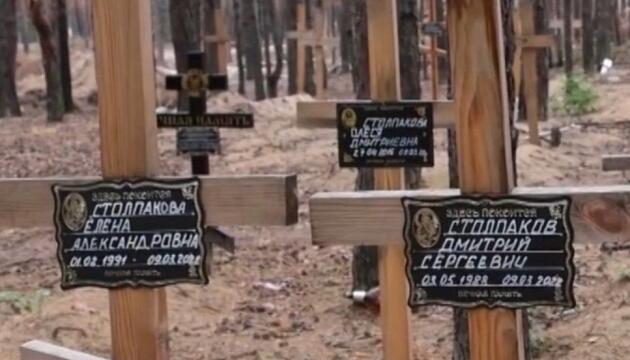
Ukrainian President Volodymyr Zelensky has said his country is in talks with G-7 nations to set up a war crimes tribunal which would investigate and punish Russia and its top officials and military leaders for “war crimes” committed amid the ongoing invasion, especially after some 440 “unmarked” graves were found in Kharkiv Oblast.

“This is an extremely important direction, which is important both in the context of European integration and in the context of the internal transformation of our state,” Zelensky said in reference to the EU recently bestowing ‘candidate status’ on Ukraine.

His comments came in an address to the nation Friday, just a day after EU chief Ursula von der Leyen visited the war-ravaged country and said in an interview that she wants to see Russian President Vladimir Putin face the International Criminal Court over war crimes.


Widely circulating photograph of grave site in Izium, which has become focus of war crimes allegations.

“That Putin must lose this war and must face up to his actions, that is important to me,” she told German television’s Bild. She expressed that there’s “no doubt” Russian forces have committed war crimes throughout the now seven-month war.

According to The Hill, “Zelensky said the proposal was made during a meeting of a group working to advance Ukraine joining the Organization for Economic Co-operation and Development (OECD), an intergovernmental association of democracies with market-based economies that work to stimulate economic growth.”

Currently, the United Nations said it has dispatched a forensic team of investigators to examine what Ukraine has alleged is a “mass grave” left in the wake of Russian forces’ retreat from the city of Izium in the east. Zelensky in his Friday remarks has alleged “torture chambers” used against civilians were found in the formerly Russian-occupied region. Zelensky has made the claims a focus of his latest charges against Russian troops:

“More than 10 torture chambers have already been found in various cities and towns liberated in Kharkiv region,” he added, describing the discovery of electrical implements for torture.

“That’s what the Nazis did. This is what Ruscists do. And they will be held accountable in the same way – both on the battlefield and in courtrooms,” he said, using the term “Ruscists” for “Russian fascists”.

Like with allegations surrounding Bucha before, reports of the mass burial sites quickly took over headlines in the West.

But curiously, some of the more sensational headlines perpetuated in the mainstream press were quickly and quietly walked back.

For example see the above and below Reuters headlines which came just hours apart…

The discrepancies in current claims, also given there has long been a fierce ‘propaganda war’ raging from all sides which is typical of any war, has led a number of independent analysts to examine the circumstances surrounding Izium.

For example, the analysis website Moon of Alabama concludes after a detailed look at the allegations of “mass graves” that “There is otherwise nothing unusual with that graveyard. During a war people on both sides die. Civilians suffer as much as soldiers while fighting around them is going on.”

“The city had been heavily defended by the Ukrainians and it took the Russian military the whole of March to take it,” the report continues. “A lot of the buried casualties were likely killed by artillery fire. There is no way to tell from which side that fire had came,” it adds.

Below: an Associated Press photo and caption…

Amid continued calls for an international inquiry into what happened at Izium and other places where Russian forces have been newly driven back amid Ukraine’s counteroffensive in the east, the Kremlin has vehemently denied carrying out the alleged atrocities.

While in Uzbekistan for last week’s Shanghai Cooperation Organization Summit, President Putin didn’t address the allegations directly, but stressed Russia is ‘not in a hurry’ in terms of achieving its goals during the “special operation” in Ukraine.