Car Manufacturers to Require Face Recognition to Drive Their Vehicles in the Near Future

by William McCurdy
BiometricUpdate.com

A slew of the world’s largest automakers, including Sony, Honda, Ford, Genesis, and Mullen Automotive, have all either recently announced or patented facial recognition technologies.

A newly unveiled prototype car from Sony and Honda, called “Afeela,” is set to employ facial recognition to unlock the vehicle and open its door.

The semiconductors and chipsets set to underpin this biometric tech will be provided by electronics giant Qualcomm.

The firms will start taking orders in 2025, with U.S. deliveries set to start in 2026.

Commenting on the move, Sony Honda Mobility President Izumi Kawanishi told Axios, that though the automotive industry has been “a very traditional business,” it is “growing up” by adopting products and software from the IT world.

Ford is yet another example of a major automaker that appears it could be getting into the action. In June, the auto giant filed a patent application for “enhanced biometric authorization,” which includes but is not limited to facial recognition.

Beyond just controlling access to the vehicle, the newly published patent filing covers technology where the user’s biometric data stored on the system can be updated automatically.

Read the full article at BiometricUpdate.com.

Joe Biden’s “Entire Act Is Unspooling”

Authored by James Howard Kunstler via Kunstler.com,

A Fun Day

“NATO has lost this war. Biden has lost this war. The lunatic Democrats have lost this war. The uni-party warmongers have lost this war. The EU has lost this war. Ukraine and Zelensky have lost this war.”

– Kim Dotcom

Somebody in the “Joe Biden” White House apparently thinks that the operations already underway are not enough to destroy our country fast enough, so a little extra push, such as nuclear annihilation, might get’er done.

By operations underway I mean things like mRNA vaccines stealthily deleting kin, friends, and public figures from the scene… decriminalizing crime… undermining the oil industry by a thousand cuts… liquidating small business… making little children insane over sex… flooding the land with illegal immigrants… devaluing the currency… queering elections — all of these things done on purpose, by the way. And if you complain about any of it, here comes the FBI or the IRS knocking on your door.

So, to make sure that a collapse of the USA comes on-schedule, there is the useful fracas created by our government geniuses over in Ukraine that creeps day-by-day toward a quick American assisted suicide. Just to remind you, here’s how that started: In 2014, the US fomented a coup against Ukrainian president Viktor Yanukovych. In short order, the Russian language was banned (despite the fact that Most Ukrainians speak Russian). A piqued Russia re-po’d the Crimean Peninsula. When ethnic Russians in eastern Ukraine (the Donbas provinces) tried to go their own way, Ukraine shelled and rocketed them for eight years. That was the setup.

All of the above was absolutely unnecessary, you understand. Ukraine had been going about its business the best it could since 1991 as a shlub nation with an aged-out Soviet infrastructure, some US-sponsored bioweapons labs, and no energy resources. It had been collecting royalties for allowing Russia to run oil pipelines across its fruited plain — of which, a lot of gas was siphoned off in transit by bandits. Ukraine attempted to compensate for its disadvantages by being an international money laundromat, though that only benefited its oligarch class (and the extended “Joe Biden” family).

After “Joe Biden” got “elected” in 2020, and news of his family’s sketchy business activities in Ukraine and elsewhere finally dribbled out, Ukraine was turned into a giant grenade and “JB” (or persons acting on his behalf) pulled the pin. NATO was dragooned into the quarrel as backup against its better judgment. If the objective was to weaken Russia, as stated by one of our strategic geniuses, SecDef Loyd Austin, it didn’t work out. Rather, it exposed the USA as a reckless global psychopath bent on wrecking every country it pretends to help — including the major countries in NATO.

Two-thirds of the world’s other nations then started backpedaling away from the US and its protective services to form an economic and security coalition around the BRICs group, as led by Russia and China. The Ukraine campaign itself was a loser from the get-go, relying utterly, as it did, on US and NATO support. This week’s NATO meet-up in Vilnius, Lithuania, showed how that’s going now: Not too well. The Ukraine army is shredded. It’s out of munitions. The US is also out of those very artillery shells most in demand. What to do?

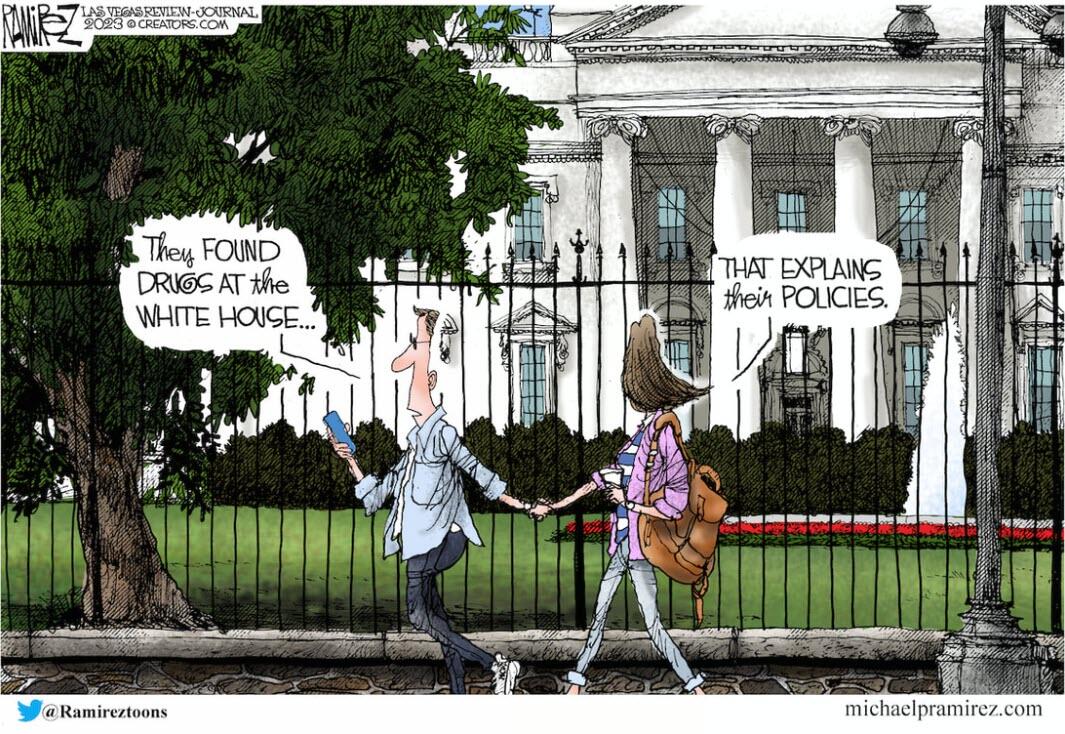
The answer to that, as “Joe Biden” returns from Europe to a White House haunted by a cocaine-snorting ghost, is to send three-thousand fresh reserve troops to Europe and promise a bunch of F-16 fighter planes. Said planes, which were introduced in the early 1970s, will come out of our country’s “high-mileage” inventory. These F-16s will require a suite of highly technical ground support infrastructure. They will not come with the latest avionics upgrades and will be no match for Russian air defenses. Good luck with that, President Z!

It’s all fakery, of course. What do we aim to do with those three-thousand US reservists? Send them into battle in Priyutnoye? I’m sure…. At this point, we can only pretend to prolong this stupid and unnecessary conflict with such lame gestures. Germany and France know this is a lost cause. The United Kingdom (so called) is such a mess that it literally doesn’t know what it’s doing in far off and irrelevant (to it) Ukraine. Without those countries, there is no NATO, really. So, the whole vaudeville this week was a sham — led by a US President who was too puny to attend the opening night banquet with fellow NATO leaders, and too incoherent to make a point on departure.

Anyway, “Joe Biden’s” entire act is unspooling. He is a prank that the Democratic Party played on the American people. Sometime before Halloween he will have to exit the scene in disgrace, gruesome as the prospect might seem, with Kamala Harris anxiously draining vodka bottles as she awaits history’s call at the old Naval Observatory. That will be a fun day in the USA, all righty.

The Strategic Initiative is Gradually Shifting to the Russian Side

Ramzai (Vladislav Shurygin, @Ramzayiegokomanda) writes about the transitional nature of the current situation at the front in the Ukrainian war:

The Ukrainian offensive has obviously run out of steam without achieving any results. Almost forty days of continuous fighting did not lead even to the breakthrough of the screening line.

At the same time, the Ukrainian Armed Forces put into battle up to 60% of the reserves at their disposal, losing up to 25% of their personnel, up to 30% of their tanks, 20% of their artillery, and up to 20% of their armoured vehicles. Further attempts to attack in all strategic directions, using the remaining reserves, have been accepted by the AFU command as futile, both from a military point of view and from a propaganda and political point of view. The success of the “offensive” planned for the NATO summit in Vilnius could not be achieved, and now the AFU command intends to focus on local offensive operations to improve their positions on different parts of the front and to wear down the Russian troops.

The AFU command retains up to eight “fresh” brigades (brigades that have not participated in the offensive) at its disposal. The combat capability of another eight brigades can be restored within three to four weeks. U.S. handlers have already become actively engaged in the process of remedying the losses by sending battalion-sized sets of Bradley IFVs and Stryker APCs, as well as artillery systems and ammunition from their forces in Europe. But it is not possible to recover losses in tanks. There is simply no place to get new tanks now.

The process of reviving the German Leopard 1 tanks from Rheinmetall warehouses is being delayed, and the first batches may arrive in Ukraine no sooner than the second half of August. In addition, the replenishment of the “worn down” brigades with personnel by means of urgent recruitment through yet-another mobilisation does not restore their combat capability. The mobilised men are nearly universally untrained, untested, and have zero motivation. They are joining companies and battalions that have suffered heavy losses, lost a large part of their most experienced fighters and, in turn, are equally demoralised. To consider such brigades “rebuilt” is a big mistake.

As a consequence, the strategic initiative is gradually shifting to the Russian side. The Russian command is increasingly moving from hard defence to offensive actions and has managed to squeeze the AFU in a number of directions.

There is every reason to believe that, after the AFU’s final loss of offensive capabilities, the Russian forces may launch an offensive in several directions. It can hardly be expected to have strategic goals—the Russian Armed Forces still do not have enough forces for that—but we can conduct at least two offensive operations at an army scale.

China’s Rise – In One Chart

by Mike Whitney via Unz Review

Look carefully at the chart above. What do you see?

You see the development of a high-speed rail system that is unrivaled anywhere on earth. You see the actualization of plan to connect all parts of the country with modern-day infrastructure that reduces shipping costs, improves mobility and increases profitability. You see a vision of the 21st century in which state-directed capital links rural populations with urban centers lifting standards of living across the board. You see an expression of a new economic model that has lifted 800 million people out of poverty while paving the way for global economic integration. You see an industrial juggernaut expanding in all directions while laying the groundwork for a new century of economic integration, accelerated development and shared prosperity.

Is there a high-speed rail system in the United States that is comparable to what we see in China today?

No, there isn’t. So far, less than 50 miles of high-speed rail has been built in the United States. (“Amtrak’s Acela, which reaches 150 mph over 49.9 miles of track, is the US’s only high-speed rail service.”) As everyone knows, America’s transportation grid is obsolete and in a shambles.

But, why? Why is the United States so far behind China in the development of critical infrastructure?

It’s because China’s state-led model is vastly superior to America’s “carpetbagger” model. In China, the government is directly involved in the operation of the economy, which means that it subsidizes those industries that enhance growth and spur development. In contrast, American capitalism is a savage free-for-all in which private owners are able to divert great sums of money into unproductive stock buybacks and other scams that do nothing to create jobs or strengthen the economy. Since 2009 US corporations have spent more than $7 trillion on stock buybacks which is an activity that boosts payouts to rich shareholders but fails to produce anything of material value. Had that capital been invested in critical infrastructure, every city in America would be linked to a gigantic webbing of high-speed rail extending from “sea to shining sea”. But that hasn’t happened, because the western model incentivizes the extraction of capital for personal enrichment rather than the development of projects that serve the common good. In China, we see how fast transformative changes can take place when a nation’s wealth is used to eradicate poverty, raise standards of living, construct state-of-the-art infrastructure, and lay the groundwork for a new century.

Here’s more from a report by the Congressional Research Service on “China’s Economic Rise…”

Since opening up to foreign trade and investment and implementing free-market reforms in 1979, China has been among the world’s fastest-growing economies, with real annual gross domestic product (GDP) growth averaging 9.5% through 2018, a pace described by the World Bank as “the fastest sustained expansion by a major economy in history.” Such growth has enabled China, on average, to double its GDP every eight years and helped raise an estimated 800 million people out of poverty. China has become the world’s largest economy (on a purchasing power parity basis), manufacturer, merchandise trader, and holder of foreign exchange reserves…. China is the largest U.S. merchandise trading partner, biggest source of imports, and the largest foreign holder of U.S. Treasury securities, which help fund the federal debt and keep U.S. interest rates low.
China’s Economic Rise: History, Trends, Challenges, and Implications for the United States, Congressional Research Service

Here’s more from an article at the Center for Strategic and International Studies titled Confronting the Challenge of Chinese State Capitalism:

China now has more companies on the Fortune Global 500 list than does the United States… with nearly 75 percent of these being state-owned enterprises (SOEs). Three of the world’s five largest companies are Chinese (Sinopec Group, State Grid, and China National Petroleum). China’s largest SOEs hold dominant market positions in many of the most critical and strategic industries, from energy to shipping to rare earths. According to Freeman Chair calculations, the combined assets for China’s 96 largest SOEs total more than $63 trillion, an amount equivalent to nearly 80 percent of global GDP. Confronting the Challenge of Chinese State Capitalism, Center for Strategic and International Studies

And here’s one more from a report by the IMF titled “Asia Poised to Drive Global Economic Growth, Boosted by China’s Reopening”:

China and India together are forecast to generate about half of global growth this year. Asia and the Pacific is a relative bright spot amid the more somber context of the global economy’s rocky recovery.
As the Chart of the Week shows, the region will contribute about 70 percent of global growth this year—a much greater share than in recent years.” Asia Poised to Drive Global Economic Growth, Boosted by China’s Reopening, IMF

In short, the Chinese state-led model is rapidly overtaking the US in virtually every area of industry and commerce, and its success is largely attributable to the fact that the government is free to align its reinvestment strategy with its vision of the future. That allows the state to ignore the short-term profitability of its various projects provided they lay the groundwork for a stronger and more expansive economy in the years ahead. Chinese reformer Chen Yun called this phenom the “birdcage economy”, which means the economy can “fly freely” within the confines of the broader political system. In other words, the Chinese leadership sees the economy as an instrument for achieving their collective vision for the future.

China’s success is only partially due to its control over essential industries, like banking and petroleum. Keep in mind, “the share of State-Owned Enterprises (SOEs) in the total number of companies in the country has dropped to just 5%, though their share of total output remains at 26%.” And even though the state sector has shrunk dramatically in the last two decades, Chinese President Xi Jinping has implemented a three-year action plan aimed at increasing competitiveness of the SOE’s by transforming them into “market entities” run by “mixed-ownership.” Simply put, China remains committed to the path of liberalization despite sharp criticism in the West.

It’s also worth noting that the so-called Chinese Miracle never would have taken place had China implemented the programs that were recommended by the so-called “western experts”. Had China imposed the radical reforms (like “shock therapy”) that Russia did following the dissolution of the Soviet Union in 1991, then they would have experienced the same disastrous outcome. Fortunately, Chinese policymakers ignored the advice of the western economists and developed their own gradual reform agenda that produced success beyond anyone’s wildest dreams. The story is summarized in a video on You Tube titled “How China (Actually) Got Rich”. I have transcribed part of the text below. Any mistakes are mine:

The single most stunning economic story of the last few decades has been the rise of China. From 1980 to 2020, China’s economy grew more than 75-fold…. It was the largest and most rapid improvement in material conditions in modern history…. China had been one of the poorest countries on earth but now it is an economic powerhouse… Economists predict it will overtake the US as the largest economy in the world by the end of the decade. People call it The Chinese Miracle. Some people describe this miracle as a straightforward story of the “free market”. They say “it’s a simple story. China was poor (but) then the economy was freed from the grip of the state. Now China is rich.” But this is misleading. China’s rise was NOT a triumph of the free market. ...
Since the 1980s, free market policies have swept the globe. Many countries have undergone far-ranging transformations. Liberalizing prices, privatizing entire industries, and opening up to free trade. But many of the economies that were subjected to the market overnight have since stagnated or decayed. None of them have had a growth record like the one seen in China. African countries experienced brutal economic shrinkage. Latin American countries experienced 25 years of stagnation. If we compare China to Russia, the other giant of Communism in the 20th Century, the contrast is even more staggering.
Under state socialism, Russia was an industrial superpower while China was still largely an agricultural economy. Yet during the same period that Chinese reforms led to incredible economic growth, Russia’s reform led to a brutal collapse. Both China and Russia had been economies that were largely ordered through state commands. ….Russia followed the recommendations of the most “scientific economics” at the time, a policy of so-called “shock therapy” As a basic principle, the idea was that the old planned economy had to be destroyed, to make space for the market to emerge…. Russia was expected to emerge as a full-fledged economy overnight. …When Boris Yeltsin took power he eliminated all price controls, privatized state-owned companies and assets, and immediately opened up Russia to global trade. The result was a catastrophe. The Russian economy was already in disarray, but shock therapy was a fatal blow. (Western economists) predicted some short-term pain, but what they didn’t see coming was how severe and destructive the effects would be. Consumer prices spiraled out of control, Hyperinflation took hold, GDP fell by 40%.
The shock therapy slump in Russia was deeper and longer than the Great Depression by a large margin. It was a disaster for ordinary Russians…. Alcoholism, childhood malnutrition and crime went through the roof. Life expectancy for Russian men fell by 7 years, more than any industrial country has ever experienced in peacetime. Russia did not get a free market overnight. Instead, it went from a stagnating economy to a hollowed-out wreck run by oligarchs. If just getting rid of price-controls and government employment didn’t create prosperity but did destroy the economy and kill huge numbers of people, then clearly, the rapid transition to “free markets” was not the solution.
Throughout the 1980s, China considered implementing the same type of sudden reforms that Russia pursued. The idea of starting from a clean slate was attractive, and shock therapy was widely promoted by (respected) economists… But in the end, China decided to not implement shock therapy. …Instead of knocking over the entire (economy) at once, China reformed itself in a gradual and experimental way. Market activities were tolerated or actively-promoted in non-essential parts of the economy. China implemented a policy of dual track pricing…. China was learning from.. the world’s most developed nations, countries like the US, UK, Japan and South Korea. Each of these managed and planned the development of their own economies. and markets, protecting early-stage industries and controlling investment.
Western free market economists thought this system would be a disaster …. But China’s leaders did not listen, and while Russia collapsed after following the “shock therapy” program, China saw remarkable success. The state kept control over the backbone of the industrial economy, as well as the ownership over the land,. As China grew into the new dynamics of its economy, state institutions were not degraded to fossils from the past, but were often the drivers at the frontier of new industries, protecting and guaranteeing their own growth. China today is not a free market economy in any sense of the word. It is a state-led market economy. The government effectively owns all land, and China leverages state ownership through market competition to steer the economy. The shock therapy approach advocated around the world was a failure. While Russia collapsed after its sudden transition, China’s gradual reforms allowed it to survive. And that made all the difference.” How China (Actually) Got Rich”, You Tube.

The fact that China’s SOEs are shielded from foreign competition and receive government subsidies, has angered foreign corporations who think China has an unfair advantage and is not playing by the rules. That is certainly fair criticism, but it’s also true that Washington’s unilateral sanctions—which have now been imposed on roughly one-third of all the countries in the world—are also a clear violation of WTO rules. In any event, China’s approach to the market under Xi has been ambivalent at best. And while “the state sector’s share of industrial output dropped from 81% in 1980 to 15% in 2005”, (in the spirit of reform) Xi has also ensured that the CCP has greater influence in corporate management and corporate decision-making. Naturally, none of this has gone-over well with US and EU businesses titans who firmly believe that corporate stakeholders should rule the roost. (as they do in the West.)

The larger issue, however, is not that China subsidizes its SOEs or even that China is set to become the biggest economy in the world within the next decade. That’s not the problem. The real problem is that China has not assimilated into the Washington-led “rules-based order” as was originally anticipated. The fact is, Chinese leaders are strongly patriotic and have no intention of becoming a vassal-state in Uncle Sam’s global empire. This is an important point that political analyst Alfred McCoy sheds light on in an article at Counterpunch:

China’s increasing control over Eurasia clearly represents a fundamental change in that continent’s geopolitics. Convinced that Beijing would play the global game by U.S. rules, Washington’s foreign policy establishment made a major strategic miscalculation in 2001 by admitting it to the World Trade Organization (WTO). “Across the ideological spectrum, we in the U.S. foreign policy community,” confessed two former members of the Obama administration, “shared the underlying belief that U.S. power and hegemony could readily mold China to the United States’ liking… All sides of the policy debate erred.” In little more than a decade after it joined the WTO, Beijing’s annual exports to the U.S. grew nearly five-fold and its foreign currency reserves soared from just $200 billion to an unprecedented $4 trillion by 2013. The Rise of China and the Fall of the US, Counterpunch

Clearly, US foreign policy mandarins made a catastrophic error-in-judgement regarding China, but now there’s no way to undo the damage. China will not only emerge as the world’s largest economy, it will also control its own destiny unlike western nations that have been subsumed into the oligarch-led system (WEF) that decides everything from climate policy to mandatory vaccination, and from transgender bathrooms to war in Ukraine. These policies are all set by oligarchs who control the politicians, the media, and the sprawling deep state. Again, the issue with China is not size or money; it’s about control. China presently controls its own future independent of the “rules-based order” which makes it a threat to that same system.

If we look again at the first chart (above), we can understand why Washington rushed into its proxy-war with Russia. After all, if China was able to spread its high-speed rail network across all of China in just 12 years, what will the next 12 years bring? That’s what worries Washington.

China’s emergence as regional hegemon on the Asian continent is a near-certainty at this point. Who can stop it?

Not Washington. The US and NATO are presently bogged down in Ukraine even though Ukraine was supposed to be a launching pad for spreading US military bases across Central Asia and (eventually) encircling, isolating and containing China. That was the plan, but the plan looks less likely every day. And remember the importance that national security advisor Zbigniew Brzezinski placed on Eurasia in his classic The Grand Chessboard nearly 3 decades ago. He said:

“Eurasia is the globe’s largest continent and is geopolitically axial. A power that dominates Eurasia would control two of the world’s three most advanced and economically productive regions. ….About 75 per cent of the world’s people live in Eurasia, and most of the world’s physical wealth is there as well, both in its enterprises and underneath its soil. Eurasia accounts for 60 per cent of the world’s GNP and about three-fourths of the world’s known energy resources.” (The Grand Chessboard: American Primacy And Its Geostrategic Imperatives, Zbigniew Brzezinski, p.31)

The consensus opinion among foreign policy mucky-mucks is that the United States must become the dominant player in Central Asia if it hopes to maintain its current lofty position in the global order. Former Undersecretary of Defense Paul Wolfowitz went so far as to say that Washington’s “top priority” must be “to prevent the re-emergence of a new rival, either on the territory of the former Soviet Union or elsewhere, that poses a threat on the order of that posed formerly by the Soviet Union.” Wolfowitz’s sentiments are still reiterated in all of recent US national security documents including the National Security Strategy and National Defense Strategy. The pundits all agree on one thing and one thing alone; that the US must prevail in its plan to control Central Asia.

But how likely is that now? How likely is it that Russia will be forced out of Ukraine and prevented from opposing the US in Eurasia? How likely is it that China’s Belt and Road Initiative will not expand across Asia and into Europe, the Middle East, Africa and even Latin America? Check out this brief excerpt on China’s Belt and Road plan:

China is building the world’s greatest economic development and construction project ever undertaken: The New Silk Road. The project aims at no less than a revolutionary change in the economic map of the world…The ambitious vision is to resurrect the ancient Silk Road as a modern transit, trade, and economic corridor that runs from Shanghai to Berlin. The ‘Road’ will traverse China, Mongolia, Russia, Belarus, Poland, and Germany, extending more than 8,000 miles, creating an economic zone that extends over one third the circumference of the earth.
The plan envisions building high-speed railroads, roads and highways, energy transmission and distributions networks, and fiber optic networks. Cities and ports along the route will be targeted for economic development.
An equally essential part of the plan is a sea-based “Maritime Silk Road” (MSR) component, as ambitious as its land-based project, linking China with the Persian Gulf and the Mediterranean Sea through Central Asia and the Indian Ocean. When completed, like the ancient Silk Road, it will connect three continents: Asia, Europe, and Africa. (and, now, Latin America) The chain of infrastructure projects will create the world’s largest economic corridor, covering a population of 4.4 billion and an economic output of $21 trillion
For the world at large, its decisions about the Road are nothing less than momentous. The massive project holds the potential for a new renaissance in commerce, industry, discovery, thought, invention, and culture that could well rival the original Silk Road. It is also becoming clearer by the day that geopolitical conflicts over the project could lead to a new cold war between East and West for dominance in Eurasia. The outcome is far from certain. (“New Silk Road Could Change Global Economics Forever”, Robert Berke, Oil Price)

The Future Is China

Xi Jinping’s “signature infrastructure project” is reshaping trade relations across Central Asia and around the world. The BRI will eventually include more than 150 countries and a myriad of international organizations. It is, without question, the largest infrastructure and investment project in history which will include 65% of the world’s population and 40% of global GDP. The improvements to road, rail and sea routes will vastly increase connectivity, lower shipping costs, boost productivity, and enhance widespread prosperity. The Belt and Road is China’s attempt to replace the crumbling post-WW2 “rules-based” order with a system that respects the sovereignty of nations, rejects unilateralism, and relies on market-based principles to affect a more equitable distribution of wealth.

The BRI is China’s blueprint for a New World Order. It is the face of 21st century capitalism and it is bound to shift the locus of global power eastward to Beijing which is set to become the de facto center of world.

H. L. Mencken – Democratic Man

NOTES ON DEMOCRACY By H. L. MENCKEN “DEMOCRATIC MAN: HIS APPEARANCE IN THE WORLD” Published in 1926 –

Democracy came into the Western World to the tune of sweet, soft music. There was, at the start, no harsh bawling from below; there was only a dulcet twittering from above. Democratic man thus began as an ideal being, full of ineffable virtues and romantic wrongs — in brief, as Rousseau’s noble savage in smock and jerkin, brought out of the tropical wilds to shame the lords and masters of the civilized lands.
The fact continues to have important consequences to this day. It remains impossible, as it was in the eighteenth century, to separate the democratic idea from the theory that there is a mystical merit, an esoteric and ineradicable rectitude, in the man at the bottom of the scale that inferiority, by some strange magic, becomes a sort of superiority — nay, the superiority of superiorities.

Everywhere on earth, save where the enlightenment of the modern age is confessedly in transient eclipse, the movement is toward the completer and more enamoured enfranchisement of the lower orders. Down there, one hears, lies a deep, illimitable reservoir of righteousness and wisdom, unpolluted by the corruption of privilege. What baffles statesmen is to be solved by the people, instantly and by a sort of seraphic intuition. Their yearnings are pure; they alone are capable of a perfect patriotism; in them is the only hope of peace and happiness on this lugubrious ball. The cure for the evils of democracy is more democracy! ….

Early democratic man seems to have given little thought to to the democratic ideal, and less veneration. What he wanted was something concrete and highly materialistic – more to eat, less work, higher wages, lower taxes. He had no apparent belief in the acroamatic virtue of his own class, and certainly none in its capacity to rule. His aim was not to exterminate the baron, but simply to bring the baron back to a proper discharge of baronial business. When, by the wild shooting that naturally accompanies all mob movements, the former end was accidentally accomplished, and men out of the mob began to take on baronial airs, the mob itself quickly showed its opinion of them by butchering them deliberately and in earnest. Etc.

…the great boon of democracy: the man of native integrity is either barred from the public service altogether or subjected to almost irresistible temptations after he gets in. …

In most other countries of a democratic tendency — for example, England – this outlawry and corruption of the best is checked by an aristocratic tradition – an anachronism, true enough, but still extremely powerful, and yielding to the times only under immense pressure. The English aristocracy (aided, in part, by the plutocracy, which admires and envies it) not only keeps a large share of the principal offices in its own hands, regardless of popular rages and party fortunes; it also preserves an influence, and hence a function, for its non-office-holding members. The scholarship of Oxford and Cambridge, for example, can still make itself felt at Westminster, despite the fact that the vast majority of the actual members of the Commons are ignoramuses.

But in the United States there is no aristocracy, whether intellectual or otherwise, and so the scholarship of Harvard, such as it is, is felt no more on Capitol Hill than it is at Westerville, Ohio. The class of politicians, indeed, tends to separate itself sharply from all other classes. There is none of that interpenetration on the higher levels which marks older and more secure societies.

Roosevelt, an imitation aristocrat, was the first and only American President since Washington to make any effort to break down the barriers. A man of saucy and even impertinent curiosities, and very eager to appear to the vulgar as an Admirable Crichton, he made his table the resort of all sorts and conditions of men. Among them were some who actually knew something about this or that, and from them he probably got useful news and advice. Beethoven, if he had been alive, would have been invited to the White House, and Goethe would have come with him.

https://archive.org/stream/NotesonDemocracyH.L.Mencken11/Notes%2Bon%2BDemocracy%2B-%2BH.L.%2BMencken%20%281%29%20%281%29_djvu.txt

The NATO Ultimatum to Ukraine – Win by Winter or Die

Ed. Note: According to Andrew Vajra – “in Ukraine, 32% believe that Kiev needs six months or a year to win, 30% – more than a year, and 17% believe that several months or less are needed to achieve it. Only 1% of Ukrainian citizens do not believe in the victory of Ukraine. If we proceed from what is in the minds of most of my acquaintances in Ukraine, then the results of the survey as a whole reflect psychic reality. They really believe in their inevitable victory. Sincerely.”

But here is the reality of the upcoming Ukrainian defeat.


By John Helmer, Moscow
@bears_with

For all its public talk, NATO has agreed on a secret six-month plan for Ukraine. It’s a case of do or die by December.

Either the Ukrainian forces, firing everything the NATO allies can give them — from US cluster munitions to Franco-English Storm Shadow missiles and German Leopard tanks — will gain territory and advantage over the Russians; or else the Kiev regime will be destroyed and must fall back on Lvov while NATO beats its own retreat westward from the Polish and Romanian borders — its military capabilities defeated but its Article Five intact.

This is hardly a secret. “Whatever is achieved by the end of this year will be the baseline for negotiation”, the Czech President Petr Pavel, former Czech and NATO army general, announced on the first day of the summit meetings in Vilnius. There is no more than a six-month window of opportunity, Pavel added, which will “more or less close by the end of this year”. After that, “we will see another decline of willingness to massively support Ukraine with more weapons.”

The difference between the Czech’s “more or less” was explained to Ukrainian President Vladimir Zelensky by Henry Kissinger on the telephone. But the telephone was rigged, and Kissinger was talking instead to the Stavka in Moscow, in the guise of the pranksters Vovan and Lexus.

After justifying himself at length for initially opposing NATO membership of the Ukraine, and then mispronouncing the word “anomalous”, Kissinger acknowledged there is a problem for the Biden Administration to combat European government opposition to NATO membership for the Ukraine. The Ukrainians must fight against that, too, he implied. So long as the US is backing Zelensky, it is necessary for the Ukrainian offensive to demonstrate small territorial advantages; abandon more ambitious ones (like Crimea); and only then agree to ceasefire talks. Although Kissinger told Zelensky he had been speaking with US “military people”, he gave no hint that they had warned him the Ukrainians are facing defeat on the battlefield, and the loss of both territory and European support.

The Russian General Staff calculation is different.

At the current rate of battlefield casualties – announced by the Defense Ministry counting conservatively — by December 31 the Ukrainian army will lose between 75,000 and 100,000 dead, and up to 300,000 wounded and out of combat. In parallel, the destruction of NATO weapons will accelerate faster than the NATO states can resupply and deliver them, or replacement parts to keep the surviving stock going at the front. By the time Russia’s General Winter takes control of the battlefield, there will be too few Ukrainian fighting men left, and insufficient weapons and ammunition, to resist the start of the Russian offensive. A demilitarized zone of mines and cluster bomblets will have taken shape over several hundred kilometres west of the surrendering Odessa, Nikolaev, and Kharkov; they will abandon Kiev when Kiev abandons them.

The Russian target then will be to drive what remains of the Ukrainian regime, its flags, tattoos, money, and stay-behind terrorism plans, into an enclave around Lvov. The NATO window, as General Pavel called it, will have been opened, but then will be closed to keep NATO itself from catching cold.

One of the unreported outcomes of the Wagner mutiny, and of the June 29 meeting in Moscow between President Vladimir Putin and Yevgeny Prigozhin, is Putin’s commitment to fight for nothing short of the Ukraine’s rout to Lvov, and the NATO retreat westward in the footsteps of the Grande Armée and the Wehrmacht. This too is incomprehensible at NATO headquarters.

The text of the 22-page, 90-paragraph agreement by the NATO allies declares at the penultimate, 89th paragraph that “NATO remains the strongest Alliance in history. As in the past, we will stand the test of time in safeguarding the freedom and security of our Allies and contributing to peace and security.” To make this point less than wishful thinking, the earlier paragraphs keep the Ukraine out of the NATO alliance but with a verbal promise which makes the indefinite future tense appear to be the present tense.

“Ukraine’s future is in NATO. We reaffirm the commitment we made at the 2008 Summit in Bucharest that Ukraine will become a member of NATO, and today we recognise that Ukraine’s path to full Euro-Atlantic integration has moved beyond the need for the Membership Action Plan.”

To get from the present to the future, the communiqué promises interoperability with NATO weapons management, and joint command-and-control for warfighting against Russia (China too). “Allies will continue to support and review Ukraine’s progress on interoperability as well as additional democratic and security sector reforms that are required. NATO Foreign Ministers will regularly assess progress through the adapted Annual National Programme. The Alliance will support Ukraine in making these reforms on its path towards future membership.”

“We have decided to establish the NATO-Ukraine Council, a new joint body where Allies and Ukraine sit as equal members to advance political dialogue, engagement, cooperation, and Ukraine’s Euro-Atlantic aspirations for membership in NATO. It will provide for joint consultations, decision-making, and activities [sic], and will also serve as a crisis consultation mechanism between NATO and Ukraine.”

The impact is pushing the NATO allies to withdraw back over the Vistula and Oder Rivers towards Berlin and Paris with this admission: “We will be in a position to extend an invitation to Ukraine to join the Alliance when Allies agree and conditions are met.” They don’t agree now. The conditions will not be met, cannot be met, if and when – after the coming winter — the capitulation of the Ukrainian armed forces will have been conceded, and the retreat to Lvov begun, leaving the demilitarized zone (DMZ) and Novorossiya to the east.

French General Staff officers have been conceding this retreat by camouflaging it as “not a French war, perhaps an American one”. According to another retired French general, Jean-Bernard Pinatel, “I absolutely do not believe in the success of the Ukrainian counteroffensive…the biggest disadvantage Ukraine faces is [not] so much the amount of military equipment, which by the way is not always of high quality, because the West supplies Kiev with outdated equipment. Ukraine’s greatest vulnerability is its people, or rather a lack of them. Its best fighters have long been dead.”

Retired German generals have been saying in public the same things on behalf of active service general staff officers in Berlin who remain under the gag of German government. Read them – retired Major General Harald Kujat here; Vice Admiral Kai-Achim Schonbach; and retired Brigadier General Erich Vad. In order to make war on Russia, French President Emmanuel Macron and German Chancellor Olaf Scholtz are not only gagging their military leaders but also avoiding accountability and voting by the Assemblée National and the Bundestag.

On the front, the current daily casualty rate for Ukrainian forces, men and weapons, since July 1 looks like this:

UKRAINIAN LOSSES OF MEN AND ARMS IN THE FIRST WEEK OF JULY

Source: http://smoothiex12.blogspot.com/

If the daily loss of men averages 500 per day, and the rate of Ukrainian offensive operations continues, then by December 31, the Ukrainian losses will have totalled another 75,000 men. If the rate of attacks is escalated, and the number of killed in action (KIA) averages 715, as it did in the first week of this month, the total losses will reach 107,000. At that point the strategic reserves of men will have been exhausted.

The losses of tanks, other armoured vehicles, artillery and rocket launchers are also increasing at a faster rate than NATO can repair or replace. The new summit communiqué promises “to further step up political and practical support to Ukraine as it continues to defend its independence, sovereignty, and territorial integrity within its internationally recognised borders, and will continue our support for as long as it takes.” For as long as it takes is short because the time is running out for the Kiev regime; and its replacement in Lvov will have neither the space, the range, nor the manpower to recover the territory it has lost.

STRATEGIC RESERVES OF UKRAINE’S WEAPONS & NATO REPLENISHMENT,

KEY: magenta=available at the beginning of the Special Military Operation, February 24, 2022; light blue=delivered since then by NATO and other western states; blue=promised for delivery by NATO and other states. Source https://t.me/readovkanews/62281 -- July 10, 2023

The Russian assessment, openly published this week, is that “by the end of the year, Kiev will not have a strategic armoured reserve — the volume of foreign supplies to Ukraine is on the decline. It’s no secret that the combat capability of the Armed Forces of Ukraine [AFU] is based on the supply of shells and equipment from abroad. We have already analysed the schedule of what has been received, the costs and the losses of these operations, and we can see the culmination of these efforts [on the battlefield]. Enemy losses are heavy, and there is nothing to replace them with because deliveries cannot be made instantly.”

“About four to five months elapse between the period of active announcements of deliveries and the actual fact of the transfer of weapons to Kiev. Right now we are destroying tank columns whose armoured vehicles were promised for transfer at the very beginning of 2023. The nuance is that no additional deliveries were announced in the second quarter. Perhaps something will be announced at the NATO summit in Vilnius, but the arrival of tanks and infantry fighting vehicles will not happen before the beginning of 2024. In the event of failure of the Ukrainian counteroffensive, the Russian army will have an additional head-start.”

“If at least the 471 tanks promised by the West have already arrived in Ukraine, then only 286 are additionally expected, some of which will arrive no earlier than 2024. The situation is similar with infantry fighting vehicles and howitzers — more than two-thirds of the total planned deliveries have already been implemented, so there are practically no reserves left. Despite the fact that both what has already been delivered and what is expected to be delivered are inferior in quantity to the old Soviet equipment in service with Ukraine (we have not even taken into account the vehicles which can be cannibalized for parts or upgraded). The prospects are obvious — on the horizon of the next six months, the AFU will have no sources with which to replenish the thinned-out units. The balance of forces at the front may significantly shift in our favour.”

An American veteran with NATO service in Afghanistan adds: “Given NATO’s inability to make up for the Ukrainian materiel losses at the front, the bottom-of-the-barrel conscript base, and increasing Russian military proficiency across the board, we could very well see the move to establish a DMZ before the Fall is out.”

“From the volume of reports I read regarding Russian strikes on Ukrainian logistics hubs, storage and marshalling areas, I am amazed by how they are managing to maintain the current tempo of operations. This being said, the Ukrainians and their handlers seem to be doing a good job of keeping much information regarding shortages or disruptions quiet for public consumption. Yes, we get the word about the need for more of this or that weapons system, or ammunition, but reading reports from both sides, the shells, missiles, rockets, etc., continue to fly from the Ukrainian side at the Russian defence line with regularity – also with walking-dead lack of quality that seems to be limitless.”

“A clue to the effectiveness of Russian interdiction is the inability of the Ukrainians to concentrate powerful forces at any point to achieve a breakthrough. The concentration at Artemovsk [Bakhmut] provides some clues. There are more than sixty thousand Ukrainians and foreign legionnaires concentrated on that front. The composition is heavily mechanised and well-supported by artillery. They are constantly in action, constantly on the attack. And yet despite their being very menacing and able to bleed outnumbered Russian defenders, they’ve not achieved much while expending huge resources.”

“Looking at other sectors of the line, such as Zaporozhye and South Donbass, it appears that the attacks, while violent, don’t have the same level of strength or stamina. The Russians are confident enough to give ground, shell their abandoned trenches, force the Ukrainians to retreat or face slaughter, and repeat the process time and time again. The Ukrainians just don’t have the resources to suppress the Russians, press the attack, and make real gains. There are several reasons to explain this. Ammunition, fuel, spares, even food, may all be in shorter supply than anyone is reporting. Logistic routes and transportation may be compromised to the point where only segments of the front can be adequately supplied at any one time – a large part of this situation may be due to the lingering effects of the electric war. Russian strikes on the NATO command-and-control centres may be undermining the Ukrainian/NATO capacity to coordinate supply trains. This is a very under-reported aspect of the war.”

From New York the century-old Henry Kissinger has confirmed to the fake Zelensky that the Biden Administration wants the Ukrainian forces to demonstrate enough gains against the Russians to retain European country support, and not to risk ceasefire talks until the battlefield gains are in place; otherwise the Europeans will stop their support, and refuse to allow Ukraine’s admission into NATO.

Left: Vovan & Lexus: Right, Henry Kissinger displaying pictures of Eleanor Roosevelt (rear left), Richard Nixon (centre), and Nelson Rockefeller (right).

“Europe”, said Kissinger, “has organised itself to defeat Russia and it would be anamalous [sic] if Finland and Sweden go into NATO but Ukraine, which has sacrificed so much, is not admitted into NATO… Ukraine will be a major country after the war, and after it is rebuilt, it should be in NATO…. We had a Bilderberg meeting…and it was very strange that the European countries that are fighting [Russia] — technically they are supporting you –at that meeting were not in favour of [Ukraine] going into NATO. I was… It will be difficult to engineer membership in NATO.”

Between ceasefire negotiations and final peace negotiations, Kissinger said , “you [Zelensky] understand that after a ceasefire it will be very difficult to start the war again with total allied support… I believe the trend in America now is towards a ceasefire… I believe you will be able to conduct your current offensive with full support. I believe our people believe that you will not have total success, that you will regain some territory but not everything. That’s what I was told by military people.

NOTE ON THE LEAD IMAGE: the snake cut into pieces represented the thirteen original British colonies of America. The cartoon with the original caption, “Join or Die”, was published in Philadelphia by Benjamin Franklin in 1754 as a call for unity among the colonies facing their indigenous and French adversaries. It then became the American colonial rallying cry in the war against the British.

American Military Hardware – Like Fashion Design, Not Made to Last

by Claudiu Secara

Apologies for the foul language in the video below. It’s how real soldiers from the frontline talk. Not for ladies.

But he says it all, bluntly. He talks about the Internet-of-all-things as the tool for brainwashing on a global scale. I would rather consider the movie industry and television as mind poison on a universal scale and with instant effect as being even more pernicious. Just look at the fashion mania. Within weeks (if not days) of the appearance of some new, must-have vestment, all across the continents young people are wearing the same new status-symbol clothing. Same for hairdos, same for metal-piercing of nostrils and lips and ears. Same for the tattoo insanity, etc., etc.

But our soldier has it right. It’s all salesmanship and no substance. All Madison Avenue PR and not quality of product, be it shoes, cars, tanks or space rockets. American products are made to be replaced with new gimmicks masquerading as better, newer, fancier, “more advanced.” Commerce and the art of turning big profits are the best skills that America has to offer to the world.

But military hardware, top military weapons?! Listen to the Russian soldier. He has tested them first hand and he knows how well they perform in real battlefield conditions. Shiny metal scrap.

More importantly, what looked like ominous signs only a few days ago turn out to be the (possible) lights at the end of the tunnel, the turning point in the Ukraine story. Something crucial happened in the last few days (weeks?).  The neocons/Biden’s plan was to make a big, big display of force in Vilnius by setting a fast track for Ukraine’s accession to NATO, followed by a full-blown war, NATO vs Russia. Did you notice Biden’s body language a few weeks ago, running and jumping like a man who has just won the lottery? And then you see a different Biden in London. Empty eyes, doddering around like a dead man walking, helped by His Majesty the King as his aide. Same when he met Erdogan in Vilnius. No sense of victory there.

The day before, he had it all lined up:

1. He forced France to sign on to the Ukraine plan: NATO membership, armed with long range missiles, new financial aid package, etc.

2. He forced Erdogan to agree to Sweden’s accession to NATO, the freeing of the Azov prisoners and, of course, Ukraine’s joining NATO –  or face a ready-made orange revolution that was already in place.

But then something crucial happened. Was it the appearance of Dr. Gal Luft, a dual US-Israeli citizen, friend of Russia’s Sputnik News all this time, who escaped arrest in Cyprus, and is now the star witness ready to testify in Congress to Biden having personally received a $100,000-a-month bribe from one Chinese military source alone (some $15 million in total) plus some $60,000 a month to Hunter, etc.?

Or maybe it was the noose around Hunter Biden’s neck that is tightening – related to the famous laptop revealing so many other felonies?

But let’s get back to the complete failure of American weapons’ conception and their worthlessness on the battlefield.

NATO’s Big Climb Down

Ed. Note: Consider the change in the body language: the indulgent smirk on Stoltenberg‘s face.

**********************************************
via Moon of Alabama

From the:

Vilnius Summit Communiqué
Issued by NATO Heads of State and Government participating in the meeting of the North Atlantic Council in Vilnius 11 July 2023:

11. [ . . . ] The Alliance will support Ukraine in making these reforms on its path towards future membership. We will be in a position to extend an invitation to Ukraine to join the Alliance when Allies agree and conditions are met.

The statement ‘when Allies agree and conditions are met’ sets arguably a higher bar than the 2008 Bucharest Summit Declaration had promised:

23. NATO welcomes Ukraine’s and Georgia’s Euro-Atlantic aspirations for membership in NATO. We agreed today that these countries will become members of NATO. Both nations have made valuable contributions to Alliance operations. We welcome the democratic reforms in Ukraine and Georgia and look forward to free and fair parliamentary elections in Georgia in May. The Membership Action Plan (MAP) is the next step for Ukraine and Georgia on their direct way to membership. Today we make clear that we support these countries’ applications for MAP. Therefore we will now begin a period of intensive engagement with both at a high political level to address the questions still outstanding pertaining to their MAP applications. We have asked Foreign Ministers to make a first assessment of progress at their December 2008 meeting. Foreign Ministers have the authority to decide on the MAP applications of Ukraine and Georgia.

Also note that the ‘conditions’, just like the rules in the ‘rules based order’, are undefined. It seems like any NATO member will be able to define its own ones.

Added:

Also note this from the:

Pre-Summit press conference
by Secretary General Jens Stoltenberg ahead of the NATO Summit in Vilnius

Iryna Somer, Interfax Ukraine
Thank you Oana. Iryna Somer, Ukrainian News Agency Interfax Ukraine. I have follow up question on Mindaugas, regarding declaration. I do understand you can’t comment on the language which will in decleration regarding membership. But can you tell us how far or how close Allies are regarding wording in the declaration regarding a possible membership for Ukraine, which also will be satisfactory for Kyiv? Thank you.NATO Secretary General Jens Stoltenberg
[…]
We will provide support to Ukraine for as long as it takes. Because unless Ukraine wins this war, there’s no membership issue to be discussed at all.

Ukraine’s victory in the war, which is unachievable, is now a main condition for its admittance to NATO.

It wasn’t what the Ukrainian government had wanted to hear.

Via Strana.news (machine translation):

“Unprecedented and absurd.” Zelensky criticized the allies for the lack of an invitation to NATO – 13:59, Today

Ukrainian President Volodymyr Zelensky commented on Western leaders’ plans not to include any specifics on Ukraine’s NATO membership in a forthcoming statement.
“Now, on the way to Vilnius, we received signals that language without Ukraine is being discussed. And I want to emphasize that this wording is only by invitation, and not by Ukraine’s membership. It is unprecedented and absurd when there is no time frame for the invitation (! ), and for the membership of Ukraine; and when some strange wording about “conditions” is added even for inviting Ukraine
It seems that there is no readiness either to invite Ukraine to NATO or to make it a member of the Alliance. Consequently, there remains the possibility of bargaining Ukraine’s membership in NATO – in negotiations with Russia. And for Russia, this means motivation to continue its terror. Uncertainty is weakness. And I will frankly discuss this at the summit,” Zelensky wrote.

Well. The little comedian seems disappointed. As if the whole play had not been obvious from the very beginning. Since 2008 the Ukraine was to be used as a tool to nag Russia. It is otherwise of little value. It will end up as a discarded rag while NATO will, in the end, again recognize the Russian Federation as the super power that that it is. NATO will have to relearn to listen to and negotiate with it.

Now lets wait and see what NATO’s climb down will do to the morale and motivations of the Ukrainian army and people.

NATO Conference – Grandstanding Rhetoric, while Smelling Defeat

A very agitated NATO Secretary General Jens Stoltenberg said that if Ukraine does not prevail as a “sovereign and independent nation” then the question of Ukraine’s membership in NATO is no longer.

But isn’t that what Russia demands?

China refuses to condemn Russia’s war against Ukraine. China is increasingly challenging the foundations of the “international rules-based world order”, so the allies will work together against such behavior by China.

International rules-based world order, but not international law… ?!

Wait a minute, doesn’t China have a right to choose its own path just like Ukraine? And if so, then what are you, Jens, going to do vis-a-vis China?

EU Support for Ukraine will Wane – Czech President

Ukraine should aim to regain as much territory as it can from Russia before the end of the year as it may not have a second chance at a counteroffensive, Czech President Petr Pavel has warned. He cited general “war fatigue” and the upcoming presidential elections stateside as potential reasons why Kiev’s backers may have less of an appetite for a continuation of hostilities.

In an interview with Britain’s Sky News TV channel broadcast on Tuesday, Pavel acknowledged that while “in an ideal world” he would want to see Ukraine regain control of all its territories within its 1991 borders, this may not be realistic.

He added that the situation will likely look “slightly different,” with Kiev ready to start talks with Moscow “once they expire all the possibilities of advancing.”

The official went on to predict that Russian President Vladimir Putin would probably arrive at the same conclusion at some point, with neither Ukraine nor Russia being interested in a frozen conflict.

“So, what Ukraine is now aiming for is to get control of as much territory as possible by the end of this year, because then we’ll have an entirely different situation,” the Czech president explained.

According to the official, who previously served as a top NATO military commander, Kiev will have a hard time mustering forces for a second counteroffensive.

The Financial Times reported last month that Western officials had been unimpressed by Kiev’s battlefield performance. The paper’s sources claimed that long-term Western support for Ukraine would be contingent on the eventual outcome of the counteroffensive.

Russia’s Defense Ministry, in turn, has reported that its forces have so far successfully repelled the push, which began in early June.

via RT