The Americans are sending to Israel their latest missiles to be used in the ethnic cleansing of Gaza. Blast Overpressure Injuries – and why children are disproportionately affected by them.
Monthly Archives: December 2023
NATO: A Defunct Yalta Relic, Says Ukraininan
Arestovich again stated that the war in Ukraine can only be ended through global negotiations between the West and Russia, which will establish new rules of the game in Europe.
In his opinion, joining NATO will not help Ukraine, since this organization “does not work” and is a “relic” of the defunct Yalta system that emerged after the Second World War.
“We need to sit down for a very serious conversation about what the real interests of the parties are and the causes of conflicts, and build the system anew,” Arestovich said. But he believes that Western leaders are not capable of this, and Henry Kissinger, “the last politician who knew how to think like an adult,” has died.
“Everyone tried to wipe themselves with real Russian interests – they got a war. And they turned out to be unable to wage this war. And Russia, gritting its teeth and losing a huge number of people, is waging this war. Crookedly, but it is waging,” says Arestovich.
Therefore, he believes, we need to start “talking seriously with Russia” and “stop talking about democracy and dictatorship.” But Arestovich does not see such aspiration either in Ukraine or in the West. “This means that the war will continue. And if we conduct it the way we are now, then it will continue in a way that we will not like,” he added.
Source: Ukrainian
US Sponsor of Terrorism?! Are you Kidding?

“There shouldn’t be a single Russian who goes to bed without wondering if his throat will be cut in the middle of the night.”
American General Mark Milley, then chairman of the US Joint Chiefs of Staff, made this appeal during a visit to Wiesbaden, Germany, to Ukrainian special forces who were working there with the American Green Berets, “in the hope of inspiring them to conduct operations in enemy-controlled territories.”
“You have to go back there and create a campaign on the home front,” The Washington Post source quoted him as saying.
The Royal Bastard on Climate Warming for Thee but Not for Me
Authored by Chris Morrison via The Daily Sceptic,
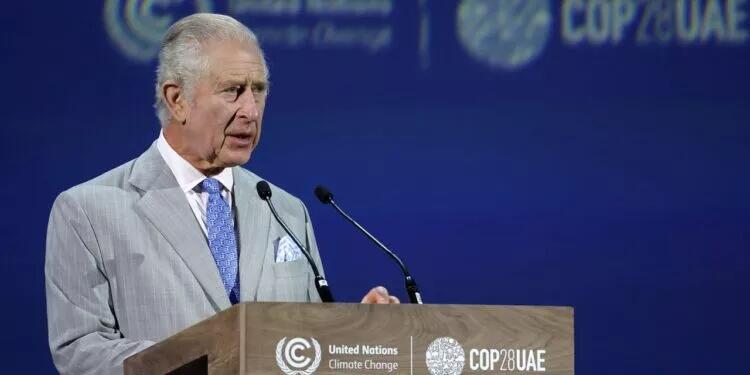
It could have been worse. King Charles could have ascended to his desert dais and pronounced that we had just 96 months to avert “irretrievable climate and ecosystem collapse”. But that was the Right Charlie back in 2009, giving us the benefit of his sandwich-board scientific wisdom. These days it is all fashionable bad weather and undefined “tipping points”. The man is now King, and at COP28 he threw away his irksome politically-neutral constitutional role, wrapped himself in Guardianista pseudoscience, and punched down hard on the poor who will be forced to pay for the collectivist madness that is the Net Zero project.

King Charles is no friend of general humanity. Speaking at COP28, he said: “The Earth does not belong to us, we belong to the Earth.” As with many know-your-place elitists, he appears to abhor the impacts that humans have on the planet. He exhibits, sadly on a world stage, a snobbish distain for capitalism – what used to be dismissed in British aristocratic circles as ‘trade’. This capitalist trend over the last 200 years has harnessed the power of natural hydrocarbons to raise billions to a standard of living and health unimaginable to previous generations. In 2009, Charles said we can no longer afford consumerism and the “age of convenience” was over.
Not for the new British King, it need hardly be observed. He lives a life of pampered indulgence where no expense is spared to ensure his every comfort. On his accession to the throne, he added considerably to his Palace Portfolio. To spread his malevolent Net Zero fantasies, he has a fleet of cars, private planes and even a personal train at his command. He uses these to call for “transformational action” to be taken to save the planet. In his COP28 speech, he called for the restoration of nature, the need for sustainable agriculture, and co-operation between the public and private sectors.
Few calls could be more political in tone. The restoration of nature and sustainable agriculture is shorthand for largely meat-free diets and massive reductions in nitrogen fertiliser. The latter, in particular, will lead to worldwide famine. COP28 seems set to announce new food and agriculture restrictions using the tactic of demonising methane, a gas emitted by animals and humans that is barely measurable in the atmosphere due to a very short lifecycle. Whenever the subject of ‘co-operation’ between public and private sectors is raised, there is an immediate dash to count the spoons, since it can only signal a large transfer of cash from productive industries to unproductive and inferior green operations.
At one point in his COP speech, King Charles veered into sandwich-board territory claiming that “we are seeing alarming tipping points being reached”. There was no evidence presented to justify this claim, often made by climate extremists using modelled data. In fact, he didn’t even refer to any actual ‘tipping’ event that has been reached. Many scientists have concluded that bad, or extreme, weather events are no worse than in the immediate past. Many categories of natural disasters such as floods, droughts and ecosystem productivity “show no clear positive trend of extreme events”, note a group of four Italian scientists. They argue that the data shows there is no “climate emergency”.
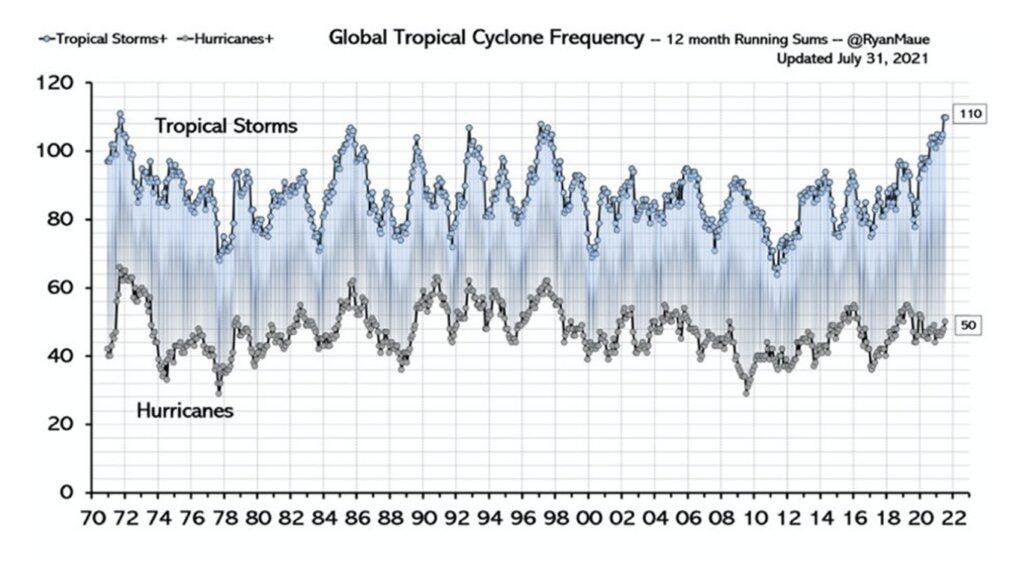
None of these facts seem to matter to a political King, who, like a stuck Guardian record, keeps on pressing on with made-up emotional stories of impending climate Armageddon. At one point he referred to repeated cyclones battering vulnerable islands, something that cyclones have always done.

The King can always cherry-pick individual storms but there is plenty of evidence to show that hurricane and cyclone frequency, along with intensity, has changed little over the recent historical record, as the above graph shows.
Wildfires are a bit of a dud when it comes to whipping up climate hysteria, not least because the UN Intergovernmental Panel on Climate Change notes that most conflagrations are started by humans. “Human activities have become the dominant driver,” it observes. But when there is political Net Zero work to be done, the King is only too happy to overlook the evidence. In common with many other countries this year, Canada experienced its worst wildfires for a century, he said.

Despite all the human involvement, the above graph shows the gradual decline of global emissions from wildfires over recent decades. In fact, wildfires are almost impossible to pin on any changes on climate since so many other factors, such as arson and land management, are in play.
Net Zero is rapidly becoming the dominant political issue of the age. Its obvious collectivist nature gathers support from mostly sectional interests in society. It has no significant grassroots support, since it aims to restrict human lifestyles and wealth on a scale never attempted before in history. It is awash with junk science, fake statistics and computer models.
The late Queen, in her infinite wisdom, never went anywhere near it.
Chris Morrison is the Daily Sceptic’s Environment Editor.
Stop Press: David Cameron at COP28 has said the U.K. will pay £60 million in climate reparations to developing countries.
Assessing the Economic Value of Military Materiel
by Philip Pilkington via American Affairs Journal
The war in Ukraine has exposed some serious misperceptions about the relative economic size and military power of major nations. Before the war, it was fashionable to say—usually sardonically—thatRussia possessed an economy similar in size to that of Italy or smaller than that of Texas. “The Russian economy will be cut in half,” President Biden tweeted on March 26, 2022, “It was ranked the 11th biggest economy in the world before this invasion—and soon, it will not even rank among the top 20.”1
The statistics that the president used for this comparison were nominal GDP numbers measured in U.S. dollars. It is unclear why the president’s economic advisers did not direct him to the purchasing-power-parity-adjusted (PPP) GDP metrics, which are the standard tool economists use to compare the relative size of national economies. That statistic would have showed that Russia’s economy is the sixth largest in the world—almost as large as Germany’s and well over twice as large as the economy of Texas. Perhaps PPP-adjusted metrics have become embarrassing in D.C. of late as they show that the Chinese economy is roughly 20 percent larger than the American economy.
Yet this is only the first layer of a rather unsettling onion. In a previous essay, I pointed out that even PPP-adjusted GDP measures may be misleading when it comes to determining the relative importance of various economies.2 This argument is simple enough: not all GDP is created equal. A dollar of GDP generated by a casino is fundamentally different from a dollar of GDP generated by extracting oil. Since economies like China and Russia have far larger mining and manufacturing industries, their relative economic importance is far greater than even a PPP-adjusted GDP figure shows. This goes a long way toward explaining why the Western sanctions did not cut the Russian economy in half, as President Biden promised, but instead created a severe energy crisis in Europe—and the continent now faces the horrifying prospect of deindustrialization.
Bad metrics can impose severe costs; that much is now clear. But can they also affect military planning? Could underestimating the relative size and power of a rival country’s economy go beyond economics and affect military readiness?
Misleading Macro Metrics
The usual metric that policymakers and pundits reach for when assessing military strength is military expenditure as a percentage of GDP. The fact that commentators typically use macroeconomic statistics to assess military strength today says a lot about how we tend to view military affairs in the modern world. It would hardly have occurred to, say, the Romans to assess the strength of their legions in terms of expenditure—much less expenditure relative to the total size of the Roman economy. In the Roman Republic, the Senate seemed mainly concerned with manpower and kept a close eye on recruitment and battlefield casualties.3 It seems likely that this is how military matters were viewed in most places and at most times.
States appear to have become more attuned to the relationship between military and economic power as the costs of large-scale materiel started to rise. Before the emergence of large-scale military equipment, soldiers generally supplied most of their own weaponry. A medieval knight, for example, is widely known to have had to purchase and maintain his own armor, weapons, and steed—all of which became symbolic of his wealth and power.
This seems to have changed in the Age of Sail, when large and expensive galleons became one of the most important weapons of the early modern period. These large ships required significant government expenditures. It was perhaps only natural, then, that a whole theory would develop around accumulating as much treasure as possible through trade so that the treasure could be used to build a large and powerful navy. That theory was known as “mercantilism” and was the de facto governing theory of the economy in Europe between the fifteenth and the eighteenth centuries. Still, one would imagine that when states compared their naval power to that of their rivals during this period, they had their spies count the number of ships on the opponent’s docks rather than the amount of money spent on the ships.
It seems likely that the best explanation for the move to compare military strength using economic measures is simply the creation of the economic measures themselves. The national accounts were developed as a response to new developments in economic theory, most notably the gradual emergence of the field of macroeconomics in the late 1920s and early 1930s. The first modern national accounts were published by the National Bureau of Economic Research (NBER) and were built by the Ukrainian American economist Simon Kuznets.4 This development was just in time for the Second World War, during which modern economic tools were deployed both to restructure the economy and to estimate military strength.
Over time, the use of GDP figures to analyze military strength became commonplace. We now know that, during the Cold War, up to 25 percent of Soviet GDP went to the armed forces, indicating at once the seriousness of the Soviet threat as well the USSR’s deep economic problems. Since the “end of history” was proclaimed after the Cold War, and peer-to-peer military competition seemed to recede, spending as a percentage of GDP is often the only measure of relative military power discussed in nonspecialist media.
Thus, the table below is one many have likely seen before. It shows overall military expenditure by country in nominal U.S. dollars for 2021.5 It also shows this spending represented as a percentage of each country’s GDP and as a percentage of total global military expenditure.

At first glance, this table seems to allow for an easy comparison of relative military strength among major world powers today. Yet a closer look at the actual military power of the countries listed reveals the severe limitations of these metrics. Let us examine Russia and the United Kingdom. If we look at the military expenditure in raw dollar terms, we will conclude that Russia and the United Kingdom are relatively similar in terms of military power. But anyone with even a cursory knowledge of the two militaries knows that this is almost certainly not the case.
Let us compare these two militaries considering what we have learned from the Russo-Ukrainian war, the first interstate, large-scale land war in Europe since the Second World War. Figure 2 shows manpower, tanks, artillery pieces, and nuclear stockpiles (which allow a belligerent to deter conventional escalation past a certain point) for Russia, the United Kingdom, and the United States.6 Air power is certainly significant as well, but as the war in Ukraine shows, it is not necessarily decisive in a peer-to-peer conflict.

The results are shocking. Even though Russia and the United Kingdom spend approximately the same on their military in dollar terms, Russia has a military that is comparable to—if not substantially larger than—that of the United States. The United Kingdom is not even in the same league as Russia. This raises serious problems for measuring military strength by relative spending. Nor are these problems solved by using a PPP-adjusted metric. If we adjust Russian and British military spending for relative purchasing power, we get $149 billion for Russia versus $77.8 billion for the United Kingdom. True, this implies that Russia spends roughly twice what Britain spends on its military, but this does not explain the extreme differences between the Russian and British armed forces.
Of course, some of this can be explained by quality and some by stockpiles. Much of the Russian armaments, especially their nuclear weapons, are stockpiled from the Soviet Union. But the manpower differential cannot be explained in this way. Moreover, if past military expenditure contributes to current military strength, this only buttresses the case against using current expenditure measures to judge relative military power.
The use of macro metrics has also led to enormous complacency on the part of Western powers with respect to their capacity to reproduce stocks of basic ammunition. As we have seen in the comparison of the United Kingdom and Russia, large expenditures in no way guarantee the procurement of large quantities of the basic materiel needed for a functional military. This fact has been hammered home during the Russo-Ukrainian war. The Center for Strategic and International Studies (CSIS) has released estimates of how long it will take the United States to rebuild stockpiles of core munitions that have been sent to Ukraine.7 Even at surge rates, CSIS estimates that it will take the United States five years to replenish 155 millimeter ammunition stocks; 155 millimeter precision ammunition, 4 years; Javelin, 5.5 years; himars, 2.5 years; and stinger, 6.5 years.8 In general, U.S. defense manufacturing requires anywhere from two to six years to replace core munitions after less than a year of sustained conflict—and with allies picking up some of the slack in terms of the required materiel. Macro metrics of military spending appear completely meaningless if the manufacturing capacity is not there to sustain a proxy war with a peer for even a year.
Micro-Level Mischief
The problems do not stop there. Even if we accept that the macro military spending metrics are broken, and that standardized attempts to adjust them fail, we might nevertheless hold out hope for some sort of clever statistical fix. But this hope disintegrates when we zoom in to the micro level and find some rather disturbing discrepancies.
Let us compare two similar weapons systems and see what their relative prices tell us about military spending. The U.S. Virginia-class submarine is a relatively new class of nuclear-powered, fast attack submarine. Its Russian rival is called the Yasen class. Military analysts broadly agree that, while the two ships have their strengths and weaknesses, they are roughly evenly matched.9 But how about the cost? This is where things get interesting. The latest listed price for a Virginia-class submarine is around $3.45 billion per unit.10 Meanwhile, the Yasen-class submarines are estimated to cost around $1.6 billion per unit.11
If we adjust $1.6bn using a PPP metric, we arrive at a purchasing-price-parity cost of around $3.48 billion for the Yasen, almost identical to the price of the Virginia-class. This shows the undoubted power of the PPP framework—and it shows why nominal dollar estimates of military spending are extremely misleading. PPP adjustments may not work perfectly, but they provide us with a better basis of comparison than nominal dollar spending.
The question is whether this holds for all comparable materiel. In figure 3, I have attempted to compare materiel in various categories using publicly available information.12 I have also included PPP-adjusted results and have added a cost-ratio metric.

What we see is that PPP-adjustment sometimes makes the costs of these weapons systems comparable and sometimes does not. What stands out from our cost-ratio metric, however, is that when the PPP-adjustment fails, it always fails in one direction: that is, even when PPP-adjusted, Russian equipment tends to be cheaper than American equipment. This means that, when we aggregate up to total spending, even when using a PPP-adjusted measure, we likely underestimate Russian military potential. This fits with the evidence of PPP-adjusted metrics failing when comparing British and Russian spending. The Russians—probably due to being a poorer country with lower wage costs—seem to get more bang for their military buck.
Market Prices for Materiel
Yet even these measures break down when we bring in more qualitative issues. Consider what is arguably the most pressing problem for military planners today: the existence of the high-speed anti-shipping missile.13 In the modern world, navies retain the status that they possessed during the Age of Sail; they are key to global power projection. Navies allow great powers to control shipping lanes and provide a platform to strike at countries far away. The U.S. Navy is absolutely central to America’s ability to project power in the Asia-Pacific region.
The U.S. Navy has faced a fundamental problem since the time that it became dominant, however. On October 25, 1944, at the Battle of Leyte Gulf, American sailors encountered a new type of weapon: the Japanese kamikaze bomber. The tactic was simple enough: load a fast plane up with massive amounts of explosives and then have the pilot fly it into the enemy’s ships. By the end of the Second World War, thirty-four ships had been sunk by kamikaze pilots and hundreds damaged.
The problem that kamikaze attacks pose is obvious: warships are large and slow while flying vehicles packed with explosives are small and fast. Warships are also very expensive, while flying bombs are relatively inexpensive. Today, of course, air forces no longer need their pilots to fly to their deaths because of the development of high-speed missile technology. Missiles are even more lethal than the old kamikaze planes because they are smaller and much, much faster. A World War II–era Mitsubishi A6M Zero had a top speed of around 350 miles per hour, while a modern Russian 3M22 Zircon anti-shipping missile has a top speed of around Mach 9, or 6,900 miles per hour!
One need not be a military expert to recognize the problem here. A credible case can be made that a ship could defend itself against one of these missiles. A credible case could even be made that it could defend itself against ten of them. But what about a hundred or a thousand? At a certain point, it becomes prima facie illogical to make the case that a large ship can defend itself against hundreds of anti-shipping missiles moving at Mach 9.
Together with the quantitative problems that we highlighted above, all of this suggests that we need a new way of pricing materiel. The underlying problem seems to be that there is no real market price based on combat effectiveness. Of course, defense companies “bid” on defense procurement contracts, but what programs are pursued and what contracts are available are essentially set by diktat, based on the objectives of military planners. This process might be adequate to identify the cost of producing various weapons systems, but it does not necessarily reflect their combat value. Even when weapons are sold to other countries, they are usually sold based on marketing. After all, many have not been tested in real war—by which we mean advanced combined arms warfare.
Yet it may be possible to come up with a market value, or something resembling one, and the case of the anti-shipping missile might give us a hint of what that might be. A piece of weaponry is only as valuable as it is potentially successful on the battlefield. Under conventional military procurement, if an arms manufacturer could convince a government to purchase extremely well-constructed trebuchets with expensive aiming technology for millions of dollars, the prices of those trebuchets would be millions of dollars. But that would not stop the trebuchets from being worth exactly nothing on the battlefield. Their stated price may be millions of dollars, but their value would be zero.
What this suggests is that we should be able, with prudential judgment, to determine the value of materiel with reference to its potential battlefield effectiveness. A weapon’s value can only be measured against its potential counter-weapon. Analysis based on this concept, if done properly, should be able to generate a “market price.” We can do so with two very simple equations:
The table below provides the definitions of the variables in an example using the cost of a U.S. Navy Carrier Battle Group and the cost of its Russian counter-weapon, the 3M22 Zircon.14

What these equations do is simply model the market price of a weapon based on its potential for battlefield success when weighed against its counter-weapon. So, taking the price of both, we adjust the counter-weapon using PPP to get a better comparison; we then take the amount of manpower being put at risk in their usage—sadly, a dollar price on human life—and finally, the probabilities that the weapon and counter-weapons will destroy one another. We have no idea how many 3M22 Zircons it would take to sink a Carrier Battle Group, but we have made the conservative assumption of 250—i.e., a probability of a single weapon sinking the carrier of 0.4 percent.
These equations, which are similar to those used in war-gaming, can also be used to “back out” how successful a weapon would need to be against its counter-weapon to justify its price. In the case of our model, a Carrier Battle Group could only justify its cost if the probability of being sunk by a 3M22 Zircon was 0.04 percent—or,what amounts to the same thing, that it would take almost 2,400 3M22 Zircon missiles to sink a Carrier Battle Group. Perhaps more realistically, one could also adjust the value (or price) of the carrier group based on the fact that it can only be deployed in situations where the threat from hypersonic antiship missiles is minimal.
With access to sufficient information about the capabilities of various weapons systems, an economist could, in theory, calculate an assessment of the economic value of a military based on its likely performance. This would be the closest we could come—without access to complete battle and weapon data—to determine the true market value of materiel. Of course, most of us do not have access to the relative performances of various weapons systems; this information is typically top secret. But even with incomplete information about these capabilities, a reasonable approximation is possible.
Many militaries around the world already use similar calculations in making threat assessments. They could therefore provide better statistics on comparative strength, without having to divulge how the statistics are calculated, although this would, of course, raise issues of trust. Nevertheless, given the clear problems policymakers and the general public have encountered in trying to determine military strength from simple economic spending metrics, this seems the most promising way to get something closer to true materiel values and more accurate military comparisons.
This article originally appeared in American Affairs Volume VII, Number 1 (Spring 2023): 90–99.
Undefeated Palestinian Resistance
EVEN IF THE ZIONISTS WANT TO KILL ME, WON’T LEAVE MY HOME – declares defiant Palestinian elderly man (00:34 above video), as he sits tired on rubble of what was home, shaken by the horror he witnessed (00:21).
God willing, Palestine will be free and we will resist until last drop of human blood – he stresses, despite losing two sons and daughter (00:12).
How Saudis Overcame “Reputational Damage”
by M. K. BHADRAKUMAR via Indian Punchline
 Prime Minister Narendra Modi (L) with Saudi Crown Prince and Prime Minister Mohammed bin Salman, New Delhi, Sept 11, 2023


European Union’s super bureaucrat Ursula von der Leyen chose April Fools’ Day last year to threaten China that it would suffer “reputational damage” in the world community for backing Russia’s Ukraine war. Being a civilisational state, China let pass that arrogant, presumptuous, egotistic remark.
The concept reeks of neo-colonial mentality. Saudi Arabia’s tryst with reputational damage has been of a different kind. The Kingdom has had spectacular success in overcoming the reputational damage related to the killing of the ex-CIA asset Jamal Khashoggi. It makes a worthy case study for India, which also is haunted by the spectre of reputational damage for allegedly committing trans-border crimes.
From an Indian perspective, there are seven “takeaways” from the Saudi experience. First, Saudi Arabia stood its ground; second, it sought no help from third parties to reach out to the power brokers in DC; third, it seized the initiative to set in motion an investigative mechanism of its own which came up with cognitive reasoning in a very short period of time; four, it followed up by sentencing the Saudi perpetrators of Khashoggi’s murder to imprisonment; five, it didn’t allow the “reputational damage” to impede normal life; six, it turned a new page so that “a new normal” became possible, which is resilient and geared for the long haul that is strengthening the Kingdom’s strategic autonomy; and, seven, in the final analysis, the “decoupling” from the US helped the Saudis to shake off the reputational damage.
Needless to say, the last point is the crux of the matter. Saudi Arabia’s assertion of strategic autonomy has taken myriad forms that caught the Biden Administration by surprise. This was not how Saudi Arabia was expected to behave under pressure with its ponderous decision-making process, the statecraft moving at a glacial pace, its comprador class among the elites only too eager to capitulate and the ruling elite’s unipolar predicament and so on.
But the “new normal” also dictated that Saudi Arabia did not get into an acrimonious brawl with the Biden Administration but instead subjected the latter to benign neglect of a kind that was most hurtful for the US’ interests and regional influence and bruised its vanities of being the only game in town in the Middle East.
In reality, Saudis had no alternative, given the profoundly troubling geopolitical reality that Khashoggi was being groomed by the Deep State in the US for a higher political destiny than that of a mere dissident — and that was something Riyadh couldn’t have tolerated, as the stability of the regime was being threatened from America, which was ironically the Kingdom’s provider of security and a strategic ally of several decades.
It takes years or even a decade to lick into shape a mole so that it can perform as a strategic asset like Khashoggi for the US intelligence, and the fury over his untimely murder surged in media attacks on the Saudi regime — targeting Crown Prince Mohammed bin Salman.
However, as months passed, it became more and more difficult to demonise the Crown Prince under whose watchful eyes, the Kingdom embarked on a historic path of reform. Three major achievements through the past 5-year period can be seen as game changers. First, Vision 2030, the transformative and ambitious blueprint to unlock the potential of the people and create a diversified, innovative, and world-leading nation. The reform programme has already begun to show impressive results.
Two, OPEC+ which was the brainchild of Russian President Vladimir Putin and Saudi Crown Prince Mohammed bin Salman, has liberated the world oil market from the US’ clutches through the past 5-year period and in turn put the two energy superpowers on the driving seat. The transition is hugely consequential in geopolitical terms. Incredibly enough, the new matrix fine-tuning the global market is taking place independent of American leverage. OPEC+ is working effectively, overcoming all external attempts to undermine it.
Three, Saudi Arabia’s induction as a full member of the BRICS — again, with Russian backing — is expected to carry forward the new impulses of the Kingdom’s independent foreign policy, which in turn is expected to galvanise the creation of a new international trade and financial architecture.
Although a sub-plot in this context becomes the normalisation with Iran, which at one stroke created a paradigm shift in the geopolitics of the Middle East region with the regional states steadily doing away with American midwifery in settling their intra-regional issues. A natural consequence of it has been the sharp decline in the US’ regional influence which has become evident during the current Israel-Palestine conflict.
All in all, the Saudi compass is laying the foundations for an emerging regional power that is destined to contribute to the international system and the world order. The US has understood that it lost the plot and is moving with alacrity to mend fences with Saudi Arabia. Biden’s visit to Saudi Arabia in June last year came tantalisingly close to an act of atonement. That was only to be expected.
A few examples from the last month alone testify to the dynamism of Saudi diplomacy and the total collapse of the US’ strategy to “isolate” the Kingdom — visit by Luiz Inacio Lula da Silva, president of Brazil (a BRICS member state, which is due to join OPEC+ in January); winning the bid in a landslide in secret ballots to host the World Expo 2030 (Saudi Arabia won 119 of the 165 votes, easily defeating South Korea and Italy thanks to the huge backing by the Global South); the $7 bn local currency swap agreement with China’s Central Bank (latest sign of strengthening relations with China and a step toward delinking from the petrodollar); leading by example the OPEC+ decision on voluntary cuts of oil production “to ensure a stable and balanced oil market” (revealing at the grouping’s virtual meeting on November 30 that it would be continuing its 1 million barrels per day reduction, ie., roughly 45 percent of total production cut of 2.2 million bpd envisaged); and, of course, placing itself at the front and centre of high-stakes public diplomacy over the Gaza war, with China again as its preferred partner (while a Saudi-Israeli normalisation, which might have been a major foreign policy win for the Biden Administration, has become politically radioactive for Riyadh.)
The moral of the story — especially for countries like India — is that firmness tempered with tact and patience pays. The Saudi secret lies in avoiding nasty confrontation but instead quietly, systematically shaking off the critical dependence on the US by diversifying the Kingdom’s external relations.
The mother of all ironies in all this is that the US not only assassinated a senior Iranian general in a third country and the then president in the White House even bragged about it. Equally, the US took revenge on Osama bin Laden and dumped his corpse in the high seas.
It has kidnapped dozens of Russian nationals travelling abroad and locked them up in prisons in an attempt to persuade them to work for the US intelligence. Now, in June, with a similar objective, the US intelligence kidnapped an Indian transiting through Prague. Evidently, the US intelligence was stalking him on Indian soil.
It is a frightening thought that the Five Eyes may have penetrated the core of the Indian security establishment. Yet, state secretary Blinken vows not to let go India, the US’ indispensable partner for the undoing of China. It almost seems as if he knows something about Indian statecraft that we do not. Indian diplomacy has truly tied itself in knots.
A Post-Ceasefire Analysis
by Norman Finkelstein via Norman Finkelstein.substack
Israel’s war on the Gaza Strip has resumed in full force. The intensity of its bombing and shelling is as intense as before the truce, perhaps even more so. Israel will however find it difficult to continue this campaign for another 50 days. Even if does, the results are unlikely to be significantly different than what we saw during the first 50 days. In other words, eliminating Palestinian military capabilities in the Gaza Strip, let alone eradicating the presence of Hamas, Islamic Jihad, and others from the territory, is an unattainable objective.
But Israel is extremely unlikely to be permitted another 50 days of war by its US and European sponsors. Their foremost concern, increasingly likely with each passing day, is uncontrolled regional escalation and the ramifications this could have on their regional and global interests, and on their economies as well. Their statements of concern about the staggering levels of death and destruction in the Gaza Strip, and about the humanitarian emergency which is predicted to result in epidemics, perhaps even famine, in the Gaza Strip, are for public consumption. After all, it’s a little disingenuous for these governments to wail about a reality they encouraged, justified, defended, enabled, and in many cases directly participated in creating. It’s equally the case that these governments, and the US in particular, could transform this reality with a single phone call. If they so choose. Rather, these statements of concern are designed to deflect public and political pressure upon such governments for a change of policy, provide cover for their complicity in Israel’s war, and present a more acceptable rationale for eventually calling a halt to Israel’s offensive.
According to press reports, Israeli Prime Minister Binyamin Netanyahu informed US President Biden that Israel would need at least an additional two months to achieve its objectives. The US response was reportedly that Israel has only two weeks. Sounds plausible in view of the above factors. The message to the Israeli government would have been along the lines of “We gave you unlimited support, everything you need, and you’ve already had 50 days to achieve it. Regrettably, you weren’t up to the job. We now need to find an alternative to your military mediocrity that is somewhat more effective.”
Even though I have argued that Israel should be analyzed as not only a radical but also an irrational state, Washington when it so chooses retains the power and leverage to set policy for its client regime. That’s certainly the case with respect to major issues that directly affect US interests, and where the US controls the arms supply and other crucial factors like a vote at the UN Security Council.
I suspect that within the next week or so we will see a new truce agreement. It is likely to be more extended than the previous one, and see complex negotiations about further exchanges of captives. These could break down and result in a new round of warfare, but that too is likely to be short and sharp.
Ultimately, and once again assuming Israel continues to fail militarily (the most likely and plausible but not a certain scenario), the Palestinians are not going to release their most valuable prisoners, the senior Israeli military officers, without obtaining the release of senior Palestinian leaders in Israeli prisons. They will also seek a guaranteed end to Israel’s war on the Gaza Strip and the withdrawal of Israeli forces to their 7 October positions. This will be a very bitter pill for Israel to swallow, but the results of military failure tend to be bitter, and the US and Europe will help Netanyahu (or whoever replaces him) take his medicine.
This leaves a fundamental question in which Western and Israeli interests remain closely aligned, unresolved: removing Hamas as a governing authority from the Gaza Strip. The most logical resolution would be for Palestinians to choose their own leaders, but this is a non-starter for both the only democracy in the Middle East and the world’s greatest democracy. In my view a Palestinian coalition makes the most sense, not only because no single Palestinian movement has the requisite qualifications to single-handedly administer the Palestinians in these territories, but also because such a construction would assist in the revitalization of the Palestinian national movement. For example as a prelude to the integration of Hamas and PIJ into the PLO, and the formation of a new national leadership committed to pursuing Palestinian rights rather than US and Israeli approval.
At this stage in their struggle Palestinians require pluralism more than elections. Although the US and Europe are in principle open to the idea of a Palestinian government chosen and appointed by Washington and Brussels administering both the West Bank and Gaza Strip, Israel has invested decades in promoting Palestinian fragmentation, will be bitterly opposed to re-unification of the West Bank and Gaza Strip, and on this issue is unlikely to be challenged by its Western sponsors. As importantly, Israel will prevent any coalition government that includes Hamas from taking office and discharging its mandate in the West Bank. Which probably means Hamas won’t accept it in the Gaza Strip.
But Israel and its Western partners are determined to remove Hamas as a governing authority from the Gaza Strip. On this point, my dear friend Ibrahim and I both almost died laughing this evening discussing the latest idea emerging from the Washington echo chamber. It’s genuinely that ridiculous, and that detached from reality. Basically, there is serious discussion of applying the same formula to Hamas in Gaza that was used to extract the PLO from Beirut in 1982.
In 1982, the US engineered an agreement whereby the PLO, both leadership and cadres, boarded trucks and ships in the port of Beirut, and withdrew from Lebanon, primarily to Algeria, Sudan, Syria, and Yemen. That agreement was possible for several reasons: the PLO could justify leaving Lebanon, because Lebanon was a foreign country whose capital city was being destroyed by Israel; the decision to withdraw was endorsed (and in some cases encouraged) by the PLO’s Lebanese allies; the PLO had formal Arab legitimacy (it is a full member of the Arab League), and also international legitimacy (it has permanent observer status at the UN); and the US provided security guarantees for the unarmed Palestinian civilians the PLO would leave behind. The following month Israel perpetrated the Sabra-Shatila massacres via its fascist Lebanese proxies. The US had knowledge of these massacres in real time, did nothing to stop them, and the Palestinians learned an unforgettable lesson in the value – that is, worthlessness – of US commitments.
In 2023 the idea would be that Hamas, or at least its leadership, senior echelons, and fighters, would depart their Palestinian homeland for a life of exile. In other words, voluntarily commit political and organizational suicide, and relinquish their main source of leverage, so that Israel and the US can claim the victory Israel’s military was unable to achieve on the ground. And once abroad, explain to their constituents and Palestinians more generally, that they carefully considered the matter and concluded that saving their own skins justifies the extraordinary price Palestinians have had to pay to make this possible. Only in Washington…
Finding governments prepared to receive several thousand PLO fighters in 1982 was a real challenge. Finding ones willing to receive Hamas in 2023, particularly its military members, will be virtually impossible. Recalling the US guarantees of 1982, it also seems reasonable to assume that if Hamas leaders and cadres board a ship in what’s left of Gaza harbor it will be sunk by an Israeli torpedo before it leaves port, and if they leave by land will be picked off by Israel’s death squads soon after. Unless Karim Khan’s ICC grabs them first in a further act of fealty to non-members US and Israel.
If this war proceeds as anticipated, the US and Israel will need to reconcile themselves to Israel’s failure to achieve a decisive outcome. Israel will probably opt for a period of more limited strikes, incursions, assassinations, and similar operations, which Hamas is unlikely to leave without response. But wars of attrition are not Israel’s strength, and at a certain point a more durable cessation of hostilities will have to be reached.
That could give the West time to consider the possibility of accepting the principle of Palestinians choosing their own representatives. And consider alternatives to active support or passive acquiescence to Israel’s agenda with respect to Israeli-Palestinian and Arab-Israeli relations. It won’t happen under Biden, who apart from sprinkling a few dollars over UNRWA has maintained each of Trump’s Palestine policies. This includes the closure of the representative office in Washington of the PLO/PA, which Blinken is now promoting as Gaza’s new governing authority.