Category Archives: Military Affairs

Military Confrontation

US ‘Toolboxes’ Are Empty

The toolbox is empty. Russia knows this. Biden knows this. Blinken knows this. CNN knows this. The only ones who aren’t aware of this are the American people

by Scott Ritter via Consortium News

Scott Ritter is a former U.S. Marine Corps intelligence officer who served in the former Soviet Union implementing arms control treaties, in the Persian Gulf during Operation Desert Storm, and in Iraq overseeing the disarmament of WMD.

U.S. Secretary of State Antony Blinken met with his Russian counterpart, Sergei Lavrov, in a hastily scheduled, 90-minute summit in Geneva yesterday, after which both sides lauded the meeting as worthwhile because it kept the door open for a diplomatic resolution to the ongoing crisis in Ukraine. What “keeping the door open” entails, however, represents two completely different realities.

For Blinken, the important thing appears to be process, continuing a dialogue which, by its very essence, creates the impression of progress, with progress being measured in increments of time, as opposed to results.

A results-oriented outcome was not in the books for Blinken and his entourage; the U.S. was supposed to submit a written response to Russia’s demands for security guarantees as spelled out in a pair of draft treaties presented to the U.S. and NATO in December. Instead, Blinken told Lavrov the written submission would be provided next week.

In the meantime, Blinken primed the pump of expected outcomes by highlighting the possibility of future negotiations that addressed Russian concerns (on a reciprocal basis) regarding intermediate-range missiles and NATO military exercises.

But under no circumstances, Blinken said, would the U.S. be responding to Russian demands against NATO expanding to Ukraine and Georgia, and for the redeployment of NATO forces inside the territory of NATO as it existed in 1997.

Blinken also spent a considerable amount of time harping on the danger of a imminent military invasion of Ukraine by Russian forces said to be massing along the Ukraine-Russian border. He pointed out that any military incursion by Russia, not matter what size, that violated the territorial integrity of Ukraine, would be viewed as a continuation of the Russian “aggression” of 2014 and, as such, trigger “massive consequences” which would be damaging to Russia.

Blinken’s restatement of a position he has pontificated on incessantly for more than a month now was not done for the benefit of Lavrov and the Russian government, but rather for an American and European audience which had been left scratching their collective heads over comments made the day before by President Joe Biden which suggested that the U.S. had a range of options it would consider depending on the size of a Russian incursion.

“My guess is he [Russian President Vladimir Putin] will move in, he has to do something,” Biden said during a press briefing on Wednesday. While presenting a Russian invasion as inevitable, Biden went on to note that Putin “will be held accountable” and has “never have seen sanctions like the ones I promised will be imposed” if Russia were, in fact, to move against Ukraine. Biden spoke of deploying additional U.S. military forces to eastern Europe, as well as unspecified economic sanctions.

Biden then, however, hedged his remarks, noting that the scope and scale of any U.S. response would depend on what Russia did. “It’s one thing,” Biden said, “if it’s a minor incursion and we end up having to fight about what to do and not do.”

Almost immediately the Washington establishment went into overdrive to correct what everyone said was a “misstatement” by Biden, with Biden himself making a new statement the next day, declaring that he had been “absolutely clear with President Putin. He has no misunderstanding, any, any assembled Russian units move across the Ukrainian border, that is an invasion,” and that there should be “no doubt at all that if Putin makes this choice, Russia will pay a heavy price.”

And just in case the President was not clear enough, Blinken reiterated that point following his Friday meeting with Lavrov.

Immutable

The U.S. narrative about Russia and Ukraine was immutable; Russia was hell bent on invading, and there would be massive consequences if Russia acted out on its intent. This was no idle threat, Blinken said, but rather represented the unified position of the United States and its allies and partners.

Or was it? In a telling admission, CNN’s White House correspondent, John Harwood, stated that the “minor incursions” statement by Biden was harmless, because (Harwood said) Putin already knew through sources that this was, in fact, the U.S. position. As for Europe and Ukraine, their collective confusion and outrage was merely an act, a posture they had to take for public consumption, since the optics of Biden’s statement “sounds bad.”

In short, the lack of an agreed-upon strategy on how to deal with a Russian incursion/invasion of Ukraine was an open secret for everyone except the U.S. and European publics, who being fed a line of horse manure to assuage domestic political concerns over being seen as surrendering to Russian demands.

Biden and his administration are old hands at lying to the American public when it comes to matters of national security. One only need look to Biden’s July 23, 2021, phone call with Afghan President Ashraf Ghani for a clear precedent into this inability to speak openly and honestly about reality on the ground. “I need not tell you,” Biden told Ghani, “the perception around the world and in parts of Afghanistan, I believe, is that things are not going well in terms of the fight against the Taliban. And there is a need,” Biden added, “whether it is true or not, there is a need to project a different picture.”

This, in a nutshell, is the essence of the posture taken by the Biden administration on Ukraine. Blinken has indicated that the U.S. has a toolbox filled with options that will deliver “massive consequences” to Russia should Russia invade Ukraine. These “tools” include military options, such as the reinforcement of NATO’s eastern flank with additional U.S. troops, and economic options, such as shutting down the NordStream 2 pipeline and cutting Russia off from the SWIFT banking system. All these options, Blinken notes, have the undivided support of U.S. European allies and partners.

The toolbox is everywhere, it seems—Biden has referred to it, as has White House Press Secretary Jen Psaki. Blinken has alluded to it on numerous occasions.

There’s only one problem—the toolbox, it turns out, is empty.

While the Pentagon is reportedly working on a series of military options to reinforce the existing U.S. military presence in eastern Europe, the actual implementation of these options would neither be timely nor even possible. One option is to move forces already in Europe; the U.S. Army maintains one heavy armored brigade in Europe on a rotational basis and has a light armored vehicle brigade and an artillery brigade stationed in Germany. Along with some helicopter and logistics support, that’s it.

Flooding these units into Poland would be for display purposes only—they represent an unsustainable combat force that would be destroyed within hours, if not days, in any large-scale ground combat against a Russian threat.

The U.S. can deploy a second heavy armored brigade to Poland which would fall in on prepositioned equipment already warehoused on Polish soil. This brigade would suffer a similar fate if matched up against the Russian army. The U.S. can also deploy an airborne brigade. They, too, would die.

There are no other options available to deploy additional U.S. heavy forces to Europe on a scale and in a timeframe that would be meaningful. The problem isn’t just the deployment of forces from their bases in the U.S. (something that would takes months to prepare for), but the sustainability of these forces once they arrived on the ground in Europe. Food, ammunition, water, fuel—the logistics of war is complicated, and not resolved overnight.

In short, there is no viable military option, and Biden knows this.

Empty Sanctions Too

The U.S. has no sanctions plan that can survive initial contact with the enemy, which in this case is the collective weakness of the post-pandemic economies of both Europe and the U.S.; the over-reliance of Europe on Russian-sourced energy, and the vulnerability of democratically elected leaders to the whim of a consumer-based constituency. Russia can survive the impact of any sanctions regime the U.S. is able to scrape together—even those targeting the Russian banking system—far longer than Europe can survive without access to Russian energy.

This is a reality that Europe lives with, and while U.S. policy makers might think hard-hitting sanctions look good on paper, the reality is that whatever passes for U.S.-European unity today would collapse in rapid order when the Russian pipelines were shut down. The pain would not just be limited to Europe, either—the U.S. economy would suffer as well, with sky-high fuel prices and a stock market collapse that would put the U.S. into an economic recession, if not outright depression.

The political cost that would be incurred by Biden and, by extension, the Democrats, would be fatal to any hope that might remain for holding onto either house of Congress in 2022, or the White House in 2024. It would be one thing if Biden and his national security team were honest and forthright about the real consequences of declaring the equivalent of economic war on Russia. It is another thing altogether to speak only of the pain sanctions would cause Russia, with little thought, if any, to the real consequences that will be paid on the home front.

Americans should never forget that Russia has been laboring under severe U.S. sanctions since 2014, with zero effect. Russia knows what could be coming and has prepared. The American people wallow in their ignorance, believing at face value what they are told by the Biden administration, and echoed by a compliant mainstream media.

Propaganda About ‘Propaganda’

One of the great ironies of the current crisis is that, on the eve of the Blinken-Lavrov meeting in Geneva, the U.S. State Department published a report on Russian propaganda, decrying the role played by state-funded outlets such as RT and Sputnik in shaping public opinion in the United States and the West (in the interest of full disclosure, RT is one of the outlets that I write for.)

The fact that the State Department would publish such a report on the eve of a meeting which is all about propagating the big lie—that the U.S. has a plan for deterring “irresponsible Russian aggression”—while ignoring the hard truth: this is a crisis derived solely from the irresponsible policies of the U.S. and NATO over the past 30 years.

While a compliant mainstream American media unthinkingly repeated every warning and threat issued by Biden and Blinken to Russia over the course of the past few days, the Russian position has been largely ignored. Here’s a reminder of where Russia stands on its demands for security guarantees: “We are talking about the withdrawal of foreign forces, equipment, and weapons, as well as taking other steps to return to the set-up we had in 1997 in non-NATO countries,” the Russian Foreign Ministry declared in a bulletin published after the Lavrov-Blinken meeting. “This includes Bulgaria and Romania.”

Blinken has already said the U.S. will reject this.

The toolbox is empty. Russia knows this. Biden knows this. Blinken knows this. CNN knows this. The only ones who aren’t aware of this are the American people.

The consequences of a U.S. rejection of Russia’s demands will more than likely be war.

If you think the American people are ready to bear the burden of a war with Russia, think again.

The West’s Weapons Won’t Make Any Difference to Ukraine

By Samuel Charap, a senior political scientist at the Rand Corporation, and Scott Boston, a senior defense analyst at the Rand Corp. via ForeignPolicy

U.S. military equipment wouldn’t realistically help Ukrainians—or intimidate Putin.

With Russian forces massed on Ukraine’s borders, the policy discussion in Washington increasingly has focused on what the United States can do to help its Ukrainian partners defend their country. Just this week, the Biden administration has approved deliveries of U.S.-made Stinger shoulder-launched anti-aircraft missiles to Kyiv, in addition to upping provision of other military equipment. Allies, including the United Kingdom, are providing their own assistance, too.

The justification for the aid has varied. Some have made the case that U.S. military assistance to Ukraine can change Russia’s calculus now, possibly deterring Moscow from launching an attack. Others claim that aid to the Ukrainian military can have a real impact on a possible fight with the Russians, making it meaningfully more challenging for the Kremlin to achieve victory and ruling out certain military options Russia might be considering. And there are also voices who call for additional capabilities merely to raise costs for Moscow—that is, to kill more Russian soldiers—so as to create political problems for President Vladimir Putin at home, although without much expectation that Ukraine would prevail.

None of these arguments is convincing. That does not mean security cooperation with Kyiv should cease. It does mean that military assistance is not an effective lever for resolving this crisis.

Since 2014, the United States has provided over $2.5 billion in military aid to Ukraine, following the Russian annexation of Crimea and invasion of the Donbass. U.S. assistance to Ukraine has included the provision of trainers, selected defensive systems (such as counter-mortar radars), and, more recently, Javelin anti-tank missiles. This assistance has principally aimed to improve Ukrainian effectiveness in the relatively static conflict against Russian-backed separatist forces in the Donbass, who are mainly armed with small arms and light weapons, along with some artillery and Soviet-era armor.

Crucially, however, Ukraine has mainly not been fighting Russia’s armed forces in the Donbass. Yes, Russia has armed, trained, and led the separatist forces. But even by Kyiv’s own estimates, the vast majority of rebel forces consist of locals—not soldiers of the regular Russian military. Indeed, the Russian armed forces engaged directly in the fighting only twice—in August-September 2014 and January-February 2015—and with limited capabilities, although both episodes ended in crushing Ukrainian defeats.

Moscow has sought to retain some veil of deniability about its involvement in the conflict, which meant the Russian military never used more than a tiny fraction of its capabilities against the Ukrainians. It applied just enough force to get the job done while avoiding protracted, overt interventions. A wide variety of signature Russian capabilities—including its air force and ballistic and cruise missiles—have not been involved in the fighting at all, even as they have been repeatedly demonstrated in combat operations in Syria.

The nature of the reported Russian buildup suggests the expanded war, if it happens, will differ fundamentally from the past seven years of simmering stalemate. Russia has the ability to carry out a large-scale joint offensive operation involving tens of thousands of personnel, thousands of armored vehicles, and hundreds of combat aircraft. It would likely begin with devastating air and missile strikes from land, air, and naval forces, striking deep into Ukraine to attack headquarters, airfields, and logistics points. Ukrainian forces would begin the conflict nearly surrounded from the very start, with Russian forces arrayed along the eastern border, naval and amphibious forces threatening from the Black Sea in the south, and the potential (increasingly real) for additional Russian forces to deploy into Belarus and threaten from the north, where the border is less than 65 miles from Kyiv itself.

In short, this war will look nothing like the status quo ante of conflict in Ukraine, and that undermines the first justification for U.S. aid: deterring Russia. The Ukrainian military has been shaped to fight the conflict in the Donbass and thus poses little deterrent threat to Russia; provision of U.S. weapons can do nothing to change that. If Moscow is willing to launch a major war, invading the second-largest country in Europe with a population of over 40 million, all while absorbing tremendous economic punishment from the West, then it is unlikely to be deterred by whatever U.S. military assistance can be delivered in the coming weeks. The only weapons systems that could plausibly impose costs that could change Russia’s calculus, such as surface-to-air missiles and combat aircraft, are ones that the United States would be highly unlikely to provide the Ukrainians. And, regardless, they could not be procured, delivered, and be made operational—to say nothing of getting the Ukrainian operators trained up to use them—in time to have an impact on this crisis. Large, modern systems require extensive training and material support.

Once deterrence fails and a war begins, the Ukrainian armed forces will find themselves in desperate circumstances almost immediately. Ukraine does not have anywhere near enough forces to credibly defend against all the potential avenues of attack, which means it would have to choose between defending a select set of fixed strong points—ceding control of other areas—or maneuvering to engage Russian forces that outnumber them. The line of conflict in the Donbass will be but one of many fronts. The Ukrainian fortifications there may well look like a modern-day Maginot Line: prepared for a frontal attack that may never come and bypassed by the mobile forces of an adversary with more advanced aircraft and more mobile land forces.

Ukraine’s great size means that the land forces operating there will be required to move to cover large areas of rural terrain. Mobile engagements would benefit Russian forces, which are far better trained and equipped to conduct coordinated air and land maneuver warfare than their Ukrainian opponents. The Russian military has repeatedly practiced the use of long-range strike and tactical fires cued by drones as well as other means of reconnaissance, both in training and in combat operations in Syria. Russia’s combat aircraft and strategic air defenses give Moscow many more options to control the air and to strike Ukrainian forces, and most Russian pilots have recent real-world experience in Syria. The Ukrainian military also largely operates legacy Soviet weapons; Russian forces have a deep familiarity with the limitations of these systems and know what tactics to employ to further reduce their effectiveness.

In short, the military balance between Russia and Ukraine is so lopsided in Moscow’s favor that any assistance Washington might provide in coming weeks would be largely irrelevant in determining the outcome of a conflict should it begin. Russia’s advantages in capacity, capability, and geography combine to pose insurmountable challenges for Ukrainian forces tasked with defending their country. The second argument for aid—changing the course of the war—thus does not hold water.

The third argument for aid is to provide assistance to enable a Ukrainian insurgency to impose costs on a Russian occupying force. Many have in mind the historical analogy here of U.S. aid to the mujahideen in Afghanistan following the Soviet invasion in 1979. Indeed, some are even recommending providing the same Stinger shoulder-launched anti-aircraft missiles that plagued the Soviet air force at the time.

If Russia attempts a long-term occupation of areas with lots of hostile Ukrainians, these forms of support could, on the margins, complicate matters for Moscow. But U.S. support to a Ukrainian insurgency should be a matter of last resort during an extended conflict, not a centerpiece of policy before it has even started. The prospect of a marginally more costly occupation is unlikely to make a difference to Moscow if it gets to that stage; it will have already absorbed far more significant costs. Russian planners are aware that a lot can go wrong in a large-scale operation, especially an occupation. If Putin takes the decision to occupy large parts of Ukraine, it will not be because he believes it will be easy or inexpensive to Russia.

We should also keep in mind that the costs of a war that lasts to the point of an insurgency campaign in Ukraine will be disproportionately borne by Ukrainians. At that stage of conflict, thousands—or, more likely, tens of thousands—of Ukrainians will have died. For any successes they achieve against the Russian occupiers, Ukrainian insurgents will be made to pay dearly; the experience of the Syrian opposition or the Chechen insurgents is not one Americans should wish on a close partner like Ukraine.

In normal times, there are many good reasons for the United States to provide military support to Ukraine. But these are not normal times. Military assistance now will at best be marginal in affecting the outcome of the crisis. It might be morally justified to help a U.S. partner at risk of aggression. But given the scale of the potential threat to Ukraine and its forces, the most effective way Washington can help is to work on finding a diplomatic solution.

America’s New Nuclear Option

By Ivan Timofeev, Valdai Club Programme Director & one of Russia’s leading foreign policy experts.

Washington mulling some of the harshest sanctions ever proposed

A new bill before the US Senate that would introduce unprecedented new sanctions against Russia, as well as against top officials including President Vladimir Putin, has soured security negotiations between Moscow and Washington.

At present, the measures have been mooted as a potential response to any invasion of Ukraine but, if imposed, they would have a dramatic effect on the Russian economy. While businesses are wary of ‘geopolitical risks,’ so far the markets have exercised restraint. Indeed, avoiding panic is the right choice, given that, barring military escalations, the chances the bill would come into force are low.

However, the proposals represent an exceptionally tough stance on Moscow’s Euro-Atlantic security proposals, which have been the subject of talks between Russia, Washington and NATO. The White House opted not to dismiss the two draft treaties put forward by the Kremlin straight away, and entered into a cautious dialogue with Russia. Nevertheless, it is clear diplomacy does not appeal to everyone, and Democratic Senator Bob Menendez, the chief architect of the sanctions, has urged Washington not to make any concessions when it comes to Russia.

In addition, the bill calls for more military assistance to Ukraine, and using punitive measures to contain Russia. And what an impressive list of sanctions it is, including:

  • Internationalrestrictions on dealing with major Russian banks;
  • Restrictions on transactions with Russian bonds (including bonds issued by state-owned companies);
  • Secondary sanctions against companies providing financial messaging services (i.e. SWIFT);
  • Personal sanctions against the Russian president and key government officials;
  • Sanctions with respect to Russian extractive industries like oil, gas and mining;
  • A review of sanctions against the Nord Stream 2 pipeline

Unlike the US administration, which ties tougher sanctions with an open military confrontation between Russia and Ukraine, American senators themselves do not clearly spell out the conditions under which the proposed set of sanctions is to be implemented. The bill calls for regular reports to be submitted to the president describing the level of tensions between Moscow and Kiev.

Should Moscow build up pressure, compared to its levels of December 2021, and if Russia’s actions (from Washington’s point of view) threaten Ukrainian statehood, the President of the United States would be required to introduce new sanctions.

In fact, the sanctions can be imposed at any time, since the criteria are somewhat vague.

It’s a bit of a consolation that the chances of the current version of the draft bill passing the Senate don’t seem to be very high. This is primarily because the bill itself is intended to provoke Russia into escalating tensions. It’s highly unlikely, though, that the US administration would be willing to meet Moscow halfway on its proposals. Instead, it will most probably try to stall many of those proposals, leaving only those that the US cares about on the table. However, it is also very clear that Washington is in no mood to anger Russia. Moscow has already demonstrated in recent years that it’s both capable of and willing to use military force – swiftly and efficiently. Slapping Russia with severe sanctions and supplying Ukraine with weapons on a fast track could by all accounts provoke the Kremlin to use force.

This is why the US administration wants to act ‘slowly but surely.’ It can, and probably will, tighten up sanctions and supply arms to Ukraine, but gradually, step by step.

There is another reason why the bill might not fly. It will burden Washington with way too much red tape. Foreign policy is where the executive and legislative branches of power in the United States have a history of playing tug-of-war. Every now and then, the United States Congress attempts to have the White House perform some of the oversight procedures for the sanctions, and the White House is never happy about it. It is therefore not entirely impossible that this proposal will go down the same track as the Defending American Security from Kremlin Aggression Act (DASKA). The DASKA bill also proposed a tightening of the sanctions on Russia and left the procedural burden to the Administration. The bill met substantial criticism from the Bureau of Legislative Affairs of the US Department of State.

Finally, only a small fraction of sanctions bills ever make it into laws. According to the Russian Council on Foreign Affairs, in 2019-2021, only 29 out of 368 bills across all types of sanctions became laws, which is around 7%. Russia sanctions bills are drafted all the time: Bob Menendez’s initiative is impressive in its scale, but is, in effect, part of the legislative routine, given that there have been at least 40 other bills against Russia introduced over the past three years. Incidentally, there have been even more such bills discussed – 65, to be precise – against China.

Nevertheless, the US administration can clearly capitalize on such tactics. By introducing these bills, it demonstrates that Washington is ready to use tougher, more radical methods. The bills can be used to intimidate, but the US doesn’t have to go through with them. The chances of them passing would increase only in the case of a military escalation. Should that happen, the hawks on Capitol Hill would have a lot more cards to play.

via RT

After Kazakhstan, The Color Revolution Era Is Over

Authored by Pepe Escobar via TheCradle.co,

What happened in Kazakhstan increasingly looks like a US-Turkish-British-Israeli-led coup d’etat attempt foiled dramatically by their Eurasian adversaries…

The year 2022 started with Kazakhstan on fire, a serious attack against one of the key hubs of Eurasian integration. We are only beginning to understand what and how it happened.

On Monday morning, leaders of the Collective Security Treaty Organization (CSTO) held an extraordinary session to discuss Kazakhstan.

Kazakh President Kassym-Jomart Tokayev framed it succinctly. Riots were “hidden behind unplanned protests.” The goal was “to seize power” – a coup attempt. Actions were “coordinated from a single center.” And “foreign militants were involved in the riots.”

Russian President Vladimir Putin went further: during the riots, “Maidan technologies were used,” a reference to the Ukranian square where 2013 protests unseated a NATO-unfriendly government.

Defending the prompt intervention of CSTO peacekeeping forces in Kazakhstan, Putin said, “it was necessary to react without delay.” The CSTO will be on the ground “as long as necessary,” but after the mission is accomplished, “of course, the entire contingent will be withdrawn from the country.” Forces are expected to exit later this week.

But here’s the clincher: “CSTO countries have shown that they will not allow chaos and ‘color revolutions’ to be implemented inside their borders.”

Putin was in synch with Kazakh State Secretary Erlan Karin, who was the first, on the record, to apply the correct terminology to events in his country: What happened was a “hybrid terrorist attack,” by both internal and external forces, aimed at overthrowing the government.

The tangled hybrid web

Virtually no one knows about it. But last December, another coup was discreetly thwarted in the Kyrgyz capital, Bishkek. Kyrgyz intel sources attribute the engineering to a rash of NGOs linked with Britain and Turkey. That introduces an absolutely key facet of The Big Picture: NATO-linked intel and their assets may have been preparing a simultaneous color revolution offensive across Central Asia.

On my Central Asia travels in late 2019, pre-Covid, it was plain to see how western NGOs – Hybrid War fronts – remained extremely powerful in both Kyrgyzstan and Kazakhstan. Yet, they are just one nexus in a western nebulae of Hybrid War fog deployed across Central Asia, and West Asia for that matter. Here we see the CIA and the US Deep State crisscrossing MI6 and different strands of Turkish intel.

When President Tokayev was referring, in code, to a “single center,” he meant a so far ‘secret’ US-Turk-Israeli military-intel operations room based in the southern business hub of Almaty, according to a highly placed Central Asia intel source. In this “center,” there were 22 Americans, 16 Turks and 6 Israelis coordinating sabotage gangs – trained in West Asia by the Turks – and then rat-lined to Almaty.

The op started to unravel for good when Kazakh forces – with the help of Russian/CSTO intel – retook control of the vandalized Almaty airport, which was supposed to be turned into a hub for receiving foreign military supplies.

The Hybrid War west had to be stunned and livid at how the CSTO intercepted the Kazakh operation at such lightning speed. The key element is that the secretary of Russian National Security Council, Nikolai Patrushev, saw the Big Picture eons ago.

So, it’s no mystery why Russia’s aerospace and aero-transported forces, plus the massive necessary support infrastructure, were virtually ready to go.

Back in November, Patrushev’s laser was already focused on the degrading security situation in Afghanistan. Tajik political scientist Parviz Mullojanov was among the very few who were stressing that there were as many as 8,000 imperial machine Salafi-jihadi assets, shipped by a rat line from Syria and Iraq, loitering in the wilds of northern Afghanistan.

That’s the bulk of ISIS-Khorasan – or ISIS reconstituted near the borders of Turkmenistan. Some of them were duly transported to Kyrgyzstan. From there, it was very easy to cross the border from Bishek and show up in Almaty.

It took no time for Patrushev and his team to figure out, after the imperial retreat from Kabul, how this jihadi reserve army would be used: along the 7,500 km-long border between Russia and the Central Asian ‘stans’.

That explains, among other things, a record number of preparation drills conducted in late 2021 at the 210th Russian military base in Tajikistan.

James Bond speaks Turkish

The breakdown of the messy Kazakh op necessarily starts with the usual suspects: the US Deep State, which all but “sang” its strategy in a 2019 RAND corporation report, Extending Russia. Chapter 4, on “geopolitical measures”, details everything from “providing lethal aid to Ukraine”, “promoting regime change in Belarus”, and “increasing support for Syrian rebels” – all major fails – to “reducing Russian influence in Central Asia.”

That was the master concept. Implementation fell to the MI6-Turk connection.

The CIA and MI6 had been investing in dodgy outfits in Central Asia since at least 2005, when they encouraged the Islamic Movement of Uzbekistan (IMU), then close to the Taliban, to wreak havoc in southern Kyrgyzstan. Nothing happened.

It was a completely different story by May 2021, when the MI6’s Jonathan Powell met the leadership of Jabhat al-Nusra – which harbors a lot of Central Asian jihadis – somewhere in the Turkish-Syrian border near Idlib. The deal was that these ‘moderate rebels’ – in US terminology – would cease to be branded ‘terrorists’ as long as they followed the anti-Russia NATO agenda.

That was one of the key prep moves ahead of the jihadist ratline to Afghanistan – complete with Central Asia branching out.

The genesis of the offensive should be found in June 2020, when former ambassador to Turkey from 2014 to 2018, Richard Moore, was appointed head of MI6. Moore may not have an inch of Kim Philby’s competence, but he does fit the profile: rabid Russophobe, and a cheerleader of the Great Turania fantasy, which promotes a pan-Turk confederation of Turkic-speaking peoples from West Asia and the Caucasus to Central Asia and even Russian republics in the Volga.

MI6 is deeply entrenched in all the ‘stans’ except autarchic Turkmenistan – cleverly riding the pan-Turkist offensive as the ideal vehicle to counter Russia and China.

Erdogan himself has been invested on a hardcore Great Turania offensive, especially after the creation of the Turkic Council in 2009. Crucially, next March, the summit of the Confederation Council of Turkic-speaking States – the new Turkic Council denomination – will take place in Kazakhstan. The city of Turkestan, in southern Kazakhstan, is expected to be named as the spiritual capital of the Turkic world.

And here, the ‘Turkic world’ enters into a frontal clash with the integrating Russian concept of Greater Eurasia Partnership, and even with the Shanghai Cooperation Organization (SCO) that, crucially, does not count Turkey as a member.

Erdogan’s short term ambition seems at first to be only commercial: after Azerbaijan won the Karabakh war, he expects to use Baku to get access to Central Asia via the Caspian Sea, complete with Turkey’s industrial-military complex sales of military technology to Kazakhstan and Uzbekistan.

Turkish companies are already investing heavily in real estate and infrastructure. And in parallel, Ankara’s soft power is on overdrive, finally collecting the fruits of exercising a lot of pressure, for instance, to speed up the transition in Kazakhstan from Cyrillic script to the Latin alphabet, starting in 2023.

Yet both Russia and China are very much aware that Turkey essentially represents NATO entering Central Asia. The organization of Turkic states are cryptically called the Kazakh operation ‘fuel protests’.

It’s all very murky. Erdogan’s neo-Ottomanism – which comes with massive cheerleading by his Muslim Brotherhood base – essentially has nothing to do with the pan-Turanic drive, which is a racialist movement predicating domination by relatively ‘pure’ Turks.

The problem is that they are converging while becoming more extreme, with Turkey’s right-wing Grey Wolves deeply implicated. That explains why Ankara intel is a sponsor and, in many cases, a weaponizer of both the ISIS-Khorasan franchise and those Turan racists, from Bosnia to Xinjiang via Central Asia.

The Empire handsomely profits from this toxic association, in Armenia, for instance. And the same would happen in Kazakhstan if the operation is successful.

Bring on the Trojan Horses

Every color revolution needs a ‘Maximum’ Trojan Horse. In our case, that seems to be the role of former head of KNB (National Security Committee) Karim Massimov, now held in prison and charged with treason.

Hugely ambitious, Massimov is half-Uyghur and that, in theory, obstructed what he saw as his pre-ordained rise to power. His connections with Turkish intel are not yet fully detailed, unlike his cozy relationship with Joe Biden and son.

A former Minister of Internal Affairs and State Security, Lt Gen Felix Kulov, has weaved a fascinating tangled web explaining the possible internal dynamics of the ‘coup’ built into the color revolution.

According to Kulov, Massimov and Samir Abish, the nephew of recently ousted Kazakh Security Council Chairman Nursultan Nazarbayev, were up to their necks in supervising ‘secret’ units of ‘bearded men’ during the riots. The KNB was directly subordinated to Nazarbayev, who until last week was the chairman of the Security Council.

When Tokayev understood the mechanics of the coup, he demoted both Massimov and Samat Abish. Then Nazarbayev ‘voluntarily’resigned from his life-long chairmanship of the Security Council. Abish then got this post, promising to stop the ‘bearded men,’and then to resign.

So that would point directly to a Nazarbayev-Tokayev clash. It makes sense as during his 29-year rule, Nazarbayev played a multi-vector game that was too westernized and which did not necessarily benefit Kazakhstan. He adopted British laws, played the pan-Turkic card with Erdogan, and allowed a tsunami of NGOs to promote an Atlanticist agenda.

Tokayev is a very smart operator. Trained by the foreign service of the former USSR, fluent in Russian and Chinese, he is totally aligned with Russia-China – which means fully in sync with the masterplan of BRI, the Eurasia Economic Union and the SCO.

Tokayev, much like Putin and Xi, understands how this BRI/EAEU/SCO triad represents the ultimate imperial nightmare, and how destabilizing Kazakhstan – a key actor in the triad – would be a mortal coup against Eurasian integration.

Kazakhstan, after all, represents 60 percent of Central Asia’s GDP, massive oil/gas and mineral resources, cutting-edge high tech industries: a secular, unitary, constitutional republic bearing a rich cultural heritage.

It didn’t take long for Tokayev to understand the merits of immediately calling the CSTO to the rescue: Kazakhstan signed the treaty way back in 1994. After all, Tokayev was fighting a foreign-led coup against his government.

Putin, among others, has stressed how an official Kazakh investigation is the only one entitled to get to the heart of the matter. It’s still unclear exactly who – and to what extent – sponsored the rioting mobs. Motives abound: to sabotage a pro-Russia/China government, to provoke Russia, to sabotage BRI, to plunder mineral resources, to turbo-charge a House of Saud-style ‘Islamization’.

Rushed to only a few days before the start of the Russia-US ‘security guarantees’ in Geneva, this color revolution represented a sort of counter-ultimatum – in desperation – by the NATO establishment.

Central Asia, West Asia, and the overwhelming majority of the Global South have witnessed the lightning fast Eurasian response by the CSTO troops – who, having now done their job, are set to leave Kazakhstan in a couple of days – and how this color revolution has failed, miserably.

It might as well be the last. Beware the rage of a humiliated Empire.

“Expect Escalation of Conflict in Donbass and Ukraine Soon,” Says Foreign Correspondent

[A Texan who enlisted as a freedom fighter in eastern Ukraine, author Russell Bentley claims that Biden administration war hawks and neo-Nazi Ukrainian officials are plotting a “false-flag” chemical warfare attack to blame on Putin as a pretext for declaring war.—Editors]

<p>A Ukraine soldier works on his tank, in the Lugansk region, not far from the front line with Russia-backed separatist forces</p>
Ukraine soldier prepares tank for combat mission in Donbass. [Source: independent.co.uk]

U.S. and Ukraine are already secretly preparing for the all-out war with Russia that they intend to make happen.

Author Russell Bentley at mass grave and memorial of 75,000 victims of German Nazis in Donetsk. [Source: texasmonthly.com]

The U.S. and Ukraine are secretly preparing for all-out war while advancing propaganda to make it appear that Russia is the aggressor. Diplomatic talks in Geneva by the U.S. and Russia have failed to alleviate tensions because the U.S. refused to adhere to Russia’s demand that Ukraine “never, never ever” become a member of the North Atlantic Treaty Organization (NATO). Deputy Secretary of State Wendy Sherman stated that the U.S. would “not allow anyone to slam closed NATO’s Open Door policy.”

Wendy R. Sherman [Source: state.gov]

Since the February 2014 Maidan coup—where worshippers of Nazi collaborators Stepan Bandera overthrew Ukraine’s democratically elected pro-Russian leader Viktor Yanukovych—the U.S. has provided $2.5 billion in military aid to the Ukrainians, including $450 million in 2021 alone. (Since 2014, the EU has provided 17 billion euros to Kyiv!)

A picture containing person, floor, indoor, crowd

Description automatically generated
Ukrainian nationalist carries portrait of Nazi collaborator Stepan Bandera in rally supporting Maidan coup. [Source: npr.org]

This aid has included 100 Javelin rocket launchers and at least 500 rockets, along with training in their use.

A group of men in military uniforms

Description automatically generated with medium confidence
An adviser with U.S. Task Force Juvigny greets Ukrainian counterparts at the Combat Training Center in Yavoriv, Ukraine. [Source: georgetownsecuritystudiesreview.com]

Other NATO countries, including Canada, UK, Poland and Turkey have provided weapons, training and intelligence. Turkey has provided Bayraktir attack drones, and instructors, and both the Javelins and the drones have been used in combat against the Donbass Republics’ defense forces.

Turkey’s Baykar to Establish Joint Bayraktar UAV Training & Maintenance Centers in Ukraine
Ukrainian Defense Minister Andriy Taran and Baykar CEO Haluk Bayraktar sign UAV agreement on September 29, 2021. [Source: defenseworld.net]

Ukraine itself has recently required women between the ages of 18 and 60 to register for the draft, including pregnant women and mothers with young children. Meanwhile, NATO already has 13,000 troops, 200 tanks, 400 APCs and 3 dozen aircraft and helicopters stationed in Eastern Europe, and there are currently 10,000 NATO “instructors” in Ukraine (including 4,000 from the United States). In early December, the Greek port of Alexandroupolis received the largest shipment of U.S. military equipment in its history, including helicopters, UAVs, tanks, IFVs and artillery for the annual NATO exercise “Atlantic Resolve.”

US and Ukraine continue preparations for assault on Donbass Republics

In early December, the water of the Severdonetsk River—which supplies more than 90% of the municipal tap water to all major cities of the Donetsk People’s Republic (DPR) in eastern Ukraine (as well as major cities of Donetsk Oblast under Ukrainian control)—was contaminated by chemical and biological agents from sources in Kharkov and Slavyansk.

This contamination—augmented by “fracking” in the areas of Donetsk Oblast under Ukrainian control—has resulted in the tap water of the DPR being unsuitable for cooking or drinking.

Ukraine. A man fills plastic containers with water.
A truck driver fills water containers with clean water in Pavlopil, eastern Ukraine. The Zelensky government of Ukraine deliberately contaminated the drinking water in the region in a major war crime ignored by the Western media. [Source: unicef.org]

Contamination and/or denial of drinking water for civilian populations constitutes a “grave breach,” and thus qualifies as a war crime, under both the Nuremberg Tribunal Charter and the Fourth Geneva Convention.[1]

The chemical attack on the Severdonetsk River is not the only chemical and biological threat against the Donbass Republics by Ukraine and its Western sponsors.

Russian Defense Minister Sergei Shoigu reported on reported on December 21st that 120 U.S. mercenaries received deliveries of chemical weapons in the Ukrainian occupied frontline cities of Avdeevka and Krasny Liman for use in a possible false-flag attack that could be blamed on Russia. 

A person in a military uniform

Description automatically generated with medium confidence
Sergei Shoigu [Source: themoscowtimes.com]

Press Secretary of the DPR Defense Ministry Eduard Basurin confirmed that Ukraine had received several batches of toxic substances, botulinum toxin and an antidote to it from the U.S.

He stated:

Various types of chemical weapons were brought to Ukraine. In October, one of the shipments contained an antidote against botulinum toxin. In November, the chemical itself was delivered. It can be used with grenade launchers. The weight is small. It can be dropped from drones, and Ukraine has been using shock drones all the time lately. 

In addition, “Another container weighing 300 kilograms was delivered to Mariupol by sea, where there was a chemical warfare agent—dibenzoxazepine, which is used in the form of an aerosol.”

A picture containing text, person, person, military uniform

Description automatically generated
Eduard Basurin [Source: wikipedia.org]

In the southern sector of the Front, near Mariupol, citizens of the frontline village Granitnoye have reported Ukrainian soldiers in full chemical/biological protective suits unloading containers.

These reports do not bode well for a peaceful settlement of the conflict in Ukraine which threatens to expand into a full-fledged war involving the U.S. and Russia.

The reports bring to mind the widely and completely debunked and exposed multiple false-flag attacks by (U.S. and NATO-backed) ISIS terrorists in Syria, in which innocent civilians were slaughtered in order to use them in “White Helmet” propaganda videos, falsely blaming the mass murders on chemical attacks by the legitimate Syrian government.[2]

Douma Chemical Attack and the Fog of Syria's Propaganda War
Scene from chemical weapon attack in Douma in 2018 in Syria which was blamed on the Assad government but was likely caused by rebel forces backed by the U.S. in an attempt to discredit Assad and invoke more U.S. military intervention in Syria. [Source: theintercept.com]

Diplomatic Option—Will the Biden Administration Pursue It?

Russian President Vladimir Putin and Foreign Minister Sergey Lavrov have said multiple times that Russia is prepared to use military force if either its citizens in Donbass or its strategic national interests are further threatened by Ukraine or NATO.

A still image taken from video showing Russian tanks in plain sight this month in Maslovka, in southern Russia.
Russian tanks in southern Russia that Putin is prepared to use. [Source: nytimes.com]

Russia, however, first has proposed a diplomatic solution that the U.S. appears to be rejecting.

On December 17, 2021, Russia published a draft of a pair of treaties for mutual security guarantees between Russia, the U.S. and NATO, with eight specific articles, the first of which is a demand for equal recognition of the security interests of both countries.

The second article requires both countries to adhere to the basic principles enshrined in the United Nations Charter. The third article prohibits the signatories from using the territory of third countries for preparation of armed attacks. The fourth article is very specific—the United States shall prevent the further eastward expansion of NATO and deny NATO membership to any further former USSR Republics, meaning specifically Ukraine, Moldova and Georgia.

The fifth article prohibits either side from deploying weapons in international and third-party spaces to provoke or threaten, including agreement on maximum-approach distances of warships and aircraft. The sixth article is the prohibition of deployment of short and intermediate range missiles outside of the national territories of the parties, or where said missiles could threaten the other party.

The seventh article requires the withdrawal of all nuclear weapons deployed outside the  territories of both parties, and the dismantling of existing infrastructure outside the territories for the deployment of nuclear weapons, and prohibits the training of other countries’ militaries in the use of nuclear weapons. The eighth and final article stipulates the entry into force of the Treaty once ratification by both sides is complete. 

U.S. President Joe Biden holds virtual talks with Russia's President Vladimir Putin amid Western fears that Moscow plans to attack Ukraine, as Secretary of State Antony Blinken listens with other officials during a secure video call from the Situation Room at the White House in Washington, U.S., December 7, 2021. The White House/Handout via REUTERS
U.S. President Joe Biden holds virtual talks with Russian President Vladimir Putin amid Western fears that Moscow plans to attack Ukraine, as Secretary of State Antony Blinken listens with other officials during a secure video call from the Situation Room at the White House in Washington, D.C., December 7, 2021. [Source: reuters.com]

This treaty is wise and highly equitable, a framework for de-escalation and a drawback from potential nuclear war. If the U.S. or NATO fails to ratify this treaty, Russia has made clear that it will enforce the provisions of the Treaty by military means.

Russia is not bluffing, and they do have the technical and military ability to do so. If the U.S./NATO refusal to ratify the treaty or further provocations in Ukraine lead to war, the onus will absolutely be on them and not on Russia. NATO armies, weapons and military infrastructure have advanced literally all the way up to the Russian border, and as Vladimir Putin has noted, “There is nowhere left to retreat.” 

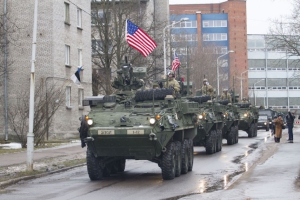
US troops in Estonia
U.S. troops in Estonia. [Source: liberationnews.com]

The treaty is not an “ultimatum,” rather it is the only feasible alternative to serious military confrontation that can easily lead to a major war. Unfortunately, it appears that Ukraine and NATO, led by the U.S., have no intention of pursuing the diplomatic option, and continue preparations and provocations that can and will lead only to a military response by Russia.

Amending of Ukrainian Constitution

On December 21st, four days after the Russian treaty proposal was published, Ukraine, on U.S. and NATO orders, with reckless impudence again amended the Ukrainian Constitution to allow foreign troops to operate on Ukrainian soil, in preparation for multiple NATO exercises to be held in Ukraine in 2022.

These include nine maneuvers to be carried out in 2022, and the number of  military personnel participating in them will almost double compared to 2021—to 64,000. 

Servicemen of the U.S. and Ukrainian armies attend the opening ceremony of the "RAPID TRIDENT-2021" military exercise at Ukraine's International Peacekeeping Security Centre near Yavoriv in the Lviv region, Ukraine September 20, 2021. REUTERS/Gleb Garanich
Servicemen of the U.S. and Ukrainian armies attend the opening ceremony of the “Rapid Trident-2021” military exercise at Ukraine’s International Peacekeeping Security Center near Yavoriv in the Lviv region, Ukraine, September 20, 2021. [Source: reuters.com]

The number of aircraft and helicopters will more than triple—to 361—and warships almost four times—to 256. This is a tremendous military escalation, and while Russia can easily handle the Ukrainian military alone, Russia will be faced with a much more formidable foe if the NATO reinforcements are in place before hostilities commence.

Russia’s window of opportunity for a preemptive strike is a matter of weeks, and on December 29th, President Putin announced that Russia and Belarus have scheduled military exercises of their own for February and March of 2022.

A group of soldiers marching

Description automatically generated with medium confidence
Russian and Belarusian army exercise from 2017. [Source: uacrisis.org]

It is quite possible and even “highly likely” that these “exercises” will be conducted not in Russia or Belarus, but in Ukraine itself. This possibility has already prompted the UK to announce plans to evacuate its soldiers and the U.S. to begin preparations to evacuate its citizens from Ukraine.

February 4, 2022, will be the opening day of the Winter Olympics in Beijing, and Putin has announced his intention to attend. The U.S. and NATO have a history of initiating military and geopolitical confrontations during the Olympics, as was seen with the Maidan coup in 2014 during the Sochi Olympics and the Georgian attack on South Ossetia during the 2008 Summer Olympics in Beijing. All the above factors have led many analysts, including this author, to predict the start of major military operations in February 2022.

Non-Military Options and Russia’s Alliance with China

If the collective “West”—U.S./NATO—continue their advances and attacks against Russia, Russia also has multiple options of the non-kinetic variety with which to respond. Economic, technical and political means that can teach, even in a non-military way, what Vladimir Putin once described as “the true meaning of pain.” 

Russia’s electronic warfare capabilities are currently unmatched in the world. The Murmansk-BN system has the ability to suppress radio and satellite communication over a distance of 3,000 kilometers, and has proven effective against hard targets like the U.S. F-35. Operating from within its own territory, Russia can suppress not only military aircraft, but civilian air traffic and ground transport and other communication over the entirety of Europe, including the UK.

A picture containing text, grass, sky, outdoor

Description automatically generated
Murmansk-BN System. [Source: eurasiantimes.com]

Russia can play the energy card—the EU’s dependence on Russian oil and gas (47% in 2021) has become painfully clear this year, but it is a little known fact that Russia is the U.S.’s third largest supplier of petroleum products. In 2020, the U.S. imported 538,000 barrels per day from Russia, and even more in 2021. Russia’s supply accounts for 7% of all U.S. petroleum imports, and while an energy loss of 7% would be a major blow to the U.S., Russia can easily divert these shipments to the East and sell them there.

Were Russia to cut off its energy supplies to the EU, the economic devastation would be immediate and immeasurable. And the physical and infrastructure destruction would be even worse. People would literally freeze to death, pipes would freeze and burst, factories would be shut down and deteriorate, never to be re-opened. That is actually happening now in Ukraine. The U.S. and EU should take a look at that and take a lesson from it.

The Russia-China strategic partnership is not only military, it is economic. The U.S. economy today is a façade, a paper tiger with no real strength or foundation. The U.S. national debt is officially $30 trillion, more than 90% of GDP, and the true number, including U.S. government “unfunded liabilities” including $21 trillion for Social Security and $33 trillion for Medicare, is perhaps as much as ten times higher. It is a debt that can and will never be paid.

Russia-China, Putin-Xi Partnership Against U.S. Makes Sense. For Now. -  Bloomberg
Putin and Xi. [Source: Bloomberg.com]

A combined economic assault by Russia and China against the U.S. dollar would cause inflation of Zimbabwean proportions. Soldiers do not fight if they are not paid, cops and government bureaucrats do not work if their paychecks are worthless, and citizens loot and riot if they cannot afford food. And if the U.S. economy implodes, it will take the EU economy with it. And vice versa.

All (or any) of these non-military moves would paralyze the economies and governments of virtually all NATO countries, inflicting a crushing defeat on the U.S. and EU without firing a shot. But Russia does have full justification and compelling motives for a military response as well. And if done correctly, it could result in total victory in a quick and relatively bloodless fashion.


  1. With that in mind, it should also be noted that in early 2017, the Kyiv regime dammed the North Crimean Canal which had supplied fresh water to the 2.5 million citizens of Crimea. While the Crimean peninsula produces adequate water for survival, this criminal act not only affects the health and quality of life of the citizens, it also has had an extremely negative impact on the agriculture, economy and ecology of the peninsula. ↑

  2. Ukraine has been using ISIS and other Jihadi terrorists in its war against the Donbass Republics since the very beginning of the war. In early 2015, The Intercept first reported the links between ISIS and Ukrainian neo-Nazis. Other credible reports soon followed, from such divergent sources as Antiwar.com, The American Thinker, and even The New York Times reported on “three full Islamic battalions fighting in eastern Ukraine.” These reports are all from 2015, and the jihadi presence in Ukraine has only grown since then. ↑

Ex-Pentagon Deputy Secretary Claims War with Russia is Inevitable

www.defenseone.com

A US security adviser alleges conflict is likely to break out over tensions surrounding Ukraine

The US must ready itself for a war with Russia, a former Defense Department official has warned, saying that Washington could be obliged to step in militarily if Moscow decides to mount an invasion of Ukraine in the near future.

Evelyn Farkas, who served as deputy assistant secretary of defense for Russia, Ukraine, and Eurasia from 2012-15, published an op-ed in Defense One on Tuesday in which she claimed that an imminent Russian invasion of Ukraine is “more likely than not.” The former Obama administration official insisted that diplomatic talks between Moscow and Washington, taking place this week, are likely to fail, and that the US should already be getting ready for war with Russia.

In an echo of the words former President George W. Bush, used to describe the nations invading Iraq in 2003, she called for the US to marshal “an international coalition of the willing” to deter Russian President Vladimir Putin “and, if necessary, prepare for war.”

According to Farkas, Russia fails to abide by international law, and has been emboldened by recent mass protests in Kazakhstan, a neighboring nation and former Soviet republic with which Moscow has close ties. All this, she alleged, makes it more likely than ever that Putin is planning to invade Ukraine.

“If Russia prevails again,” she warned, “we will remain stuck in a crisis not just over Ukraine but about the future of the global order far beyond that country’s borders. Left unrestrained, Putin will move swiftly, grab some land, consolidate his gains, and set his sights on the next satellite state in his long game to restore all the pre-1991 borders: the sphere of geographical influence he deems was unjustly stripped from Great Russia.”

Farkas’ article comes as senior diplomats from the US and Russia are meeting in Geneva this week to discuss security proposals that Moscow delivered to Washington in December. The Kremlin has requested written guarantees that NATO, the US-led military bloc, will not expand into Ukraine and Georgia, two countries that share borders with Russia. American officials, meanwhile, have expressed concern about the alleged Russian troop buildup near Ukraine, and have said that they will not make any promises about NATO membership.

Despite the apparent impasse, officials from both sides have indicated that they are willing to negotiate while they have the chance. Russia has repeatedly denied it has any aggressive intentions towards Ukraine, and has accused the US of fueling tensions by providing Kiev with arms and military support.

Are We Heading Unavoidably Straight to War in Europe?!

By Jonny Tickle

Last month,Moscow published a draft treaty that would end eastward enlargement of the US-led bloc

Washington will not consider Russian proposals to legally prohibit the eastward expansion of the NATO military bloc, and has no intention of even discussing the idea, US State Department spokesman Ned Price said on Monday.

Earlier that day, in Geneva, US Deputy Secretary of State Wendy Sherman and Russian Deputy Foreign Minister Sergey Ryabkov spoke for almost eight hours about proposals put forward by Moscow in December for legally binding security guarantees, including prohibitions on weapons placements and restrictions on military exercises. However, one of the key aims for Russia is to get Washington to agree that NATO won’t expand further even eastwards and allow Ukraine become a member.

According to Price, American diplomats are happy to accept various reciprocal agreements on missiles and transparency of troop movements.

“We were firm, however, in pushing back on security proposals we have heard from Moscow that are simply non-starters for the United States,” he said. “We will not, for example, allow anyone to slam closed NATO’s ‘Open Door’ policy, which has always been central to the NATO alliance.”

He also noted that Washington was unwilling to make decisions about Ukraine without Ukraine’s input.

“Negotiations on complex topics like arms control can not be completed in a matter of days, or even weeks. We must give diplomacy the time and space required to make progress on such complex issues,” he concluded.

A NATO-Russia meeting is planned for Wednesday, in which diplomats will discuss another set of security proposals, pitched by Moscow, also in December. The text delivered to the 30-member bloc last month focuses mainly on the movement of military personnel and material, including a promise that no signatories will station their forces on European states that were not members of NATO in 1997. It also includes a clause that current NATO members renounce any military activity on the territory of Ukraine, as well as in other Eastern European, Transcaucasian, and Central Asian states.

On Monday, following the meeting in Geneva, Ryabkov told the press that Moscow would not accept anything less than complete assurance from Washington that NATO ends its eastward enlargement.

“For us, it’s absolutely mandatory to make sure that Ukraine never, never, ever becomes a member of NATO,” he said.

Separately, Russia’s Deputy Foreign Minister Sergey Ryabkov warned his American counterparts on Monday that some form of military response to the US stationing advanced weapons in Europe could be possible in the future.

He insisted that if NATO proceeds toward the deployment of new capabilities in weaponry, “which are being developed very rapidly in the US,” the Russian military may reply in a way that “will inevitably and unavoidably damage the security of the US and its European allies.”

Speaking to the media after a day of crucial US-Russian negotiations on security guarantees in Geneva, Ryabkov also said that there has been no progress so far on Russia’s proposals to curb NATO expansion. He said that the ball is now in NATO’s court, which, in his words, has to finally make a “real step” toward finding common ground with Russia.

“We are calling on the US to demonstrate a maximum of responsibility at this moment. Risks related to a possible increase of confrontation shouldn’t be underestimated,” Ryabkov said, adding that “significant” effort has been made to persuade the Americans that “playing with fire” is not in their interests.

The “Sovereign Right” to Join Military Blocs

by Glenn Diesen, Professor at the University of South-Eastern Norway and an editor at the Russia in Global Affairs journal.

Excerpt:

The Warsaw Pact was dismantled and the Soviet Union dissolved, which made NATO the only military bloc in Europe. By rejecting an inclusive European security architecture, Washington was able to monopolise security, as states could either have guarantees within the US-led military alliance or be left with uncertainty outside the tent.

With NATO being the only game in town, former truths about security were denounced. The fundamental principle of European security is now that states must have the sovereign right to choose membership in military blocs. In other words, they have the right to be in the bloc, no matter what anyone else thinks.

Peace derives from compromise and the constraining of rival military blocs, but NATO has rebranded itself as a liberal democratic institution and thus a ‘force for good’. No longer does peace depend on compromise and constraints, but rather on the compromising of values, and the acceptance of limitation on expansionism is deemed tantamount to appeasement. Any Russian concern about zero-sum bloc politics is dismissed as “paranoia”, a “zero-sum mentality”, and a “Cold War mentality”. Russian opposition to NATO expansionism is viewed simply as a rejection of democratic values and an indication of Russia’s expansionist intentions.

We are told that NATO is a liberal democratic institution that poses no threat to anyone, does not do zero-sum politics and cannot have spheres of influence. The term ‘sphere of influence’ used to infer ‘exclusive influence’ achieved by incorporating a state into a military bloc. NATO has now turned the meaning of this word on its head, as ‘sphere of influence’ is now used to mean Russia limiting the sovereign right of its neighbours to join the bloc.

George Orwell brilliantly summed up how propaganda turns language on its head to make dissent impossible: “War is peace, freedom is slavery and ignorance is strength”. In the age of NATO hegemony, invasion is humanitarian intervention, coup is democratic revolution, subversion is democracy promotion, gunboat diplomacy is freedom of navigation, torture is enhanced interrogation techniques, sphere of influence is a ring of well-governed states, expansion of military blocs is European integration, dominance is negotiating from a position of strength, purging the media and political opposition in Ukraine is defending democracy against Russian hybrid war, and Russia’s demands for guarantees against NATO expansionism are an assault on democracy and sovereignty.

The entire principle of the sovereign right to join military blocs is premised on the bloc being the sole option. Both the EU and NATO refuse to cooperate with the Russian-led Collective Security Treaty Organization for fear it may be perceived as legitimate. Similarly, Hillary Clinton announced that Washington was determined to “slow down or prevent” the development of the Eurasian Economic Union. The argument of sovereign choice is insincere if NATO is the only legitimate option.

The new balance of power

More powerful states will naturally embrace principles that remove constraints. Now the era of unipolarity is over and the world is transitioning to multipolarity, will the West accept a return to seeking peace by constraining military blocs? It seems fair to assume the term ‘sovereign right’ to join military alliances would disappear from the American vocabulary if Russia returned its nuclear missiles to Cuba or China developed a military alliance with states in Central America.

Putin and US President Joe Biden will speak on Tuesday, at a time when stakes are high. It may be the last chance to avert a modern-day European Cuban Missile Crisis.

Russian Drivers vs. NATO Tanks

https://twitter.com/ValLisitsa/status/1466190120575541249


Shoigu: 10 US Air Force Strategic Bombers Trained to Use Nukes Against Russia This Month

by Daria Bedenko via Sputnik

On Tuesday, Russian Defence Minister Sergey Shoigu spoke to his Chinese counterpart, Wei Fenghe, via video conference.

Russian Defence Minister Sergey Shoigu said that ten US strategic bombers have trained to use nuclear weapons against Russia this month.

Elaborating on his remarks, Shoigu said that “this month, during US strategic forces exercise Global Thunder, ten strategic bombers practised the option of using nuclear weapons against Russia almost simultaneously from the Western and Eastern directions.”

The minister also noted that Russia has recorded a significant increase in the activity of US bombers near the country’s eastern borders, with about 30 sorties detected this month. In 2019, there were only three such flights, Shoigu underlined.
Following the talks with his Chinese counterpart Wei Fenghe, the Russian minister said “such actions of the US strategic bomber aviation pose a threat not only to Russia but also to China.”

Shoigu said that military cooperation between the two countries is ramping up, with Russian and Chinese troops “interacting on land, sea, and air.”

The Russian minister said bilateral relations between Moscow and Beijing are “trusting and friendly,” while Fenghe commented that Russia is successfully countering US military threats, and the two countries are jointly opposing the American tactics of containment.

“I also support your vision of the military threat to our countries coming from the United States of America,” Fenghe said during the video conference with Shoigu.

Following the negotiations, both Russian and Chinese ministers agreed to intensify joint strategic exercises and patrols.

“I am convinced that today’s meeting will serve the development of relations of comprehensive partnership and strategic interaction between Russia and China,” said Shoigu.

Moscow earlier voiced its concerns over how the US and other Western countries hype up claims of Russia’s purported “invasion” of Ukraine, with this pretext used by the West to beef up the Ukrainian military.

The allegations of the “invasion” were dismissed by Kremlin Spokesman Dmitry Peskov as “absurd” and he voiced concern that the Western military aid will lead to a “further escalation” of tensions.

China, for its turn, recently denied claims about its alleged “hypersonic missile test” over the South China Sea, which reportedly left Pentagon officials “baffled” over how Beijing managed to develop such technology.

Beijing has also recently reiterated concerns about cooperation between the United States, Australia, and the United Kingdom under the AUKUS deal in the field of nuclear submarines, saying that “these actions exacerbate tensions in the region, incite an arms race, threaten regional peace and stability, and undermine international efforts in the field of non-proliferation of nuclear weapons.”