Category Archives: It’s All About Jews

It’s All About Jews

Rabbi Schneerson in the Words of Two Respected Jewish Professors

by ALISON WEIR via Counterpunch Excerpts
▼

Schneerson has been praised widely for a public persona and organization that emphasized “deep compassion and insight,” worked to bring many secular Jews “back” into the fold, created numerous schools around the world, and had offered, in the words of the Jewish Virtual Library, “social-service programs and humanitarian aid to all people, regardless of religious affiliation or background.”

▲▼However, there is also a less attractive underside often at odds with such public perceptions. And some of the more extreme parts of Schneerson’s teachings – such as that Jews are a completely different species than non-Jews, and that non-Jews exist only to serve Jews – have been largely hidden, it appears, even from many who consider themselves his followers.

As we will see, such views profoundly impact the lives of Palestinians living – and dying – under Israeli occupation and military invasions.

…While Chabad sometimes openly teaches that “the soul of the Jew is different than the soul of the non-Jew,” Schneerson’s specific teachings on this subject are largely unknown.

▲▼Quite likely very few Americans, both Jews and non-Jews, are aware of Schneerson’s teachings about the alleged deep differences between them – and about how these teachings are applied in the West Bank and Gaza.

▲▼Let us look at Schneerson’s words, as quoted by two respected Jewish professors, Israel Shahak and Norton Mezvinsky, in their book Jewish Fundamentalism in Israel (text available online here). This book, praised by Noam Chomsky, Edward Said, and many others is essential reading for anyone who truly wishes to understand modern day Israel-Palestine. (Brackets in the quotes below are in the translations by Shahak and Mezvinsky.)

▼Some of Schneerson’s rarely reported teachings:

“The difference between a Jewish and a non-Jewish person stems from the common expression: “Let us differentiate.” Thus, we do not have a case of profound change in which a person is merely on a superior level. Rather, we have a case of “let us differentiate” between totally different species.”
“This is what needs to be said about the body: the body of a Jewish person is of a totally different quality from the body of [members] of all nations of the world … The difference in the inner quality between Jews and non-Jews is “so great that the bodies should be considered as completely different species.”
“An even greater difference exists in regard to the soul. Two contrary types of soul exist, a non-Jewish soul comes from three satanic spheres, while the Jewish soul stems from holiness.”
“As has been explained, an embryo is called a human being, because it has both body and soul. Thus, the difference between a Jewish and a non-Jewish embryo can be understood.”
“…the general difference between Jews and non-Jews: A Jew was not created as a means for some [other] purpose; he himself is the purpose, since the substance of all [divine] emanations was created only to serve the Jews.”
“The important things are the Jews, because they do not exist for any [other] aim; they themselves are [the divine] aim.”
“The entire creation [of a non-Jew] exists only for the sake of the Jews.”

▲▼Most people don’t know about this aspect of Schneerson’s teaching because, according to Shahak and Mezvinsky, such teachings are intentionally minimized, mistranslated, or hidden entirely.

▲▼For example, the quotes above were translated by the authors from a book of Schneerson’s recorded messages to followers that was published in Israel in 1965. Despite Schneerson’s global importance and the fact that his world headquarters is in the U.S., there has never been an English translation of this volume.

Sent from my iPad

“One War, One Election at a Time” – One Step Forward for National Liberation, Two Steps Back

by John Helmer, Moscow
@bears_with

Not even in revolutionary times have Russian elections been waged on the issue President Vladimir Putin proposed a few days ago of what it means, what it costs, what it risks for Russia to lead the national liberation of the world.

Nor has Putin revealed after two days of intensive talks with Emirati, Saudi, and Iranian leaders, and then a telephone call with the Egyptian President, Abdel Fattah al-Sisi, what plan of action for the Gaza war they discussed. “Russia is thinking about an initiative on Gaza,” Iranian Foreign Minister Hossein Amir Abdollahian has announced after the talks concluded.

El-Sisi was so negative about this, the Kremlin record of his Saturday morning telephone call reveals no more than that he and Putin talked over “a number of issues related to Russian-Egyptian cooperation, which has been developing very successfully. Both parties expressed their interest in further expanding cooperation in various areas in a traditionally friendly manner based on the principles of strategic partnership.” The two presidents then wished each other good luck for their re-elections.

The Egyptian presidential vote is running for three days from Sunday with the result to be declared on December 18; the Russian poll will be held on March 15-17. The outcome is certain for both.

Two hours after Putin put down the phone with el-Sisi, he picked it up again to call Israeli prime minister Benjamin Netanyahu. The Kremlin communiqué has omitted to report what Netanyahu said.

Instead, Putin gave the Israeli his personal assurance there will be no Russian participation in a Gaza blockade-busting plan to deliver humanitarian aid to the Palestinians by sea, or across the Egyptian land border. Nor will the Russian military intervene to threaten Israeli aircraft if they commence bombing Beirut and southern Lebanese targets in the war against Hezbollah.

A Russian source on military strategy believes the Russian objective is to protract the Palestine war on all fronts simultaneously, and exhaust the US and Israel by threatening Israeli ports and shipping, Israel’s offshore gas supplies, and the economy’s principal sources of income. Exhausting the US in the Middle East helps exhaust the US and NATO in the Ukraine, the source adds.

Tactically, the source said, this should mean an international humanitarian operation to break the Israeli blockade of Gaza in order to deliver as much aid as the besieged Palestinians need; action at the international level to deter the Israelis using uranium radiation warheads, poison gas, and other weapons to attack the Hamas tunnel network; and a no-fly zone to cover Lebanon and Syria from Israeli bombing and missile attacks. Military action, the source cautions, should be indirect and confined to proxy forces like Hezbollah on the northern front; Iraqi groups in the east; the Houthis in the south; and support for the Palestinians fighting in the West Bank.

Hezbollah forces flying the Hezbollah and Syrian flags in Syrian operations to support President Bashar Assad.

The Israeli reaction – “what we can do in Gaza we can do in Beirut” — is to deter Russia, Iran, and the Arab states from allowing their “initiative” to adopt any of these tactics; and to deter an expanded operation by Hezbollah. “If Hezbollah chooses to start an all-out war,” Netanyahu declared publicly just before he spoke to Putin, “then it will, by its own hand, turn Beirut and southern Lebanon, not far from here, into Gaza and Khan Younis.”

Russian sources acknowledge the blackout on debate of these options in the Russian media, including the military bloggers who have become the most outspoken journalists in the country. “One war at a time, one election at a time”, according to one source. “That’s how Putin is thinking right now. How can the General Staff argue with that?”

The official Russian record on Hezbollah is almost empty; Russian officials are reluctant to pronounce the name in public. In 2005, asked what Russian policy was towards Hezbollah, Foreign Minister Sergei Lavrov said: “It is necessary to implement UN Security Council Resolution 1559 in all its aspects. Like all the other decisions on the Middle East, they cannot be implemented just by one half or one third. This concerns matters related to Hezbollah and the Palestinians. As to the role of Hezbollah, I think that it is in the interest of Lebanon and the entire Middle East that the political role of Hezbollah should be taken into consideration and that the party receive a possibility to represent its interests through the elections for the power structures to be formed in Lebanon. Russia can help by being in contact with the Lebanese friends and the Syrian friends, the US, the Europeans, and the countries of the region and by advocating a well-balanced, comprehensive and just implementation of UNSCR 1559 and that in its implementation no one would pursue aims which do not relate to it.”

Source: http://unscr.com/en/resolutions/doc/1559

A year later, Lavrov’s ministry attempted “well-balance” between the Israel Defence Forces (IDF) and Hezbollah. “The Russian MFA resolutely condemns the abduction of the [IDF] servicemen, and the firing of rockets at Israeli territory. At the same time we regard the military actions launched by Israel as a disproportionate and inadequate use of force, endangering the sovereignty and territorial integrity of Lebanon and peace and security across the region…We urge Israel to cease incursions into Lebanon and the destruction of civilian infrastructure in the country and lift the blockade of its territories…In its turn, the Hezbollah movement should give up anti-Israeli actions that endanger the interests of its own country as well, release the kidnapped Israeli servicemen, cease firing into Israeli territory and respect the UN Blue Line.”

The same balancing act is being attempted now, as Lavrov told Al-Jazeera on Sunday in answer to questions on Russia’s policy towards Hamas. “Hamas committed a terrorist attack on the 7th of October, which we condemned immediately. Hamas has a political branch which operates in Doha, and we have relations with this political branch. We immediately got in touch with the people in Doha to negotiate the fate of the people taken hostages, Russian citizens (but not only Russian citizens), Israeli citizens, and citizens of the neighbouring countries to Russia, and some others. We managed to reach a deal which, as far as I can say, Israelis understand and even appreciate it as far as their citizens are concerned.”

Lavrov attempted to distinguish between national liberation as a political strategy which the Kremlin supports, and Hamas, Hezbollah and Houthi operations which amount to “terrorism” the Kremlin condemns.

Listen to the exchange on “terrorism” from Min 13:40 to 16:14.

“I don’t believe I am hypocritical or Russia is hypocritical,” Lavrov said. “We never have been hiding the operations which we conducted in the Republic of Chechnya. We never have been hiding what we have been doing in Syria at the request of the legitimate government, member of the United Nations, fighting ISIS, Jabhat al-Nusra, Hayat Tahrir al-Sham, and other organizations which have popped up after the American interventions in Iraq when Al-Qaeda was created, then in Libya, Jabhat al-Nusra, and you know this story. And we will continue to fight terrorism. Exactly with the rules.”

One of the “rules” to which Lavrov refers is that Russian military engagement in the Middle East must be requested by a government for the security of its territory. In August 2019, when then- Lebanese Prime Minister Saad Hariri requested Russian intervention after the IDF flew drones over Beirut, the response from the Foreign Ministry in Moscow was: “The Russian side reaffirmed its commitment to the sovereignty, independence, territorial integrity and stability of friendly Lebanon and underscored the need for unfailing compliance by all sides with international law.”

There is no reliable evidence that Russian air defence missile systems have been supplied to the Lebanese government. Hezbollah is better equipped, but there is also no reliable evidence for Israeli and US propaganda claiming Russian deliveries of the Pantsir system to Hezbollah since the Gaza War began.

The evidence is much clearer that there has been no Lebanese government request for Russian air cover, nor even a Lebanese government conversation with the Russians since November 2021.

Last official communication between Lebanon and Russia – November 22, 2021.

“If the Egyptians won’t agree to request Russian backing for a blockade-busting operation,” comments a Moscow source, “and the Lebanese government will not request Russian military support for its airspace, what can the Kremlin do, let alone the General Staff? Considering the Russian attitude towards Hezbollah, and the position in Syria leaving gaping holes in their air defence against Israeli attack, I think we should expect nothing. I do not see the Arabs, Russians, and Chinese forming an alliance of any military consequence for now.”

How long is now?

A veteran of NATO military operations in Afghanistan observes: “The Ukrainian lines are breaking up all along the front. The push is on and that’s where Putin will put his effort to keep his credibility at home. If [Chief of the General Staff General Valery] Gerasimov can keep destroying the fascists riding NATO junk at the current rate of a battalion per day and gain ground doing it, everyone is happy — for now. As for the Arabs, no one in the region will directly take Israel on. The Lebanese Government is petrified of Israel — and they know better than to ask for Russian help. Sisi, with the most capable military, is a coward. The rest will make noise while clandestinely helping the Palestinian resistance, and causing trouble for the US in the neighbourhood. The Iranians know how to fight and won’t stop. The Israelis should and do see them as threat number-one.”

“The only way I see a direct intervention is if China takes the lead on, or announces support for, one. But [President] Xi [Jinping] has some trouble at home, and nothing I’m reading shows Chinese popular support for intervening. If anything, they’re indifferent.”

In wars for national liberation and in civil wars, the terrorism label is one side’s propaganda against the other – this is the consensus of the Russian sources, unspoken and unpublished for the time being. Russian public policy has yet to resolve the contradiction between Russian support for Palestine’s national liberation and opposition to Hamas’s “terrorism” – this can’t happen, the sources say, before the presidential election in March, and the success of the Russian military offensive in the Ukraine by then too.

“There’s nothing new here. Putin is following the old Soviet line on exercising ‘the greatest possible caution’ towards the ‘frightful collisions’ which Stalin’s famous speech on revolution and tactics spelled out a century ago.”

The Politics of The Slaughter of Everybody

by John Helmer, Moscow
@bears_with

Religious fundamentalists think that because God is on their side – more, that God has Chosen Them to be His People — they can leave it to Him to keep tabs on history, remember the lessons of the past, count the years, tote up the gains, costs, and losses. So long as God doesn’t issue any red alerts or insolvency notices during their prayers, when the Chosen People get up they can concentrate their minds and resources on preparing for the future. When the murder of a million or two Palestinians is the future which the Israelis and Americans are concentrating on now, it’s obvious that they and their God have not been re-reading the Melian Dialogue, if He did in the first place.

That’s Sections 84 to 116 of Book Five of Thucydides’ History of the Peloponnesian War, which he wrote over twenty years of the war, from 431 to 411 BC, leaving off before Athens and its army were defeated and lost everything they thought they had won.

It was in 416 that the Athenian army laid a starvation siege to Melos; then when the Melians surrendered, the Athenians murdered every man and enslaved every woman and child. After that, the Athenian empire of Melos lasted just eleven years before the Athenians were driven off the island by a Spartan force the Hellenes had become too weak to resist. The German empire of the island didn’t murder as many; they were driven off after just two years, from 1943 to 1945.

What Thucydides has reproduced in his book is the argument for genocide if you think you are strong enough to get away with it.

Its main point — the most remembered today of the lines from the book — is the Athenian declaration: “When these matters are discussed by practical people, the standard of justice depends on the equality of power to compel and that in fact the strong do what they have the power to do and the weak accept what they must.”

This is what US President Joseph Biden and Israeli Prime Minister Benjamin Netanyahu are insisting upon. It’s what Biden means to demonstrate with his fleets in the eastern Mediterranean, northern Red Sea, and the Persian Gulf.

This is slaughter of everybody in Gaza because the Americans and the Israelis have the power, for the time being.

Practical people is the phrase Thucydides put in the mouth of the Athenian side in the dialogue.

ATHENIANS

Left to right: Olaf Scholz (Germany), Joseph Biden (US), Rishi Sunak (UK), Benjamin Netanyahu (Israel).

These days it means politicians running for election. They are Vladimir Putin in March 2024; Olaf Scholz in June 2024; Biden in November 2024; Rishi Sunak in January 2025; the French election is in 2027 but Emmanuel Macron cannot run for a third term. Netanyahu’s term is likely to run out as soon as the war against the Palestinians of Gaza ends. If all of them are dead or gone, Netanyahu may win.

The only certain winner on this list of practical people is Putin; he has now agreed with the Russian Army to concentrate their force against the US on the Ukrainian battlefield. The terms of this agreement can be found on, and also between, the lines of Putin’s speech of October 30. Read between the lines here.

In Thucydides’s reconstruction and dramatisation of the negotiations between the attacking and the defending sides, the Melians acknowledged it was pointless appealing to commonly held ideas of justice, morality, and fair play because the Athenians made clear they didn’t share them. Worse, the Athenians said they were convinced that only by demonstrating their superior force against the weaker Melians could they deter others, including their own critical and restive fellow citizens at home. “It is not so much your hostility that injures us,” the Athenians said. “It is rather the case that if we were on friendly terms with you, our subjects would regard that as a sign of weakness, whereas your hatred is a sign of our power.”

So the Melians tried arguing instead that there were common and shared political and economic interests which should spare them from the Athenians’ liquidation plan. “If yours and ours happen to coincide, we must try to persuade you of the fact. Is it not certain that you will make enemies of all states who are at present neutral, when they see what is happening here and naturally conclude that in the course of time you will attack them too?”

Forget it – there is only the present for you, leave the future to us, the Athenians replied. “This is no fair fight , with honour on one side and shame on the other. It is rather a question of saving your lives and not resisting those who are far too strong for you.”

Death-dealing is the power – for those who are victims, and even more for those who are witnesses. Hope for another outcome which the Melians expressed, “is by nature”, said the Athenians, “an expensive commodity, and those who are risking all on one cast find out what it means only when they are already ruined.”

The Melians tried the Chosen People line. That wasn’t because they were Semites, although God had sailed westward from ancient Palestine to make landfall on the island. The Phoenicians, a Semitic people but not a Jewish one, had established trading posts on Melos and intermarried with the Caucasian arrivals from Sparta, on the Hellenic mainland. The Athenians dismissed the theology – God, like history and warfare, chooses winners, not losers. “So far as the favour of the gods is concerned, we think we have as much right to that as you have,” the Melians were told. “Our opinion of the gods and our knowledge of men lead us to conclude that it is a general and necessary law of nature to rule whatever one can.”

An Israel Air Force strike on October 10 destroyed this mosque in Khan Younis, Gaza.

The Melians then tried to argue that if they fought on for long enough, their ethnic allies, the Spartans, would come to their rescue, break the Athenian siege, defeat Athens. “Where danger is concerned,” came the Athenian reply, “the Spartans are not as a rule very venturesome.”

The force calculus would prevail on the Spartans, the Athenians were confident – Melos was too small and was surrounded, so a Spartan relief operation was out of the question. “What is looked for is a positive preponderance of power in action. And the Spartans pay attention to this point even more than others do.”

Inferiority wasn’t so dishonourable, the Athenians offered as they prepared to wind up the talks. “There is nothing disgraceful in giving way to the greatest city in Hellas when she is offering you such reasonable terms – alliance on a tribute-paying basis and liberty to enjoy your own property…And when you are allowed to choose between war and safety…this is the safe rule – to stand up to one’s equals, to behave with deference to one’s superiors, and to treat one’s inferiors with moderation.”

MELIANS

Left to right: Yahya Sinwar, Mohammed Deif, and Ismail Haniyeh of Hamas.

The two sides then adjourned for internal consultations; later they returned to the table for the last round. The Melians said they had decided not to surrender their seven-hundred year old city state. “We put our trust in the fortune that the gods will send and which has saved us up to now, and in the help of men — that is of the Spartans; and so we shall try to save ourselves.” They added they were still open to negotiating terms of “a treaty which shall be agreeable to both you and us”. One condition was non-negotiable — the Athenians must “leave our country”.

The Athenian negotiators stood up. “As you have staked most on and trusted most in Spartans, luck, and hopes, so in all these you will find yourselves most deluded.”

The Athenian army built a new wall completely cutting off the Melians inside their city from the outside. Several months of siege followed while the Athenians withdrew their heavy forces to fight elsewhere. The Melians made sallies to capture food. Then the Athenians returned in force; but even then they didn’t risk a frontal assault. Instead, they bribed several Melians inside the city to betray the others. “As there was also some treachery from inside,” Thucydides concluded his account without more detail, “the Melians surrendered unconditionally to the Athenians, who put to death all the men of military age whom they took, and sold the women and children as slaves. Melos itself they took over for themselves, sending out later a colony of 500 men.” Book Five ends at this point.

That was almost two thousand five hundred years ago.

It’s near-certain that Biden and Netanyahu haven’t read the Melian Dialogue. If men like US Secretary of State Antony Blinken and National Security Adviser Jacob Sullivan were required to read the book during their undergraduate studies at Harvard and Yale, they have forgotten that after the genocide of the Melians, the Athenians were defeated – first their army and foreign empire, then their domestic democracy.

These practical men can hear the political clock ticking. They can’t hear the gods counting down.

What Really Happened on 7th October?

by Robert Inlakesh via The Cradle

Two weeks after the Hamas breakout assault on Israel on 7 October, a clearer picture of what happened – who died, and who killed – is now beginning to emerge.

Instead of the wholescale massacre of civilians claimed by Israel, incomplete figures published by the Hebrew newspaper Haaretz show that almost half the Israelis killed that day were in fact combatants – soldiers or police.

In the interim, two weeks of blanket western media reporting that Hamas allegedly killed around 1,400 Israeli civilians during its 7 October military attack has served to inflame emotions and create the climate for Israel’s unconstrained destruction of the Gaza Strip and its civilian population.

Accounts of the Israeli death toll have been filtered and shaped to suggest that a wholesale civilian massacre occurred that day, with babies, children, and women the main targets of a terror attack.

Now, detailed statistics on the casualties released by the Israeli daily Haaretz paint a starkly different picture. As of 23 October, the news outlet has released information on 683 Israelis killed during the Hamas-led offensive, including their names and locations of their deaths on 7 October.

Of these, 331 casualties – or 48.4 percent – have been confirmed to be soldiers and police officers, many of them female. Another 13 are described as rescue service members, and the remaining 339 are ostensibly considered to be civilians.

While this list is not comprehensive and only accounts for roughly half of Israel’s stated death toll, almost half of those killed in the melee are clearly identified as Israeli combatants.

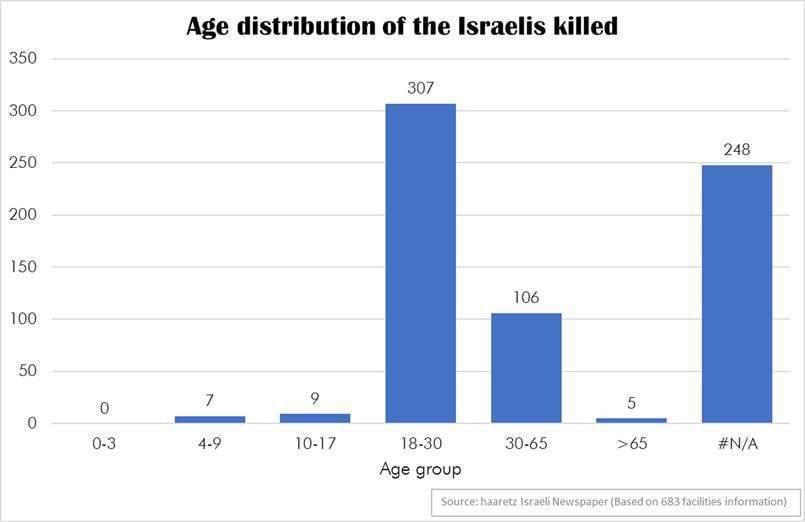
There are also so far no recorded deaths of children under the age of three, which throws into question the Israeli narrative that babies were targeted by Palestinian resistance fighters. Of the 683 total casualties reported thus far, seven were between the ages of 4 and 7, and nine between the ages of 10 and 17. The remaining 667 casualties appear to be adults.


Age distribution of the Israelis killed during Hamas’ October 7 operation (as of 23 October).

The numbers and proportion of Palestinian civilians and children among those killed by Israeli bombardment over the past two weeks – over 5,791 killed, including 2,360 children and 1,292 women, and more than 18,000 injured – are far higher than any of these Israeli figures from the events of 7 October.

Revisiting the scene

The daring Hamas-led military operation, codenamed Al-Aqsa Flood, unfolded with a dramatic dawn raid at approximately 6:30 AM (Palestine time) on 7 October. This was accompanied by a cacophony of sirens breaking the silence of occupied Jerusalem, signaling the start of what became an extraordinary event in the occupation state’s 75-year history.

As per the spokesperson of Hamas’ armed wing, the Al-Qassam Brigades, around 1,500 Palestinian fighters crossed the formidable Gaza-Israel separation barrier.

However, this breakout was not limited to Hamas forces alone; numerous armed fighters belonging to other factions such as Palestinian Islamic Jihad (PIJ) later breached the armistice line, along with some Palestinians unaffiliated with any organized militia.

As it became apparent this was no ordinary resistance operation, hundreds of videos quickly flooded social media, most of which have been viewed by The Cradle, depicting dead Israeli troops and settlers, fierce gunfire battles between various parties, and Israelis being taken captive into Gaza.

These videos were either taken on the phones of Israelis, or were released by Palestinian fighters filming their own operation. It wasn’t until hours later that more gruesome and downright dubious allegations began to surface.

Unsubstantiated allegations of ‘Hamas atrocities’

Aviva Klompas, a former speechwriter for the Israeli mission to the UN, was the first Israeli of note to spread the claim that there were reports of “Israeli girls being raped and their bodies dragged through the street.”

She posted this on X at 9:18 PM (Palestine time), on 7 October, although an op-ed Klompa published with Newsweek at 12:28 AM (Palestine time), on 8 October, made no mention of any sexual violence.

Klompas is also the co-founder of Boundless Israel, a “think-action tank” that works “to revitalize Israel education and take bold collective action to combat Jew-hatred.” An “unapologetically Zionist” charitable group that works to promote Israeli narratives on social media.

The one case touted as proof of rape was that of a young German-Israeli woman named Shani Louk, who was filmed face down in the back of a pickup truck and was widely assumed dead.

It was unclear whether the fighters filmed with Louk in the Gaza-bound vehicle were members of Hamas, as they do not sport the uniforms or insignia of the Al-Qassam troops identifiable in other Hamas videos – some even wore casual civilian clothing and sandals.

Later, her mother claimed to have evidence that her daughter was still alive, but had suffered a severe head wound. This rings true with information released by Hamas that indicated Louk was being treated for her injuries at an unspecified Gaza hospital.

Complicating matters further, on the day these rape allegations arose, Israelis would not have had access to this information. Their armed forces had not yet entered many, if not most, of the areas liberated by the resistance and were still engaged in armed clashes with them on multiple fronts.

Nevertheless, these rape claims took on a life of their own, with even US President Joe Biden alleging, during a speech days later, that Israeli women were “raped, assaulted, paraded as trophies” by Hamas fighters. It is important to note that The Forward’s article on 11 October reported that the Israeli military acknowledged they had no evidence of such allegations at that point.

When the army later made its own allegations of decapitations, foot amputations, and rape, Reuters pointed out that “the military personnel overseeing the identification process didn’t present any forensic evidence in the form of pictures or medical records.” To date, there is no credible evidence of these atrocities that has been presented.

Other outrageous allegations, such as the story of Hamas “beheading 40 babies‘ made headlines and the front pages of countless western news outlets. Even Biden claimed to have seen “confirmed photos of terrorists beheading babies.” The claims trace back to Israeli reserve settler and soldier David Ben Zion, who has previously incited violent riots against Palestinians and called for the West Bank town of Huwara to be wiped out. No evidence was ever produced to support these claims and the White House itself confirmed later that Joe Biden had never seen such photos.

The Hamas plan

There is little to no credible evidence that Palestinian fighters had a plan to – or deliberately sought to – kill or harm unarmed Israeli civilians on 7 October. From the available footage, we witness them engaging primarily with armed Israeli forces, accounting for the deaths of hundreds of occupation soldiers. As Qassam Brigades’ Spokesman Abu Obeida made clear on 12 October:

“Al-Aqsa Flood operation aimed to destroy the Gaza Division (an Israeli army unit on Gaza’s borders) which was attacked at 15 points, followed by attacking 10 further military intervention points. We attacked the Zikim site and several other settlements outside the Gaza Division headquarters.”

Abu Obeida and other resistance officials claims that the other key objective of their operation was to take Israeli prisoners that they could exchange for the approximately 5,300 Palestinian prisoners held in Israeli detention centers, many of whom are women and children.

Hamas Deputy Head of the Political Bureau of Saleh Al-Arouri, in an interview after the operation, stressed: “We have a large and qualitative number and senior officers. All we can say now is that the freedom of our prisoners is at the doorstep.”

Both sides play this game: Since the start of its military assault on Gaza, Israel has rounded up and imprisoned more than 1,200 Palestinians in the occupied West Bank. To date there have been 38 prisoner exchange deals between the resistance factions and Tel Aviv – deals that Israelis often resist to the very last minute.

While these kinds of testimonies trickle out, reports are emerging that Israeli authorities have dialed up the mistreatment, torture, and even killing of Palestinian prisoners in their custody – a violation of the Geneva Conventions, which ironically, a non-state actor like Hamas appears to have followed to the letter.

In relation to the events of 7 October, there are certainly some videos depicting possibly unarmed Israelis, killed in their vehicles or at entrances to facilities, so that Palestinian troops could gain access.

There are also videos which show the fighters engaging in shootouts with armed Israeli forces, where there were unarmed Israelis taking cover in between, in addition to videos of fighters shooting toward houses and throwing grenades into fortified areas. Eyewitness testimony also suggests grenades were thrown into bomb shelters, though by whom is unclear.

Even at the Israeli “peace rave”, which has been cited as the single deadliest attack committed by Palestinian fighters during their operation, videos emerged that appeared to show Israeli forces opening fire through a crowd of unarmed civilians, toward targets they believed to be Hamas members. ABC News also reported that an Israeli tank had headed to the site of the festival.

An Israeli massacre in Kibbutz Be’eri?

In its report on the events at Be’eri Kibbutz, ABC News photographed artillery pieces resembling Israeli munitions outside a bombed-out home. The reporter, David Muir, mentioned that Hamas fighters, covered in plastic bags, were found in the aftermath.

Additionally, videos of the scene show homes that appear to have been struck by munitions that Hamas fighters did not possess. Muir reported that about 14 people were held hostage in a building by Palestinian fighters.

A Hebrew-language Haaretz article published on 20 October, which only appears in English in a must-read Mondoweiss article, paints a very different story of what went down in Be’eri that day. A Kibbutz resident who had been away from his home – whose partner was killed in the melee – reveals stunning new details:

“His voice trembles when his partner, who was besieged in her home shelter at the time, comes to mind. According to him, only on Monday night (9 October) and only after the commanders in the field made difficult decisions — including shelling houses with all their occupants inside in order to eliminate the terrorists along with the hostages — did the IDF complete the takeover of the kibbutz. The price was terrible: at least 112 Be’eri people were killed. Others were kidnapped. Yesterday, 11 days after the massacre, the bodies of a mother and her son were discovered in one of the destroyed houses. It is believed that more bodies are still lying in the rubble.”

Photo evidence of the destruction in Be’eri corroborates his account. Only the heavy munitions of the Israeli army could have destroyed residential homes in this manner.

Hamas behaviors: Evidence vs allegations

Yasmin Porat, a survivor from Kibbutz Be’eri, said in an interview for an Israeli radio-show, hosted by state-broadcaster Kan, that Israeli forces “eliminated everyone, including the hostages,” going on to state that “there was very, very heavy crossfire” and even noted tank shelling.

Porat had attended the Nova rave and testified to the humane treatment throughout different interviews she conducted with Israeli media. She explained that when she was held prisoner, the Hamas fighters “guarded us”, telling her in Hebrew to “Look at me well, we’re not going to kill you. We want to take you to Gaza. We are not going to kill you. So be calm, you’re not going to die.” She also added the following:

“They give us something to drink here and there. When they see we are nervous they calm us down. It was very frightening but no one treated us violently. Luckily nothing happened to me like what I heard in the media.”

Increasingly, and to the horror of some Israeli officials and news outlets, Israeli eyewitnesses and survivors of the bloodshed are testifying that they were treated well by Palestinian fighters. On 24 October, Israeli state broadcaster Kan bemoaned the fact that prisoner Yocheved Lifshitz, released by Hamas the day before, was allowed to make statements live on air.

As she was handed over to Red Cross intermediaries, the elderly Israeli female captive was caught on camera turning back to squeeze the hand of her Hamas captor in her last goodbyes. Lifshitz’s live broadcast, in which she spoke about her two-week ordeal, “humanized” her Hamas captors even further as she recounted her daily life with the fighters:

“They were very friendly toward us. They took care of us. We were given medicine and were treated. One of the men with us was badly injured in a motorbike accident. Their (Hamas) paramedics looked after his wounds, he was given medicine and antibiotics. The people were friendly. They kept the place very clean. They were very concerned about us.”

More questions than answers

It is essential to recognize that in many reports by western journalists on the ground, the majority of information regarding the actions of Hamas fighters comes from the Israeli army – an active participant in the conflict.

Emerging evidence now indicates that there is a high probability, especially due to the scale of the infrastructural damage, that Israeli military forces could have deliberately killed captives, fired on incorrect targets, or mistaken Israelis for Palestinians in their firefights. If the only source of information for a serious claim made is the Israeli army, then it has to be taken into account that they have reason to conceal cases of friendly fire.

Israeli friendly fire was rampant, even in the days that followed, from an army with very little actual combat experience. In the city of Ashkelon (Askalan) on 8 October, Israeli soldiers shot dead and shouted insults at the body of a man they believed to have been a Hamas fighter, yet later realized they had executed a fellow Israeli. This is just one of three such examples of friendly fire in one day, resulting in the killing of Israelis by their own troops.

Amid the fog of war, parties to the conflict have different perspectives on what occurred during the initial raid and its aftermath. It’s not disputed that Palestinian armed groups inflicted significant losses on the Israeli military, but there will be plenty of ongoing debate regarding everything else in the weeks and months to come.

An independent, impartial, international investigation is urgently needed, one that has access to information from all sides involved in the conflict. Neither the Israelis nor the Americans will agree to this, which itself suggests that Tel Aviv has much to conceal.

In the meantime, Palestinian civilians in Gaza endure ongoing, indiscriminate attacks with the most sophisticated heavy weapons in existence, living under the persistent threat of forced and potentially irreversible displacement. This Israeli air blitz was made possible only by the flood of unsubstantiated ‘Hamas atrocities’ stories that media began to circulate on and after 7 October.

(Republished from The Cradle)

“A despicable call for a ceasefire”

“We categorically reject the UN’s despicable call for a ceasefire. We will act against Hamas the same way the world acted against the Nazis and against ISIS,” said the Israeli Foreign Minister Eli Cohen.
“A despicable call for a ceasefire” is a new term in diplomacy.

Who is Johnson, the New Speaker?

New Speaker of the House is Zionist Evangelical Christian Who Wants Americans to Believe He was Ordained by God to Support Israel and Destroy Palestinians

Louisiana Congressman Mike Johnson has been elected as Speaker of the U.S. House of Representatives.

Johnson is a Zionist Evangelical Christian, and his first act as the newly elected Speaker was to draw up a resolution supporting the current government in Israel.

Johnson apparently is also calling for the genocide of the Palestinian people, who at the time of this writing, have reportedly seen over 7,000 of their people killed in the recent conflict.

Do you Zionist Evangelical Christians not understand how supporting modern-day Israel will eventually lead to your belief also being declared illegal as hate speech, and “antisemitic”?

Gaza, a Town Underground

More information appears especially in the German media about the Hamas tunnels, which is preparing for a ground operation by the Israeli army. Tunnels with a total length of approximately 500 km have been dug in the Gaza Strip. Most often it is 2 meters high and 2 meters wide. But there is more. In total there are more than a thousand such tunnels, they call it 1300.

In the tunnels there are Hamas militants, all the necessary supplies, water, food, generators, weapons depots.

It is precisely because of the fear of Hamas militants from tunnels and apartment buildings that the Israeli army is afraid to launch a ground operation. Israel is simply afraid of losing this war.

Source: De Welt

Netanyahoo’s Strategic Dilemma: Lose/Lose

via Moon of Alabama

Israel is a colonial settler state in permanent conflict with the suppressed natives.

It thought it could survive in that state, or even extend its settlements, by deterring opposing forces with its superior military.

Hamas has breached that deterrence myth by inflicting, in one day, more casualties in Israel than it had experienced in any previous wars.

Natanyahoo is under pressure to restore the deterrence, to again provide the Zionists with a feeling of superiority.

He can not do that.

Any land attack in Gaza means urban warfare in an already destroyed city with large underground facilities. During the taking of Bakhmut the Wagener forces had in total some 40,000 casualties (dead and wounded). The other side had more than 70,000. What price would the IDF have to pay to ‘destroy Hamas’?

The other factor is of course Hizbullah and other resistance groups, which may well attack Israel from the north and various other directions. Hizbullah has loudly said it would do so should the IDF enter Gaza. It has some 100,000 missiles – more than enough to exhaust Israel’s air defenses. Its longest reach missiles can attack any major city within Israel. There have already been daily fire exchanges at the norther border.

The 2006 war in Lebanon has shown that Hizbullah is dug in and very able to defend itself. It has since gained more experience by fighting ISIS in Syria. Neither U.S. air force attacks nor a land force invasion can hinder Hizbullah from firing its missiles.

(Syria, as well as Iran, will not intervene in the war unless they are directly attacked.)

Netanyahoo must attack Gaza to restore deterrence. He can not attack Gaza because the urban warfare would cause large Israeli casualties. He can not attack Gaza because Hizbullah would then destroy the myth of the superior settler state even more than Hamas has done so far.

Israel, with the help of the U.S., has tried to push the population of Gaza into Egypt. From Egypt’s standpoint that would be a humanitarian solution, at least as long as others pay for it. But it would cause a serious strategic problem. Resistance by Hamas and others against Israel would continue indefinitely, but Egypt would be held responsible for it. It can not and will not take on that burden.

Netanyahoo’s next idea was to starve Gaza. But the world will not let him do that. At least not beyond a certain point. Even the UN Secretary General has visited the Rafah crossing. Other global organizations, like the WHO and ASEAN, have spoken up. Pictures of starving people will make it impossible for the west to support that ‘solution’.

Meanwhile Hamas fighters will continue to sit in their tunnels, ready to defend their land, and likely with enough provisions to hold out for months.

Israeli settlers, with the support of the IDF, are rampaging through the West Bank. They are killing more Palestinians and further enrage the global public against their deeds. This will escalate.

Israel’s decision making is paralyzed. It will for now continue to talk of a ground invasion but will not launch one. It will also continue to starve Gaza.

But something will soon break. At any minute there might be a new large atrocity in Gaza or a pogrom in the West Bank. Any miscalculation in the north could launch that front into a hot war. Hizbullah could start to ‘preemptively’ invade Israeli proper.

But Israel’s Jewish public is still demanding a war of revenge. It still needs the restoration of its deterrence and superiority.

But what if that turns out to be impossible to achieve?

Well. Then something else must change.

As Adam Shatz summarizes in the London Review of Books:

Vengeful Pathologies (archived)

The inescapable truth is that Israel cannot extinguish Palestinian resistance by violence, any more than the Palestinians can win an Algerian-style liberation war: Israeli Jews and Palestinian Arabs are stuck with each other, unless Israel, the far stronger party, drives the Palestinians into exile for good. The only thing that can save the people of Israel and Palestine, and prevent another Nakba – a real possibility, while another Holocaust remains a traumatic hallucination – is a political solution that recognises both as equal citizens, and allows them to live in peace and freedom, whether in a single democratic state, two states, or a federation. So long as this solution is avoided, a continuing degradation, and an even greater catastrophe, are all but guaranteed.

Why Biden Lied on Gaza Hospital Attack

by M. K. Bhadrakumar via Indian Punchline

US President Joe Biden hugs Israeli PM Benjamin Netanyahu upon arrival at Tel Aviv airport, October 18, 2023

White lies are often uttered to protect someone or deflect the upsetting truths. The US President Joseph Biden’s white lie obfuscated the horrific truth about the Israeli missile attack on the Baptist church in Gaza on Tuesday night, which took the lives of over 500 people.

Biden probably felt safe because platinum grade war crimes seldom get probed — Vietnam (My Lai massacre), Afghanistan (Kunduz hospital airstrike) and Iraq (Fallujah). Nonetheless, there will be a trial at the high court of his own conscience.

If and when such a moment comes, all he needs to do is to read a stunning blog written by Jonathan Cook, an award-winning British journalist and the author of Israel and the Clash of Civilisations who was based in Nazareth (Israel) for twenty years — This is another Iraqi WMD moment. We are being gaslit.

Cook wrote: “It’s not just ‘unlikely’ that a Palestinian rocket hit the Gaza hospital. It’s impossible. The media know this, they just don’t dare say it.”

Biden knows it, too. Read carefully his remark Wednesday, upon arrival in Israel: “Based on what I’ve seen, it appears as though it was done by the other team, not you. But there’s a lot of people out there, not sure.” [Emphasis added.]

The White House National Security Advisor Jake Sullivan who drafted those words for Biden to deliver took care to lace the statement with caveats. A White House statement by NSC spokesperson Adrienne Watson that followed a few hours also prevaricated: “While we continue to collect information, our current assessment, based on analysis of overhead imagery, intercepts and open source information, is that Israel is not responsible for the explosion at the hospital in Gaza yesterday.” [Emphasis added.]

The big question, therefore, is: Why did Biden indulge in a risky white lie? Multiple factors come into play here. The news of the Gaza blast was already available Tuesday night in DC, as Biden and his entourage sat on the runway waiting to leave for Tel Aviv, with gnawing anxiety about what the visit would be able to achieve.

Indeed, the visit was a gamble. Yet, cancellation of the trip was a “non-option”, as compulsions of domestic politics and foreign policy had coalesced inseparably by then. One only had to follow the withering criticism of Biden by Fox News and the growing demands by the Republicans to wreak vengeance on Iran for empowering the Palestinian resistance.

Equally, Biden was conscious of the debris of the regional tour undertaken by Secretary of State Antony Blinken just the previous week. Blinken was subjected to snubs and tongue-lashing in a way none of his predecessors ever probably experienced in West Asian capitals. The US’ influence in the region is at rock bottom.

Biden knew he had to act — and to be seen as acting. He also sensed that the optics meant a great deal to Israel (a key ally), to Benjamin Netanyahu (an intimate personal friend of yesteryears whose political career is in jeopardy), and, of course, to Biden himself (as his re-election bid is at stake.)

Biden took out of his toolbox Modi-style “hug diplomacy” at the tarmac of the Tel Aviv airport. As he hugged Netanyahu, Biden killed three birds in a single shot: first, he silenced the Republican Party criticism of him for having appeased Iran and neglected Israel’s security. Second, Biden underscored that although the going gets tough in the proxy war in Ukraine, the US firmly holds Israel’s back.

Most important, he planted rings of engagement around Netanyahu although the latter is at the end of the road in his political career, as he is Washington’s best bet to ensure that future Israeli behaviour remains amenable to US persuasion.

This last point holds the key. The US is not looking for a regional conflict in West Asia. Biden understands Israel’s zest for retribution against Hamas but is averse to widening the conflict. The US takes seriously Tehran’s warning about direct intervention if Israeli attacks continue. But then, Tehran is also not looking for a conflict.

From such a perspective, Biden reaffirmed to Netanyahu Washington’s stalwart support for Israel’s self-defence, but also urged Israel “not to be consumed by rage” in its response to the attack by Hamas. As he put it, “Justice must be done. But I caution that, while you feel that rage, don’t be consumed by it. After 9/11, we were enraged in the United States. While we sought justice and got justice, we also made mistakes.”

Certainly, it needed courage to admit own mistakes to counsel moderation to the present Israeli government, which is dominated by ultranationalist forces. The leader of the Religious Zionist Party, Bezalel Yoel Smotrich is Israel’s Finance Minister — a supporter of expanding Israeli settlements in the West Bank who opposes Palestinian statehood and denies the existence of the Palestinian people.

The leader of the Otzma Yehudit, Itamar Ben-Gvir is Netanyahu’s Minister of National Security, who was once convicted of supporting the terrorist group Kach, which espoused Kahanism, an extremist religious Zionist ideology, whom Haaretz newspaper described as the ‘go-to man’ for Jewish extremists and whose client list “reads like a ‘Who’s Who’ of suspects in Jewish terror cases and hate crimes in Israel”.

Yet, following hours of talks with Netanyahu and his war cabinet, Biden disclosed that Israel had agreed to allow the opening of the Egypt-Gaza border to deliveries of desperately needed food, water and medical supplies after the 11-day total blockade. “The Palestinian people are suffering greatly as well, and we mourn the loss of innocent Palestinian lives like the entire world,” Biden said. “The people of Gaza need food, water, medicine and shelter.”

Later, Biden remarked during a refuelling stop at Ramstein Air Base in Germany, “Israel has been badly victimised but the truth is they have an opportunity to relieve suffering of people who have nowhere to go – it’s what they should do.”

The Guardian newspaper wrote that “US officials are believed to have tried to convince their Israeli counterparts in meetings during the presidential visit that a scorched-earth response in Gaza would trigger a humanitarian catastrophe, a loss of global support for Israel and perhaps a wider war, without eradicating Hamas.”

Elsewhere, in another report, Guardian also noted, “That Biden is emotionally and politically committed to Israel is not open to question. His career confirms it, as do his votes when he was a senator; he has visited Israel many times, from the era of Golda Meir to the present day. His speech in Washington last week after the Hamas murders was an exceptionally powerful moral statement of the Israel with which he identifies.

“But Biden also supports the Palestinians… The most obvious reason for this visit is for Biden to show solidarity after the slaughter on 7 October. Showing empathy is one of Biden’s default strengths. But he has also travelled to urge a strategically informed response by Israel, avoiding overreaction. Escalation is against the US’s interests. Washington also wants to keep open the possibility that Hamas’s hostages, some of whom are Americans, can be returned alive.

Time will tell how far Biden succeeded in his mission. He had no choice but to resort to a white lie for a larger good. The clincher comes as the hostage crisis prolongs. Biden seems to be hopeful that Washington’s efforts through mediation by Qatar will show results. If that happens, it will have a profound impact on American opinion.

Cheap Hamas Drones Made Israel’s Border Wall ‘Useless’ – NYT

Deceiving Israel about its intentions and finding a key vulnerability in the surveillance infrastructure on the Gaza border were some of the crucial elements of the plan which allowed Hamas to inflict the worst breach of the country’s security in five decades, The New York Times reported on Tuesday.

The newspaper spoke to senior Israeli security officials about the preliminary conclusions that their agencies made about last Saturday’s incursion of Hamas fighters into southern Israel. The Palestinian militants raided more than 20 towns and military bases, killing hundreds of troops and civilians and capturing dozens of hostages.

Prior to the attack, Israel had considered Hamas successfully deterred since clashes in May 2021. Intercepted calls between militants appeared to confirm the assessment that the organization was not an imminent threat, sources said. An analysis is underway on whether those conversations were staged.

Israel was over-reliant on the sophisticated wall it built along the Gaza border, which has multiple types of sensors and remotely operated machine guns. Officials believed it to be virtually impenetrable and kept a relatively small military force nearby, prioritizing other areas for deployment, the report said.

Hamas took out at least four communication towers using drone-dropped munitions in the early phase of its attack, rendering the system “useless,” NYT said. The Israelis could not see the consequent breach of the physical barrier, which turned out to be an easier task than they expected it would be. Hamas used explosives and bulldozers to create nearly 30 gaps for some 1,500 fighters to pour through.

An operational lapse by Israel resulted in the clustering of its senior commanders in the area at a single base, which was overrun in a lightning offensive by the militants. With the leadership mostly killed or taken hostage, Israeli response to the emergency was disorganized and slow, sources said.

People higher up in the command chain did not initially realize the scale of the incursion amid the chaos. It took Israeli warplanes hours to provide air support to responding forces, despite their being based just minutes’ flying time from the area.

The newspaper suggested that the Hamas raid had shattered the nation’s sense of safety and undermined its international reputation as a reliable security partner.