Category Archives: Cold War

Cold War

The USA’s decades long warfare against China – Part I

by Robert S. Rodvik, via VoltairNet.com

In the first part of his study of the low-intensity warfare carried out by the United States against communist China since the Cold War, Robert S. Rodvik focuses on the U.S. collaboration with the nationalist government of Generalissimo Chiang Kai-shek. As a rabid anti-communist, Washington knew it could count on the Generalissimo to be more preoccupied with anti-Communist extermination campaigns than with resisting the Japanese invaders, and complicitly turned a blind eye to Chiang’s massacres and unbridled corruption.

GIF - 112 kb

Generalissimo Chiang Kai-shek (L) appointed Allied Commander-in-Chief in the China theater in 1942, with his very influential wife, and U.S. General Joseph Stilwell (R) who served as Chiang’s Chief of Staff, and at the same time commanded US forces in the China Burma India Theater.

For as long as I can remember the US has been waging an undeclared war against China, the latter very lucky to have avoided being nuked when it joined North Korea in its battle against the Empire. Considering that millions of North Koreans were wiped out by the bombing, killing, murdering giant, its land devastated by the marauding monster, the mere fact that the Joint Chiefs were unable to get the OK to nuke China seems a rare non-happening of great importance. This doesn’t mean, however, that the US hasn’t continued its covert wars to actually destroy communist China over the years. So don’t be surprised when that scenario actually comes into play; sooner, I believe, rather than later.

At the end of WWII writes William Blum, “The ink on the Japanese surrender treaty was hardly dry when the United States began to use the Japanese soldiers still in China alongside American troops in a joint effort against the Chinese communists.” [1]

Blum was referring to US collaboration with Generalissimo Chiang Kai-shek and his Kuomintang (KMT) nationalist army and their plans to repel Mao Tse-Tung’s communist soldiers, at war with the rampantly corrupt KMT. Chiang’s nationalist army hoarded US aid monies, arms and material to such a degree that President Truman wrote that “the Chiangs, the Kungs and the Soongs (were) all thieves” having stolen some $750 million dollars of US funds. [2]

To understand the role of the Generalissimo and the KMT in the long, tortured history of modern China we need to go back in time and examine Chiang’s monstrous role in the country’s development.

Dr. Sun Yat-sen was the respected leader of modern China and the early leader of the KMT. His death in 1924 led to a scramble for power, which, in turn, led to the head of the Green Gang triad, Big Eared Tu (Tu Yueh-sheng) succeeding Sun as leader. Tu was the undeniable head of opium trafficking in China and also the head of worker suppression for the Chinese elites and their foreign counterparts in the International Settlement who found labour turmoil as anathema to profit. In 1925 worker and student unrest was such that police from the International Settlement were called in and a British detachment “fired into the crowd killing twelve workers and wounding fifty others. This ‘May 30th Incident’ precipitated strikes, boycotts, and demonstations,” [resulting in the further killing of fifty-two protestors in Canton] murdered by “French and British machine gunners.” [3] Big Eared Tu and his close drug trafficking sidekick Chiang Kai-shek were on their way to controlling all of China.

In February 1927 yet another worker’s strike took place in Shanghai and along with them student supporters were passing out leaflets on city streets. As Sterling Seagrave informs us in his valuable book The Soong Dynasty, “Police and soldiers fell upon them, dragging them into the middle of streets and beheading them on the spot. In the presumed sanctuary of the International Settlement and French Concession, British, American and French police arrested students handing out leaflets, and expelled them from the barricades into the waiting arms of warlord soldiers—who immediately beheaded them. Two hundred were decapitated that day…In an act of calculated treachery, Chiang ordered his army vanguard [alleged rescuers] to stop twenty-five miles outside Shanghai…The man whose troops carried out these beheadings, Li Pao-chang, was rewarded by Chiang a few weeks later with the command of the Eighth Nationalist Army.” [4]

By now the Western leaders of the International Settlement were closely aligned with Big Eared Tu and the Green Gang with the French Concession becoming the heart of China’s opium and heroin trade-all of which was controlled by Big-eared Tu, Chiang, and the Green Gang. As Seagrave writes, “Each month Big-eared Tu was realizing profits of $6,500,000 and passing $150,000 of this on to French government officials and concession police to guarantee a happy working relationship between the Concessionaires and the Green Gang.” [5] It also helped that the chief of detectives of the narcotics police was Green Gang honcho Pockmarked Huang (Huang Chih-jung). By now Chiang was the undisputed leader of the drug-dealing killer triad, as ruthless as any hoodlum in written history. As Seagrave informs us, “Chiang’s police record in the British-administered International Settlement grew over the years to include murder, extortion, numerous armed robberies, and assorted other crimes. He was indicted on all the listed charges, but was never brought to trial, or jailed.” [6]

JPEG - 44.3 kb

Shanghai 1927: Chiang’s execution squad beheading a communist worker.

April 1927 soon became infamous with Chiang’s ‘White Terror’ slaughters of leftists and communists (massacres that would accompany Chiang throughout his murderous career). Throughout April more than 12,000 were killed in Shanghai alone. Two Chinese scholars write that, “In the year after 1927, over 300,000 people died across China in anti-communist suppression campaigns executed by the KMT.” [7] Other researchers estimate the deaths being in the millions, mostly in the rural areas where communists and leftists had retreated from Chiang’s terror.

Publisher Henry Booth Luce of Life and Timemagazine fame (later the leading light, along with wife Clare Booth Luce, of the ‘China Lobby’) became an early apologist of Chiang’s butcher gang and of Chiang himself. In its April 25 edition of Time, Luce would have Time declare that the Shanghai Massacre was merely an example of Chiang “impeaching” the leftists. [8] As Luce was equally a rabid anti-communist I believe it is accurate to say that he was fully informed of the Generalissimo’s Nazi-like operations and therefore, with his defense of Chiang, approved of the massacres undertaken by Chiang and his KMT armies.

Chiang, meanwhile, was extorting massive payments from all segments of society and T.V. Soong, Minister of Finance, was aware that virtually none of this money was going to the national treasury, most of it going into Chiang’s endless pockets. T.V. knew that he was “no match for a military man whose troops enjoyed disemboweling young girls and winding their intestines around their naked bodies while they were still conscious.” [9]

The illicit partnership was consummated when T.V.’s sister Mei-ling (Madame Chiang) married the Generalissimo in a royal wedding in Shanghai. Chiang now had an inroad into the wealth of China via T.V.’s role as head of the Central Bank and Soong stood by helplessly as the silver reserves vanished into Chiang’s personal accounts. Another of T.V.’s sisters, Ai-ling, married wealthy industrialist H.H. Kung, principal agent of the Standard Oil Company of China. Both Kung and wife Ai-ling happened to be personal intimates of Big Eared Tu and FBI reports stated that she was responsible for the assassinations of family enemies.

Now, in the 1930s, Chiang became enamored with Italy’s Benito Mussolini and Germany’s Adolf Hitler. Thus, when Hitler came to power in 1933 Chiang asked him for help in his ongoing war with Mao Tse-tung and the communists fighting against the massive corruption of Chiang and his warlord armies. Hitler dispatched his top military strategist, General Hans von Seect and his aide Lieutenant General George Wetzell. Together they devised a ‘Scorched earth’ policy for Chiang and the KMT, which brought famine to the mountain populations that provided shelter for the communists. Historian Edgar Snow estimated that “in all a million people were killed or starved to death.” [10]

Chiang became so enthralled with Hitler and the Nazis that he sent his younger son, Wei-kuo, to be schooled by the Nazis. As Sterling Seagrave reports, “Wei-kuo became a second lieutenant in the 98th Jaeger Regiment and before returning to China took part in the invasion of Austria in 1938.” [11]

By now, Chiang, T.V. Soong, H.H. Kung and Big Eared Tu were entirely in charge of China’s opium and heroin trade. “Shanghai police reports indicate that in 1930 T.V. Soong personally arranged with Tu to deliver 700 cases of Persian opium to Shanghai under KMT military protection to supplement depleted Chinese stocks.” [12]

Then in 1931 came the ‘Mukden Incident’ by which the Japanese contrived (Like the Reichstag fire in Berlin) a self-inflicted event thus allowing them opportunity to invade northern China (Manchuria) where it established a puppet state called Manchukuo. Chiang was not eager to fight the Japanese, preferring to continue his war with the ill-equipped communists in their mountainous retreats. Even within his KMT army an uprising against Chiang and his policies gave rise to the ‘Xi’an Incident’ whereby the despised Generalissimo was kidnaped by some of his generals and held in confinement till he agreed to opening another front to fight the Japanese. Chiang agreed, took the generals with him to Shanghai, then had them executed. Killing communists was far more important.

The Second Sino-Japanese War broke out in July 1937 and Chiang’s leadership led to the retreat of the KMT towards the interior city of Wuhan. Prior to their flight however, Chiang ordered General Shang Chen to destroy the dams around Nanjing in order to impede the advace of the Japanese army. This resulted in the “killing of 500,000 people in the 1938 Yellow River flood.” [13] Barbara Tuchman elaborates further: “Eleven cities and 4,000 villages were flooded, the crops and farms of three provinces ruined, two million people rendered homeless, and in that vast and sodden wasteland another fund of animosity stored up against the Government.” [14] As Sterling Seagrave notes, “General Ku Chu-t’ung, the author of the atrocity, was eventually promoted to commander-in-chief of all KMT armies.” [15]

Numerous secret files on Chiang et al from this time period seem to have disappeared from US Treasury and FBI archives, nevertheless still leaving a damning indictment via those files still in existence and which author Sterling Seagrave has meticulously researched. What the existing record shows is a continuation of horrifying atrocities that took place up to the time of his death.

With Chiang in virtual control of all of China (except for Mao’s mountainous retreats), the country’s most notorious gangster, drug trafficker, murderer and extortionist, Big Eared Tu, was now “respectable, the director of many banks, companies and exchanges, including the Bank of China.” [16] Sort of like the fox being in charge of the henhouse, but with very sinister designs for the future of China’s wealth.

GIF - 112.4 kb

Mao recruited peasants to join his Red Army. He then trained them in guerrilla warfare. Nationalists attacked the Communists repeatedly but failed to drive them out.

Chiang’s KMT government was so thoroughly corrupt that masses of China’s peasant class willingly joined Mao’s communist army and after a protracted struggle Chiang’s nationalists were handily defeated on the fields of battle, resulting in preparations for the evacuation of KMT criminal forces to the Island of Formosa (renamed Taiwan by Chiang himself). The Generalissimo quickly made plans for the departure. As Sterling Seagrave informs us, “Chiang set his most trusted men to systematically emptying China’s banks, her arsenals, and her museums…[which included]…treasures collected by Chi’en Lung, the Fourth Emperor of the Manchu Dynasty. His reign, from 1735-96, had been a golden age of the arts…The Generalissimo regarded these as his dynastic heritage...[thus]…Nearly a quarter of a million paintings, porcelains, jades, and bronzes ultimately were spirited away to Taipei before the conclusion of the Battle of Huai-hai. Eleven days after the battle ended, on January 21, 1949, Chiang Kai-shek resigned as President of Nationalist China…That February, although he was no longer President of Nationalist China, Chiang Kai-shek arranged for the government’s remaining gold reserves to be removed urgently to Taipei.” [17]

A study of the historical record shows that every ruthless dictator worldwide supported by the US; the Shah of Iran, Marcos of the Philippines, Somoza in Nicaragua and numerous others, all driven out of office, departed with their nation’s wealth, leaving the poor to pay the debts undertaken by these depraved gangsters – all with the approval of their US patrons.

“In Shanghai that April, Big Eared Tu saw Chiang one last time…Chiang’s real reason for coming to town was to get Big Eared Tu and the Green Gang to help him rob the Bank of China…Chiang’s plans for the Bank of China had been laid with considerable care. A dingy freighter was tied up on the Bund, opposite the Cathay Hotel. Its coolie crew, dressed in filthy rags, were hand-picked naval ratings in disguise. Several executives of the Bank of China had been given large bribes and a promise of passage to safety on the waiting freighter, in return for opening the vaults. Nationalist troops had cordoned off an area of several blocks around the bank.” [18] The country’s wealth was being stolen by the leading bandit of the era. All with the USA’s approval.

GIF - 122.2 kb

Chiang Kai-shek, Franklin Roosevelt, Winston Churchill and Madame Chiang Kai-shek at the Cairo Conference in 1943. (CNA 11/22/1943)

Native Formosans were appalled at what was happening to their island, suddenly beset by a million thugs in uniform descending unwanted upon them. After WWII “the allies had turned [the island] over to Chiang as part of a secret agreement made during the Cairo talks. [As with Formosa, the US also turned Palestine over to the Zionist thugs and we all know what has happened since, the massacres of thousands of Arabs by the Zionist terrorists] Chiang forced Taiwan to heel. There were massacres: in the first, 10,000 Taiwanese were slain by KMT troops in downtown Taipei. Twenty thousand more were put to death before Chiang was firmly established.” [19]

American statesman George Kerr was in Taipei during this period and had a personal observation of the ongoing terror. He later wrote a book of his experience, Formosa Betrayed, which outlined the KMT’s murder spree against the native islanders. From an upper window in his refuge Kerr saw and reported the following:

“We saw Formosans bayoneted in the street without provocation. A man was robbed before our eyes – then cut down and run through. Another ran into the street in pursuit of soldiers dragging away a girl from his house and we saw him, too, cut down. This sickening spectacle was only the smallest sample of the slaughter taking place throughout the city, only what could be seen from one window on the upper floor of one isolated house. The city was full of troops.” [20]

Kerr continues: “The roadways, the river banks and the harbor shores were strewn with bodies at that moment, and the Nationalist troops were spreading out through the countryside, to bring “peace and protection” a la Kuomintang. In later days when UNNRA members, missionaries, foreign businessmen and our consular staff men could come together to compare notes for that week, the stories were the same from every part of the island. For the government had decided on a policy of pure terrorism.” [21]

“We saw students tied together, being driven to the execution grounds, usually along the river banks and ditches about Taipei, or at the waterfront in Keelung. One foreigner counted more than thirty young bodies – in student uniforms – lying along the roadside east of Taipei; they had had their noses and ears slit or hacked off, and many had been castrated. Two students were beheaded near my front gate. Bodies lay unclaimed on the roadside embankment near the Mission compound.” [22]

The Corruption of USA Politics

Kerr continues: “I shall not forget the wordless appeal in the eyes of four well-dressed young men who passed my gate and my protective American flag at midday on March 13. They were tied together by ropes attached to wires twisted about their necks, their arms were bound, and they were being hurried along toward the execution place on the banks of the Keelung River nearby. The ragged Nationalist soldier prodding them along at bayonet point saw the American flag on my jeep, and gave me the smartest salute he could manage. Here was the betrayal in its most simple terms; the Formosans looked to us for help, we armed and financed the Nationalists, and the Nationalists were making sure, if they could, that there would be no more appeal to the United States and “democracy”. [23] [A fantasy sold to the uneducated at home and abroad].

With Formosa/Taiwan completely under Chiang’s control and fully supported by Henry Booth Luce and General Douglas MacArthur (who in the late 30s was put in charge of unleashing War Plan Red – the invasion of Canada, mostly to take over the immense water resources), [24] the China Lobby promoted Chiang as a model “democrat” and a perfect partner in the US war against Mao and the communists. Scott Anderson and Jon Lee Anderson offer more detail about MacArthur and his role in promoting “the Peanut” as General Stilwell called him. Appearing before the Senate Committee on Foreign Relations, the General extolled the virtues of the Kuomintang government:

“I superficially went through Formosa. I was surprised by the contentment I found there. I found that the people were enjoying a standard of living which was quite comparable to what it was before the war…I found representative government being practiced…I went into their courts. I found a judicial system which I thought was better than a great many of the other countries in Asia. I went into their schools. I found that their primary instruction was fully on a standard with what was prevalent in the Far East…I found many things I could criticize too, but I believe sincerely that the standard of government that he [Chiang] is setting in Formosa compares favorably with many democracies in the world. [25]

Aside from the fact that he was lying through his teeth, one has to wonder how the members of the Senate Committee could accept that MacArthur accomplished all that he stated in the course of his one day visit. We should accept, rather, that he was speaking to a like-minded cast who cared not for the truth and were fully supportive of elevating Chiang into being the USA’s #1 Chinese hero. A glance at the historic record of the MacArthur family demonstrates a vicious set of cutthroats finding a home in US military life. General Arthur MacArthur, Douglas’s father, was, for a period of time, head of the US expeditionary forces invading the Philippines. US atrocities resembled those inflicted upon native American Indians in the US conquest of tribal lands, not surprising since Gen. Arthur MacArthur led military campaigns during the Indian Wars, most notably against Geronimo. Of the Philippine Campaign, MacArthur displayed his ruthless side, declaring that it would take “ten years of bayonet treatment” to subdue the Filipino people. [26]

Gen. Douglas MacArthur established his own appalling record early on in his military career. In 1932 WWI veterans who had been promised a bonus payment, but had not yet received payment, marched on Washington to demand their promised reward, setting up a tent city in the Capital. President Herbert Hoover ordered the estimated 40,000 protestors removed and Douglas MacArthur led troops and tanks to fulfil the job. In 1934 he sued journalists Drew Pearson and Robert Allen for defamation after they wrote that his treatment of the Bonus marchers as “unwarranted, unnecessary, insubordinate, harsh and brutal“. [27]

GIF - 116.3 kb

South Korea’s first President Syngman Rhee, right, and General Douglas MacArthur attend a ceremony for the establishment of the Republic of Korea in Seoul on Aug. 15, 1948.

Pearson and Allen struck back harshly, adding the name Isabel Rosario Cooper to the witness list. MacArthur had met her in the Philippines and she became his mistress. Adding her name to the witness list caused him to withdraw his suit and the reality of his brutality became recorded in history. President Harry S. Truman relieved MacArthur from his command of the Korean War when it was known that the latter was advocating the dropping of nuclear weapons on China. US military entry into Korea took place to protect Syngman Rhee, another of America’s savage, murderous tyrants. And, contrary to most historical narratives, legendary journalist I.F. Stone pointed out in his book The Hidden History of the Korean War that Rhee and his military were the first offenders, attacking the North which led to their responding invasion of the South. Not a scenario that the propaganda press wanted known. Rhee and Chiang had hold of US foreign policy much the same as Israel’s vicious rulers have taken control of Arab destinies in order to rule their US-appointed land (Israel) and serve as America’s Jannisaries in the Middle East. Killers all. The US war in Korea killed some four million people and also involved numerous atrocities in which American forces massacred South Korean civilians, No Gun Ri [28] being but one of the savageries. Only Chiang, to date, could manage as many deaths.

Thus, along with his American pals and also having an abiding hatred of anything communist, Chiang, immediately on being in control of Taiwan, set up a Nazified academy of terror training designed to overthrow leftists across the world. Fellow assassins in numerous countries were invited to Taiwan to enrol in Chiang’s deadly World Anti-Communist League (WACL) in order to apply their terror education against unionists, scholars and civil rights activists, leading to further death and destruction that knew no end. That record is well delineated in the book Inside the League.

It is impossible to believe that the USA was not aware of the entirety of Chiang’s appalling record, what with the OSS and numerous agents reporting his bestiality at every turn (Which is likely why many records are still off limits to researchers, even to this late date). That the US government nevertheless promoted Chiang to all who would listen (as well as supporting dozens of the world’s worst killers and plunderers), tells us all we need to know about a hypocritical, depraved system that sets about bombing the world into submission, while simultaneously extolling their own revolting values to all who have been brainwashed through US media propaganda. USA#1 indeed.

JPEG - 32.4 kb

On February 28, 1947, the KMT troops of the Republic of China began a repressive crackdown of a popular uprising on Formosa against the Chinese-imposed local government, which the United States permitted to rule following Japanese surrender at the end of World War II. Four decades of harsh martial law followed the 228 Massacre and subsequent White Terror period when it was even illegal to commemorate the anniversary of the 1947 tragedy.Wiki Commons photo

Although Chiang and the majority of his KMT army took refuge on Formosa, massacring the indigenous peoples while doing so, a large number of Chinats (as opposed to Chicoms) fled into northern Burma to the resentment of the Burmese government. Here the CIA organized its drugs army into bands of marauders and sent them into China on various sabotage missions, some of the earliest campaigns against the Chinese people by the USA. Having had decades of involvement in the drugs schemes of Chiang and Big Eared Tu, these KMT leftovers also managed a new drugs empire being run out of the Golden Triangle, the CIA flying the finished product to new homes in the western world. [29]

As William Blum writes: “Burma was not the only jumping-off site for CIA-organized raids into China. The islands of Quemoy and Matsu, about five miles off the Chinese coast, were used as bases for hit-and-run attacks, often in battalion strength; for occasional bombing forays, and to block mainland ports…The Chinese retaliated several times with heavy artillery attacks on Quemoy, on one occasion killing two American military officers.” [30]

In August 1954 the Chinats placed 58,000 troops on Quemoy and another 15,000 on Matsu on the basis of “recovering” mainland China; another of Chiang’s delusions. With the artillery attacks devastating the islands the Joint Chiefs of Staff recommended the use of nuclear bombs against China, an idea thankfully rejected by Dwight Eisenhower. During this period numerous CIA flights to gather intelligence were conducted against China and many were shot down, with many killed and a few captured, all for little gain.

“Beginning in 1957 or 1958,” writes William Blum, “the CIA began to recruit Tibetan refugees and exiles in neighboring countries such as India and Nepal. Amongst their number were members of the Dalai Lama’s guard…Those selected were flown to the United States, to an unused military base high in the Colorado mountains, an altitude approximating that of their mountainous homeland…[where they were]…trained in the fine points of paramilitary warfare.” [31]

(To be continued…)

Robert S. Rodvik
<:ver_imprimer:> Facebook Twitter Delicious Seenthis Digg RSS

[1] Blum,William, The CIA: a forgotten history, Zed Books Ltd. (London and New Jersey) 1986, p.15. Reprinted under the title Killing Hope, Common Courage Press.

[2] Bagby, Wesley Marvin, The Eagle-Dragon Alliance: America’s Relations with China in World War II, University of Delaware Press, 1992, p.65.

[3] Seagrave, Sterling, The Soong Dynasty, Perennial Library-Harper&Row Publishers, New York, 1986, p.206.

[4] Seagrave, Soong Dynasty, pp.218-19.

[5] Seagrave, Ibid, p.222

[6] Seagrave, Ibid, p.156.

[7] Barnouin, Barbara and Yu Changgen. Zhou Enlai: A Political Life. Hong Kong: Chinese University of Hong Kong, 2006. P.38.

[8] Seagrave, op.cit., p.232.

[9] Seagrave, op.cit., p.237.

[10] Seagrave, op.cit., p.290.

[11] Seagrave, op.cit., p.320.

[12] Seagrave, op.cit., p.332.

[13] Wikipedia, Chiang Kai-shek

[14] Tuchman, Barbara, Stilwell and the American Experience in China, 1911-45. (The Macmillan Company, New York 1970). P.186.

[15] Seagrave, op.cit., p.374.

[16] Seagrave, op.cit., p.329.

[17] Seagrave, op.cit., pp. 437-9.

[18] Seagrave, op.cit., pp. 440-1.

[19] Seagrave, op.cit., p. 442.

[20] Kerr, George, Formosa Betrayed, (Cambridge, MA, Houghton Mifflin, 1965), p.293.

[21] Kerr, ibid, p.297.

[22] Kerr, ibid, pp.300-1.

[23] Kerr, ibid, pp.306-7.

[24] On MacArthur’s role in executing ’War Plan Red’, see Rudmin, Floyd, Bordering on Aggression: Evidence of US Military Preparations Against Canada, (Voyageur Publishing, Hull, Quebec) 1993.

[25] Anderson, Jon Lee and Scott, Inside the League, (Dodd, Mead & Company, New York 1986) p. 50.

[26] The Philippines Reader, Edited by Daniel B. Schirmer & Stephen Rosskamm Shalom, (South End Press, Boston 1987) p.14.

[27] Manchester, William, American Caesar: Douglas MacArthur 1880-1964, (Little Brown, Boston, 1978) p.156.

[28] Charles Hanley, Martha Mendoza and Sang-hun Choe, The Bridge at No Gun Ri: A Hidden Nightmare from the Korean War, Henry Holt & Co., New York

[29] On the CIA’s drugs operations, see McCoy, Alfred, The Politics of Heroin.

[30] Blum, op.cit., p.19.

[31] Blum, op. cit., p.21.

Robert S. Rodvik

Internet activist and the author of The Balkans: US Covert Activity and American Media Complicity” (1995).

The USA’s decades long war against China – Part II

by Robert S. Rodvik, via Voltaire

After decades of covert actions meant to overthrow the communist government of China, in 1989 the CIA launched the first of its so-called “colour” revolutions, which, being unsuccessful, did not achieve a designation of its own, those appellations coming later, in Eastern Europe and Georgia. This action took place in Beijing, where the CIA had trained a coterie of “students” to unseat the government.

JPEG - 38.7 kb

The iconic photo of the “tank man”, taken by Jeff Widener of the Associated Press, which consecrated the account of the Tiananmen events peddled by the Western media, portraying them as a massacre of peaceful demonstrators.

Fast forward to 1989 and Tiananmen Square

In one of those fortuitous discoveries of the time I happened on a small sideline article buried on page A20 of The Vancouver Sun dated September 17, 1992 and attributed to the Associated Press. It was a one and only printing which obviously escaped the Gatekeepers that offer us “the only news fit to print.” The article was titled: “TIANANMEN – CIA man misread reaction, sources say.” [1]

Forget the title. All titles are created by someone other than the writer and often have little connection to the content of the story. In this case the story was extremely indispensable to truth, and this AP story was a real eye-opener, so far as truth is concerned. The article starts like this:

“The CIA STATION chief in China left the country two days before Chinese troops attacked demonstrators in the capital Beijing in 1989, after predicting the military would not act, U.S. officials said…The Central Intelligence Agency had sources among protestors, as well as within China’s intelligence services with which it enjoyed a close relationship since the 1970s, said the officials, who spoke this week on condition of anonymity.”

Much more than “sources” however, were the methods being implemented to cause overthrow of the country’s communist leadership, continuing a decades long history.

JPEG - 28.2 kb

Is this what a peaceful protestor looks like…? Jeff Widener / Associated Press / June 3, 1989

The article continues:

“For months before the June 3 attack on the demonstrators, the CIA had been helping student activists form the anti-government movement, providing typewriters, facsimile machines and other equipment to help them spread their message, said one official. (Emphasis added) The CIA declined all comment.“

A further article in The Vancouver Sun dated May 31, 1999 and attributed to the Washington Post [2] came shortly after US bombing of the Chinese embassy in Belgrade, Yugoslavia. It was an official response to constant US anti-China commentary surrounding the western version of events in Tiananmen. The article starts as follows:

“China accused the United States Sunday of inciting the massive democracy protests in Tiananmen Square, which rocked Beijing a decade ago, as part of a strategy to promote political chaos in China“. (Emphasis added)

The Washington Post indicates what it thinks of such a statement, telling us that it had been made by China’s “rubber-stamp parliament.” Naturally we all accept that anything printed by the Post originating from China surely must be delusional, while anything originating from Washington must be beyond doubt. The Postarticle continues with this statement from the Chinese parliamentary source:

“The United States ’played an inglorious role’ in the 1989 protests by ’directly master-minding schemes and giving money and goods to support those making the disturbance’ the statement said…America also spread ’horrifying rumours by using their media to cheat and hoodwink the international community’ it said.

The Post article seems to deplore any and every bit of information emanating from China, closing by saying,

“The government has continued unrelenting criticism of the United States for the May 7 bombing of the Chinese Embassy in Belgrade, which it said was intended to destabilize China“. [3]

Imagine that. The Chinese protesting merely because the US bombed its embassy and killed a number of its agents. Imagine a reversal of the situation with China bombing a US embassy somewhere in the world. How long do you think before the B2 bombers would be launched.

JPEG - 26.8 kb

Burning vehicles in Beijing

GIF - 89.5 kb

Burned out Armored Personnel Carriers.JPEG - 34.3 kb

Chinese student protestors swarm over a captured PLA tank.

Which brings me to another amazing discovery, actual photos of the CIA’s “students” in their “democracy protest” activities, again disappeared from reality content and shortly thereafter the magazine that printed the photos, China Review, vanishing from the print world altogether. The July 1989 issue contained a number of photographs of violent activity undertaken by the “peaceful” participants – Tanks, personnel carriers, and army trucks demolished and lying in ruins; “students” carrying assault rifles etc. Apparently their CIA training involved more than facsimile machines. [4]

GIF - 124 kb

Outside a bus, the body of a soldier burned to death by the rioters.JPEG - 24.5 kb

Body of lynched and burned Chinese soldier hanged from a building by Tiananmen Square.JPEG - 34.7 kb

Burnt down bus and burned to a crisp Chinese soldier.

It so happens that I watched a PBS FRONTLINEdocumentary in 2006 titled “Tank Man.”

Among its participants was Professor Timothy Brook, professor of Chinese History at the University of British Columbia in Vancouver, BC. Professor Brook might as well have worked for the CIA since he was a stalwart promoter of China’s despicable (to him) malfeasance in that docudrama. I managed to reach professor Brook by telephone, certify that I was speaking to the right man, and asked if he knew of the CIA’s involvement in the whole woeful affair, and the destruction of a large part of the PLA’s forces. Professor Brook asserted that no such incident took place. I responded by saying I would mail him copies of my material, which I did. That was the last I would hear from the head of UBC’s China department, demonstrating that the disseminators of information in the university system are very often little but propagandists for western imperialism.

Bombing China’s Embassy

JPEG - 30.8 kb

May 7, 1999: the Chinese embassy in Belgrade is bombed ; 3 persons are killed and 20 injured.JPEG - 39.5 kb

Two injured Chinese men sit in an ambulance outside the Chinese embassy after NATO air strikes.Photo by Reuters

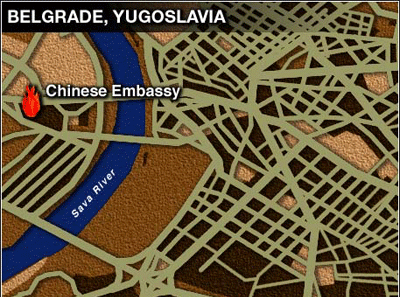
On the night of May 7, 1999, three NATO-launched missiles struck a critical corner of the Chinese Embassy in Belgrade, Yugoslavia which contained the intelligence gathering chamber dedicated to electronic eavesdropping. At first the atrocity was attributed by the US to faulty, outdated maps, which didn’t place the embassy in its proper location. That pathetic offering didn’t convince a single person, least of all the Chinese, who exploded in furious reaction over the 26 wounded and three killed in the deliberate attack. Turns out that the CIA had specifically chosen the target which, they claim, was purely accidental due to the outdated maps. It was a “pure coincidence” said an unnamed Pentagon official.

“The mistake here was the original data base. It was outdated. I believe it was a 1992 map when it should have been an up-to-date map.” [5]

GIF - 99.5 kb

In Washington, Defense Secretary William Cohen and CIA Director George Tenet issued a joint statement saying that NATO believed the building housed a Yugoslav military facility, not the Chinese Embassy.

In further explanation of this obviously fraudulent story the reader is offered the following: “Only after the disaster did the C.I.A. turn up in its files two maps that accurately placed the embassy…A final backup also failed when several computerized databases of sites that were off-limits to bombing, including embassies, hospitals and churches, did not have the current location of the Chinese Embassy.” [6] And if you believe any of that come see me. I’ve got a bridge to sell.

Commentary took a different track later in the same year, in October 1999, when The Observer of London challenged the official US account under the heading: Nato Bombed Chinese Deliberately. The article states, inter alia, the following info:

“Nato deliberately bombed the Chinese embassy in Belgrade during the war in Kosovo after discovering it was being used to transmit Yugoslav army communications.

According to senior military and intelligence sources in Europe and the US the Chinese embassy was removed from a prohibited targets list after Nato electronic intelligence (Elint) detected it sending army signals to Milosevic’s forces.

A NATO flight control officer in Naples also confirmed to us that a map of ‘non-targets’: churches, hospitals and embassies, including the Chinese, did exist. On this ‘don’t hit’ map, the Chinese embassy was correctly located at its current site, and not where it had been until 1996 – as claimed by the US and NATO.” [7]

If, however, the NATO gang does have such a “non-target” list as earlier cited, then why did they bomb so many hospitals, rest homes, churches, schools and other civilian sites? A historic study of NATO-inflicted terror establishes beyond doubt its criminal contempt for civilians wherever its military apparatus is unleashed against the world. On the same day that the Chinese embassy was struck NATO bombers also struck Nis, the third largest city in Yugoslavia, bombing a hospital and an outdoor market filled with civilians, “killing 15 people and wounding 70.”

JPEG - 35.4 kb

The magnitude of a cluster bomb by the city of Nis, 1999

Journalists were taken to Nis, an industrial city 195 kilometres southeast of Belgrade, to view the devastation from the cluster-bomb attack, which hit a market and a hospital complex…Buildings were pockmarked from the bombs, which release explosives that then explode again [releasing smaller bomblets that fan out to kill over a wide radius, scattering the explosives indiscriminately and turning the bombing ground into a monstrous killing field]. [8]

After a lengthy study of the embassy bombing, I find the Observer account of why NATO struck the embassy to be lacking in authenticity. Why would the Chinese pass communications from the capital to Yugoslav troops in the field? What would they gain from so doing? I believe there is a more credible explanation.

The actual reason for the bombing was meant to cover-up NATO war crimes that were taking place almost daily, and the Chinese listening post located in the corner of the embassy that was bombed were intercepting orders issued by NATO which clearly revealed those crimes. The Chinese needed to be silenced and their operations ended, no matter the fallout. Take, for instance, that refugee column of Kosovo Albanians exiting the region on tractors and horse-carriages. The column that the US and NATO bombed, killing dozens. As the Toronto Globe and Mailreports:

Last Wednesday, Yugoslav authorities said NATO planes had killed more than 60 Kosovo Albanians in an attack on a refugee column. A road strewn with refugee bodies was shown on Serbian television and foreign journalists were escorted to the site to film the carnage.

Serb television last night revealed extracts of what it called a taped conversation of a NATO pilot being ordered to attack a civilian convoy in Kosovo last week despite seeing only cars and tractors. It said the conversation was between the pilot and an early warning radar plane [AWACS]. The extract covered the critical moment when the pilot identified the convoy. Asked if there were any tanks in the convoy, he said he could see only cars and tractors. But the other plane responds “This is a military target, a completely legitimate military target. Destroy the target…” [9].

That, I believe, is why the listening post was destroyed. The ability to intercept NATO communications was far more damaging to NATO’s credibility than any other purported reason. AWACS radar planes guide all NATO bombing runs and the ability to record those communications presents a serious predicament to the war criminals busily attacking those non-targets: hospitals, churches, markets, bridges, industry, TV stations, and virtually every target imaginable.

The Chinese, humbled due to their inability to respond, would pay attention and realize that the US and its satrap partners were giving notice that China was a paper tiger without substance, and that they were on the future chopping block of the imperialist aggressors. This, I believe, is when they began to seriously devote larger portions of the budget to develop their military forces. It was, Chinese analysts decided, a wake-up call whereby they realized the need for a far greater responsiveness, surely understanding that without a more effective military, their economy and sovereignty would suffer an attack that might even include nuclear weapons.

With Obama’s shift to the Pacific, I believe it’s only a matter of time!

Robert S. Rodvik
<:ver_imprimer:> Facebook Twitter Delicious Seenthis Digg RSS

Attached documents

Scenes of devastation at the DIN tobacco factory in Nis after the NATO bombing.

(JPEG – 39.9 kb)

[1] The Vancouver Sun, “TIANANMEN – CIA man misread reaction, sources say” September 17, 1992, p.A20.

[2] Michael Laris, “Beijing Blames America For Tiananmen Protests,” The Washington Post, May 31, 1999.

[3] The Vancouver Sun, “U.S. had ‘inglorious role’ in 1989 protest, China says,” May 31, 1999, p.A2.

[4] China Review, July 1989, pp. 31-43.

[5] US Senate intelligence committee chairman Richard Shelby, May 10, explaining why the Central Intelligence Agency directed NATO to bomb what turned out to be the Chinese embassy in Belgrade killing four (?) People. (Other accounts say three were killed.)

[6] The New York Times, “In Fatal Error, C.I.A. Picked a Bombing Target Only Once: The Chinese Embassy,” July 23, 1999, P.A9.

[7] The Observer, “NATO bombed Chinese deliberately,” John Sweeney and Jens Holsoe in Copenhagen and Ed Vulliamy in Washington, October 17, 1999.

[8] The Globe and Mail, “NATO bombs Chinese embassy,” Julijana Mojsilovic, Reuters News Agency, Belgrade, May 8, 1999, p.A1.

[9] The Globe and Mail, “Reports on bombing cloud the picture,” April 19, 1999, p.A7

Robert S. Rodvik

Internet activist and the author of The Balkans: US Covert Activity and American Media Complicity” (1995).

Tiananmen Square, 1989 — Revisited

Godfree Roberts

via Unz

Scholarship program has been canceled. Student leaders–some sponsored by a shadowy Chinese NGO, and recently returned from Beijing–say the failure to prosecute bankers is evidence of criminal conspiracy and government illegitimacy. The returnees are taunting the crowd for its cowardice, urging them to ignore the snipers on every roof and rush the White House. Inside, nervous staffers with sons and daughters, nieces and nephews among the demonstrators–try to discover which of them have been conspiring with the agitators.

Suddenly, simultaneously, all White House doors burst open and uniformed officers rush out bearing either (a) submachine guns, with which they open fire, slaughtering the children of America’s leading families, or (b) bottles of mineral water, slices of the First Lady’s birthday cake and an invitation to join the President that evening on the White House lawn for a barbecue and serious discussion.

In 1989, fourteen million Americans, six percent of the population were in college. That year two million Chinese kids, 0.2% of the population–the first postwar generation whose education was uninterrupted–an entire generation of its future leaders. The idea that any elite–let alone the child-worshipping Chinese–would murder its own children for demonstrating peacefully over legitimate grievances is even sillier than the notion that they were demonstrating about democracy. They were demonstrating about money and sex. The only ‘democracy’ they wanted was the big character democracy they had learned under Mao: hence the re-appearance of big character posters–not seen since the government de-revolutionized the Cultural Revolution twenty years earlier. Mao had told them what to do when an incompetent government would force them to bear the burdens of its incompetence and corruption: bring out the Big Character Posters. He’d even tried to get big postering constitutionally guaranteed.

1989 was a most uncommon year: the fortieth anniversary of the founding of the People’s Republic, the seventieth anniversary of the May Fourth Movement, the centenary of the Second Communist Internationale and the bicentennial of the French Revolution. The USSR was coming unglued and Deng’s Reform and Opening had, says Orville Schell,[1] ‘rammed Chinese society into reverse gear, stampeding the country into a form of unregulated capitalism that made the U.S. and Europe seem almost socialist by comparison’. Radical market-price reforms caused a major inflation and popular, student and worker unrest.

Elizabeth Perry wrote, “The Cultural Revolution left a significant mark on popular protests in post-Mao China. Repertoires of collective political action popularized during the Cultural Revolution—such as singing revolutionary songs, marches, rallies, and hunger strikes—had a great impact on the 1989 protest movement. The haunting specter of the Cultural Revolution also had a crucial impact on the Deng regime’s interpretation of—and thereby reaction to—the movement. Over three decades after China ventured down the path of capitalist marketization, the bleak reality of growing socioeconomic disparity, environmental degradation, massive layoffs of workers in state-owned enterprises, evisceration of social protections, rampant official corruption, illicit appropriation of public property, and exploitation of rural migrant labor has led to the unraveling of the broad but fragile consensus regarding the direction and rationality of post-Mao reforms that dominated Chinese intellectual discussions of the 1980s”. Reform and Opening–as far as common people could see–was a disaster and little was needed to light the fires of protest, according to Suzanne Pepper:[2]

With the multiple economic and political crises of 1988 and 1989, the consequences of Deng Xiaoping’s decade of reform for higher education, at least, might better be categorized as a major tragedy for all concerned. Deng’s decade had begun with great fanfare, high hopes, and the total reversal of Cultural Revolution priorities.

During the spring 1988 academic meetings, the comments of Beijing University President Ding Shisun in particular created a sensation both because of their candor in criticizing official policies, “Some people ask me whether as Beijing University president I fear student protests, but I answer that what I fear most is not having enough money”. This provoked heated discussions among delegates and a satirical demonstration by a handful of student protesters who gathered in Tiananmen Square offering to shine delegates’ shoes.

By then, the imperatives driving the student protest movement had already taken on a life of their own. The most important issues were high prices, widespread corruption and the special privileges enjoyed by the families of high-level officials who appeared to benefit more than others from the new opportunities to engage in trade and travel. The students also began demanding the unhindered right to protest such negative consequences as they saw fit, once it became apparent that the authorities were trying to stop them. Between mid-October and December 1985, virtually every provincial and city Party secretary in the country visited every leading university and personally listened to students’ complaints. Inherent in the popular response was an undercurrent of Maoist mass-line or “work unit” democracy that was obviously different from both the Western and Deng Xiaoping’s anti-bureaucratic conceptions.

Thus while student demonstrators were occupying Tiananmen Square in May, one middle-aged, middle-ranking Beijing cadre remarked to a friend during a visit to Shenzhen that “Mao would have sent someone out to talk to them.”

The cadre went on to explain that workers and cadres alike in her industrial system felt they had much less opportunity to ‘participate’ within that system now than in the 1970s, when meetings were called for every problem and people could raise opinions that today would result in their dismissal. Preparations for the next phase of the student movement were thus essentially in place when Hu Yaobang died suddenly in mid-April and provided the perfect, if unanticipated, link. Later demands would include more pointed references to inflation, the special privileges of cadres, Swiss bank accounts and so on, but the leading concerns throughout were political. Among the first were seven drafted on April 23 by students from nineteen Beijing colleges and universities:

  1. reassess Hu Yaobang’s [an official much loved by the students] merits and demerits;
  2. allow the people to run newspapers;
  3. increase educational funding and raise the pay of intellectuals;
  4. reevaluate the 1986 student movement and the opposition to bourgeois liberalization;
  5. make public the truth of the April 20, 1989, incident (when police allegedly beat student demonstrators);
  6. oppose corruption, oppose bureaucratism and severely punish official profiteering;
  7. report truthfully all the events from the death of Hu Yaobang to the student demonstrations in Tiananmen Square.

In April, students and workers began massive demonstrations in Beijing and Shanghai, denouncing Deng Xiaoping’s reforms on placards, “It doesn’t matter if the cat is black or white, so long as the cat resigns”.

Dongpin Han, a student at the time, tells how the sudden relaxation of price controls set off bank runs, panic buying and hoarding. Crime was rampant and the country was ripe for destabilization: “Official corruption had disrupted China’s economy. The government, facing bankruptcy, had printed more money in 1984 than in the previous thirty-five years combined. Prices of commodities, previously State-controlled and stable, exploded. Meat rose five hundred percent. My parents had saved two thousand yuan. They’d bought their first house for four hundred yuan then, overnight, their savings lost 90 percent of their value. My mother rushed to the store and bought two hundred feet of plain cloth. Her neighbor bought four hundred pounds of salt and another bought forty TV sets. They believed that war-era inflation had returned and their money would become worthless. People started publicly denouncing corrupt officials and their children’s promotion to high office. Beijing’s Consumer Price Index had jumped 30% in 1988 and salaried workers panicked when they could no longer afford staples. State-owned enterprises were pressured to cut costs. Mao’s iron rice bowl–job security and social benefits ranging from medical care to subsidized housing–were suddenly at risk”.

State owned companies dumped millions of workers into the labor market and inflation consumed their severance pay, designed to last six months, in as many weeks. Graduates found themselves in the worst employment market since the war where, it seemed, only those with political connections got hired. A survey showed that the average university graduate earned less than high school matriculants. Government subsidies were cut to the bone and professors’ incomes reduced. Peasants who followed Deng’s admonition to ‘get rich’ were getting rich, enraging social elites who demanded[3] ‘more money for education and higher pay for intellectuals’. The Toronto Sun’s Eric Margolis wrote, “This reaction to Deng’s policies was reflected not only in the Maoist sympathies of some Chinese students but also in the broad demands put forward by the student movement.The 1989 events were, at their core, a political civil war within the CCP where the weapons used went beyond the back rooms and onto the street: students and workers with real grudges due to rapid changes ended up being manipulated by factions within the CCP and foreign conspirators–and things got pretty out of hand”.

The withdrawal of Mao’s tuition subsidies crushed the dreams of millions of families thirsting for education and the government’s decision to maintain scholarships for African students touched off race riots. Thousands of Nanjing students chanted demands for reform, waved signs like “Kill the black devils!” and rampaged through the Africans’ student quarters, injuring many. The anti-African demonstrations spread to Beijing where, late on the night of April 19, student militants carrying banners saying, “No Offend Chinese Women,” yelling “Kill the foreigners!” and screaming insults at Deng marched on Party leaders’ living quarters at Zhongnanhai.

As eyewitness Lee Feigon relates, “The police seemed remarkably tolerant, unflustered by the constant jeering and screaming. Many who watched doubted that the American Secret Service would have reacted so genially if a similar mob were battering on the gates of the White House in the middle of the night. This was carried to an extreme at about 2:30 a.m. when the police tried to clear the crowd and some of them were pushed back onto a cluster of fallen bicycles. One tough picked up one of the bikes and smashed it over the head of one of the police. He was not arrested”.

Squabbling within the Forbidden City, where opposition to Deng’s Reform and Opening was still powerful among Maoists, reflected the turmoil in the Square. Conservatives and progressives struggled to implement contradictory policies and Hu Yaobang’s unexpected death left no trusted interlocutor. Demonstrations intensified when students marched into Tiananmen Square on April 26 singing the Internationale and holding aloft portraits of Mao. Lee Feigon continues, “The leaders of a prominent student group hung big pictures of Mao in the tents they pitched on the square. They talked openly and boldly about the good old days of the Cultural Revolution. Mao, they felt, had the right ideas although he sometimes used wrong tactics. Now they were determined to use what they considered the right ones”.

Like their American counterparts, whose dreams died at Kent State, China’s New Left knew the value of publicity. They expected repression and openly provoked it but, to their considerable surprise, provoked mostly sympathy. The Party’s reform wing hailed them as ‘bearers of the spirit of socialist democracy’ and The Peoples Daily gave them front-page photo spreads and adulatory coverage with headlines like, ‘A Million from All Walks of life Demonstrate in Support of Hunger-Striking Students,’ ‘Save the Students! Save the Children!’ The Guangming Daily ran front-page stories like, “The conditions of the students and the future of the country touch the heart of every Chinese who has a conscience”. Clearly, the students were not alone.

At the height of the turmoil organizers met with Party leaders and CCTV broadcast the meeting nationwide to millions sympathetic to their demands for an end to corruption and the crime wave Deng’s reforms had unleashed.By May 18, support for the students was so strong that the The Peoples Daily pushed coverage of Russian President Gorbachev’s state visit below the fold to feature their demands. Capitalizing on television coverage of Gorbachev’s visit, protesters blocked the Square and announced a hunger strike. The government responded by sending ten thousand doctors and nurses, one hundred ambulances and teams of sanitation workers and portable toilets.

The hunger strikers insisted on further dialog and, when the government complied, demanded that Deng retire, troops stationed outside the city be dispersed and martial law revoked and presented four demands. (1) better treatment for intellectuals, including more money for education, better salaries and job assignments after graduation. (2) An end to pervasive official corruption and to preferential treatment for relatives of Party officials in getting lucrative jobs and better living arrangements and education. (3) Hu Yaobang’s political reforms, including more government accountability and responsiveness to citizens’ ideas and opinions and broader input into government policy. (4) Respect for constitutionally guaranteed freedoms like freedom to demonstrate, freedom of speech and freedom of the press. (As these reforms were made in subsequent years the government’s trust and approval ratings rose steadily, reaching Olympian heights with Xi’s ending pervasive political corruption.)

The students received large sums of money from ordinary citizens, from foreign tourists and organizations abroad and worker activists claimed to have witnessed a ‘chaos of money’ and accused the leadership of pocketing it for themselves. The size and quality of tents and sleeping mats purchased with donated funds, they noted, ‘were allocated among student leaders according to their relative rank.’ Carried away by self-importance, like the elderly Party leaders they despised, they became steadily less available to the press and their bodyguards refused access to journalists without multiple ID cards and press passes. CNN’s Mike Chinoy[4] recalled, “The bickering students began to display the same bureaucratic and autocratic tendencies in their People’s Republic of Tiananmen Square that they were trying to change in the government”. Vito Maggioli, CNN’s assignment manager, recalled how, by late May, camera crews and producers would come back after reporting on events in the Square, complaining about the bureaucracy the students had created, with some even referring to student leaders as ‘fascists.’

Nor did student leaders welcome those who suffered the reforms’ cruelest effects, common workers. Andrew Walder and Gong Xiaoxia[5] said a member of the Workers’ Autonomous Federation found the students were ‘especially unwilling’ to meet members of the Construction Workers’ Union, whom they drove from the Square, considering them as lowly ‘convict laborers’. They ‘were always rejecting us workers. They thought we were uncultured. We demanded participation in the dialogue with the government but the students wouldn’t let us. They considered us workers to be crude, stupid, reckless, and incapable of negotiating’. In response to their exclusivity, the workers produced their own charter inviting all to join and ‘members took pride in the fact that their leaders would talk freely with city people of all walks of life and peasants as well, and that the ‘democratic forum’ of their broadcasting station was open to any and all statements from the audience.’The workers added that they ‘observed in the student leaders and in their movement many of the faults of the nation’s leaders and their political system: hierarchy, secrecy, condescension toward ordinary people, factionalism, struggles for power, and even special privilege and corruption’.

The situation was volatile, but violence would require a catalyst, and the CIA was ready and eager to provide it. Having overthrown Iran’s government in 1953, South Vietnam’s in 1963 and Chile’s in 1973, the Agency moved its team of coupsters to Beijing. As The Vancouver Sun reported, “For months before the June 3 attack on the demonstrators, the CIA had been helping student activists form the anti-government movement, providing typewriters, facsimile machines and other equipment to help them spread their message, said one official”. The CIA moved Gene Sharp, author of the Color Revolution manual, to Beijing where financier George Soros had incorporated the eponymous Fund for the Reform and Opening of China. CIA Director George H.W. Bush withdrew Ambassador Winston Lord from Beijing and replaced him with James Lilley, an operative experienced in regime change. Bush and Lilley had been close friends since the early 1970s when Lilley was the head of station for the CIA in Beijing and Bush was Chief of Mission and de facto Ambassador. In 1975, as Bush was returning to Washington from Beijing to head the CIA he appointed Lilley National Intelligence Officer for China, the highest-ranked expert on China in the American intelligence community.

Lilley had made contact with Premier Zhao Ziyang who wanted China to adopt privatized media, freedom to organize, an independent judiciary, a multiparty parliamentary democracy, privatization of state-owned assets, the separation of Party and State and market-oriented economic reforms. In 1986 Soros endowed his Fund for the Reform and Opening of China with one million dollars—a huge sum for China those days—to promote cultural and intellectual exchanges with Zhao’s Institute for Economic Structural Reform. In 1988 the National Endowment for Democracy opened two offices in China, gave regular seminars on democracy, sponsored select Chinese writers and publications and recruited Chinese students studying in US. In February 1989, two months before the CIA launched its Tiananmen destabilization campaign, President Bush paid his first and only visit to China.

When the student protests erupted in late April the NED mailed thousands of inflammatory letters from Washington to recipients in China and aroused public opinion through Voice of America (VOA) shortwave radio broadcasts, in Mandarin, across China on the days of the protests. In Nanjing, university students had boom-boxes turned high as the VOA described events in China.

Deng had CIA strategist Gene Sharp arrested and expelled to British Hong Kong, whence he directed the insurrection, as he recounts in his memoir, Non-Violent Struggle in China. Another CIA operative, VOA’s Beijing chief, Alan Pessin, provided encouragement, provocation, strategic guidance and tactical advice in round-the-clock broadcasts and students who were there still talk of the VOA’s promised land of ‘freedom and democracy’.

The Taiwan-funded Chinese Alliance for Democracy issued an Open Letter from New York which, posted in Beijing University’s Triangle on April 26, called for ‘consolidating the organizational links established during the movement, strengthening the contacts with the critics and strengthening support for the movement within all sectors of society’. The Taiwanese government provided $1 million for equipment and flew its most prominent member (and future Nobelist) Liu Xiaobo from Washington to lead the protests. The students’ local leader Chai Ling, secretly holding a US visa, angrily accused Liu of using the student movement to ‘rebuild his own image’.

The stage was set for violence. Moderate student leaders argued that, having made their point, the students should withdraw and live to fight another day but Chai Ling commanded[6] them to stay because, she explained, “Some fellow students asked me what our plans are, what our demands will be in future. This made me feel sick at heart; I started out to tell them that what we were waiting for was actually the spilling of blood, for only when the government descends to the depths of depravity and decides to deal with us by slaughtering us, only when rivers of blood flow in the Square, will the eyes of our country’s people truly be opened…But how could I tell them this? How could I tell them that their lives would have to be sacrificed in order to win?”

Wang Yam, her fellow organizer, publicly supported Chai Ling’s call for violence and gave government conservatives the excuse they needed, asone Long March veteranput it: “Those goddamn bastards! Who do they think they are, trampling on sacred ground like Tiananmen? They’re really asking for it! We should send the troops right now to grab those counter-revolutionaries! What’s the People’s Liberation Army for, anyway? What are the martial law troops for? They’re not supposed to just sit around and eat!”

At midnight on June 3, six weeks after the protests began, troops began moving from the railway station into the city under orders not to fire unless fired upon. An officer later testified at the official enquiry, “If we had been allowed to let ourselves go, one battalion would have been quite sufficient to quell the riot but, with rioters hiding behind onlookers, we had to stay our hand”. On the way in one soldier was seized, thrown from an overpass and killed, another doused with gasoline and set alight, one was clubbed to death and disemboweled and three major-generals were attacked and hospitalized. Rioters looted weapons and ammunition from captured trucks and attacked government buildings. Leaders distributed knives, iron bars, bricks and chains, urging people to ‘take up arms and overthrow the government’. At six the following evening loudspeakers told Beijingers to remain indoors as troops had been ordered to suppress the uprising by force and, when the soldiers moved in, rioters burned hundreds of vehicles, including sixty armored cars and thirty police cars. NYU Professor James C. Hsiung watched⁠[7] the action from his perch in the Beijing Hotel:

After midnight, I saw troops trotting on foot from the East towards Tiananmen Square, without helmets or weapons. As they were approaching the square, they were blocked by huge crowds and were forced to retreat, trotting back in the direction (east) they had come from. On their retreat route, the troops were chased by the crowds, many throwing rocks and bricks. Not long after, troops returned by truck, this time with helmets on and weapons in hand. By then, the crowds had set up more roadblocks. As the trucks were negotiating their way through, the crowds stopped them with a barrage of rocks. This free-for-all went on for some time, during which many soldiers were either killed or wounded; and some lost their weapons to the ruffians. Then came the armored reinforcements spitting sporadic fire, apparently in revenge, into the crowds along both sides of the road. Besides the ruffians and students, many were merely onlookers. The crowds, however, fought back hard. They climbed atop the on-coming tanks. Some even used Molotov cocktails or the equivalents of a flame-thrower against the tanks. One tank went ablaze. As the three soldiers inside opened the latch to run away from the heat, some hooligans shouted: “Kill them, kill them!” A BCC (Taiwan) radio reporter on the scene recorded the shouting. He later told me that he saw the three soldiers killed by their maulers. A Chinese-American friend, in whose house I had been a dinner guest only two nights before, later called and told me that a similar attack took place in front of their apartment building. One soldier’s corpse, lying by an incinerated troop-carrier truck, I was told, was set on fire by his killers, who had poured gasoline on the body. In all the cases we knew, the ruffians were much older than most college students and did not appear to be students at all.

Informed that troops were approaching Tiananmen Square and shooting had started, the students began withdrawing at 5 am and were gone by 6:30. Journalist Che Muqi⁠[8]

recounts his conversation with Kong Xiangzhi, a professor at Chinese People’s University:

At about 12:10 a.m., the troops marched in from West Chang’an Avenue. I was sitting on the steps outside the West entrance of the Great Hall of the People. When the troops marched towards the square, I saw a group of people throwing rocks at them. When a few soldiers went up to them, they ran southwards. These soldiers fired into the air. Then some other soldiers came up but they didn’t shoot at the crowds, otherwise I would have been shot, since I was now on the sidewalk.

I walked to the East entrance of the Great Hall where several hundred soldiers were sitting and some people were talking with them. The atmosphere seemed friendly. When I saw someone binding up a wound for a young soldier, I went up to help and asked him how he had been wounded. He told me he had been hit by rocks. He also told me that many of his comrades had also been wounded. I saw many whose heads, arms or hands were bound with gauze. I told him that I believed that the majority of the students and residents would not do this. He agreed with me. Then, an officer came to talk with us. He said that the troops would never open fire on the masses or the students. At about 3:30 a.m., the troops began to fall in. The officer then said to his men: “We’re going in to clear out the square. Now I want to make clear that no-one is permitted to shoot at the students or people; right now, this is the highest form of discipline”.

About 4:10 a.m. all the lights at the square went out. A lot of soldiers came out from the East entrance of the Great Hall. I sat down to watch under the pine trees, feeling excited and nervous. I was nervous because this was the first time I had seen so many soldiers carrying guns and I didn’t know how they were going to clear up the square. ..At about 4:30, the martial law troops announced over the loudspeaker, “Attention, students. We have agreed to your appeal. We will allow you to leave peacefully”. The announcement was broadcast over and over again. At about 4:50, the students around the monument began to leave. I looked around and saw that there was almost no one in sight. So I came back with the students. That was at 5:05 a.m. This was what I saw at the time. No one was killed throughout the whole process. Some people with ulterior motives who had fled abroad spread rumors that Tiananmen Square had been a blood-bath and that they had had to crawl out from underneath the corpses, which was sheer nonsense.

Famous Taiwanese entertainer Hou Dejian summarized his experience of the finale, “Some people said that two hundred died in the Square and others claimed that two thousand died. There were also stories of tanks running over students who were trying to leave. I have to say that I did not see any of that. I don’t know where those people died. I myself was in the Square until six-thirty in the morning”. Future Nobelist Liu Xiaobo remained to the end and said he saw nobody harmed.

On June 19, Beijing Party Secretary Li Ximing delivered the results of the official enquiry. More than 7,000 were wounded or injured and two hundred forty one killed, including thirty-six students, ten soldiers and thirteen People’s Armed Police during a riot in Chang’An Road.

For all its failures, tragedies and confusions, the Tiananmen incident ranks among the most successful propaganda campaigns in history. Long after the massacre story was disproved, foreign journalists–all of whom had left the Square–told readers that students had been demanding Western values in the face of ‘Red Chinese totalitarianism’. Their fabricated massacre gave the West an excuse to embargo China yet again, and to label it an international human rights pariah.

Some journalists, sinologists and officials had second thoughts. “I believe we tried to put a ‘made in the USA’ democracy stamp on it,” said Jackie Judd[9]

of ABC. Photographer Jeff Widener[10] said he took the Tank Man photograph on June 5, more than a day after the students had left the Square. (Associated Press still distributes the image as if it were from June 4, so look for it).

>


Widener’s photo shows a man stopping four tanks but another photograph, taken by Stuart Franklin a few seconds earlier, shows nineteen tanks behind Widener’s four and makes it clear that the tanks are leaving the Square, driving east, out of the city.

And the story continued to leak out abroad:[11]

CIA man misread reaction, sources say. Vancouver Sun.

WASHINGTON – THE CIA STATION chief in China left the country two days before Chinese troops attacked demonstrators in the capital Beijing in 1989, after predicting the military would not act, U.S. officials said. China’s government had declared martial law 12 days earlier and moved tens of thousands of troops to the outskirts of Beijing in preparation for removing the demonstrators from Tiananmen Square.

The Central Intelligence Agency had sources among protesters, as well as within China’s intelligence services with which it enjoyed a close relationship since the 1970s, said the officials, who spoke this week on condition of anonymity.

For months before the June 3 attack on the demonstrators, the CIA had been helping student activists form the anti-government movement, providing typewriters, facsimile machines and other equipment to help them spread their message, said one official.

In the weeks leading up to the 1989 bloodshed, the CIA monitored the growing tension closely using its case officers, diplomats at the U.S. embassy, and a network of informers among the students who led the protest. But as the protest lost steam, the chief of the CIA station decided the threat of confrontation had been defused, said one official. The CIA declined all comment”.

The BBC’s Beijing correspondent, James Miles,confessed to having “Conveyed the wrong impression, and that there was no massacre in Tiananmen Square. Protesters who were still in the square when the army reached it were allowed to leave after negotiations with martial law troops…There was no Tiananmen Square massacre”. But, even after TheColumbia Journalism Review discredited⁠12 the massacre story and WikiLeaks released Ambassador James Lilley’s July 12 (a month after the events) cable, few editors were interested.

OF JUNE 3-4 EVENTS ON TIANANMEN SQUARE

  1. CONFIDENTIAL – ENTIRE TEXT.
  2. SUMMARY- DURING A RECENT MEETING, A LATIN AMERICAN DIPLOMAT AND HIS WIFE PROVIDED POLOFF AN ACCOUNT OF THEIR MOVEMENTS ON JUNE 3-4 AND THEIR EYEWITNESS ACCOUNT OF EVENTS AT TIANANMEN SQUARE. ALTHOUGH THEIR ACCOUNT GENERALLY FOLLOWS THOSE PREVIOUSLY REPORTED, THEIR UNIQUE EXPERIENCES PROVIDE ADDITIONAL INSIGHT AND CORROBORATION OF EVENTS IN THE SQUARE. THEY WERE ABLE TO ENTER AND LEAVE THE SQUARE SEVERAL TIMES AND WERE NOT HARASSED BY TROOPS. REMAINING WITH STUDENTS BY THE MONUMENT TO THE PEOPLE’S HEROES UNTIL THE FINAL WITHDRAWAL, THE DIPLOMAT SAID THERE WERE NO MASS SHOOTINGS OF STUDENTS IN THE SQUARE OR AT THE MONUMENT. END SUMMARY. (Emphasis mine – WE)
  3. GALLO [Chilean Second Secretary Carlos Gallo and his wife] EVENTUALLY ENDED UP AT THE RED CROSS STATION, AGAIN HOPING THAT TROOPS WOULD NOT FIRE ON THE MEDICAL PERSONNEL THERE. HE WATCHED THE MILITARY ENTER THE SQUARE AND DID NOT OBSERVE ANY MASS FIRING OF WEAPONS INTO THE CROWDS, ALTHOUGH SPORADIC GUNFIRE WAS HEARD. HE SAID THAT MOST OF THE TROOPS WHICH ENTERED THE SQUARE WERE ACTUALLY ARMED ONLY WITH ANTI-RIOT GEAR–TRUNCHEONS AND WOODEN CLUBS… (Emphasis added – WE)
  4. ALTHOUGH GUNFIRE COULD BE HEARD, GALLO SAID THAT APART FROM SOME BEATING OF STUDENTS, THERE WAS NO MASS FIRING INTO THE CROWD OF STUDENTS AT THE MONUMENT. WHEN POLOFF MENTIONED SOME REPORTEDLY EYEWITNESS ACCOUNTS OF MASSACRES AT THE MONUMENT WITH AUTOMATIC WEAPONS, GALLO SAID THAT THERE WAS NO SUCH SLAUGHTER. ONCE AGREEMENT WAS REACHED FOR THE STUDENTS TO WITHDRAW, LINKING HANDS TO FORM A COLUMN, THE STUDENTS LEFT THE SQUARE THROUGH THE SOUTHEAST CORNER. ESSENTIALLY EVERYONE, INCLUDING GALLO, LEFT. THE FEW THAT ATTEMPTED TO REMAIN BEHIND WERE BEATEN AND DRIVEN TO JOIN THE END OF THE DEPARTING PROCESSION. ONCE OUTSIDE THE SQUARE, THE STUDENTS HEADED WEST ON QIANMEN DAJIE WHILE GALLO HEADED EAST TO HIS CAR. (Emphasis mine – WE)

The Public Security Ministry issued arrest warrants for twenty-one demonstrators including Liu Xiaobo, Wang Dan, Wu’er Kaixi, Liu Gang and Chai Ling, but the CIA’s Operation Yellowbird had already exfiltrated four hundred leaders to Western countries. Ambassador Lilley claimed that America was involved in ‘almost exclusively legal exfiltrations,’ though it was later proven that Hong Kong’s notorious Sun Yee On criminal triad was involved.

A few months after the event Deng discussed the incident with Chinese-American academic Li Zhengdao, “In suppressing the turmoil we were at pains to avoid hurting people, especially the students; that was our guiding principle” and criticized his colleague Zhao Ziyang whom, he said, “was clearly exposed as siding with the agitators and attempting to split the Party” and reportedly told West German Chancellor Helmut Schmidt, “the students should not be blamed too much. The roots of the problem lay within the leadership of the Party”.

In The Legacy of Tiananmen James A. R. Miles explained, “A year after Tiananmen, Deng elaborated on his fears of civil war during a meeting with the former Canadian prime minister Pierre Trudeau. ‘You can imagine,’ Deng said, ‘what China in turmoil would be like. If turmoil erupts in China, it wouldn’t just be a Cultural Revolution-type problem. At that time (during the Cultural Revolution) you still had the prestige of the elder generation of leaders such as Mao Zedong and Zhou Enlai. Even though it was described as ‘all-out civil war,’ actually there wasn’t any major fighting. It wasn’t a proper civil war. Now it’s not at all the same. If turmoil erupts again, to the extent that the party is no longer effective and state power is no longer effective and one faction grabs one part of the army and another faction grabs another part of the army–that would be civil war. If some so-called democratic fighters seize power, they’ll start fighting among themselves. As soon as civil war breaks out there’ll be rivers of blood. What would be the point then of talking about ‘human rights’? As soon as civil war breaks out, local warlords will spring up everywhere, production will plummet, communications will be severed, and it won’t be a matter of a few million or even tens of millions of refugees. There’d be well over a hundred million people fleeing the country and the first to be affected would be Asia, now the most promising part of the world. It would be a global disaster’”.

Singapore’s Lee Kwan Yew later said he would have shot 200,000 demonstrators to maintain stability and U.S. Ambassador Charles Freeman opined, “I cannot conceive of any American government behaving with the ill-conceived restraint that the Zhao Ziyang administration did in China, allowing students to occupy zones that are the equivalent of the Washington National Mall and Times Square combined, while shutting down much of the Chinese government’s normal operations”.

The CIA’s operational analysis attributed the failure to ‘the difficulty of mobilizing young activists in the desired direction due to lack of strong polarizations in Chinese society’ and Chinese analysts attributed the lack of strong polarizations in Chinese society to the Cultural Revolution, which Mao had conducged specifically for that purpose.

Students had discovered their leader, Chai Ling, leaving the square and, accusing her of abandoning them to die, detained her. She escaped and recorded a speech saying that she witnessed at least twenty students and workers being massacred in the Square. She was given a scholarship to Princeton University and nominated for the 1990 Nobel Peace Prize. Though he had left the Square hours before the military arrived, another leader, Wu’er Kaixi claimed that he witnessed tanks killing hundreds of protesters by driving over them as they slept.Liu Xiaobo, later awarded the Nobel Peace Prizehelped the students avoid bloodshed and was pardoned. He, too, said that nobody in the Square was harmed.

The vice-president of the Tiananmen student body and leader of the riot in Chang’An Avenue, Wang Yam, was smuggled to the UK and given British citizenship. In 2006 he was tried in London, in the first British murder trial to be held in secret, for bludgeoning to death an elderly man. The Crown Prosecutor demanded that Wang’s trial be held in camera and the trial judge assented and gagged media speculation. Wang Yam was convicted of first degree murder and MI6, Britain’s intelligence agency, admitted that he was their employee.

In 1998, President Bill Clinton discussed the incident with President Jiang Zemin, as John Border⁠13 reported, “The drama of the meeting came in a remarkable 70-minute news conference, carried live on nationwide Chinese television, in which the two Presidents differed sharply on the nature of personal freedom, the role of the state and the meaning of the Tiananmen Square demonstrations that were violently suppressed by the Chinese Government in June 1989…Mr. Clinton flatly told the Chinese leader that his Government had been ‘wrong’ to use force to end the peaceful demonstrations of the spring of 1989 and that broad personal freedom and political expression were the price of admission to the world community of the 21st century. ‘For all of our agreements, we still disagree about the meaning of what happened then,’ Mr. Clinton said in his opening statement, referring to the violent crackdown on Tiananmen Square the night of June 3-4, 1989, that left hundreds of protesters dead”.

Three years after Tiananmen, in response to demonstrations in Los Angeles, President Bush sent in thousands of troops saying “There can be no excuse for the murder, arson, theft or vandalism that have terrorized the people of Los Angeles… Let me assure you that I will use whatever force is necessary to restore order”. Sixty-six people died, eleven thousand were arrested, and the media called the President’s action ‘decisive’. The following year, when President Clinton ordered federal forces to attack a Christian community in Waco, Texas, they killed eighty-one men, women and children. No-one was disciplined.

Notes

[1] Mandate of Heaven: The Legacy of Tiananmen Square and the Next Generation. By Orville Schell.

[2] China’ Education Reform in the 1980s Policies, Issues, and Historical Perspectives. SUZANNE PEPPER. 1990. INSTITUTE OF EAST ASIAN STUDIES UNIVERSITY OF CALIFORNIA AT BERKELEY CENTER FOR CHINESE STUDIES.

[3] China Rising: The Meaning of Tiananmen https://www.amazon.com/gp/product/0929587308/ref=as_li_tl?ie=UTF8&camp=1789&creative=9325&creativeASIN=0929587308&linkCode=as2&tag=inpraiseofchi-20&linkId=fe9aef54d84dbb0f5e056169f9f74077.

[4] Mike Chinoy, China Live: Two Decades in the Heart of the Dragon, p.242.

[5] University Workers in the Tiananmen Protests: The Politics of the Beijing Workers’ AutonomousFederation. Author(s): Andrew G. Walder and Gong Xiaoxia Source: The Australian Journal of Chinese Affairs, No. 29 (Jan., 1993), pp. 1-29.

[6] Cries for Democracy: Writings and Speeches from the 1989 Chinese Democracy Movement (Princeton Univ. Press, 1990), p. 327.

[7] When the author queried Dr. Hsiung, he replied, “It could have been in a paper (report) I gave at a meeting in New York. The meeting had been scheduled long before the June 4 1989. I was supposed to give a paper at the meeting. But, since I had come only a few days before when the meeting took place, I did not have the time to write a paper. So, I gave a report on what I witnessed at the Tiananmen Square, instead.

I can assure you that I received very strong, almost tumultuous, reactions in response. One person in the audience even said: “Don’t think you can fool us. We witnessed it too, from the TV shorts”. So, watching TV made him an eye witness, too.

If you can read Chinese, I did have an article written on the 20th anniversary of the June 4th tragedy, titled: “一個天安門事件 ‘變相受害者’ 的喊冤回憶”, (The Painful Reminiscences of a “Virtual Victim“ of the Tiananmen Event, published in Taiwan’s Straits’ Review (海峽評論),No. 223 (July, 2009), pp. 173-178.

The Straits Review can be reached by e-mail at: <sreview@ms47.hinet.net>.

If you write, pls. ask for Mr. Shu-tao FU (福蜀濤)。 He knows me. In fact, he asked me for the article.

[8] Che Muqi: «Beijing turmoil – More than meets the eye», Foreign language press, Beijing 1990, ISBN 0-8351-2459-2; 7-119-01305-X

https://www.amazon.com/gp/product/0835124592/ref=as_li_tl?ie=UTF8&camp=1789&creative=9325&creativeASIN=0835124592&linkCode=as2&tag=inpraiseofchi-20&linkId=8ae5ac33198984828ff0fdb336af8833

[9] Coverage of the Crisis

TURMOIL AT TIANANMEN

A STUDY OF U.S. PRESS COVERAGE OF THE BEIJING SPRING OF 1989.

[10] Behind the Scenes: Tank Man of Tiananmen, NYT

[11] The Vancouver Sun; Vancouver, B.C. [Vancouver, B.C]17 Sep 1992: A20 (1st Edition)

[12] The Myth of Tiananmen

[13] The New York Times http://www.nytimes.com/1998/06/28/world/clinton-china-overview-clinton-jiang-debate-views-live-tv-clashing-rights.html.

Optimism About Korea Will Kill Us All

The first step towards peace is lowering your expectations.

BY JEFFREY LEWIS in Foreign Policy

Last week’s inter-Korean summit, and North Korean leader Kim Jong Un’s declaration that he would “close” his nuclear test site by May, were greeted widely with celebration. But contrary to the hoopla, we have now arrived at an especially dangerous moment in Washington’s relationship with Pyongyang. We are on the verge of letting our hopes get in the way of our survival.

Consider the now widespread view that North Korea’s test site is unusable or that the mountain that contains it has collapsed. This was always garbage reporting. You can download the two academic papers that are said to have originally made these claims — they say nothing of the kind. What the papers do is prove that, after North Korea’s big nuclear test in September 2017, the cavity created by the explosion collapsed in on itself. We already knew that probably happened (although it is cool to see it demonstrated through seismology).

But the collapsing of the cavity and shrinking of the mountain do not mean the tunnels leading to it collapsed, let alone that the mountain itself had done so. And, of course, there are two other nuclear test complexes underneath entirely different mountains at the site. Kim was quoted as making this point himself: “Some said we will dismantle unusable facilities, but there are two more larger tunnels [in addition to] the original one and these are very in good condition as you will get to know that when coming and seeing them.” But commentators in the West, hoping for a diplomatic breakthrough (whether for political or more idealistic reasons), still heard what they wanted to hear about the condition of North Korea’s program.

The whole episode reminds me of something that happened a decade ago — when North Korea agreed to demolish the cooling tower at its Yongbyon gas-graphite reactor. The demolition of the cooling tower, accomplished with great fanfare, was not, in fact, a part of the original agreement that the Bush administration had reached with North Korea. But the Bush administration went back and asked North Korea to do it because it wanted “a striking visual, broadcast around the globe, that would offer tangible evidence that North Korea was retreating from its nuclear ambitions.” In other words, it was a PR stunt — and people fell for it.

There was just one problem. Although North Korea never rebuilt the cooling tower, that didn’t stop it from it secretly restarting Yongbyon — it simply connected the reactor to a nondescript and very boring pump house it had constructed under everyone’s noses. (This was the same sort of pump house, incidentally, that North Korea helped Syria build at its secret nuclear reactor near Al Kibar.) But without the visual of Yongbyon’s cooling tower, almost no one noticed what North Korea was doing with the reactor.

Kim’s promise to close the nuclear test site doesn’t really mean much in practice, certainly not much more than the demolition of the cooling tower. The site is a few support buildings surrounded by mountains with massive tunnel complexes dug horizontally into them. Simply closing the site wouldn’t be anything like the disabling of South Africa’s nuclear test site, whose vertical shafts were filled with debris. Instead, it would be more like the closure of Degelen Mountain at the Semipalatinsk test site in Kazakhstan, which the United States helped seal after the Soviets had abandoned it. Scavengers eventually just popped open the seals, forcing the United States to reseal them and then add surveillance measures. North Korea can seal up the tunnels, but it could always unseal them later. And we should keep an eye out for the proverbial pump house. After all, it’s not like North Korea is short on mountains or labor to dig new tunnels.

This is not to say that I am not delighted that North Korea has announced an end to nuclear explosive testing and the closure of its test site. This is a very good thing. But we must be clear about what’s happening and what it means. North Korea isn’t giving up a test site because it collapsed. North Korea agreed to stop testing because Kim is getting what he wants. The third inter-Korean summit was not premised on Kim Jong Un offering to disarm. He has never, ever made a concrete promise to abandon his nuclear weapons program. If you read the joint statement closely, what South and North Korea have done is to take disarmament off the table as a concrete outcome and substitute a vague aspiration that at some point nuclear weapons will no longer be necessary.

Until that time, Kim is willing to agree to a much more modest series of steps — a moratorium on launches of intermediate- and intercontinental-range ballistic missiles, as well as an end to nuclear testing. Those are good things. We should appreciate them as genuine improvements to U.S. security, not something to tide the United States over until North Korea turns over missiles and nuclear warheads.

Kim is working toward winning a de facto recognition of North Korea as a nuclear power in exchange for his agreement to respect certain limits — an end to certain missile tests and nuclear explosions, an agreement not to export nuclear technology to other states, and perhaps a pledge by North Korea not to use nuclear weapons. To accept this would represent a complete and total retreat from decades of U.S. policy — a retreat that I believe is overdue and the inevitable consequence of North Korea’s development of ICBMs and thermonuclear weapons. We have to learn to accept North Korea as it is. And what North Korea is, is nuclear-armed.

But because it represents a retreat, we’re not acknowledging it honestly. If Trump were to say this clearly, then I would support the old racist windbag in this pursuit. But instead, Trump and others are presenting this process as a route that leads to North Korea’s disarmament — even though Kim has said nothing that deviates from statements that every North Korean leader has made. And in our collective self-delusion, we have a surprising cheerleader: national security advisor John Bolton.

It is worth asking why Bolton is busy giving interviews in which he raises hopes for a complete elimination of North Korea’s nuclear weapons that can occur in a matter of months. He has repeatedly called for a “Libya style” deal — one in which the United States simply shows up and collects the weapons and supporting infrastructure. And South Korean officials are also saying that Trump won’t meet with Kim without “a specific timeline for complete denuclearization: as soon as possible and no later than the end of Mr. Trump’s current term, in early 2021.”

This is madness. There is no reason to think that Kim has any intention of agreeing to such a thing. (Starting with the fact that he has never offered to part with North Korea’s “powerful treasured sword,” as it calls its nuclear arsenal.) And there is no reason to think that Bolton, given all the things he has written and said over the years about North Korea, believes it either. Bolton isn’t suddenly naive. He’s working an angle. And that angle is almost certainly misaligning the president’s expectations. Bolton won’t try to kill diplomacy by opposing it. Rather he’ll kill it by making the perfect the enemy of the good. By raising the prospects of a Libya-style surrender, the much more modest settlement offered by Kim looks sad by comparison.

This is a very cynical — and dangerous — game that Bolton and others are playing. Because what happens once it becomes clear that Kim is not abandoning his nuclear weapons? What does Trump do? Given his personality, what’s most likely is that he’ll lash out, blaming his secretary of state, Mike Pompeo, for his role in setting up the fiasco — and turning the keys over to Bolton. Trump has already hinted at that. At a rally the other day, Trump spoke glowingly about his own efforts to eliminate North Korea’s nuclear weapons, before turning dark. “And if I can’t do it,” Trump warned, “it will be a very tough time for a lot of countries and a lot of people.”

That is a mild description for a situation that would expose millions of Koreans, Japanese, and Americans to a heightened risk of nuclear war. If diplomacy fails, it will be a tough time for everyone — everyone except Bolton.

ABOUT THE AUTHOR

Jeffrey Lewis is director of the East Asia Nonproliferation Program for the James Martin Center for Nonproliferation Studies at the Middlebury Institute of International Studies at Monterey.

Churchill Had Stalin Killed, US Bombed Russian Far East in 50s – Top Russian Official (Video – Mikhail Poltoranin)

Transcribed by Inessa S
Edited by Algora Blog
In this episode Mikhail Poltoranin, former Head of the Government Committee on the Declassification of KGB Archives and Deputy Prime Minister (Wikipedia), talks about the way the US Air Force bombed Soviet bases in 1950 – and about the death of Stalin.

In 1950, the U.S. Air Force attacked Soviet bases in Eastern Russia destroying over 100 Soviet aircraft.

Following these events Stalin was poisoned with cyanide leading to his untimely death.

In order to keep this secret, Stalin’s secretary and even the coroner that examined Stalin were killed and the house of the latter searched.

These events were carried out upon the orders of Churchill because he feared a strong USSR.

TRANSCRIPT:

-You were the head of the committee on declassifying KGB archives; tell us, is it true that the US Air Force bombed our Soviet bases in the Far East in the 1950s?

-Yes, it’s true.

-And we hid this from the rest of the world?

-We hid a lot of things. Actually, we live in a fog of historical myth…

-But you’ve seen the documents, so we will try to dispel some of those myths…What did they bomb and when?

-Their group of fighter jets bombed our Naval bases…

-Which year?

-It was October 1950, an F80 group attacked our Naval bases

-How many of them?

-Four fighter jets. They bombed 5 of our bases…

-Where are these bases?

-30 km from Vladivostok. They destroyed a hundred and three aircraft.

-103?

-Yes, a hundred and three.

-The Americans destroyed 103 of our aircraft, on our territory, when there wasn’t a war?

-Yes, in 1950.

-What was Stalin’s reaction?

-This actually has to do with why they killed Stalin…

-What do you mean they killed Stalin?

-It’s exactly what I mean.

-Was Stalin poisoned?

-Yes, he was.

-Are you making an official statement, as the person who used to head the committee on declassifying KGB archives, under Yeltsin?

-Yes.

-Joseph Stalin was poisoned?

-Joseph Stalin died an unnatural death… In 1981, the American Stuart Cahan, who was the nephew of Lazar Kaganovich, Stalin’s close associate, visited Lazar in Russia… Lazar described to him how Stalin was killed…

-Lazar’s niece, Roza Kaganovich, was a Kremlin doctor. Stalin was (allegedly) given a pill – the equivalent of which in today’s medicine would be a thrombo ASS pill, to prevent blood clotting. But when you change the composition, it becomes poison. Like rat poison.

This is what Kaganovich himself bragged about to Kahan.

-So who was it that killed Stalin?

-So listen… I didn’t believe this statement.

Then there were the statements of various officials – there was Enver Hoxha (Albanian president), when Mikoyan (Soviet statesman) came to visit Hoxha’s congress – he made a statement that the leadership of the USSR are ‘cynical conspirators’.

So the likes of Mikoyan traveled the world and bragged about the way they (allegedly) killed Stalin. When I went to look into it myself, what actually happened…

-The archives themselves?

-Yes, the materials themselves…

-So what’s being hidden from us?

-What’s being hidden from us is that Stalin was poisoned. That it was a special operation, which was prepared over a long time.

Because by then, a number of people from Stalin’s close circle had already been removed; Poskrebysheb (Stalin’s secretary), Vlasik (head of security), the Kremlin commandant (Kosynkin) strangely died.

-Who was very close to Stalin.

-Then (Lavrentiy) Beria appointed a new head of the Kremlin clinic, responsible for all medicines.

In February, 1953 – Stalin began to feel unwell at his holiday home. (It may have come) from a drink of water, or he used to wet his finger when he turned pages – he used to read a lot – maybe that’s how it got in… we don’t know…

But we do know what the blood and urine samples showed. Well, firstly there was an enlarged liver – this shows toxicity. His leucocytes were four times the norm. This is the white blood cell that fights against toxins.

He experienced vomiting with blood in it, and his skin was a bright pink color with dark patches under the arms, etc…

-Was it cyanide? What was the medicine he was given?

-We looked through his medical log; all his checkups were in it. He was a healthy guy – he had mild first stage hypertension and some rheumatism in his knees.

-And nothing else?

-And nothing else…And all of the sudden these symptoms are documented. But a conclusion whether he was poisoned – was not written…

But there was one person, Professor Rusakov, who carried out Stalin’s autopsy – he wrote a report to the new head of the Kremlin clinic. The new one, that Beria had appointed…

He wrote that Stalin was poisoned. Poisoned by cyanide, cyanic acid. All the symptoms pointed to that – and when the body was examined, his airways and mucus membranes were damaged with dots of cyanic acid.

Three days after the report – this person died.

-Professor Rusakov?

-Yes…But not only did he die – his house was searched and all the documents in it were destroyed. But, through insufficient diligence, [they missed the fact that] although the majority of his documents on Stalin were destroyed, Rusakov had [left] another copy of the report.

-So a copy remained intact elsewhere? And you’ve had that in your own hands?

-Yes, I read it with my own eyes. So there you go…

So then the question is – why did they poison Stalin? What kind of act is this? So I started to research reports from the main headquarters of the intelligence services…

We have a myth – that the USSR didn’t know war was coming. This is why we mentioned Richard Sorge (Soviet spy, working undercover as a German journalist); it was Richard Sorge who that said that Germany will attack the USSR on 22 June, (1941).

Well, I looked at the reports of our agents from March – April… goodness! That said everything we needed to know.

Hitler wanted to start the war in May – but Denmark and Belgium had a bad crop season. Hitler said “let them work the fields first in the USSR and then we will begin our offensive.”

-So let them plant, but we will eat it!

-Yes, of course, it was in their own interest.

I was most impressed by the work of our informant in aviation. He described everything – which cities would be attacked first, with which forces.

Moreover – he even mentioned who the guy would appoint as Gauleiters (official governing district under Nazi rule). In Kiev, Minsk, even Moscow…

-Our intelligence worked well! Were there German agents in the USSR too in 1941?

-I can say that it was very difficult to be a foreign agent (in the USSR) in Stalin’s time.

-Difficult?

-Very difficult…It’s not that long ago that the theory arose that powerful Western forces were behind the death of Stalin.

It’s true that the USSR victory over fascist Germany raised the authority of our state in the world to unprecedented levels. Communist parties had a widespread influence not only on countries of the socialist camp, but on Europe at large.

Both Italy and France experienced a lot of good feelings toward the USSR. This did not sit right with the “global behind the scenes” who started this war…

How could they fix the situation? The simplest thing was to remove the leader of the victors. This required bringing Winston Churchill, who was known for his antipathy toward Stalin, to the role of Prime Minister for the second time.

Two weeks after the death of Stalin – Winston Churchill was knighted with the order of the Garter. Nikolai Starikov (the historian) notes: we think of Churchill as one of the victors of World War II. But in May 1945 – instead of honors – he was removed from office having apparently lost the elections. He didn’t receive any governmental honors.

Because he had nothing to receive them for. As per the envisaged plan of the “global behind the scenes” and Britain, the war was supposed to end in the destruction of the USSR, then the destruction of Germany itself, leading to an entirely different configuration of political power on the world arena.

Our tanks in Berlin didn’t fit into the plan of our British friends. So here you have a British Prime Minister – during whose reign the USSR obtained half of Europe; of course he wasn’t so popular with Britain’s elite.

Churchill won his respect much later. A number of years later, his party wins the elections, and he once again becomes Prime Minister – “the second coming” of Churchill.

His main task was to correct the mistake. What was Churchill’s mistake? It was Stalin’s Soviet Union. How could that be corrected? By killing the leader who is moving his country forward in the right direction and you can’t stop it, so long as Josef Stalin is at the helm.

I am absolutely sure that the government coup, the aim of which was the murder of Stalin, relied on some internal forces – Khrushchev for one was certainly a winner. But in equal measure it was done with the help of foreign powers, and most likely the British intelligence MI6.

‘The Saker’ Isn’t Just Wrong, He’s Irrelevant – Putin’s An Excellent Warrior

By Russell Bentley

“The greatest warrior is not he who wins every battle. The most excellent warrior is he who wins without fighting.”

– Sun Tzu, The Art of War, 600 B.C.

I have read The Art of War many times, and you can bet that Vladimir Putin has too. I found the quote above to be the most important maxim in that masterpiece, and I think Putin would agree. And when the “fighting” could potentially lead to the 3rd World War and the extinction of Humanity, then to avoid fighting becomes as important as avoiding defeat, because the 3rd World War is a war no one will win. Once it starts, we all lose. And so far, it is Putin who has prevented the war from starting.

The recent criticism of Vladimir Putin for “betraying” Syria or the Donbass Republics or even Russia itself is as impudent as it is misguided, and it comes from the usual collection of armchair warriors and self-styled pundits who actually seem to think they know more about geopolitics than Vladimir Putin does.

They seem to fail to understand that war requires sacrifices, as well as deception, and that perhaps all may not be exactly as they think it is. They also fail to understand that preventing war sometimes requires distasteful compromises. These self-appointed critics and “strategists” should look at the results of Putin’s work, rather than be confused by their amateur interpretation of how he accomplishes it. And they should keep in mind the fact that Putin’s objectives may not be the same as their own, and that it is always easy to talk when you have no skin in the game.

Let’s start with the recent words of “The Saker”, aka Andrei Raevski, an alleged “Pro-Russian analyst” who is “personally bitterly disappointed” by the nomination of Dmitri Medvedev as Prime Minister. He goes on to quote a comment he read on Youtube – “Putin betrayed the people, we didn’t vote for Medvedev”. While the second part of the comment is technically correct, it is the parliament, not the people, who votes for or against the President’s nominee, the “Putin betrayed the people” lie is straight off the Strelkov/Suchan/5th column troll farm.

Note that The Saker doesn’t actually say it himself, but by quoting an anonymous comment off Youtube, he does actually say it himself, and then our illustrious analyst goes on to say he is “afraid” it’s going to be a “very widely shared feeling”. As he himself shares it as widely as he can. It is not a feeling shared by those with any sense or any skin in the game, but perhaps among some of the credulous naifs who read and believe his drivel.

There are a number of legitimate explanations for Medvedev’s appointment, but The Saker “doesn’t buy any of them”. Or apparently even understand any of them. He then goes on to claim the appointment pours fuel on the fire of rumors that Putin will cave in on Syria and/or Donbass, even as he pours fuel on the fire of those rumors by spreading them himself.

He claims to be aware (as “we all” are) of “alarmist rumors circulating all over the internet about this for many days”, and goes on to say the nomination will strengthen these “very dangerous” rumors, even as he spreads and strengthens them himself. Is it treachery or idiocy? Either way, it’s anti-Russian propaganda by a White Russian immigrant who lives in the USA, and pretends to support Russia’s battle against US hegemony.

A calm and rational examination of the facts shows the above interpretation of Medvedev’s appointment to be baseless, melodramatic fear-mongering. The fact is, the Prime Minister, whose actual official title is “Chairman of the Government of the Russian Federation”, serves at the pleasure of the President, and can be fired and replaced at the President’s discretion. The President may himself chair meetings of the Cabinet, may give obligatory orders to the PM, and may revoke any act of the government. The term “Prime Minister” is strictly informal and is actually never used in the Russian Constitution, federal laws or official documents.

The President has complete control of the PM. Putin is the immensely popular President, Medvedev is the unpopular PM who Putin appointed and can fire at any time. No need for fear or bitter disappointment. Or abject misinterpretation. What better way could Putin have to keep Medvedev on a short leash than to have him as PM under these conditions?

I am no fan of Medvedev or his oligarch clique, but Putin’s appointing him doesn’t mean that he is either. There is a well known quote that is from the book The Godfather – “Keep your friends close and your enemies closer.” The simple interpretation of this quote is “know your enemy”, but the much more profound meaning is that you don’t want your enemies to know that you are enemies. This vital distinction may be lost on some Russian voters, Youtube commenters and self-styled analysts who think they are qualified to advise and criticize the former KGB Colonel and current President of the Russian Federation, but I am quite certain that Putin himself understands it perfectly. So, only a fool or a liar would say “Putin betrayed Russia” by appointing Medvedev.

Sergey Kurginyan (the only Russian I trust and admire as much as Putin) pointed out that Putin has six years to complete the monumental tasks he has set for Russia, and realistically, he needs the Medvedev Bloc’s help. Their report card comes out two years from now. If they help, they stay, if they don’t, they get booted, all Russia sees it, and Putin sill has four more years to install a new team of oligarch hunters, and to do some hunting himself. And if you haven’t heard of Kurginyan or want to know where he stands on other huge questions facing Russia, check out this clip where he breaks down who Gorbachev really was, and what he was all about. His analysis is cutting. He’s no liberal, no bourgeois reformer.

Sergey Kurginyan (the only Russian I trust and admire as much as Putin) pointed out that Putin has six years to complete the monumental tasks he has set for Russia, and realistically, he needs the Medvedev Bloc’s help. Their report card comes out two years from now. If they help, they stay, if they don’t, they get booted, all Russia sees it, and Putin sill has four more years to install a new team of oligarch hunters, and to do some hunting himself. And if you haven’t heard of Kurginyan or want to know where he stands on other huge questions facing Russia, check out this clip where he breaks down who Gorbachev really was, and what he was all about. His analysis is cutting. He’s no liberal, no bourgeois reformer.

If Putin did not betray Russia, what about Syria and the Donbass Republics? The quick, simple and obvious answer is that the fact that they still exist proves that he continues to support them and has not betrayed them in any way. The idea that Syria or the Republics could have survived without Putin’s support is laughable, and only an idiot could put forth such a proposition. Yet some do. They say that Putin has “betrayed” Syria by not responding to recent provocationsand that Russian forces should have attacked US forces that are illegally in Syria after the US attack in which Russian contractors were killed.
The story about “500 Russians killed” is a lie. There were about 100 soldiers killed by the US air attack, mostly Syrian Army, with about 15 to 20 Wagner contractor/advisers. And unlike the various keyboard commandos who called for the start of WW3 over the incident , I actually know what happened. A friend of mine was there, and I have seen the video. Yes, it was a treacherous and underhanded attack by the US, knowing there were Russians among the Syrian soldiers, but this provocation is not worth risking a real world war over, is it? What kind of imbecile could possibly think it would be?

The same goes for Trump’s impotent and ridiculous missile attacks, and Israel’s as well. Yes, all these attacks were “allowed” by Russia, but Russia told both the US and Israel where they were, and were not, allowed to shoot, and both obeyed the Russian mandate. The cost of the attacks for the US was far greater than the destruction they imposed on Syria, and the Israelis probably just barely broke even. Enough Pyrrhic victories like these, and the US and Israel will defeat themselves. And Putin will stand aside and allow them to. He will win without fighting.

Of course, the Russians are fighting in Syria, against ISIS and other Western terrorist proxies, and they are winning. The US and Israeli attacks are absolutely meaningless in regards to the final outcome of the war, so why should Putin escalate? Putin and the Russian military have drawn their lines in the sand, and it is clear the US and their allies understand and respect them. If they are foolish enough to cross them, those who now call for war will soon be begging the Russians for peace. Yes, soldiers were killed, but they were not Russian soldiers or Bashar al Assad. And getting killed is a risk every soldier must face. It’s part of the job, and sometimes they must even be sacrificed. That too is part of the job. This is sometimes hard for keyboard commandos and those who have never been soldiers to understand. And they should refrain from commenting on things they don’t understand.

As for Putin’s “betrayal” by inviting Netanyahu to Moscow, yes, a rather disgusting sight considering Israel’s recent actions, but a very shrewd move, not “stupid” or a betrayal.

There’s a difference between bad optics, and bad moves. Bad optics can be a bad move, but there’s much more to reality than optics – much more than meets the eye. This is so basic, the expression itself is currency.

No doubt Netanyahu standing beside Putin made Trump, Poroshenko and Netanyahu nervous. Yes, Russia has again put the S-300 delivery to Syria on hold, but the sale and delivery of S-400’s to Turkey is still on schedule. Think about Erdogan calling for all Muslim countries to unite against Israel.

Erdogan truly is a megalomaniac, with dreams of being a new Salahudin and leading the ME, and a war against Israel makes him exactly that. And I doubt he’s forgotten about the US engineered coup attempt against him, and where Fetullah Gulen lives. But Turkey doesn’t even need the S-400’s. It’s still in NATO, so basically bulletproof from Israel, even from their nukes. Because if Israel gets into a shooting war with Turkey, it invokes Article 5, and either NATO has to go to war against Israel, or NATO falls apart, because if the US and EU NATO members don’t defend Turkey, how can they trust each other?

Either way, Putin wins without fighting. The more you think about it, the more you like it!

The same applies to those who say Putin “betrayed” Donbass. Take my word for it or figure it our for yourself. After four years of war, the Republics still stand.

While we certainly do have our problems, life has gotten better in every measurable way, and continues to, just as it has gotten continually worse in Ukraine. If not for Putin’s support, we would have been attacked and overwhelmed long ago. Putin has said these exact words – “If the Ukraine army overruns Donbass there will be a genocide of ethnic Russian people. We will not allow that.” What do you think he means, “We will not allow that”? I know, the people here know, the Ukrops and US military knows, and so far, they have not been suicidal enough to try it. Putin will never betray Donbass.

I’d bet my life on it. In fact, I do bet my life on it. Millions of us here do. And we know it. We respect and appreciate it. We are still here because he is with us. As long as the Republics exist, we are winning. Time is on our side, and just like NATO, the Kiev junta and Ukrop Nazis will eventually consume themselves. The Republics too, can win without fighting.

There are few men in history, much less alive today, who have the courage, the honor and the true genius of Vladimir Putin. Those who call themselves “pro-Russian” and use the words “Putin” and “betrayed” in the same sentence only prove themselves, without exception, to be either fools, or liars and traitors. Remember the lesson Girkin (“Strelkov”) taught us here in Donbass. A false comrade is a real enemy. As for the fools, they are not just wrong, they’re irrelevant. They blow wind about actions they don’t even understand. The dog barks, and the caravan moves on. What matters is the results. And the results speak for themselves. Things have gotten better in Syria, Donbass and Russia itself ever since Putin came along, he hasn’t betrayed anybody, and he’s not going anywhere till the job is done.

The job is to protect Russia, and protecting Syria and Donbass does protect Russia. It also prevents World War Three. And preventing World War Three protects us all. So far, Vladimir Putin has done it, and done it well. He is refusing to escalate, minimizing violence as long as his red lines are not crossed. And those lines have not yet been crossed. It is important for those who live under the regimes that make provocations and call for war to do whatever they can to prevent their governments from going too far and crossing those lines. We should all give Vladimir Putin a hand in trying to prevent World War Three. If we win without fighting, we all become most excellent warriors.

Does Russia Know What’s Up? Trump Has Invited Putin to the White House

By Dr. Paul Craig Roberts

I find myself wondering if Russia understands the Washington criminal with whom Russia is so desperate to negotiate peace and understanding.

Russian Foreign Minister Lavrov is excited that Trump has invited Putin to the White House “to jointly curb the arms race.”

Of course the US military/security complex wants to curb an arms race in which Russia is 30 years ahead. Will the Russian government in all its delusions and romanticized view of the US and its vassals again be sucked into meaningless agreements that leave Russia exposed to annihilation?

How can Russia expect any agreement with Washington or any European country to mean anything when in front of Russia’s very eyes the US, alone in the world, is breaking the agreement the US made with Iran with regard to Iran’s enrichment of uranium?

Why does Lavrov want to negotiate another agreement with Washington that Washington will break as it has every other negotiated agreement with Russia since the Clinton regime. Does the Russian Foreign Ministry find it difficult to learn from experience?

Russia has the winning hand, but does not know how to play it. The caution with which the government operates encourages more provocations, whereas a more decisive policy would discourage provocations.

Washington interprets Russia’s conciliatory behavior as weakness, and now also so does the tiny country of Israel. Believe it or not, Israel has issued an ultimatum to Russia. Israel, a country so small that it can be wiped out by conventional weapons alone has now ordered the world’s primary military power to get out of the way of Israel’s illegal military attacks on Syria.

A country that can be given an ultimatum by Israel, whose army was twice routed and utterly defeated by a small Lebanese militia, has no respect in the West. This is Russia’s problem. Even the militarily impotent British talk about going to war with Russia as if that is a riskless undertaking.

As long as the Russian government conveys indecisiveness and weakness in its responses to extreme provocations, the provocations will continue to push the world to World War 3.

*

This article was originally published on Paul Craig Roberts Institute for Political Economy.

Russian diplomat expulsions signal crude side of Western intentions

Source: editorial Global Times Published: 2018/3/27

On March 26, the US, Canada, and several European Union countries expelled Russian diplomats from their respective foreign embassies and consulates in retaliation against Russia’s alleged poisoning of former double agent Sergei Skripal and his daughter. As of this writing, 19 countries, including 15 EU member states, have shown their support to Great Britain by enforcing such measures.

On March 4, Skripal and his daughter Yulia were rushed to a hospital after they were found unconscious at a park in Salisbury. It was later reported the father and daughter had come into contact with an obscure nerve agent. UK government officials said the Skripals were attacked by “Novichok,” a powerful Soviet-era chemical nerve agent used by the military.

The British government did not provide evidence that linked Russia to the crime but was confident from the beginning there could be no other “reasonable explanation” for the attempted assassination. Great Britain was so convinced of their Russia theory, they wasted no time taking the lead in levying sanctions against the country by quickly expelling Russian diplomats from London. Shortly afterwards, UK capital officials reached out to NATO and their European allies who provided immediate support.

The accusations that Western countries have hurled at Russia are based on ulterior motives, similar to how the Chinese use the expression “perhaps it’s true” to seize upon the desired opportunity. From a third-person perspective, the principles and diplomatic logic behind such drastic efforts are flawed, not to mention that expelling Russian diplomats almost simultaneously is a crude form of behavior. Such actions make little impact other than increasing hostility and hatred between Russia and their Western counterparts.

The UK government should have an independent investigation conducted into the Skripal poisoning by representatives from the international community. An effort such as this would provide results strong enough for those following the case to make up their minds on who should or shouldn’t be accused of the crime. Now, the majority of those who support Britain’s one-sided conclusion happen to be members of NATO and the EU, while others stood behind the UK due to long-standing relations.

The fact that major Western powers can gang up and “sentence” a foreign country without following the same procedures other countries abide by and according to the basic tenets of international law is chilling. During the Cold War, not one Western nation would have dared to make such a provocation and yet today it is carried out with unrestrained ease. Such actions are nothing more than a form of Western bullying that threatens global peace and justice.

Over the past few years the international standard has been falsified and manipulated in ways never seen before. The fundamental reason behind reducing global standards is rooted in post-Cold War power disparities. The US, along with their allies, jammed their ambitions into the international standards so their actions, which were supposed to follow a set of standardized procedures and protocol, were really nothing more than profit-seizing opportunities designed only for themselves. These same Western nations activated in full-force public opinion-shaping platforms and media agencies to defend and justify such privileges.

As of late, more foreign countries have been victimized by Western rhetoric and nonsensical diplomatic measures. In the end, the leaders of these nations are forced to wear a hat featuring slogans and words that read “oppressing their own people,” “authoritarian,” or “ethnic cleansing,” regardless of their innocence.

It is beyond outrageous how the US and Europe have treated Russia. Their actions represent a frivolity and recklessness that has grown to characterize Western hegemony that only knows how to contaminate international relations. Right now is the perfect time for non-Western nations to strengthen unity and collaborative efforts among one another. These nations need to establish a level of independence outside the reach of Western influence while breaking the chains of monopolization declarations, predetermined adjudications, and come to value their own judgement abilities.

It’s already understood that to achieve such international collective efforts is easier said than done as they require foundational support before anything can happen. Until a new line of allies emerges, multi-national associations like BRICS, or even the Shanghai Cooperation Organization, need to provide value to those non-Western nations and actively create alliances with them.

What Russia is experiencing right now could serve as a reflection of how other non-Western nations can expect to be treated in the not-to-distant future. Expelling Russian diplomats simultaneously is hardly enough to deter Russia. Overall, it’s an intimidation tactic that has become emblematic of Western nations, and furthermore, such measures are not supported by international law and therefore unjustified. More importantly, the international community should have the tools and means to counterbalance such actions.

The West is only a small fraction of the world and is nowhere near the global representative it once thought it was. The silenced minorities within the international community need to realize this and prove just how deep their understanding is of such a realization by proving it to the world through action. With the Skripal case, the general public does not know the truth, and the British government has yet to provide a shred of evidence justifying their allegations against Russia.

It is firmly believed that accusations levied by one country to another that are not the end results of a thorough and professional investigation should not be encouraged. Simultaneously expelling diplomats is a form of uncivilized behavior that needs to be abolished immediately.

“Is this poker, or int’l relations?” Moscow called to accept that is guilty of po isoning Skripal

“Are we playing cards here or dealing with serious matters? Is this a game of poker or international relations?” Maria Zakharova said when asked by Sky News correspondent John Sparks if Moscow accepted that “Russia has a serious credibility problem,” as a large group of countries simply don’t believe its denials in the case of the poisoning of double agent Sergei Skripal.

“Is it a sort of international game within the rules set by the UN Charter or, alternatively, is it an unrestricted use of force and pressure?”she said, questioning the behavior of the UK and the US.

You Know The US Is Losing, We’re Willing To Talk

Authored by Tom Luongo,

How do you know when the United States is at a disadvantage in a geopolitical quagmire?

Our diplomats and Presidents want to ‘open up talks.’

Multiple times in the past four years the U.S. has used negotiating ceasefires in Syria and Ukraine to rearm and regroup those we’re backing or get our opposition (the Syrian Arab Army, the Russians) to let their guard down and then attack within 24 hours.

We’ve used the U.N. Security Council as a bludgeon to brazenly lie about on the ground facts in Syria to attempt to save our pet jihadists in places like Aleppo and now eastern Ghouta.

And in each of these instances the Russian counterparts have documented the U.S.’s mendacity, patiently building up an international file of such incidents for future use. As I’ve pointed out so many times, the Russians rightly feel we are “Not Agreement Capable” either from a short-term or long-term perspective.

Winning Looks like Losing

So, why do I think the U.S. is in a losing position right now, despite the pronouncements from President Trump and his most ardent supporters that he’s winning on everything?

Because on the two most important issues of 2018, Korean denuclearization and strategic arms control, Trump is ready to sit down and talk. And we have not been willing to do that on either of these issues at the Head of State level for most of this century, if not longer.

I wrote recently that the Neoconservative cabal in D.C. is in its final push for war with Russia. The catalyst, for me, was President Putin’s state of the union address on March 1st where he unveiled new weapons that conjured up images from the finale of Dr. Strangelove.

I said, and still believe …

The neocons are cornered. All of their major pushes to destroy Russia and Iran and control central Asia are collapsing. The EU is fast approaching a political crisis. The U.K. is still a loyal subject but the White House has a cancer at its center, Donald Trump. The window has nearly closed on regime change in Russia. In effect, it’s now or never.

And the clock started the moment Putin unveiled these weapons. It’s not that the military and intelligence services in the U.S. didn’t know about these systems. They did.

The embarrassing part is that for fifteen years (or more) the neocons, through their mouthpieces like John Bolton, have argued that war with Iran and Russia was the right course of action precisely because it was winnable at minimal cost to the U.S.

They peddled the lie that the Russians couldn’t defend themselves against us while our military commanders, especially one James Mattis, argued otherwise and from a position of knowledge, not ideological fervor.

In Korea it is the Koreans themselves that are pushing for reunification. The election of President Moon Jae-in is a testament to that. And the rapidity with which the situation has gone from full throated U.S. push for war and regime change to, “Hey, let’s talk about this,” has been stunning.

It means that some underlying fact has changed which precludes the U.S. from taking the neocon approach of further encirclement and destabilization of Russia and China.

Trump is now willing, against the advice of his inner council, to talk with Vladimir Putin about arms control. Why? The Russians have weapons that we cannot and will not be able to counter for a decade, if not longer.

We may have or will soon have weapon systems of parallel aggressive capabilities, but counter systems, like missile defense and electronic warfare, no. In fact, the Russians are most likely ahead of us in both of those areas as well.

So, now that the neocon push for war has been outed as the worst kind of malicious fever dream the only thing left to do is push this moment to its crisis point and trap Trump and Putin in a stand-off that most likely ends in tears.

MOAR Escalation!

Remember, not two weeks ago U.N. Ambassador Nikki Haley failed to advance a total ceasefire in eastern Ghouta to save our ISIS/Al-Qaeda pet Salafist head-choppers there before they were wiped out. The resolution went nowhere because you can only go to that well so many times before it doesn’t work anymore.

The hysteria surrounding the poisoning of former Russian double agent Sergei Skripal is being used cynically to force Europe back into the fold of the U.S.’s ambitions to destroy Russia.

Every time Haley goes to the security council with another worthless ceasefire she is building the case for Russia’s removal from the U.N. Security Council. Or, at least, that’s the thinking. But, if that happens, then the U.N. is finished.

Meanwhile, as I pointed out earlier, the Russians keep making the case that it is the U.S. that negotiates in bad faith, treats allies like lepers and abuses its status to push for ends orthogonal to their interests.

And that brings me to Germany and the Nordstream 2 pipeline, Russia’s next weapon in its war with the U.S. U.S. lawmakers are apoplectic that this pipeline is getting built. Just this morning Germany issued the permits to allow its construction over the most strenuous objections from the U.S.

More sanctions are being threatened, assets frozen. More pressure will be placed on Denmark to not issue the permit. But Nordstream can be re-routed around Danish waters if need be for a small cost. So, with Germany’s permit Nordstream 2 is, for all practical intents, a go.

Lastly, China’s yuan-denominated oil futures contract (which is convertible to gold, FYI) began trading on Sunday evening and the initial volume was impressive to say the least. With China becoming the world’s largest importer of oil and the need for an oil futures benchmark in something other than light sweet crude, the challenge posed by this contract to the pricing of oil to the current petrodollar system is real.

And this will play into any and all trade negotiations between Trump and Jinping over the next year. The goal of this contract is not only to remove unnecessary friction from oil pricing but also to put pressure on Saudi Arabia to un-peg the Riyal from the U.S. dollar and accept Yuan as payment for the significant amount of oil they sell China.

You will know in the next few months just how much this new weapon is forcing change by how willing the U.S. is willing to cut deals on trade.

We’re approaching the crescendo of Trump’s ‘Crazy Ivan’ ploy to exert maximum leverage in a number of areas including foreign policy and trade. I believe the neoconservatives are worried he will not cut acceptable deals in the end, because they know his hand is poor.

Therefore, the big bluff he’s trying to execute will be called. This is why they are pushing for war so badly. And this is why he’s willing to go along with them, they are handing him leverage that he understands.

Unfortunately, Putin doesn’t bluff. And for a bully like Trump, losing is not an option. Lying our way into war is a time-honored U.S. Presidential tradition. Is this time different? The world hopes so.