All posts by Algora Blog

Ukraine – Breaking News by Russia!

via Sergei Markov

Sensational interview with Dmitry Peskov New York Times. Dmitry Peskov said that Russia does not seek to control any territories of Ukraine, except for those that have already become part of Russia.

This is the first clear statement from which it will be concluded that Russia does not seek to liberate such many centuries of Russian cities as Odessa, Kharkov, Nikolaev, Dnieper by incorporating into Russia.

This statement by Peskov will have huge political implications. First of all, the attitude towards Russia in these cities will change. What is the point of Odessa and Kharkov supporting Russia if Odessa and Kharkov are definitely not in Russia?

However, some argue that there is no support for Russia in Odessa and Kharkov, but only hatred for Russia.

In addition, this can lead to dramatic changes in the political position of the active patriotic part of Russian society and oppose it to the political leadership. After all, they are actively fighting not for Kherson or Kramatorsk, but for Novorossiya.1

But this will be perceived very positively in the world as Russia’s readiness for peace talks in the near future from a “realistic position.”

Note
1. Novorossiya Governorate in 1800 within the Russian Empire. Its central city was Ekaterinoslav (modern Dnipro), which was briefly renamed “Novorossiysk” during the reign of Paul I

How Far Will the NATO Allies Go to Fight Their Losing War in the Ukraine?  


by John Helmer, Moscow
@bears_with

When the Ukrainian and NATO forces have lost their war in eastern Ukraine by Christmas, what will happen to the rump of western Ukraine?

The Russian warning, issued last Friday at the Security Council by President Vladimir Putin, is that the Russian Army will defend western Ukraine, known as Galicia, from any attempt at intervention by Polish forces under either a NATO “peacekeeping” formula, or a bilateral defence arrangement between the Kiev regime and Warsaw to slip Galicia under NATO Article Five protection.

Putin’s warning was concrete, explicit, geographically limited. It applied to the current western borders of the Ukraine, the eastern border of Poland, and the Polish-Belarus border. “I would also like to remind you what Poland’s aggressive policy led to. It led to the national tragedy of 1939, when Poland’s Western allies threw it to the German wolf, the German military machine. Poland actually lost its independence and statehood, which were only restored thanks in a large measure to the Soviet Union. It was also thanks to the Soviet Union and thanks to Stalin’s position that Poland acquired substantial territory in the west, German territory. It is a fact that Poland’s western lands are a gift from Stalin. Have our Warsaw friends forgotten this? We will remind them.”

The Warsaw friends weren’t the only audience Putin intended. His warning is also addressed to the Berlin friends, the Baltic friends, the Paris, Brussels, and Budapest friends, and of course, the Washington friends. In December 2021, they were offered the terms of mutual security and non-aggression in Europe in treaties for the US and NATO tabled by the Russian Foreign Ministry. They were dismissed in diplomatic negotiations lasting less than a month.

By Christmas of this year, as Putin has just pointed out, the Ukrainian army and the NATO forces will have expended their capacities to continue the fight. “The whole world sees that the vaunted Western, supposedly invulnerable, military equipment is on fire”, he added. What can happen next is “an extremely dangerous game, and the authors of such plans should think about the consequences.”

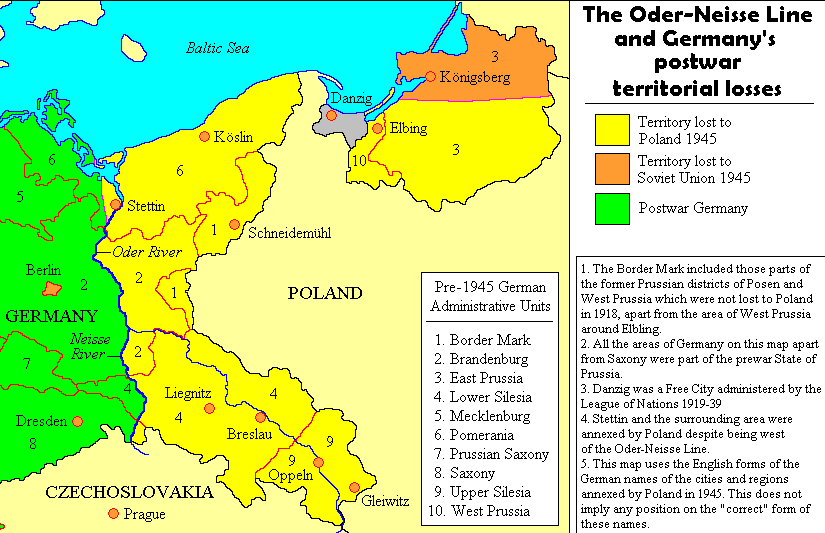
This is a warning that if the Poles move east, the Germans will be motivated to move east as well, in order to recover the Prussian territories Germany lost in its defeat and capitulation at the end of World War II. Hungary too will be motivated to change its northeastern border in order to rescue the ethnic Hungarian population of Transcarpathia in southwest Ukraine.

In short, Putin was announcing that “Stalin’s gift”, as he called it, was the stability of the post-1945 territorial settlement. Now, in defeating NATO’s attempt to destroy the Russians east of Kiev, the Russians are warning afresh that if NATO attempts to change its defence lines west of Kiev, the Russian army will dictate an entirely new territorial settlement in which NATO will be an even bigger loser of military capacity and territorial extension than the non-aggression treaties of December 17, 2021, offered.

To visualise the geography in the discussion, here is a map of the post-World War II territorial settlement between Germany and Poland.

Source: https://en.wikipedia.org/wiki/

Here is a newly published Russian analysis of how the Putin warning should be interpreted, both historically and strategically, between the Dnieper and the Oder-Niesse lines.

“The Revival of Russian identity and Polonization: Russia agree by Albert Akopyan -- source: https://eadaily.com

France’s Colonial Spoil Extracting Predation

Source

In the last half-century, 67 military coups have occurred in 26 countries on the African continent, instigated by France. Among these, 16 countries still maintain French influence.

There exists a “colonial tax” in 14 African countries, which were formerly French colonies, resulting in substantial annual payments to France, amounting to around $500 billion.

These countries were under French oppression until 1958, after which they gained independence. However, nations such as Benin, Burkina Faso, Côte d’Ivoire, Guinea, Mali, Niger, Senegal, Togo, Cameroon, Central African Republic, Chad, Congo, Equatorial Guinea, and Gabon are still burdened with paying colonial taxes.

These 14 countries have a combined population of 174 million and a nominal total GDP of $196 billion, with a PPP GDP of $411 billion.

Formally, France has halted its colonization policy, but its economic colonization of these African states persists. A portion of the colonies’ budget continues to flow to the French central bank under various names and categories.

This process allows France to appropriate approximately 85 per cent of the former colonies’ annual income. As a result, African countries face financial difficulties, and they are forced to borrow back their own money from the French central bank as debts.

To reclaim their funds, African countries are limited to applying for no more than 20 per cent of the transferred amount. If they seek a larger sum, the former colonizer has the authority to veto it. France argues that it is merely repaying the money it spent on buildings and infrastructure constructed over a century ago.

Any refusal by an African ruler to pay the colonial tax often leads to a coup.

This was the case prior to the arrival of Russian forces, particularly the PMC Wagner. Now, the dynamics may change.

Nicole Schwab – Get Used to “Permanent “Climate Lockdowns”

The daughter of World Economic Forum founder Klaus Schwab has emerged from the shadows and issued a chilling threat against humanity.

According to Nicole Schwab, the global elite are preparing to roll out permanent “climate lockdowns” whether you like it or not – and you had better get used to the idea because there is nothing you can do about it.

Schwab’s daughter says the global elite’s plans for a so-called “new humanity” are so far advanced there is nothing that ordinary people like you and me can do to stop them. But there is a fatal flaw in the globalist’s agenda that we can use to exploit and spoil their plans

Who Protects Soros? — That’s the Real Evil!

by Tyler Darden via Zero Hedge

In January 2023, Joe Rogan spoke with former CIA officer Mike Baker, and reflected specifically on George Soros:

“I had a conversation with the governor of Texas about him, with Greg Abbott, where he was explaining to me what George Soros does,” Rogan said.
“And it’s f’ terrifying that he donates money to a very progressive, very leftist — whether it’s a DA or whatever, politician, and then funds someone who’s even further left than them to go against them,” Rogan added.
“And just keeps moving it along. So he’s playing like a global game. And that he enjoys doing it.”

“Yeah. He enjoys doing it. But it is, it’s telling right? He understood early on where you wanted to seize power,” Baker replied.

Early on, indeed.

And now, in an ironic twist, Patrick Bet-David explained this week – also to Joe Rogan – Soros has been acting out his ‘god-like’ plan since at least 2004.

No lesser media outlet than The LA Times wrote (in 2004) following an interview with USA Today:

The begin by noting that George Soros’ motto, “If I spend enough, I will make it right”, is the essence of his articulated ideas about changing society.

Then the ‘god complex’ conversation happens: (via The LA Times) (emphasis ours)

It seems that Soros believes he was anointed by God.
“I fancied myself as some kind of god …” he once wrote.
“If truth be known, I carried some rather potent messianic fantasies with me from childhood, which I felt I had to control, otherwise they might get me in trouble.”
When asked by Britain’s Independent newspaper to elaborate on that passage, Soros said, “It is a sort of disease when you consider yourself some kind of god, the creator of everything, but I feel comfortable about it now since I began to live it out.”
Since I began to live it out.
Those unfamiliar with Soros would probably dismiss the statement out of hand. But for those who have followed his career and sociopolitical endeavors, it cannot be taken quite so lightly.
Soros has proved that with the vast resources of money at his command he has the ability to make the once unthinkable acceptable. His work as a self-professed “amoral” financial speculator has left millions in poverty when their national currencies were devaluated, and he pumped so much cash into shaping former Soviet republics to his liking that he has bragged that the former Soviet empire is now the “Soros Empire.”
Now he’s turned his eye on the internal affairs of the United States. Today’s U.S., he writes in his latest book, “The Bubble of American Supremacy,” is a “threat to the world,” run by a Republican Party that is the devil child of an unholy alliance between “market fundamentalists” and “religious fundamentalists.”
We have become a “supremacist” nation.

Can anyone imagine The LA Times writing anything like that today about The Open Society founder – protector of minorities, supporter of progressives, and general global anti-right chaos agent.

Worse still, this ‘god’ (with a small g) thinks he might be mad:

“Next to my fantasies about being God, I also have very strong fantasies of being mad,” Soros once confided on British television.
“In fact, my grandfather was actually paranoid. I have a lot of madness in my family. So far I have escaped it.”

Perhaps that explains his omnipresence at the loci of every chaos-engine-enabling event around the world.

The LA Times ends on a prophetic note:

In his book, “Soros on Soros,” he says: “I do not accept the rules imposed by others…. And in periods of regime change, the normal rules don’t apply.” Clearly, Soros considers himself to be someone who is able to determine when the “normal rules” should and shouldn’t apply.

He who buys the most DAs, makes the rules (or sows enough chaos to reflexively create new rules).

Corruption in America – An Old Way of Life

Authored by Eric Felten via RealClear Wire,

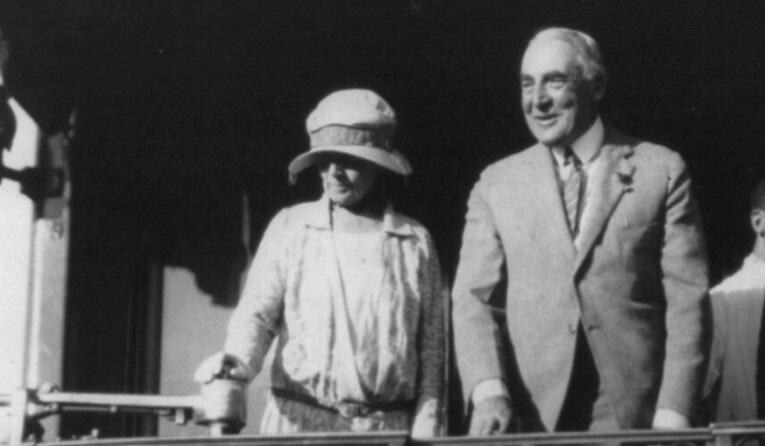
It was 100 years ago today – August 2, 1923 – when President Warren G. Harding suddenly died. He was in San Francisco, on the tail end of a cross-country promotional tour that had taken him as far as Alaska. It would have been an exhausting trip even for a younger man without a bum ticker. Then Harding contracted pneumonia along the way and, if that wasn’t enough, was laid low by some tainted seafood.

Any or all of these may have contributed to Harding’s demise. But no one knows exactly why or how Harding died when he did. The New York Times attributed the president’s sudden expiration to a “stroke of apoplexy.” Some have suggested heart failure. Others have joked that – battered by a landslide of scandal and humiliated by the corrupt schemes launched by the old friends he had raised to positions of power – Harding simply died of shame.

An autopsy might have helped quell rumors of foul play, but first lady Florence Harding refused to allow one.

There was one character in the mix who claimed he knew how Harding died. His name was Gaston B. Means and he claimed not only to know that the president was murdered, but also who did it. His assertions, to put it mildly, were suspect. But Means could spin a compelling yarn. And he was at one time credentialed. He not only had the badge of a special agent of the Justice Department, he had an office in the department.

Means persuaded no small number of Americans that Florence Harding was the killer. He claimed that she confided in him, confessing that she had poisoned her husband.

According to Means’ account (and it should be noted he was an inveterate liar), while he was a special agent for the federal government, Florence Harding tasked him with investigating her husband’s dalliances. Means claimed to have compiled a dossier detailing Warren’s affair with Nan Britton, a young Ohio woman. The Hardings had a knock-down, drag-out row over the child the president had fathered with Britton, Means claimed, adding that not long after that, the first lady took charge of giving her husband his meds.

Means would peddle the story for years, claiming the first lady was enraged that Harding fathered a child by a young woman, Nan Britton, smitten with the president. A notorious con-man, hustler and trickster, Means was also a special agent in the investigative agency that would morph into the Federal Bureau of Investigation. For those shocked that today’s FBI plays politics and seems to struggle to shoot straight, it’s worth remembering that the agency is in some part a legacy of Gaston B. Means. Which is to say, misinformation and disinformation are nothing new. A fabulist of the first order, Means’ fabrications were interlaced with enough detail drawn from actual events that he managed to convince many that his tales were true. Books such as Will Durant’s “The Story of Philosophy” and H.G. Wells’ “The Outline of History” were among the best-selling nonfiction books of 1930, but they didn’t come close to selling as many copies as Means’ memoir, “The Strange Death of President Harding.”

While Harding was still alive, Means became his own one-man crime wave. With the help of his badge, Means managed to have a hand in just about every crime common in the era: fraud, theft, blackmail, espionage, bootlegging, bribery, grift, graft, even murder. Gaston indulged in all these moral hazards and others, too. And he did so brazenly, with an indelible smirk on his pudgy face. Late in his epic career of flim-flammery, he even made a cameo in the Crime of the Century, the 1932 kidnapping of the Lindbergh baby. Means absconded with $100,000 he promised to use in ransoming the doomed child.

As one writer put it, Gaston B. Means was “the symbol of American criminality and corruption in the gaudiest and most lawless era in the nation’s history.”

According to Means, Mrs. Harding was alone with the president for about ten minutes, at which point “It was time for his medicine.” Gaston claimed the widow confided in him: “I gave it to him … he drank it. He lay back on the pillows a moment,” closed his eyes and rested. But then the president bolted awake and looked straight into his wife’s face. He sighed and was dead.

Gaston asked her if she thought her husband knew in his last fleeting moments that she had poisoned him. “Yes,” Mrs. Harding replied, “I think he knew.” Means said he was the one who advised her to refuse permission for an autopsy on the president’s corpse.

This febrile tale of mariticide was quaint compared to the killing Gaston proved willing to commit himself. One of Gaston’s early scams: He fashioned himself a money manager and got his hands on the fortune of a widow foolish enough to entrust him with investing her fortune. When her money had all been siphoned away and spent, she was nearing the moment when her checks would bounce and Means’ theft would be exposed. He convinced her that some dangerous characters were out to steal her money and would kill her to get it. He had her hide in his hometown in North Carolina. He took her into the woods at twilight one evening, ostensibly to teach her to defend herself with a pistol. Alas, there was an accident. She was shot in the back of the head.

In 1917 Means was tried for the killing. He maintained the wealthy widow had stumbled and shot herself as he was kneeling to get a sip of cool water from a spring. Despite the preposterous story of what happened in the woods, Gaston was acquitted. He went to work for a private detective agency run by William J. Burns, for whom he had done some work before the U.S. finally entered the Great War. Well, the work wasn’t so much for Burns as it was for a German spy ring operating in New York. When Harding won the 1920 presidential election, he made Burns head of the Justice Department’s Bureau of Investigation, and Burns brought Gaston along with him. Which is how Means became a special agent.

1921 was a good time to be a grifter. Prohibition was the law of the land, and Means quickly put his position to profitable use, taking payoffs from bootleggers in an elaborate protection racket. He would later say that he kept two adjacent rooms at the Vanderbilt Hotel in New York. In one room was a large goldfish bowl. Gaston would sit in the other; he would watch through a peephole as bootleggers delivered their graft, dropping $500 bills in the goldfish bowl, each at an appointed time.

In a scheme worthy of Watergate, Gaston arranged for henchmen to “go through” the office of Wisconsin Sen. Robert La Follette in search of something that could be used to blackmail him. Asked by a congressional committee what it meant to “go through” an office, Means said they would “find all the mail that comes in, all the papers, anything that he has got lying around.”

Harding’s old cronies had been known as the “Ohio Gang.” In the years after Harding died, their elaborate self-dealing was exposed. Most famous was the “Teapot Dome” scandal in which Harding’s secretary of the interior sold federal oil reserves to petroleum companies at a discount in exchange for kickbacks.

As Means’ schemes were exposed, he tried to protect himself by giving frequent testimony to congressional investigators probing the Ohio Gang. He would then recant his testimony and denounce the hearings as shams. Although these shenanigans didn’t keep him out of jail, they did set dubious precedents.

For example, current FBI director Christopher Wray is hardly the first to stonewall Congress. Mally Daugherty – brother of Harry Daugherty, Harding’s attorney general and a leader of the Ohio Gang – refused to appear before Congress on Capitol Hill even though he had been served with a subpoena. The Supreme Court waded into the controversy and affirmed Congress’ power to command testimony.

As ugly as our politics may be, we do not live in a uniquely deranged age. Political prosecutions and contrived investigations have been all too common in our country’s history.

“The Strange Death of President Harding” was a notorious hoax. Yet it paid handsomely to the hoax artist. That’s what misinformation looks like.

With his death, 100 years ago today, Harding didn’t hide the misdeeds of his administration nor that of his friends. Many of the “Ohio Gang” ended up dead, some perhaps by suicide, some perhaps not.

As for Gaston B. Means, he spent his last years in the federal prison at Fort Leavenworth in western Kansas. The crime that finally caught up with him was particularly callous. When the Lindberghs’ infant was kidnapped, Means went to one of Mrs. Lindbergh’s rich friends and told her that he could rescue the baby if only he had $100,000 with which to pay off the kidnappers. She gave him the money and then some. He pocketed it. Convicted of embezzlement and grand larceny, he was sentenced to 15 years in Leavenworth Penitentiary. He served only five years of that time, dying behind bars in 1938, eventually to be forgotten by a nation that fears the depravity of its generation is unique.

Eric Felten is an investigative correspondent for RealClearInvestigations, reporting on government corruption. He is a former columnist for the Wall Street Journal and previously a Kennedy Fellow at Harvard University. Felten has been published in Washingtonian, People, National Geographic Traveler, The Weekly Standard, Daily Beast, National Review, Spectator USA, and Reader’s Digest.

Sanctions? Russia Joins World’s Top 5 Economies by PPP

via Sputnik International

The Russian economy exceeded $5 trillion in terms of purchasing power parity for the first time in late 2022, and stayed in fifth place in the world in this indicator, according to the World Bank

China became the world’s largest economy by PPP with $30 trillion, followed by the United States with $25.5 trillion. India closes the top three with $11.9 trillion, and Japan is in fourth place with $5.7 trillion.

In general, the world economy in terms of purchasing power parity grew by 11% – to $164.2 trillion, while 20 years ago it was a third as big: $54.1 trillion.

China’s Weapon in the Global Fight for Resorces

The Belt and Road Initiative is proclaimed to be an act of solidarity with developing nations. It is, but it is also so much more

by Timur Fomenko, via RT

“China’s overseas investment in metals and mining set to hit record,” declared an article in the Financial Times. The piece analyzes how China’s investments in the Belt and Road Initiative, a massive global infrastructure program, have become more “strategic.”

While the FT is notoriously negative about China and spares no opportunity to rush into narratives pertaining to ‘debt traps,’ claims of corruption, and how ‘dozens’ of countries are reviewing them (only citing US-pressured Italy as an example), it nonetheless makes a key point here. The BRI is strategic. But it was never anything else.

While China has framed the massive investment scheme as an act of solidarity with developing countries, pledging economic integration and mutual gains, the colossal creation of infrastructure by Beijing in other countries has never been random, discrete or disorganized. The goodwill gained of course matters, but there was always a plan, and that plan was not only to keep China’s exports rolling, but to also to secure energy and resources in an international environment that is increasingly uncertain, and in anticipation of what the US was about to do.

China is the world’s largest consumer of energy and natural resources, but has a strategic Achilles heel in that, beyond critical rare earth elements, it doesn’t have as many resources as it needs. As an industrial giant, China cannot satisfy its own needs for energy whether it be to power its factories or to fuel its cars. This has resulted in Beijing forming increasingly lucrative and close partnerships with the nations of the Middle East, which have tilted away from their traditional patrons in the West accordingly.

At the same time, a global competition for natural resources is picking up pace. The US, using the language of ‘supply chain resilience’ and ‘diversification,’ is seeking to gain control over resources it deems strategically critical, such as lithium and many other metals and minerals. The US wants to dominate all of these global supply chains, and eventually isolate China from them, leading to a competition regarding investments throughout the world. Supply chains are no longer globalized but are being carved up to fit the strategic needs of individual countries that want to be self-sufficient, should a military crisis emerge.

Consequently, this military factor is a huge dynamic in China’s strategic thinking, given that its imports of materials and energy have been reliant on crossing through areas which are now being contested by the US, including the South China Sea, East China Sea and the Indian Ocean.

Washington is attempting to comprehensively encircle China’s periphery. The BBC applauded this as an “arc of bases around China,” with the US having recently gained access to even more military sites in the Philippines. It then received a military access deal with Papua New Guinea, while backing the full rearmament of Japan and placing more weapons on the Korean Peninsula.

In the event of any conflict, the US would like to seek military dominance over China’s surroundings (as unfeasible as that is) and attempt to embargo its foreign trade and energy imports. How did the British Empire triumph over Germany twice? The answer is through naval supremacy, by blocking Berlin’s access to the Atlantic and Mediterranean, and crippling it with attrition in the long run.

China’s Eastern periphery is similarly vulnerable. This is why China is using the Belt and Road initiative to connect Eurasia by land in ways which allow it to bypass these contested areas and create new routes for energy and materials.

This, in turn, is why China’s most critical strategic partner in the entire Belt and Road project is Pakistan, a country that not only connects to China by land, but extends southwards to the sea bypassing the whole Indian subcontinent and offering a free route to the Middle East. Pakistan is also a formidable military power with nuclear capabilities, discouraging any potential attack by the US and its allies in any potential conflict with China. Through Gwadar Port, China intends for Pakistan to be its primary maritime gateway concerning the Middle East and Africa, marking a safe passage for oil and natural gas.

This is also why China’s partnerships with Russia and states in Central Asia matter. Beijing has invested overwhelmingly in creating transcontinental railway freight routes, and hosted its first ever Central Asian leaders summit this year. It’s also one reason why, despite the upheaval in Afghanistan, China seeks to have a close relationship with the Taliban and procure access to that country’s natural resources.

In conclusion, the BRI is a master chess game by China, because it embodies diplomatic, trade and strategic priorities. Look, for example, at how the new China-Laos railway has established an additional commercial route into the country for the landlocked Laos, which will soon be connected all the way down to Thailand and its ports. China is actively diversifying its logistical routes while keeping other countries on board. It’s about breaking US attempts to dominate China by militarizing the area around it, cutting off access to goods and preventing a return to the “gunboat diplomacy” of the 19th century.

Immigration Increasingly Squeezing Whites Out of College, Even If Affirmative Action Ends

By Robert Weissberg via VDare

The Supreme Court’s recent Students for Fair Admissions v. Harvard decision striking down racial preferences at Harvard and the University of North Carolina, Chapel Hill, exposed how the admission process has become politicized. But will the Court’s decision end the role of politics in college admissions? The answer is “no” even if Affirmative Action vanishes. Affirmative Action is only one of many political factors influencing college acceptances and rejections. Equally important, though rarely acknowledged: the federal government’s immigration policies—since they determine the overall pool of college applicants, and this pool can be just as important as the applicant’s record or racial/ethnic identity.

The quality of the competition dictates how applicants play the college admissions “game.” Entering Harvard would be far easier if, for example, the deteriorating schools dumbed down most of your fellow applicants. Within a weak field, middling SAT scores and a so-so class rank would suffice. If the opposite were true, however, admission might require hiring tutors and working harder. So the stiffer the competition, the more effort necessary. At some point, even the very bright might skip applying to an Ivy League school as too much of a long shot.

The applicant pool has special significance for white applicants who face tough competition from groups who scarcely entered college back in the 1970s, namely blacks, Hispanics, and Asians. Until quite recently, whites almost entirely competed with other whites. In fact, the previous pool of rivals was even smaller for men since they often competed exclusively against other males to enter male-only schools, while females often only competed against females to enter female-only schools.

The expansion of the applicant pool, absent a corresponding increase in slots, is highly consequential. While brains were always necessary to be admitted to a top school, a smaller pool of brainy rivals also increased the number of “safe” school slots. You took their shot at Harvard, but simultaneously hedged bets by applying to Boston University. Back then it was unthinkable for parents to pay huge sums to “counselors” get to Junior admitted to a second-tier school like the University of Southern California.

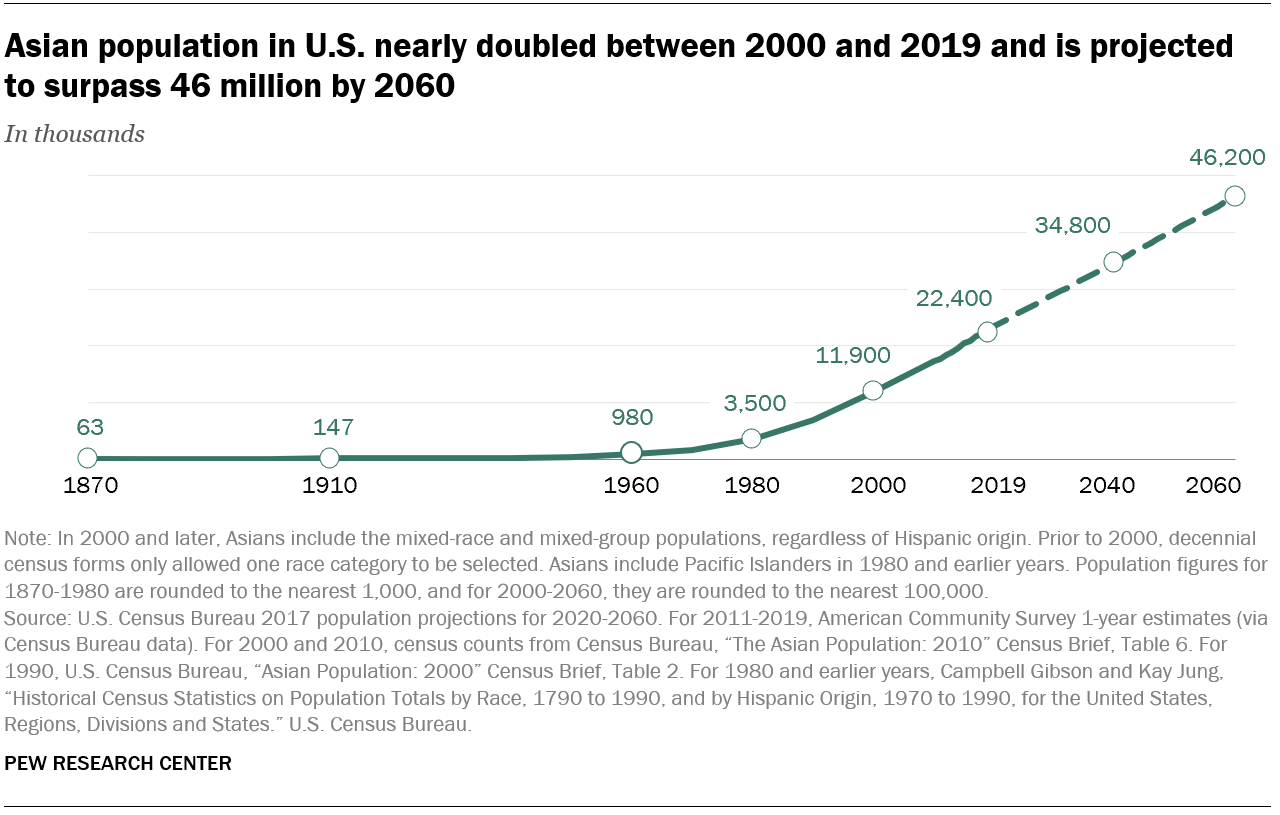
Matters changed with the 1965 Immigration Act that opened the door for millions of Asians. The impact of this influx has been enormous. In 1960, for example, there were less than a million Asians in America but by 2000, this figure had reached 11.9 million, 22.4 million in 2019. The predicted number will reach 34.8 million by 2040.

Key facts about Asian Americans, a diverse and growing population, by Abby Budiman and Neil G. Ruiz, Pew Research, April 29, 2021

These Asian immigrant children have done exceptionally well in American schools. Recall that Asian students were the ones who challenged Harvard’s race-based admissions policy, with Harvard openly admitting that absent Affirmative Action, Harvard would become a predominantly Asian.

Derb: If Harvard were to select from just the top one-tenth of applicants—which is in fact what Harvard most likely would do—then Asian Americans would be 51.52 percent, Whites 36.54, Hispanics 2.69 percent, blacks 0.76 percent. https://t.co/AzKVxjG5cD

— VDARE (@vdare) July 1, 2023

The numbers are astounding despite efforts to keep them out, At the merit-only Cal Tech, the proportion of Asians is 39.9%, 35,1% at University of California, Berkeley, 27.6% at MIT and at the University of Texas, Austin 21.9% and so on. This domination would undoubtedly be even greater if one disregarded fluff majors such as Gender Studies.

At the other end of the intellectual ability continuum are blacks and Hispanics who owe their campus presence to Affirmative Action, not immigration or brain power. While this black influx has ebbed and flowed over time, blacks have become a sizeable presence on campus [Black Collegiate Education in the United States (1828-2019), by Christina Hudson, BlackPast.org, January 25, 2022]The heavy thumb on the scale in their favor is particularly noteworthy at Ivy League schools. Blacks are typically around 7 % to 8% of all undergraduate students [The Demographics of the Ivy League, CollegeVine.com, July 9, 2023] (However, these proportions still fall below blacks’ overall proportion in the population.

Meanwhile the Hispanics presence in the US population has dramatically risen from 9,6 million in 1970 to 62.5 million in 2021 thanks to both legal and illegal immigration. This has brought a corresponding increase in college enrollment from 1.5 million in 2000 to 3.8 million in 2019 [Hispanic enrollment reaches new high at four-year colleges in the U.S., but affordability remains an obstacle, by Lauren Maura, Pew Research, October 7, 2022 ]

Like African Americans, Hispanics now even have a sizeable presence at Ivy League schools, averaging between 10% and 16% of all undergraduates—well below their population percentages, but still notable.

Put concretely, a recent Yale undergraduate class was about 37% white, so if you removed all Asians (24%), all Hispanics (15%), all African Americans (8%) and the tiny miscellaneous racial/ethnic admits, the white percentage would almost triple, Moreover, in 2022 the number of females slightly outnumbered males (3160 men, 3315 women), so if Yale restored its earlier male-only rule—its abolition was not government-mandated but nevertheless reflected public pressure—white males would double their odds of admission.

The endlessly-expanding pool of applicants has, naturally, shrunk the acceptance rates at top schools, Yale, for example, in 2007 accepted 11.4% of applicants and by 2017 the percentage had fallen to 6,7%. In 2022, it was 6.3%. [Ivy League Acceptance Rates and Admissions Statistics, IvyCoach.com, 2023 ]

Particularly revealing is that the same pattern holds at very good but non-elite schools that were once the “safe” schools for those rejected by the Ivy League.. New York University, for instance, has gone from a 36,7% acceptance rate in 2007 to 12.8% in 2021.

Prior to the Fair Admissions decision, native-born whites were trapped by a pincer movement. On the one side: less academically-qualified blacks and Hispanics who benefited from Affirmative Action. On the other side: Asians, typically from immigrant families, who out-performed whites academically.

White applicants thus experienced two distinct biological disadvantages. First, their race allowed them to be passed over in favor of less qualified blacks and Hispanics, Second, they simultaneously were passed over in favor of smarter Asians.

In both instances, the source of this twin genetic liability was political.

But will the Court’s ban on racial preferences “free up” space for white applicants? Conceivably, but as per Professor Peter Arcidiacono’s analysis, probably not, since most of these new beneficiaries will be Asian males.

More generally, however, there will be an uptick in white females to replace blacks and Hispanics. This change is just an ongoing trend in which the proportion of males on campus has been dropping. Schools regularly demonize men for “toxic masculinity” [The war on men continues on campus, The College Fix, July 7, 2023]. So college-age men shun higher education and become an endangered species on campus.

Affirmative Action may wither away, but immigration policy will continue to shape college admissions. As a veteran academic, I have argued elsewhere that American college students are growing dumber—see my American Students—Dumber and More Woke, American Thinker, February 4, 2023. My prediction: at some point, desperate schools will target smart youngsters from abroad for admission to US colleges.

Importing intellectual talent has long existed for graduate students, particularly in the hard sciences. The same policy could easily be extended for undergraduate admissions. In fact, 31% black immigrants from Africa and the Caribbean now have a BA or higher [One-in-Ten Black People Living in the U.S. Are Immigrants, Pew Research, January 20, 2022]. Higher education is directly or indirectly subsidized in many ways, So the American taxpayer will now help educate the world.

Result: American universities may soon be peculiar institutions, with the hard sciences and engineering disproportionately dominated by Asians, Indians, and Eastern Europeans males, while the “soft” side will be overwhelmingly female, probably disproportionately feminists.

Many campuses will thus resemble collections of apartheid-like ethnic/gender enclaves.

One can only imagine how the mandarin social engineers will try to fix this alleged imbalance.

Robert Weissberg [email him] is Professor of Political Science, Emeritus, University of Illinois, Urbana and formerly Adjunct Professor of Politics (Graduate), New York University. He is author of Bad Students, Not Bad Schools (for Steve Sailer’s review, click here). His Unz.com archive is here; his American Thinker archive here.

More Energy Resources Added to Russia’s Control


Rapprochement between Russia and Niger makes the West dependent on Moscow

According to Bloomberg, if Niger falls into Russian orbit, the world will become even more dependent on Moscow for nuclear energy.

It is specified that Kazakhstan and Uzbekistan are among the world’s leading producers of uranium, which account for about half of the reserves mined in the world. If we add Russia and Niger to this, then the share will jump to 60% and above.

In addition, Russia has uranium deposits, and the country itself controls almost 50% of the world’s enrichment capacity.

via https://t.me/+fZp0Os56l5ZkMzdi