What Might A Lame Duck Biden Aim For?

via Moon of Alabama

These are a pretty bad days for U.S. President Joe Biden.

Wednesday: Quinnipiac poll shows Biden with 33 percent approval rating

The poll found 57 percent disapproved of Biden’s handling of the economy, 54 percent disapproved of his handling of foreign policy and 55 percent disapproved of his handling of the pandemic, which was once a consistent bright spot for Biden.

Thursday: Kyrsten Sinema Backs Senate Filibuster in Blow to Joe Biden Amid Voting Rights Showdown

Senator Kyrsten Sinema has delivered a major blow to President Joe Biden as she reiterated her support for the chamber’s 60-vote filibuster—the biggest obstacle for Democrats in passing voting rights legislation.

Thursday: Biden all but concedes defeat on voting, election bills

All but conceding defeat, President Joe Biden said Thursday he’s now unsure the Democrats’ major elections and voting rights legislation can pass Congress this year. He spoke at the Capitol after a key fellow Democrat, Sen. Kyrsten Sinema of Arizona, dramatically announced her refusal to go along with changing Senate rules to muscle the bill past a Republican filibuster.

Thursday: Supreme Court blocks vaccine rule for companies, allows health care worker mandate

The Supreme Court on Thursday blocked the Biden administration’s vaccine-or-test rule for businesses with at least 100 workers, but granted a separate request from the Biden administration to allow its vaccine mandate for health care workers to take effect.

Thursday: Producer price index increased by 0.2%, up more than 6% for 2021

Friday: U.S. Retail Sales Slide Most in 10 Months on Inflation, Omicron

The value of overall purchases decreased 1.9%, after a revised 0.2% gain a month earlier, Commerce Department figures showed Friday. The figures aren’t adjusted for inflation, suggesting price-adjusted receipts were even weaker than the headline number.

Friday: U.S. Consumer Sentiment Drops More Than Expected Due To Inflation Worries

Noting inflation’s regressive impact, Curtin said consumer sentiment among households with total incomes below $100,000 slumped by 9.4 percent in early January, while sentiment among households with incomes over that amount increased by 5.7 percent.

Losses on all fronts. The midterms will likely be devastating for the Democrats. Afterwards Biden will be a lame duck.

The only field where he will still be able to show political initiative, and maybe have some successes, will be in foreign policy.

What could he aim for?

Pfizer CEO Predicts Life On Earth “Will Return To Normal” In The Spring

Note: As we at Algora predicted many months ago, the rhetoric at the very top is changing. “They” are admitting already that this is no longer sustainable. But the state bureaucracy is difficult to turn on a dime; it is difficult to come overnight and proclaim the opposite of what was the “truth”/indoctrination for the masses. And here is why the turnaround: 

1. The war on China is self defeating. Even the latest attempt to send the Omicron via the Post Office backfired. The military “superiority” is melting away, the semiconductor blackmail/blockade slowly turns into a major Chinese industrial revolution. China supports an economic alliance with Iran and just signed up Syria for its Belt & Road.

2. The adventure/coup in Ukraine, didn’t scare Russia a bit, the economic blockade of North Stream 2 only backfired horrendously by bringing Europe to a freezing winter. No SWIFT embargo is possible and now Russia has high level discussions with Iran on a possible alliance.

3. Biden’s approval rating is nosediving, the country rallies against the curriculum of CRT, against woke culture, against the vaccine mandates, against BLM, against the BBB, against electoral reform, etc. 

The net balance of Covid mania: total shambles, inflation and mutiny.
************************************************************

via ZeroHedge

Just a few days ago, Bill Gates shared some of his (revised) thoughts on the COVID pandemic and the trajectory that omicron has left us on. Several weeks after warning that omicron’s heightened infectiousness might send the pandemic into overdrive, the Microsoft founder postulated instead that omicron might hasten the end of the pandemic by leaving the human population with more antibodies against the virus. As a result, SARS-CoV-2 might enter its endemic stage more quickly, Gates suggested.

This view, that the end of the pandemic might finally be at hand after two years of suffering, has become increasingly popular as of late. Take this piece from the BBC: “Endemic COVID: Is the pandemic entering its endgame?”.

While the piece mostly focused on the UK, the sense is that the developed world more broadly is closer to the end because of its access to vaccines.

So, is a new Covid-era truly imminent and what will that actually mean for our lives?

“We’re almost there, it is now the beginning of the end, at least in the UK,” Prof Julian Hiscox, chairman in infection and global health at the University of Liverpool, tells me. “I think life in 2022 will be almost back to before the pandemic.”

What’s changing is our immunity. The new coronavirus first emerged two years ago in Wuhan, China, and we were vulnerable. It was a completely new virus that our immune systems had not experienced before and we had no drugs or vaccines to help.

It even came with his handy illustration depicting the difference between “pandemic” and “endemic” COVID:

Source: The BBC

Well, it appears the CEO of Pfizer has caught on to this narrative – and he approves. Speaking to the French media, Pfizer CEO Albert Bourla that while he expects COVID to continue to circulate for many years to come, he expects future waves won’t cause the types of restrictions that people have become used to over the last two years, and that life will return to “normal” in the spring.

Bourla told French news outlet Le Figaro in an interview published Jan. 16 that he expects a “return to normal life” at some point in spring of this year. However, he added the caveat that the mysterious dynamics of COVID’s spread make accurate predictions more difficult.

“We will soon be able to resume a normal life,” Albert Bourla told the French paper. “We are well positioned to get there in the spring thanks to all the tools at our disposal: tests, very effective vaccines and the first treatments that can be taken at home.”

He also credited improvements in COVID testing, vaccines, and therapeutics for his optimistic outlook, telling BFM TV that he expects the current omicron-driven wave to be the “last with so many restrictions.”

But given its affinity for its human hosts, COVID will likely be “very difficult to get rid of,” which is why Bourla expects it to become endemic, with the occasional seasonal flareup, like the flu.

Finally, the Pfizer CEO shared details of local partnerships that he said would help France produce more of Pfizer’s COVID fighting drug Paxlovid.

With his approval rating at an all-time low, President Biden better hope the likes of Bourla and Gates are right. Ending the COVID pandemic might be the only thing that could help Biden regain some support among the tired and frustrated American electorate.

Deep Split Among Americans on Covid

via: Rassmusen Reports

While many voters have become skeptical toward the federal government’s response to the COVID-19 pandemic, a majority of Democrats embrace restrictive policies, including punitive measures against those who haven’t gotten the COVID-19 vaccine.

A new Heartland Institute and Rasmussen Reports national telephone and online survey finds that 48% of voters favor President Joe Biden’s plan to impose a COVID-19 vaccine mandate on the employees of large companies and government agencies. That includes 33% who Strongly Favor the mandate. Forty-eight percent (48%) are opposed to Biden’s vaccine mandate, including 40% who Strongly Oppose the mandate. (To see survey question wording, click here.)

Voters are similarly divided over the federal government’s top COVID-19 expert, Dr. Anthony Fauci. Forty-five percent (45%) view Fauci favorably, including 28% who have a Very Favorable impression of him. Forty-eight percent (48%) have an unfavorable impression of Fauci, including 34% who have a Very Unfavorable view of him.

The even split among voters is the result of deep partisan divisions. While 78% of Democratic voters support the Biden administration’s COVID-19 vaccine mandate plan, only 22% of Republicans and 41% of voters not affiliated with either major party support the vaccine mandate. And many Democrats would support even harsher measures, including fines for Americans who won’t get the COVID-19 vaccine and criminal punishment for vaccine critics.

The survey of 1,016 U.S. Likely Voters was conducted on January 5, 2022 by the Heartland Institute and Rasmussen Reports. The margin of sampling error is +/- 3 percentage points with a 95% level of confidence. Field work for all Rasmussen Reports surveys is conducted by Pulse Opinion Research, LLC. See methodology.

The survey found that 75% of likely Democratic voters – but only 21% of Republicans and 38% of unaffiliated voters – have a favorable opinion of Dr. Fauci. Among other findings of the survey:

– Fifty-eight percent (58%) of voters would oppose a proposal for federal or state governments to fine Americans who choose not to get a COVID-19 vaccine. However, 55% of Democratic voters would support such a proposal, compared to just 19% of Republicans and 25% of unaffiliated voters.

– Fifty-nine percent (59%) of Democratic voters would favor a government policy requiring that citizens remain confined to their homes at all times, except for emergencies,if they refuse to get a COVID-19 vaccine. Such a proposal is opposed by 61% of all likely voters, including 79% of Republicans and 71% of unaffiliated voters.

– Nearly half (48%) of Democratic voters think federal and state governments should be able to fine or imprison individuals who publicly question the efficacy of the existing COVID-19 vaccines on social media, television, radio, or in online or digital publications. Only 27% of all voters – including just 14% of Republicans and 18% of unaffiliated voters – favor criminal punishment of vaccine critics.

– Forty-five percent (45%) of Democrats would favor governments requiring citizens to temporarily live in designated facilities or locations if they refuse to get a COVID-19 vaccine. Such a policy would be opposed by a strong majority (71%) of all voters, with 78% of Republicans and 64% of unaffiliated voters saying they would Strongly Oppose putting the unvaccinated in “designated facilities.”

– While about two-thirds (66%) of likely voters would be against governments using digital devices to track unvaccinated people to ensure that they are quarantined or socially distancing from others, 47% of Democrats favor a government tracking program for those who won’t get the COVID-19 vaccine.

How far are Democrats willing to go in punishing the unvaccinated? Twenty-nine percent (29%) of Democratic voters would support temporarily removing parents’ custody of their children if parents refuse to take the COVID-19 vaccine. That’s much more than twice the level of support in the rest of the electorate – seven percent (7%) of Republicans and 11% of unaffiliated voters – for such a policy.

The survey also found that more black voters (63%) than whites (45%), Hispanics (55%) or other minorities (32%) support Biden’s vaccine mandate for government workers and employees of large companies.

President Biden’s strongest supporters are most likely to endorse the harshest punishments against those who won’t get the COVID-19 vaccine. Among voters who have a Very Favorable impression of Biden, 51% are in favor of government putting the unvaccinated in “designated facilities,” and 54% favor imposing fines or prison sentences on vaccine critics. By contrast, among voters who have a Very Unfavorable view of Biden, 95% are against “designated facilities” for the unvaccinated and 93% are against criminal punishment for vaccine critics.

As the Omicron variant of COVID-19 produces a spike in cases nationwide, about three-quarters of Americans are already vaccinated against the coronavirus, and two-thirds of those have gotten booster shots.

Most Americans are concerned about new variants of the COVID-19 virus, but Democrats are more concerned than others, and place more trust in vaccines to protect against the disease.

Additional information from this survey and a full demographic breakdown are available to the public as well as Platinum Members.

America’s New Nuclear Option

By Ivan Timofeev, Valdai Club Programme Director & one of Russia’s leading foreign policy experts.

Washington mulling some of the harshest sanctions ever proposed

A new bill before the US Senate that would introduce unprecedented new sanctions against Russia, as well as against top officials including President Vladimir Putin, has soured security negotiations between Moscow and Washington.

At present, the measures have been mooted as a potential response to any invasion of Ukraine but, if imposed, they would have a dramatic effect on the Russian economy. While businesses are wary of ‘geopolitical risks,’ so far the markets have exercised restraint. Indeed, avoiding panic is the right choice, given that, barring military escalations, the chances the bill would come into force are low.

However, the proposals represent an exceptionally tough stance on Moscow’s Euro-Atlantic security proposals, which have been the subject of talks between Russia, Washington and NATO. The White House opted not to dismiss the two draft treaties put forward by the Kremlin straight away, and entered into a cautious dialogue with Russia. Nevertheless, it is clear diplomacy does not appeal to everyone, and Democratic Senator Bob Menendez, the chief architect of the sanctions, has urged Washington not to make any concessions when it comes to Russia.

In addition, the bill calls for more military assistance to Ukraine, and using punitive measures to contain Russia. And what an impressive list of sanctions it is, including:

  • Internationalrestrictions on dealing with major Russian banks;
  • Restrictions on transactions with Russian bonds (including bonds issued by state-owned companies);
  • Secondary sanctions against companies providing financial messaging services (i.e. SWIFT);
  • Personal sanctions against the Russian president and key government officials;
  • Sanctions with respect to Russian extractive industries like oil, gas and mining;
  • A review of sanctions against the Nord Stream 2 pipeline

Unlike the US administration, which ties tougher sanctions with an open military confrontation between Russia and Ukraine, American senators themselves do not clearly spell out the conditions under which the proposed set of sanctions is to be implemented. The bill calls for regular reports to be submitted to the president describing the level of tensions between Moscow and Kiev.

Should Moscow build up pressure, compared to its levels of December 2021, and if Russia’s actions (from Washington’s point of view) threaten Ukrainian statehood, the President of the United States would be required to introduce new sanctions.

In fact, the sanctions can be imposed at any time, since the criteria are somewhat vague.

It’s a bit of a consolation that the chances of the current version of the draft bill passing the Senate don’t seem to be very high. This is primarily because the bill itself is intended to provoke Russia into escalating tensions. It’s highly unlikely, though, that the US administration would be willing to meet Moscow halfway on its proposals. Instead, it will most probably try to stall many of those proposals, leaving only those that the US cares about on the table. However, it is also very clear that Washington is in no mood to anger Russia. Moscow has already demonstrated in recent years that it’s both capable of and willing to use military force – swiftly and efficiently. Slapping Russia with severe sanctions and supplying Ukraine with weapons on a fast track could by all accounts provoke the Kremlin to use force.

This is why the US administration wants to act ‘slowly but surely.’ It can, and probably will, tighten up sanctions and supply arms to Ukraine, but gradually, step by step.

There is another reason why the bill might not fly. It will burden Washington with way too much red tape. Foreign policy is where the executive and legislative branches of power in the United States have a history of playing tug-of-war. Every now and then, the United States Congress attempts to have the White House perform some of the oversight procedures for the sanctions, and the White House is never happy about it. It is therefore not entirely impossible that this proposal will go down the same track as the Defending American Security from Kremlin Aggression Act (DASKA). The DASKA bill also proposed a tightening of the sanctions on Russia and left the procedural burden to the Administration. The bill met substantial criticism from the Bureau of Legislative Affairs of the US Department of State.

Finally, only a small fraction of sanctions bills ever make it into laws. According to the Russian Council on Foreign Affairs, in 2019-2021, only 29 out of 368 bills across all types of sanctions became laws, which is around 7%. Russia sanctions bills are drafted all the time: Bob Menendez’s initiative is impressive in its scale, but is, in effect, part of the legislative routine, given that there have been at least 40 other bills against Russia introduced over the past three years. Incidentally, there have been even more such bills discussed – 65, to be precise – against China.

Nevertheless, the US administration can clearly capitalize on such tactics. By introducing these bills, it demonstrates that Washington is ready to use tougher, more radical methods. The bills can be used to intimidate, but the US doesn’t have to go through with them. The chances of them passing would increase only in the case of a military escalation. Should that happen, the hawks on Capitol Hill would have a lot more cards to play.

via RT

Universal Basic Income vs. Cura Annonae

by Lee Camp

Basic income has been tried successfully countless times. So why the hell isn’t the US government implementing it?

This article was originally published by Scheerpost.

Here’s how the world should operate in simple terms: A certain country or region or city or township or Hobbit hole tries something in order to help their society or group or hovel – if it works, other places then do it. If it doesn’t work, other places don’t do it. It’s like when you were a kid and you saw your brother slide down the banister and rack himself on the newel post – You then thought, “Maybe that activity is not for me.” But if he didn’t nail himself in the jewels, you probably thought, “I think I’ll try that.” 

That’s how the United States government should work, but it doesn’t. For-profit healthcare, corporate personhood, the drug war, funding terrorists overseas that we call “moderate rebels,” etc. – all of these things have been tried, they fu***n’ suck every time, and we keep doing them. The U.S. continually racks itself on the newel post all day long and then responds, “I think I’ll try that again.” 

But the reverse should be true also – if a city or country anywhere in the world tries something and it works great, we should do it. 

This brings me to Universal Basic Income: everybody receiving money from a government simply for being a citizen, no questions asked. It’s high time we try it in the US and see whether it works. Oh wait, I just remembered – it’s been tried countless times and worked every damn time. How do I know that? …Reading

As Rutger Bregman details in his book “Utopia For Realists,” UBI has been tried many times — in Canada, Alaska, Africa, the US, Europe, and more. Even backwards lawless lands like North Carolina have experimented with it.

There was a study in Britain where 13 men who had lived on the streets for years were given £3,000 each (about $4,500 at the time). Did they use it for hundreds of pricey almond milk lattes, or giant bags of crack, or maybe just wad it up into balls and wipe themselves with them? Nope, turns out they didn’t do any of those things. Eighteen months after receiving the money, over half were no longer homeless, and all of them had improved their lives significantly.

As Bregman noted, “Even The Economist had to conclude that ‘the most efficient way to spend money on the homeless might be to give it to them.’

No! We can’t possibly do that! We here in the US have to take the money meant to help the homeless and launder it through all kinds of plans and incentives and bureaucratic digestive tracts that result in one out of every 100 people in extreme poverty receiving a gift certificate for a free basket of breadsticks at Arby’s. 

In another program Bregman describes, everybody in a village in Kenya was given $500, about a year’s wages. Several months later, the village had been completely transformed. People had better jobs, sturdier home structures, and healthier kids. “In Namibia figures for malnutrition took a nosedive (from 42% to 10%), as did those for truancy (from 40% to nothing) and crime (down by 42%),” writes Bregman. 

So, basically there’s almost a silver bullet to ending poverty and decreasing crime. Well, we better avoid it like the plague. Let’s go back to giving homeless people a can of soup and a pair of mismatched socks. If they collect enough cans and socks, they can build a house out of them

The point is basic income has been tested numerous times. By 2010, there were income transfer programs for 110 million families in 45 different countries. In North Carolina, in 2001 the Cherokee were getting $6,000 a year per family thanks to a casino they had built. When that started, for most of those families that money took them out of extreme poverty, and the Cherokee children saw drastic changes. Their crime rates, behavioral issues, and alcohol abuse went down significantly. The money literally changed their lives. (And sure, all casinos are based on drunk people spending money they don’t have on machines they don’t know are rigged in hopes of getting money they will never get. But you can’t get mad at the Cherokee because that’s also the basic definition of capitalism: Drunk people spending money we don’t have on machines we don’t know are rigged in hopes of getting money we’ll never get.) 

The University of Manchester summarized many UBI programs in poor African communities. They found, overall, the money was put to good use: Poverty decreased, and while the programs cost less than other so-called solutions, there were myriad long-term benefits that impacted  health and safety. How shocking! The thing we know works seems to work! (Hopefully somebody can study this a little more and find out if it works.)

Bregman then writes of NGO workers, “So why send over to Africa expensive white folks in SUVs when we can simply hand over their salaries to the poor?” Great point. At the very least, let’s give away the SUVs. 

The latest basic income “test” reported-on last month in Fast Company showed that it worked yet again in Hudson, NY. Despite all of these successful trials, people still argue, “We can’t have basic income because the poor will just use it for beer and cigarettes!” Well, first of all – So what? The world’s on fire. Beer and cigarettes sound like just what the doctor ordered. In fact, I think we’re at the point when we can call alcohol and tobacco survival foods. (I am a longtime supporter of Universal Basic Beer and Cigarettes.) 

But perhaps more importantly, as Bregman notes, “A major study by the World Bankdemonstrated that in 82% of all researched cases in Africa, Latin America, and Asia, alcohol and tobacco consumption actually declined.” Declined? Well, then I have to say these poor people have their priorities completely wrong.

Another major argument against UBI is, “It’s not fair. Giving people money for doing nothing simply isn’t fair.” My response to that is twofold. First, it actually is fair because the money would go to literally everyone. Hence the word “universal” in the name. (It would be weird to have something called “Universal Basic Income” that only went to a vintage clothing store clerk named Stanley.) Secondly, who told you fairness mattered in life? Who told you fairness has anything to do with our stupid world? There’s no fairness. In the first three seconds you come out of the womb, life is not fair. You’re covered in blood and mucus, some doctor slaps you on the ass, and you’re told your name is something you’ve never even heard before! Completely unfair. You’re just lying there going, “Chet? My name’s CHET?!” 

Some people are born rich as sh*t.

Some people are born poor as sh*t.

Some people are born hot as sh*t. (I mean, not as a baby but… later. You get the point.) 

Some people are born in wealthy areas with safe streets, good schools and clean water.

Some people are born in poverty with crime-ridden streets, terrible schools, and water that has a crispy film on the top like a cancerous crème brulée.

In our society, on average, men get paid more than women, white people get paid more than Black people and Native people, and most everyone gets paid more than ugly people. (I’m not even kidding – ugly people earn up to 15% less per hour in the workplace.)

Society. Is. Not. Fair. 

So if I say that universal basic income would solve several of society’s problems and someone responds that UBI’s not fair, they’re being completely illogical. It’s like if I said a law against killing endangered species would save the exotic birds, and you retort, “But we can’t do that because it’s not purple.


Cura Annonae (“care of Annona”) was the term used in ancient Rome, in honour of their goddess Annona, to describe the import and distribution of grain to the residents of the cities of Rome and, after its foundation, Constantinople. Rome imported most of the grain consumed by its population, estimated to number one million people by the second century AD. An important part of this was the grain dole or corn dole,[a] a government program which gave out free or subsidized grain, and later bread, to the poorest residents of the city of Rome. The dole was given to about 200,000 people, and is an early and long-lasting example of a social safety net.

A regular and predictable supply of grain and the grain dole were part of the Roman leadership’s strategy of maintaining tranquility among a restive urban population by providing them with what the poet Juvenal sarcastically called “bread and circuses“. In 22 AD, the emperor Tiberius said that the Cura Annonae if neglected would be “the utter ruin of the state”.[1]

The most important sources of the grain, mostly durum wheat, were Roman Egypt, North Africa (21st century Libya, Tunisia, Algeria, and Morocco), and Sicily. The logistics of moving the grain by sea from those places to Rome required many hundreds of ships, some very large, and an extensive system for collecting the grain and distributing it inside Rome itself. The archaeological records of the grain trade are sparse, due to the perishability of grain which has made its detection difficult for archaeologists.[2]

It is unknown when the Cura Annonae ended. Some form of it may have persisted as late as the 6th century for Rome, but far less grain was shipped compared to earlier periods; in Constantinople, a reduced form of it lasted as late as the 7th century. Tiberius was correct that the Cura Annonae was tied to the health of the city of Rome: the population of the city of Rome declined precipitously during the last years of the Western Roman Empire. After Rome’s decline, no city in Europe would assemble the transportation network required to feed a million inhabitants until the 19th century.

History of the grain dole

The city of Rome grew rapidly in the centuries of the Roman Republic and Empire, reaching a population approaching one million in the second century AD.[3]

In the early centuries of the Republic (509-287 BC), the Roman government intervened sporadically to distribute free or subsidized grain to its population. Regular distribution began in 123 BC with a grain law proposed by Gaius Gracchus and approved by the Roman popular assembly. Adult male citizens (over 14 years of age) of Rome were entitled to buy at a below-market price five modii, about 33 kilograms (73 lb), of grain monthly. Approximately 40,000 adult males were eligible for the grain. In 62 and 58 BC the number of Romans eligible for grain was expanded and grain became free to its recipients. The numbers of those receiving free or subsidized grain expanded to an estimated 320,000 before being reduced to 150,000 by Julius Caesar and then set at 200,000 by Augustus Caesar, a number that remained more or less stable until near the end of the Western Roman Empire.[4][5]

In the 3rd century AD, the dole of grain was replaced by bread, probably during the reign of Septimius Severus (193-211 AD). Severus also began providing olive oil to residents of Rome, and later the emperor Aurelian (270-275) ordered the distribution of wineand pork.[6] The doles of bread, olive oil, wine, and pork apparently continued until near the end of the Western Roman Empire in 476 AD, although the decline in the population of the city of Rome reduced the quantities of food required.[7]

The dole in the early Roman Empire is estimated to account for 15 to 33 percent of the total grain imported and consumed in Rome.[8]

Supply

By the late 200s BC, grain was being shipped to the city of Rome from Sicily and Sardinia. In the first century BC, the three major sources of wheat were Sardinia, Sicily, and North Africa, i.e. the region centered on the ancient city of Carthage, present day Tunisia. With the incorporation of Egypt into the Roman empire and the rule of the emperor Augustus (27 BC – AD 14), Egypt became the main source of supply of grain for Rome.[9] By the 70s, the historian Josephus was claiming that Africa fed Rome for eight months of the year and Egypt only four. Although that statement may ignore grain from Sicily, and overestimate the importance of Africa, there is little doubt among historians that Africa and Egypt were the most important sources of grain for Rome.[10] To help ensure that the grain supply would be adequate for Rome, in the second century BC, Gracchus settled 6,000 colonists near Carthage, giving them about 25 hectares (62 acres) each to grow grain.[11]

Grain made into bread was, by far, the most important element in the Roman diet. Several scholars have attempted to compute the total amount of grain needed to supply the city of Rome. Rickman estimated that Rome needed 40 million modii (272,000 tonnes) of grain per year to feed its population.[12] Erdkamp estimated that the amount needed would be at least 150,000 tonnes, calculating that each resident of the city consumed 200 kilograms (440 lb) of grain per year.[13] The total population of Rome assumed in calculating these estimates was between 750,000 and one million people. David Mattingly and Gregory Aldrete[14] estimated the amount of imported grain at 237,000 tonnes for 1 million inhabitants;[15] This amount of grain would provide 2,326 calories daily per person not including other foods such as meats, seafood, fruit, legumes, vegetable and dairy. The Historia Augusta, states that Severus left 27 million modii in storage, enough for 800,000 inhabitants at 225 kilograms (496 lb) of bread per person per annum.[16]

Read more here:

Cura Annonae

All They Want is Your DNA – To Be Added to PCR Test

Photo: Janek Skarzinski AFP

People most at risk from coronavirus can be identified with a simple genetic check, health officials say

The Polish Health Ministry is planning to introduce a new type of screening for coronavirus after a gene was discovered that determines the likelihood of a patient suffering from severe or fatal Covid-19.

People most at risk of suffering the severest effects or even dying of coronavirus can be identified using a genetic test, health officials in Poland revealed this week. The study that resulted in the discovery was supported by the country’s Ministry of Health and Medical Research Agency, and involved around 1,500 patients with Covid-19. Researchers from the Medical University of Bialystok identified a gene in chromosome 3 that significantly influences how badly the virus will affect an individual.

“After more than a year and a half of work, it was possible to identify a gene responsible for a predisposition to becoming seriously ill [with Covid],” Health Minister Adam Niedzielski said at a press conference on Thursday.

The findings will now be applied to help identify patients at increased risk from the virus when or even before they contract the infection. The Health Ministry plans to develop and launch a “relatively simple” and quick genetic test that can be performed alongside PCR screening within a few months.

It could also be implemented around the world to help people with apparent genetic preconditions, Polish officials said.

“This is a step towards personalized medicine, which is the medicine of the future – when, knowing our genome, we will know what harm to expect when it comes to our health,” Joanna Zajkowska, a professor at the University of Bialystok, told Polish Radio.

If at least one version of the gene is present in the chromosome, a patient is more than twice as likely to suffer the worst effects of Covid-19 or die, according to the study of genetic individual susceptibility led by Marcin Moniuszko and Miroslaw Kwasniewski. The gene is the fourth-most-important factor responsible for acute disease, and is said to be an even more important risk factor than comorbidity. It comes after age, obesity and gender (men are believed to suffer from Covid worse than women), according to the study.

The gene is present in around every 10th person in Europe, while in India the rate is almost three times higher, with some 27% of the population being genetically prone to severe Covid. In Poland, where the death rate from the virus is higher than the EU average, around 14% of the population carry the gene.

“From the beginning of the pandemic, we have been trying to understand why, even among people of similar age, some are infected asymptomatically while others fight for their lives,” said a spokesman for the university. “Thanks to the research, we are getting closer to understanding this phenomenon.”

The Polish study is not the first to suggest correlation between certain genetic factors and patients’ reactions to Covid-19. A genome-wide analysis of Italians and Spaniards in 2020 studied blood types and a chromosome 3 gene cluster in association with respiratory failure caused by coronavirus. Extreme susceptibility to severe illness was found in persons with certain DNA markers, while the study also showed that people with type A-positive blood are at higher risk of respiratory failure from Covid.

Other research from Germany also detected correlation between a gene cluster on the same chromosome and the risk of severe infection. A mutation which helps fight off RNA viruses, inherited by some people from our Neanderthal ancestors, has been found.

via RT

Fauci and CDC Director Rochelle Walensky Lie Under Oath

by Brian Shilhavy
Editor, Health Impact News

CDC Director Rochelle Walensky and Anthony Fauci appeared before a Senate Committee Hearing this week regarding the “Omicron Response,” and both of them lied under oath.

They both claimed that they “didn’t know” how many deaths were recorded in VAERS following COVID-19 vaccines, and Walensky stated the COVID-19 vaccines are “incredibly safe” and “protect us against Omicron, they protect us against Delta, they protect us against COVID.”

She also stated that all reported COVID-19 vaccine deaths have been “adjudicated,” when in fact not a single COVID-19 vaccine injury, let alone a death, has been tried in the Government CounterMeasures Injury Compensation Program, the only place where a vaccine death or injury following a COVID-19 shot can be “adjudicated.”

Alabama Senator Tommy Tuberville either displayed his complete ignorance regarding VAERS, or colluded with Walensky and Fauci to ask them a meaningless question which then gave them the opportunity to control the narrative.

Tommy asked:

Dr. Walensky, it has been reported by some virologists and scientists that this year around 170 people have died from taking the regular flu vaccine.

The Vaccine Adverse Reporting System reported that the number of people dying after or following the COVID vaccine is actually in the thousands.

Now this is what I am hearing. I’ll give you a chance to refute that or confirm it here. Is this true?

Are we having that many people die after taking one of these vaccines?

This is a meaningless question because the answer is already public knowledge!

The VAERS database is open to the public, and anybody can search it. You don’t need a “virologist” or “scientist” to tell you how many deaths there are following COVID-19 shots. Anyone can make that search, and it takes less than 60 seconds to find the answer.

As of this recorded Senate Hearing, the total deaths following COVID-19 shots in VAERS was 21,382. (Source.)

So what he should have asked was:

Dr. Walensky, VAERS is reporting 21,382 deaths following the emergency use authorized COVID-19 vaccines for the first year, which is more deaths than following all FDA-approved vaccines for the past 31 years combined, since VAERS started recording deaths following vaccines in 1990.

Why are we still injecting these experimental products into Americans?

But instead, he questioned whether or not VAERS was actually reporting this, which led to a canned response by both Walensky and Fauci that VAERS is not reliable, because someone can get the vaccine and then walk outside and get hit by a car, and that is recorded as a vaccine death.

Here is the clip from our Bitchute channel (also available on our Telegram channel for easy download):

So let’s fact check this new narrative that people getting hit by a car after getting a COVID-19 shot are being entered into VAERS.

VAERS does have a “symptom” that is called “Road traffic accident.”

So if we search for “Road traffic accident” following COVID-19 vaccines that result in a death, we get 20 listed deaths out of the current 21,382 deaths recorded following COVID-19 shots that are associated with a “Road traffic accident.” (Source.)

Of those 20 cases, two of them appear to have listed “Road traffic accident” by mistake because nothing in the description mentioned a traffic accident.

Of the remaining 18, it appears that most, if not all of them, happened with the person driving the car (or motorcycle), not being hit by a car.

Here is one example from VAERS ID 1028476:

She started having breathing problems/heart attack appearance. on 1/22/21 and went to the ER. Upon admittance was told it was an anaphylactic shock from the Covid shot. They kept her in ICU and released her 1/23/21. At 12:45 am on 1/24/21 she passed out and we called the ambulance. Hospital admitted her and worked through multiple organ failure issues and thought her numbers were under control. She was released on 1/27/21 and was driving on 1/28/21 around 4:15 pm and appears to have had heart failure and had a wreck. She passed away that day.

Doesn’t quite fit the new narrative that Walensky and Fauci are claiming regarding “getting hit by a car,” does it?

After Kazakhstan, The Color Revolution Era Is Over

Authored by Pepe Escobar via TheCradle.co,

What happened in Kazakhstan increasingly looks like a US-Turkish-British-Israeli-led coup d’etat attempt foiled dramatically by their Eurasian adversaries…

The year 2022 started with Kazakhstan on fire, a serious attack against one of the key hubs of Eurasian integration. We are only beginning to understand what and how it happened.

On Monday morning, leaders of the Collective Security Treaty Organization (CSTO) held an extraordinary session to discuss Kazakhstan.

Kazakh President Kassym-Jomart Tokayev framed it succinctly. Riots were “hidden behind unplanned protests.” The goal was “to seize power” – a coup attempt. Actions were “coordinated from a single center.” And “foreign militants were involved in the riots.”

Russian President Vladimir Putin went further: during the riots, “Maidan technologies were used,” a reference to the Ukranian square where 2013 protests unseated a NATO-unfriendly government.

Defending the prompt intervention of CSTO peacekeeping forces in Kazakhstan, Putin said, “it was necessary to react without delay.” The CSTO will be on the ground “as long as necessary,” but after the mission is accomplished, “of course, the entire contingent will be withdrawn from the country.” Forces are expected to exit later this week.

But here’s the clincher: “CSTO countries have shown that they will not allow chaos and ‘color revolutions’ to be implemented inside their borders.”

Putin was in synch with Kazakh State Secretary Erlan Karin, who was the first, on the record, to apply the correct terminology to events in his country: What happened was a “hybrid terrorist attack,” by both internal and external forces, aimed at overthrowing the government.

The tangled hybrid web

Virtually no one knows about it. But last December, another coup was discreetly thwarted in the Kyrgyz capital, Bishkek. Kyrgyz intel sources attribute the engineering to a rash of NGOs linked with Britain and Turkey. That introduces an absolutely key facet of The Big Picture: NATO-linked intel and their assets may have been preparing a simultaneous color revolution offensive across Central Asia.

On my Central Asia travels in late 2019, pre-Covid, it was plain to see how western NGOs – Hybrid War fronts – remained extremely powerful in both Kyrgyzstan and Kazakhstan. Yet, they are just one nexus in a western nebulae of Hybrid War fog deployed across Central Asia, and West Asia for that matter. Here we see the CIA and the US Deep State crisscrossing MI6 and different strands of Turkish intel.

When President Tokayev was referring, in code, to a “single center,” he meant a so far ‘secret’ US-Turk-Israeli military-intel operations room based in the southern business hub of Almaty, according to a highly placed Central Asia intel source. In this “center,” there were 22 Americans, 16 Turks and 6 Israelis coordinating sabotage gangs – trained in West Asia by the Turks – and then rat-lined to Almaty.

The op started to unravel for good when Kazakh forces – with the help of Russian/CSTO intel – retook control of the vandalized Almaty airport, which was supposed to be turned into a hub for receiving foreign military supplies.

The Hybrid War west had to be stunned and livid at how the CSTO intercepted the Kazakh operation at such lightning speed. The key element is that the secretary of Russian National Security Council, Nikolai Patrushev, saw the Big Picture eons ago.

So, it’s no mystery why Russia’s aerospace and aero-transported forces, plus the massive necessary support infrastructure, were virtually ready to go.

Back in November, Patrushev’s laser was already focused on the degrading security situation in Afghanistan. Tajik political scientist Parviz Mullojanov was among the very few who were stressing that there were as many as 8,000 imperial machine Salafi-jihadi assets, shipped by a rat line from Syria and Iraq, loitering in the wilds of northern Afghanistan.

That’s the bulk of ISIS-Khorasan – or ISIS reconstituted near the borders of Turkmenistan. Some of them were duly transported to Kyrgyzstan. From there, it was very easy to cross the border from Bishek and show up in Almaty.

It took no time for Patrushev and his team to figure out, after the imperial retreat from Kabul, how this jihadi reserve army would be used: along the 7,500 km-long border between Russia and the Central Asian ‘stans’.

That explains, among other things, a record number of preparation drills conducted in late 2021 at the 210th Russian military base in Tajikistan.

James Bond speaks Turkish

The breakdown of the messy Kazakh op necessarily starts with the usual suspects: the US Deep State, which all but “sang” its strategy in a 2019 RAND corporation report, Extending Russia. Chapter 4, on “geopolitical measures”, details everything from “providing lethal aid to Ukraine”, “promoting regime change in Belarus”, and “increasing support for Syrian rebels” – all major fails – to “reducing Russian influence in Central Asia.”

That was the master concept. Implementation fell to the MI6-Turk connection.

The CIA and MI6 had been investing in dodgy outfits in Central Asia since at least 2005, when they encouraged the Islamic Movement of Uzbekistan (IMU), then close to the Taliban, to wreak havoc in southern Kyrgyzstan. Nothing happened.

It was a completely different story by May 2021, when the MI6’s Jonathan Powell met the leadership of Jabhat al-Nusra – which harbors a lot of Central Asian jihadis – somewhere in the Turkish-Syrian border near Idlib. The deal was that these ‘moderate rebels’ – in US terminology – would cease to be branded ‘terrorists’ as long as they followed the anti-Russia NATO agenda.

That was one of the key prep moves ahead of the jihadist ratline to Afghanistan – complete with Central Asia branching out.

The genesis of the offensive should be found in June 2020, when former ambassador to Turkey from 2014 to 2018, Richard Moore, was appointed head of MI6. Moore may not have an inch of Kim Philby’s competence, but he does fit the profile: rabid Russophobe, and a cheerleader of the Great Turania fantasy, which promotes a pan-Turk confederation of Turkic-speaking peoples from West Asia and the Caucasus to Central Asia and even Russian republics in the Volga.

MI6 is deeply entrenched in all the ‘stans’ except autarchic Turkmenistan – cleverly riding the pan-Turkist offensive as the ideal vehicle to counter Russia and China.

Erdogan himself has been invested on a hardcore Great Turania offensive, especially after the creation of the Turkic Council in 2009. Crucially, next March, the summit of the Confederation Council of Turkic-speaking States – the new Turkic Council denomination – will take place in Kazakhstan. The city of Turkestan, in southern Kazakhstan, is expected to be named as the spiritual capital of the Turkic world.

And here, the ‘Turkic world’ enters into a frontal clash with the integrating Russian concept of Greater Eurasia Partnership, and even with the Shanghai Cooperation Organization (SCO) that, crucially, does not count Turkey as a member.

Erdogan’s short term ambition seems at first to be only commercial: after Azerbaijan won the Karabakh war, he expects to use Baku to get access to Central Asia via the Caspian Sea, complete with Turkey’s industrial-military complex sales of military technology to Kazakhstan and Uzbekistan.

Turkish companies are already investing heavily in real estate and infrastructure. And in parallel, Ankara’s soft power is on overdrive, finally collecting the fruits of exercising a lot of pressure, for instance, to speed up the transition in Kazakhstan from Cyrillic script to the Latin alphabet, starting in 2023.

Yet both Russia and China are very much aware that Turkey essentially represents NATO entering Central Asia. The organization of Turkic states are cryptically called the Kazakh operation ‘fuel protests’.

It’s all very murky. Erdogan’s neo-Ottomanism – which comes with massive cheerleading by his Muslim Brotherhood base – essentially has nothing to do with the pan-Turanic drive, which is a racialist movement predicating domination by relatively ‘pure’ Turks.

The problem is that they are converging while becoming more extreme, with Turkey’s right-wing Grey Wolves deeply implicated. That explains why Ankara intel is a sponsor and, in many cases, a weaponizer of both the ISIS-Khorasan franchise and those Turan racists, from Bosnia to Xinjiang via Central Asia.

The Empire handsomely profits from this toxic association, in Armenia, for instance. And the same would happen in Kazakhstan if the operation is successful.

Bring on the Trojan Horses

Every color revolution needs a ‘Maximum’ Trojan Horse. In our case, that seems to be the role of former head of KNB (National Security Committee) Karim Massimov, now held in prison and charged with treason.

Hugely ambitious, Massimov is half-Uyghur and that, in theory, obstructed what he saw as his pre-ordained rise to power. His connections with Turkish intel are not yet fully detailed, unlike his cozy relationship with Joe Biden and son.

A former Minister of Internal Affairs and State Security, Lt Gen Felix Kulov, has weaved a fascinating tangled web explaining the possible internal dynamics of the ‘coup’ built into the color revolution.

According to Kulov, Massimov and Samir Abish, the nephew of recently ousted Kazakh Security Council Chairman Nursultan Nazarbayev, were up to their necks in supervising ‘secret’ units of ‘bearded men’ during the riots. The KNB was directly subordinated to Nazarbayev, who until last week was the chairman of the Security Council.

When Tokayev understood the mechanics of the coup, he demoted both Massimov and Samat Abish. Then Nazarbayev ‘voluntarily’resigned from his life-long chairmanship of the Security Council. Abish then got this post, promising to stop the ‘bearded men,’and then to resign.

So that would point directly to a Nazarbayev-Tokayev clash. It makes sense as during his 29-year rule, Nazarbayev played a multi-vector game that was too westernized and which did not necessarily benefit Kazakhstan. He adopted British laws, played the pan-Turkic card with Erdogan, and allowed a tsunami of NGOs to promote an Atlanticist agenda.

Tokayev is a very smart operator. Trained by the foreign service of the former USSR, fluent in Russian and Chinese, he is totally aligned with Russia-China – which means fully in sync with the masterplan of BRI, the Eurasia Economic Union and the SCO.

Tokayev, much like Putin and Xi, understands how this BRI/EAEU/SCO triad represents the ultimate imperial nightmare, and how destabilizing Kazakhstan – a key actor in the triad – would be a mortal coup against Eurasian integration.

Kazakhstan, after all, represents 60 percent of Central Asia’s GDP, massive oil/gas and mineral resources, cutting-edge high tech industries: a secular, unitary, constitutional republic bearing a rich cultural heritage.

It didn’t take long for Tokayev to understand the merits of immediately calling the CSTO to the rescue: Kazakhstan signed the treaty way back in 1994. After all, Tokayev was fighting a foreign-led coup against his government.

Putin, among others, has stressed how an official Kazakh investigation is the only one entitled to get to the heart of the matter. It’s still unclear exactly who – and to what extent – sponsored the rioting mobs. Motives abound: to sabotage a pro-Russia/China government, to provoke Russia, to sabotage BRI, to plunder mineral resources, to turbo-charge a House of Saud-style ‘Islamization’.

Rushed to only a few days before the start of the Russia-US ‘security guarantees’ in Geneva, this color revolution represented a sort of counter-ultimatum – in desperation – by the NATO establishment.

Central Asia, West Asia, and the overwhelming majority of the Global South have witnessed the lightning fast Eurasian response by the CSTO troops – who, having now done their job, are set to leave Kazakhstan in a couple of days – and how this color revolution has failed, miserably.

It might as well be the last. Beware the rage of a humiliated Empire.

“Expect Escalation of Conflict in Donbass and Ukraine Soon,” Says Foreign Correspondent

[A Texan who enlisted as a freedom fighter in eastern Ukraine, author Russell Bentley claims that Biden administration war hawks and neo-Nazi Ukrainian officials are plotting a “false-flag” chemical warfare attack to blame on Putin as a pretext for declaring war.—Editors]

<p>A Ukraine soldier works on his tank, in the Lugansk region, not far from the front line with Russia-backed separatist forces</p>
Ukraine soldier prepares tank for combat mission in Donbass. [Source: independent.co.uk]

U.S. and Ukraine are already secretly preparing for the all-out war with Russia that they intend to make happen.

Author Russell Bentley at mass grave and memorial of 75,000 victims of German Nazis in Donetsk. [Source: texasmonthly.com]

The U.S. and Ukraine are secretly preparing for all-out war while advancing propaganda to make it appear that Russia is the aggressor. Diplomatic talks in Geneva by the U.S. and Russia have failed to alleviate tensions because the U.S. refused to adhere to Russia’s demand that Ukraine “never, never ever” become a member of the North Atlantic Treaty Organization (NATO). Deputy Secretary of State Wendy Sherman stated that the U.S. would “not allow anyone to slam closed NATO’s Open Door policy.”

Wendy R. Sherman [Source: state.gov]

Since the February 2014 Maidan coup—where worshippers of Nazi collaborators Stepan Bandera overthrew Ukraine’s democratically elected pro-Russian leader Viktor Yanukovych—the U.S. has provided $2.5 billion in military aid to the Ukrainians, including $450 million in 2021 alone. (Since 2014, the EU has provided 17 billion euros to Kyiv!)

A picture containing person, floor, indoor, crowd

Description automatically generated
Ukrainian nationalist carries portrait of Nazi collaborator Stepan Bandera in rally supporting Maidan coup. [Source: npr.org]

This aid has included 100 Javelin rocket launchers and at least 500 rockets, along with training in their use.

A group of men in military uniforms

Description automatically generated with medium confidence
An adviser with U.S. Task Force Juvigny greets Ukrainian counterparts at the Combat Training Center in Yavoriv, Ukraine. [Source: georgetownsecuritystudiesreview.com]

Other NATO countries, including Canada, UK, Poland and Turkey have provided weapons, training and intelligence. Turkey has provided Bayraktir attack drones, and instructors, and both the Javelins and the drones have been used in combat against the Donbass Republics’ defense forces.

Turkey’s Baykar to Establish Joint Bayraktar UAV Training & Maintenance Centers in Ukraine
Ukrainian Defense Minister Andriy Taran and Baykar CEO Haluk Bayraktar sign UAV agreement on September 29, 2021. [Source: defenseworld.net]

Ukraine itself has recently required women between the ages of 18 and 60 to register for the draft, including pregnant women and mothers with young children. Meanwhile, NATO already has 13,000 troops, 200 tanks, 400 APCs and 3 dozen aircraft and helicopters stationed in Eastern Europe, and there are currently 10,000 NATO “instructors” in Ukraine (including 4,000 from the United States). In early December, the Greek port of Alexandroupolis received the largest shipment of U.S. military equipment in its history, including helicopters, UAVs, tanks, IFVs and artillery for the annual NATO exercise “Atlantic Resolve.”

US and Ukraine continue preparations for assault on Donbass Republics

In early December, the water of the Severdonetsk River—which supplies more than 90% of the municipal tap water to all major cities of the Donetsk People’s Republic (DPR) in eastern Ukraine (as well as major cities of Donetsk Oblast under Ukrainian control)—was contaminated by chemical and biological agents from sources in Kharkov and Slavyansk.

This contamination—augmented by “fracking” in the areas of Donetsk Oblast under Ukrainian control—has resulted in the tap water of the DPR being unsuitable for cooking or drinking.

Ukraine. A man fills plastic containers with water.
A truck driver fills water containers with clean water in Pavlopil, eastern Ukraine. The Zelensky government of Ukraine deliberately contaminated the drinking water in the region in a major war crime ignored by the Western media. [Source: unicef.org]

Contamination and/or denial of drinking water for civilian populations constitutes a “grave breach,” and thus qualifies as a war crime, under both the Nuremberg Tribunal Charter and the Fourth Geneva Convention.[1]

The chemical attack on the Severdonetsk River is not the only chemical and biological threat against the Donbass Republics by Ukraine and its Western sponsors.

Russian Defense Minister Sergei Shoigu reported on reported on December 21st that 120 U.S. mercenaries received deliveries of chemical weapons in the Ukrainian occupied frontline cities of Avdeevka and Krasny Liman for use in a possible false-flag attack that could be blamed on Russia. 

A person in a military uniform

Description automatically generated with medium confidence
Sergei Shoigu [Source: themoscowtimes.com]

Press Secretary of the DPR Defense Ministry Eduard Basurin confirmed that Ukraine had received several batches of toxic substances, botulinum toxin and an antidote to it from the U.S.

He stated:

Various types of chemical weapons were brought to Ukraine. In October, one of the shipments contained an antidote against botulinum toxin. In November, the chemical itself was delivered. It can be used with grenade launchers. The weight is small. It can be dropped from drones, and Ukraine has been using shock drones all the time lately. 

In addition, “Another container weighing 300 kilograms was delivered to Mariupol by sea, where there was a chemical warfare agent—dibenzoxazepine, which is used in the form of an aerosol.”

A picture containing text, person, person, military uniform

Description automatically generated
Eduard Basurin [Source: wikipedia.org]

In the southern sector of the Front, near Mariupol, citizens of the frontline village Granitnoye have reported Ukrainian soldiers in full chemical/biological protective suits unloading containers.

These reports do not bode well for a peaceful settlement of the conflict in Ukraine which threatens to expand into a full-fledged war involving the U.S. and Russia.

The reports bring to mind the widely and completely debunked and exposed multiple false-flag attacks by (U.S. and NATO-backed) ISIS terrorists in Syria, in which innocent civilians were slaughtered in order to use them in “White Helmet” propaganda videos, falsely blaming the mass murders on chemical attacks by the legitimate Syrian government.[2]

Douma Chemical Attack and the Fog of Syria's Propaganda War
Scene from chemical weapon attack in Douma in 2018 in Syria which was blamed on the Assad government but was likely caused by rebel forces backed by the U.S. in an attempt to discredit Assad and invoke more U.S. military intervention in Syria. [Source: theintercept.com]

Diplomatic Option—Will the Biden Administration Pursue It?

Russian President Vladimir Putin and Foreign Minister Sergey Lavrov have said multiple times that Russia is prepared to use military force if either its citizens in Donbass or its strategic national interests are further threatened by Ukraine or NATO.

A still image taken from video showing Russian tanks in plain sight this month in Maslovka, in southern Russia.
Russian tanks in southern Russia that Putin is prepared to use. [Source: nytimes.com]

Russia, however, first has proposed a diplomatic solution that the U.S. appears to be rejecting.

On December 17, 2021, Russia published a draft of a pair of treaties for mutual security guarantees between Russia, the U.S. and NATO, with eight specific articles, the first of which is a demand for equal recognition of the security interests of both countries.

The second article requires both countries to adhere to the basic principles enshrined in the United Nations Charter. The third article prohibits the signatories from using the territory of third countries for preparation of armed attacks. The fourth article is very specific—the United States shall prevent the further eastward expansion of NATO and deny NATO membership to any further former USSR Republics, meaning specifically Ukraine, Moldova and Georgia.

The fifth article prohibits either side from deploying weapons in international and third-party spaces to provoke or threaten, including agreement on maximum-approach distances of warships and aircraft. The sixth article is the prohibition of deployment of short and intermediate range missiles outside of the national territories of the parties, or where said missiles could threaten the other party.

The seventh article requires the withdrawal of all nuclear weapons deployed outside the  territories of both parties, and the dismantling of existing infrastructure outside the territories for the deployment of nuclear weapons, and prohibits the training of other countries’ militaries in the use of nuclear weapons. The eighth and final article stipulates the entry into force of the Treaty once ratification by both sides is complete. 

U.S. President Joe Biden holds virtual talks with Russia's President Vladimir Putin amid Western fears that Moscow plans to attack Ukraine, as Secretary of State Antony Blinken listens with other officials during a secure video call from the Situation Room at the White House in Washington, U.S., December 7, 2021. The White House/Handout via REUTERS
U.S. President Joe Biden holds virtual talks with Russian President Vladimir Putin amid Western fears that Moscow plans to attack Ukraine, as Secretary of State Antony Blinken listens with other officials during a secure video call from the Situation Room at the White House in Washington, D.C., December 7, 2021. [Source: reuters.com]

This treaty is wise and highly equitable, a framework for de-escalation and a drawback from potential nuclear war. If the U.S. or NATO fails to ratify this treaty, Russia has made clear that it will enforce the provisions of the Treaty by military means.

Russia is not bluffing, and they do have the technical and military ability to do so. If the U.S./NATO refusal to ratify the treaty or further provocations in Ukraine lead to war, the onus will absolutely be on them and not on Russia. NATO armies, weapons and military infrastructure have advanced literally all the way up to the Russian border, and as Vladimir Putin has noted, “There is nowhere left to retreat.” 

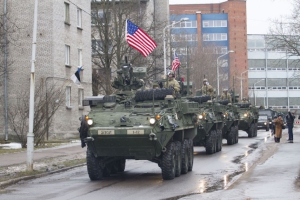
US troops in Estonia
U.S. troops in Estonia. [Source: liberationnews.com]

The treaty is not an “ultimatum,” rather it is the only feasible alternative to serious military confrontation that can easily lead to a major war. Unfortunately, it appears that Ukraine and NATO, led by the U.S., have no intention of pursuing the diplomatic option, and continue preparations and provocations that can and will lead only to a military response by Russia.

Amending of Ukrainian Constitution

On December 21st, four days after the Russian treaty proposal was published, Ukraine, on U.S. and NATO orders, with reckless impudence again amended the Ukrainian Constitution to allow foreign troops to operate on Ukrainian soil, in preparation for multiple NATO exercises to be held in Ukraine in 2022.

These include nine maneuvers to be carried out in 2022, and the number of  military personnel participating in them will almost double compared to 2021—to 64,000. 

Servicemen of the U.S. and Ukrainian armies attend the opening ceremony of the "RAPID TRIDENT-2021" military exercise at Ukraine's International Peacekeeping Security Centre near Yavoriv in the Lviv region, Ukraine September 20, 2021. REUTERS/Gleb Garanich
Servicemen of the U.S. and Ukrainian armies attend the opening ceremony of the “Rapid Trident-2021” military exercise at Ukraine’s International Peacekeeping Security Center near Yavoriv in the Lviv region, Ukraine, September 20, 2021. [Source: reuters.com]

The number of aircraft and helicopters will more than triple—to 361—and warships almost four times—to 256. This is a tremendous military escalation, and while Russia can easily handle the Ukrainian military alone, Russia will be faced with a much more formidable foe if the NATO reinforcements are in place before hostilities commence.

Russia’s window of opportunity for a preemptive strike is a matter of weeks, and on December 29th, President Putin announced that Russia and Belarus have scheduled military exercises of their own for February and March of 2022.

A group of soldiers marching

Description automatically generated with medium confidence
Russian and Belarusian army exercise from 2017. [Source: uacrisis.org]

It is quite possible and even “highly likely” that these “exercises” will be conducted not in Russia or Belarus, but in Ukraine itself. This possibility has already prompted the UK to announce plans to evacuate its soldiers and the U.S. to begin preparations to evacuate its citizens from Ukraine.

February 4, 2022, will be the opening day of the Winter Olympics in Beijing, and Putin has announced his intention to attend. The U.S. and NATO have a history of initiating military and geopolitical confrontations during the Olympics, as was seen with the Maidan coup in 2014 during the Sochi Olympics and the Georgian attack on South Ossetia during the 2008 Summer Olympics in Beijing. All the above factors have led many analysts, including this author, to predict the start of major military operations in February 2022.

Non-Military Options and Russia’s Alliance with China

If the collective “West”—U.S./NATO—continue their advances and attacks against Russia, Russia also has multiple options of the non-kinetic variety with which to respond. Economic, technical and political means that can teach, even in a non-military way, what Vladimir Putin once described as “the true meaning of pain.” 

Russia’s electronic warfare capabilities are currently unmatched in the world. The Murmansk-BN system has the ability to suppress radio and satellite communication over a distance of 3,000 kilometers, and has proven effective against hard targets like the U.S. F-35. Operating from within its own territory, Russia can suppress not only military aircraft, but civilian air traffic and ground transport and other communication over the entirety of Europe, including the UK.

A picture containing text, grass, sky, outdoor

Description automatically generated
Murmansk-BN System. [Source: eurasiantimes.com]

Russia can play the energy card—the EU’s dependence on Russian oil and gas (47% in 2021) has become painfully clear this year, but it is a little known fact that Russia is the U.S.’s third largest supplier of petroleum products. In 2020, the U.S. imported 538,000 barrels per day from Russia, and even more in 2021. Russia’s supply accounts for 7% of all U.S. petroleum imports, and while an energy loss of 7% would be a major blow to the U.S., Russia can easily divert these shipments to the East and sell them there.

Were Russia to cut off its energy supplies to the EU, the economic devastation would be immediate and immeasurable. And the physical and infrastructure destruction would be even worse. People would literally freeze to death, pipes would freeze and burst, factories would be shut down and deteriorate, never to be re-opened. That is actually happening now in Ukraine. The U.S. and EU should take a look at that and take a lesson from it.

The Russia-China strategic partnership is not only military, it is economic. The U.S. economy today is a façade, a paper tiger with no real strength or foundation. The U.S. national debt is officially $30 trillion, more than 90% of GDP, and the true number, including U.S. government “unfunded liabilities” including $21 trillion for Social Security and $33 trillion for Medicare, is perhaps as much as ten times higher. It is a debt that can and will never be paid.

Russia-China, Putin-Xi Partnership Against U.S. Makes Sense. For Now. -  Bloomberg
Putin and Xi. [Source: Bloomberg.com]

A combined economic assault by Russia and China against the U.S. dollar would cause inflation of Zimbabwean proportions. Soldiers do not fight if they are not paid, cops and government bureaucrats do not work if their paychecks are worthless, and citizens loot and riot if they cannot afford food. And if the U.S. economy implodes, it will take the EU economy with it. And vice versa.

All (or any) of these non-military moves would paralyze the economies and governments of virtually all NATO countries, inflicting a crushing defeat on the U.S. and EU without firing a shot. But Russia does have full justification and compelling motives for a military response as well. And if done correctly, it could result in total victory in a quick and relatively bloodless fashion.


  1. With that in mind, it should also be noted that in early 2017, the Kyiv regime dammed the North Crimean Canal which had supplied fresh water to the 2.5 million citizens of Crimea. While the Crimean peninsula produces adequate water for survival, this criminal act not only affects the health and quality of life of the citizens, it also has had an extremely negative impact on the agriculture, economy and ecology of the peninsula.

  2. Ukraine has been using ISIS and other Jihadi terrorists in its war against the Donbass Republics since the very beginning of the war. In early 2015, The Intercept first reported the links between ISIS and Ukrainian neo-Nazis. Other credible reports soon followed, from such divergent sources as Antiwar.comThe American Thinker, and even The New York Times reported on “three full Islamic battalions fighting in eastern Ukraine.” These reports are all from 2015, and the jihadi presence in Ukraine has only grown since then.

Ex-Pentagon Deputy Secretary Claims War with Russia is Inevitable

www.defenseone.com

A US security adviser alleges conflict is likely to break out over tensions surrounding Ukraine

The US must ready itself for a war with Russia, a former Defense Department official has warned, saying that Washington could be obliged to step in militarily if Moscow decides to mount an invasion of Ukraine in the near future.

Evelyn Farkas, who served as deputy assistant secretary of defense for Russia, Ukraine, and Eurasia from 2012-15, published an op-ed in Defense One on Tuesday in which she claimed that an imminent Russian invasion of Ukraine is “more likely than not.” The former Obama administration official insisted that diplomatic talks between Moscow and Washington, taking place this week, are likely to fail, and that the US should already be getting ready for war with Russia.

In an echo of the words former President George W. Bush, used to describe the nations invading Iraq in 2003, she called for the US to marshal “an international coalition of the willing” to deter Russian President Vladimir Putin “and, if necessary, prepare for war.”

According to Farkas, Russia fails to abide by international law, and has been emboldened by recent mass protests in Kazakhstan, a neighboring nation and former Soviet republic with which Moscow has close ties. All this, she alleged, makes it more likely than ever that Putin is planning to invade Ukraine.

“If Russia prevails again,” she warned, “we will remain stuck in a crisis not just over Ukraine but about the future of the global order far beyond that country’s borders. Left unrestrained, Putin will move swiftly, grab some land, consolidate his gains, and set his sights on the next satellite state in his long game to restore all the pre-1991 borders: the sphere of geographical influence he deems was unjustly stripped from Great Russia.”

Farkas’ article comes as senior diplomats from the US and Russia are meeting in Geneva this week to discuss security proposals that Moscow delivered to Washington in December. The Kremlin has requested written guarantees that NATO, the US-led military bloc, will not expand into Ukraine and Georgia, two countries that share borders with Russia. American officials, meanwhile, have expressed concern about the alleged Russian troop buildup near Ukraine, and have said that they will not make any promises about NATO membership.

Despite the apparent impasse, officials from both sides have indicated that they are willing to negotiate while they have the chance. Russia has repeatedly denied it has any aggressive intentions towards Ukraine, and has accused the US of fueling tensions by providing Kiev with arms and military support.