Britain was never “Great,” and America was “Snuffed Out” long ago

By
VT Editors

September 28, 2019
Introduction

The Library of Congress has now digitized American newspapers from the late 19th through late 20th century. You can search births and deaths, bankruptcies, news analysis, shopping, anything.

This was a vast undertaking and quite revealing, let me tell you why.

America was founded by largely slave owning farmers who took advantage of cheap labor and free land. However, within half a century, trade and industrialization had transferred most financial and governmental functions of the US to the same group in Europe that controlled Britain, France, the Netherlands, Spain, in fact all of Europe.

You see, as the Founding Fathers fell to the wayside, new “familes” emerged, American sounding names, Astor (Astorga-Sephardic), Cabot (Cabota-Sephardic) or Rockefeller, Bush and even Drumpf.

For fake German families like the Drumpf’s, minor functionaries for the Rothschilds, running whores for the gold fields of California or the Yukon led them to controlling gold claims, and later establishing themselves in the world’s largest trafficking industry, the immigration boom of the 19th century, whores, Irish to fight the civil war, more whores, and the slaves that filled the immigrant neighborhoods of New York, Boston and a dozen other cities that organized crime, not Irish, not Italian but RKM, lived off then and still lives off today.

When you hunt for births, deaths, land purchases, family relations, all the things millions of Americans have mentioned in news snips now in the Library of Congress, these families won’t exist.

Their history will be a fiction.

More often than not, when looking at the Skull and Bones families or the Robber Barons, one finds wealth originating from New York banking houses that were 100% “European” owned, meaning formerly Sephardic Spain, then Venice or Genoa, then to Frankfurt or Amsterdam and on to London, all owned by the same people who now control the Federal Reserve, the RKM and the State of Israel.

We see a pattern. The “West” was developed through St. Louis where Kuhn and Loeb, of the Rothschilds, outfitted wagon trains, later took over rail roads, then the cattle business, then the oil business and of course the grain business and then the exchanges, commodities and stock markets.

They were aided by Jacob Schiff, who ran America’s banking, JP Morgan was a front so was Harriman. Behind them the mysterious Bush family, who some claim to be of the “Scherf” Nazi clan but others who use more recent sources now see as of the family of Schiff, the original family of Zionism, the Jakob Schiff who maneuvered Russia and China into war in 1905, brought the US into the “Fed” and World War I and II and, later on, through “agents,” came 9/11 and the War on Terror.

William of Orange – Jewish donkey and homosexual​


William of Orange, known to his bum buddies as Billy the Pink, was a Dutch nobody who was picked up by the Amsterdam Jews with a very particular purpose in mind. The Jews had been run out of England by King Edward I in 1290 for their usury and several of their members being convicted of holding human sacrifices with Christian children as their victims.

The Jews had found England a very profitable place indeed, and made many attempts to regain entry – including funding Oliver Cromwell, who toyed with the idea of giving Ireland to the Jews as a New Zion – once he had completed the extermination of the Irish people. In the end, Cromwell never did allow the Jews back into England – though he had taken their money.

The Jews had been the backroom boys of the Roman empire. They followed the Legions around Europe, buying conquered peoples as slaves – particularly blond haired Celtic and Germanic girls who fetched a high price in Southern Europe, North Africa and the Middle East. They had also amassed a fortune by lending at interest to the Roman officers and soldiers – knowing that the Romans would simply rob what they needed to pay back the loans.

The main reason that Julius Caesar conquered Gaul was because he was up to his neck in debt and his family was in danger of being declared bankrupt and their estates foreclosed. Caesar boasted that he murdered a million Gauls and enslaved another million – that’s a million Celtic people sold to the Jews as slaves. That was the worst Holocaust in European history – and all because one man was up to his neck in debt.

Following the collapse of the Roman empire, the Jews fell on hard times. Both Christianity and Islam tried to stop the Holocaust that usury had created, and for a few centuries the people of Europe had a little bit of peace and comfort. But, the discovery of the Americas by the Spanish gave the Jews a golden opportunity to get back to their old business.

They funded the ships – there were even a large number of Jews on Colombus’ first voyage – Conversos, Jews who had pretended to convert to Christianity for the purpose of business. By the time Cortez reached South America, he was up to his eye balls in debt. And even though he looted untold billions worth of gold and silver in today’s money – he died a poor man in debt.

As in the old days of the Roman empire, the Jews made sure the Spanish soldiers were nothing but their donkeys. And the more these donkeys fell into debt, the more vicious and genocidal was their behaviour towards the native people, as they desperately tried to rob enough gold to get ahead of their debts.

The Spanish conquest of South America left Spain with crippling debts – and the Jews with unimaginable wealth. As often happened over the course of history, the Spanish became very hostile to the Jews who had tricked them out of a vast fortune. So, the Jews moved their money to Amsterdam, where already a Liberal mindset ruled.

The Jews got back to work and soon the Dutch empire overshadowed the Spanish empire, and Jewish profit soared. But, Amsterdam was always under the the influence of the Spanish king – and sometimes under direct Spanish occupation.

It wasn’t an ideal situation. But, there was one place that was well out of Spanish control, had turned its back on Rome, and, most importantly, was protected by the sea. England was like a massive aircraft carrier off the coast of Europe. Near enough for business purposes – but far enough so that the Pope and the King of Spain couldn’t dominate it. But, there was one very big problem – the Jews were banned from England.

Enter William of Orange. The Catholic King James had irritated the English Protestants, and they were looking for someone to overthrow him. But they didn’t have the resources or the organisation to do anything about it. The Jews had both.

But they wanted their man on the throne of England – not just any Protestant. After all, they had funded Cromwell’s wars only to end up with nothing. Well, the rest is history. What’s interesting from the point of view of this topic is the price the Jews extracted for their support of William’s invasion of England, Scotland and Ireland.

The ban on the Jews entering England was immediately lifted. But, even that was not the big prize. The big prize was the founding of the Bank of England. The Jews had founded the Bank of Amsterdam in 1609. It was the world’s first real Central Bank. In 1694 William granted the Bank of England its charter.

It was a private bank. It’s shareholders were full of Jews with Spanish sounding names – Da Costa, A Fonseca, A Mendes, A Nunes, A Henriquez, Rodrigues, A Salvador, De Mattos, De Medina. But although it was a private bank, it immediately acted as if it were the government. Because it had huge capital compared to native English banks, it could put any English bank out of business instantly.

It could do this by simply calling in all the paper notes of any English bank that displeased it. Since at that time notes had to be backed up by gold, the Bank of England would simply buy up all the notes of a rebellious bank – and then present them all at once demanding gold in return. When the victim bank couldn’t hand over so much gold – it would be declared bankrupt and closed down.

And once the Bank of England made that point clear to everybody, it made a rule that any other bank that wanted to stay in business had to deposit a certain amount of gold in the Bank of England – or be closed down. The Jews had English banking by the balls. From now on, the banking and financial system of England and the British empire was, in fact, the banking and financial system of the Jews.

Is Hungary the World’s Second Most Jewish Country?

By STEVE SAILER

From blog of a genetic testing company called My Heritage DNA:

Hungary’s Secret: New Study by MyHeritage Reveals that Hungary Has the World’s Second Largest Percentage of Population with Jewish Ancestry
By Esther ·
August 14, 2019

A new study that we’ve conducted in conjunction with expert statistician and demographer Dr. Daniel Staetsky has uncovered that there are surprising numbers of people descended from Jewish ancestors in Hungary — far higher than previously estimated by demographers.

Our analysis of a huge cohort of 1.8 million anonymized DNA tests — the first of its kind in Jewish demography research — has revealed that the country with the highest proportion of Ashkenazi Jewish ethnicity after Israel is Hungary, and not the United States as was previously believed. After Israel, the top countries in terms of significant Ashkenazi Jewish ethnicity were Hungary and Russia, followed by Argentina, South Africa, Ukraine, and then the USA.

So I imagine that they are counting people who are, say, 1/4th Jewish as Jewish in this. In the U.S., there aren’t yet a lot of people who are 1/4th Jewish, although there will be. When I look at list of old guys, like the Forbes 400 or the top political donors, most are either Jewish or gentile but not both. But, apparently, things are different in Hungary.

Update: They explain exactly what they are doing in terms of cut-offs below.

This shows that there is a significant number of people in Hungary who have a Jewish heritage background that they do not acknowledge, are not aware of, or that their ancestors intentionally repressed.

MyHeritage collaborated with Dr. Daniel Staetsky, Director of the European Jewish Demography Unit at the Institute for Jewish Policy Research, who conceived the study….

Among the 100 countries included in the research, the country that stood out with the highest percentage of Ashkenazi Jewish ethnicity outside of Israel was Hungary. 7.6% of the 4,981 people living in Hungary who took the MyHeritage DNA test were found to have 25% or more Ashkenazi Jewish ethnicity (equivalent to having at least one grandparent who is fully Ashkenazi Jewish). This is a significantly higher percentage than the 3.5% observed in DNA test-takers living in the USA and the 3.0% in Canada.

Keep in mind that people who are part Jewish might be more inclined to pay for a DNA test to find out than a random person.

Hungary’s lead grows further at lower thresholds for Ashkenazi Jewish ethnicity. 12.5% of the people tested in Hungary have 10% or more Ashkenazi Jewish ethnicity, compared to only 4.7% of people in the USA and 4.0% in Canada. Meanwhile, 4.2% of people tested in Hungary have 50% or more Ashkenazi Jewish ethnicity (equivalent to having at least one parent who is fully Jewish), compared to 2.3% in the USA.

… Dr. Staetsky suggests accounting for a degree of selectivity of MyHeritage users. Since commercial genetic testing is an activity where the most educated and well-to-do classes of a society will be over-represented, he accounted for such selectivity, estimating the number of people with 50% or more Ashkenazi Jewish ethnicity in Hungary as 130,000.

This is significantly higher than some recent estimates. Official statistics set the number of Jews in Hungary at only 10,965, according to the 2013 national census. Alternative estimates, such as the estimate produced by Professor Sergio DellaPergola, show that the number of people in Hungary who self-identify as Jews — for example, when asked in a survey — comes to 47,500 people or 0.49% of the population.

Larger estimates of the population with Jewish ancestry in Hungary, produced by Professor Andras Kovacs, give a range of 73,000 to 138,000 people with at least one Jewish parent. Thus, the estimate based on MyHeritage data aligns well with the high end of some demographic estimates, lending credibility to both the traditional demographic methods and to the novel estimates based on genetic testing.

Ashkenazi Jews throughout the past centuries have lived in isolated communities that developed unique genetic signatures. … Previous studies have found Ashkenazi Jews to be a clear, homogeneous genetic group. …

Jews have a long history in Hungary, with Jewish officials having served the king during the early 13th-century reign of Andrew II. By the early 20th century, the Jewish community constituted 5% of Hungary’s total population (comparable to MyHeritage’s findings) and Jews comprised 23% of the population of the capital, Budapest. Seven of the thirteen Nobel prize winners born in Hungary are Jewish. However, by 1941, over 17% of Budapest’s Jews were Roman Catholic converts, following coordinated pressure across Europe that began with the Spanish Inquisition in the late 15th century. Like many ethnic minorities in the Austro-Hungarian Empire, Hungary’s Jews had rapidly assimilated in the decades preceding the Holocaust. In the Holocaust, about 560,000 of Hungary’s Jews were murdered. The trauma of the Holocaust and the subsequent communist rule led to portions of the Jewish community either being completely unaware of their Jewish identity or discouraged from divulging it. …

In Russia, the study revealed results similar to those in Hungary, with many more people having Jewish ethnicity than expected by demographers. 7.5% of the 5,266 DNA test-takers living in Russia had Ashkenazi Jewish ethnicity of 25% or more, making it the country with the third-largest percentage of Jewish ethnicity in the world, after Israel and Hungary.

… When setting the threshold of Ashkenazi Jewish ethnicity at 50% or more, the percentage in Russia drops to 3.1%, compared to 4.2% in Hungary. This indicates that in Russia, people who were ethnically Jewish tended to marry non-Jewish people at a greater frequency than in Hungary, which means that Jewish ethnicity in Russia is dissolving at a higher rate than in Hungary.

Here in the San Fernando Valley, there are now a whole bunch of people who are kind of Russian and kind of Jewish. Maybe they were born in the Soviet Union, qualified as Jewish enough to move to Israel, then bounced to L.A.

You don’t hear about them a lot, even though they congregate at the heart of the entertainment industry in places like West Hollywood and The Valley. One reason is because conventional American-born Jews are lately heavily into Russophobia, seeing Putin as the neo-Czar, so the existence of a lot of kind of Jewish Russians and kind of Russian Jews is disconcerting for the predominant worldview in which Russians are seen as dangerous anti-Semites.

Razib Khan points to intermarriage as early as 1780 for the diffusion of Jewish genes in Hungary:

A massive wave of demographic expansion occurred among Ashkenazi Jews after 1500. In the 18th-century Jewish fertility was far greater than gentile fertility in Poland. This resulted in an increase in the Jewish proportion over time, but likely also assimilation of some Jews into Christian society. The “Jewish Enlightenment”, spanning the 100 years between 1780 and 1880, was also a period when massive defections occurred from the more integrated elements of the Central European Jewry. Moses Mendelssohn’s last male descendant to practice Judaism died in 1871, after one century of assimilation and conversion.

Budapest was famous for smart Jews (e.g., John von Neumann), which I suspect correlates with early openness to intermarriage.

Rothschild Emerges From The Shadows For The Centenary Of The London Gold Fixing

Submitted by Ronan Manly, BullionStar.com

This month in London marks the 100th anniversary of the first “London Gold Fixing”, the infamous daily meeting of a secretive cartel of bullion banks which has met since 1919 to set benchmark gold prices used throughout the international gold market, a meeting which continues to this day through its thinly disguised successor, the LBMA Gold Price auction.

London gold price benchmarks are critically important to the global gold market because they are used as a valuation source for everything from ISDA gold interest rate swap contracts to gold-backed Exchange Traded Funds (ETFs), and everything from OTC gold contracts to transaction reference prices used by physical bullion dealers when purchasing gold bars and gold coins from refineries and suppliers.

Since 2015, the London Gold Fixing has been known as the LBMA Gold Price following a rush by the London Bullion Market Association (LBMA) bullion banks to patch over the then scandalized ‘Fixing’ in a smoke and mirrors and circle the wagons relaunch and renaming exercise. The collusive Gold Fixing first formally came into existence on 12 September 1919 when the Bank of England tapped its favorite bankers N.M. Rothschild & Sons to be the daily Fixing’s permanent chairman. Rothschild and the Bank of England had been joined at the hip since the early 1800s and would continue to be so in the Gold Fixing throughout the next century.

The 1919 launch of the Gold Fixing by the Bank of England and Rothschild succeeded a more informal version of a gold fixing that had existed up to the outbreak of the First World War in 1914, which consisted of a meeting of four London gold brokers Mocatta & Goldsmid, Samuel Montagu, Sharps & Wilkins, and Pixley & Abell who between them set a daily gold price at the offices of Sharps & Wilkins.

For the next 85 years from its inception in September 1919, the Gold Fixing occurred daily at Rothschild’s headquarters in New Court, St. Swithins Lane, across the road from the Bank of England, with five men from five bullion banks religiously meeting at 10:30 am each morning. After the collapse of the London Gold Pool in 1968, the Gold Fixing moved to a twice per day pricing with an extra 3:00 pm meeting added by the fixers to ‘watch over’ the US morning hours gold market.

Rothschild would remain as the Gold Fixing’s permanent chairman until May 2004 at which point the fabled investment bank mysteriously departed the gold fixing and stepped back into the shadows after 200 years in the London Gold Market. Until now that is, for in one of its rare re-appearances, the LBMA’s seminar and cocktail reception to celebrate the Gold Fixing’s centenary took place this week at, you guessed it, NM Rothschilds’ headquarters in St Swithins Lane. In the words of the LBMA, the ‘momentous occasion’ of the centenary celebrations is being:

“held on the centenary of the first gold price, and held in the current Rothschild building which was built on the site of (the second) New Court, St Swithin’s Lane, where the first gold price was set. We are grateful to Rothschild & Co for their support in co-hosting this event with LBMA.”

N.M. Rothschild’s London headquarters at New Court in St Swithin’s Lane, City of London

So is the centenary of the Gold Fixing the ‘momentous occasion’ that the LBMA pitches it as, or is a more realistic perspective needed to counterbalance the cheerleading hullabaloo from the LBMA camp?

Let’s take a look, drawing on some of the many articles on this website and elsewhere that have covered aspects of the infamous gold fixing over the course of its existence, including articles that have looked at more recent LBMA Gold Price. After all, the LBMA Gold Price is just another name for the Gold Fixing, and was conceded as such by the LBMA press office this month when they threw pretense out of the window, saying that: “12 September 2019 marks the centenary of the first London gold price, or what is now known as the LBMA Gold Price.”

The very definition of the centenary as covering 1919 – 2019 underscores the continuity of the “London Gold Fixing – LBMA Gold Price” as one and the same thing, with the LBMA Gold Price just a disguised and more palatable version of the Gold Fixing, a classic case of same old wine in a new bottle, and a pricing process still controlled by the Bank of England and the bullion banks.

Permanent Fixtures – Rothschild and Bank of England

So how did the old five gold fixers of Mocatta & Goldsmid, Samuel Montagu, Sharps & Wilkins, Pixley & Abell and of course NM Rothschild end up being the modern day five gold fixers of HSBC, Deustsche Bank, Barclays, Scotia, and SocGen, five banks which were exclusively running the Fixing until the 2014-2015 timeframe? To give a quick recap it was as follows.

The five former gold fixers in the offices of Rothschild in London where the fixings took place until 2004.

In 1957, Sharps & Wilkins merged with Pixley & Abell to become Sharps Pixley. In 1966, at the ‘behest of the Bank of England’, the Kleinwort Benson investment bank bought Sharps Pixley. In 1993, Deutsche Bank took over Kleinwort Benson, and in doing so acquired one of the seats at the Gold Fixing.

In 1957, Mocatta & Goldsmid was acquired by Hambros Bank, who then sold Mocatta to Standard Chartered Bank in 1973. In 1997, Scotiabank bought Mocatta Bullion from Standard Chartered to form ScotiaMocatta. That explains gold fixing seat number two.

In 1967, Midland Bank took control of Samuel Montagu, and made it a fully owned subsidiary by 1974. In 1992, Hongkong and Shanghai Banking Corporation (HSBC) fully acquired Midland Bank, and thus acquired the third of the five seats at the Gold Fixing.

As a major gold refiner, Johnson Matthey (JM) had been involved in the gold fixing from the 1920s but in the early 1960s JM formed Johnson Matthey Bankers Ltd (JMB) which took on one of the seats in the fixing. In 1984, JMB collapsed in one of London’s most memorable financial and gold market scandals and the Bank of England bought JMB, selling it on to Mase Westpac, the gold trading division of Australian bank Westpac. In 1993, Republic National Bank of New York bought Mase Westpac’s fixing seat.

In 2000, HSBC also acquired Republic National Bank of New York. Since HSBC already had one of the five seats on the Gold Fixing, and Republic also had a seat (from its Mase Westpac purchase), HSBC then had two seats on the fixing, so sold one of these seats to Credit Suisse. In 2002, Credit Suisse sold on this seat to Societe Generale (SocGen). This explains Gold Fixing seat number four.

And of N.M. Rothschild? Well, in all of this you can see that the only thing permanent about the Gold Fixing throughout most of its history was the most powerful of all investment banks, NM Rothschild, as well as its old friend, the Bank of England operating behind the curtain. However in 2004, Rothschild mysteriously withdrew from the Gold Fixing. Was it a reprimand from the Bank of England for forcing the Bank to “stare into the abyss’ and sell British gold reserves to bail out a market short of physical gold, or was it the characteristic Rothschild habit of retreating into the shadows? Whatever the reason, in 2004 the Bank of England organised for the more pliable Barclays Bank to buy Rothschild’s gold fixing seat.

Notably, the Rothschild influence lived on with Barclay’s in the Gold Fixing because from 2006 to 2012, if you can believe this and its true, the chairman of Barclays was one Marcus Agius, who is son-in-law of former NM Rothschild chairman, Edmund de Rothschild.

For Rothschild, acquainted with the number five in the form of the five houses of Rothschild and its five arrows symbolism, the fact that there were only ever five seats on the Gold Fixing, is, to say the least coincidental, and maybe even symbolic. But as to which was the real puppet master in the London Gold Market, Rothschild or the Bank of England, that has always been the question.

The Bank of England’s not so hidden hand

The one constant in the Gold Fixing from its inception, apart from NM Rothschild, is of course the Bank of England, the central bank which controls and has always controlled the London Gold Market.

For example, the 1954 – 1968 period saw countless brazen attempts by the Bank of England and fellow central banks to cap the market price of gold at $35 per ounce, culminating in the infamous London Gold Pool, an experiment in gold price intervention from 1961 to 1968 which famously collapsed in March 1968 when the US Treasury ran out of Good Delivery gold bars despite the Bank of England as the Pool’s agent selling thousands of tonnes of gold into the Gold Fixings in late 1967 and early 1968.

But the the Bank of England had been regularly intervening into the Gold Fixing even before the London Gold Pool, to exercise what it aloofly called a ‘moderating influence’ on the gold price. This is starkly illustrated in the following passage from a Bank of England’s Quarterly Bulletin in 1964 in which it wrote (page 16):

“The Bank of England are not physically represented at the fixing. But they are able, like any other operator, effectively to participate in the fixing by passing orders by telephone through their bullion broker and at the fixing they use exclusively the services of the chairman of the market, namely, Rothschilds.

…, the Bank aim, as in the case of the foreign exchange and gilt-edged markets, to exercise, so far as they are able, a moderating influence on the market, in order to avoid violent and unnecessary movements in the price and thus to assist the market in the carrying on of its business.”

After the London Gold Pool collapsed in March 1968, the gold market reopened after two weeks using a two tier approach of an official gold price pegged at $35 per ounce for central banks, and a supposedly ‘free market’ gold price for everyone else. Notably, upon reopening, the daily Gold Fixing of Rothschild and friends switched to being priced in US dollars, and an afternoon fixing meeting was added 3:00 pm so as to allow the Bank of England and the five fixers to exert more control over morning trading hours in New York.

But if you think that the Bank of England bowed out of thinking about ways to manipulate the gold price in 1968, then you would be mistaken. On the contrary, it continued to scheme behind closed doors and in secretive ways right up to the modern era, including discussions with other G10 central bank governors at the Bank of International Settlements (BIS) in Basel, Switzerland in 1979 and 1980 about forming a new interventionist gold pool to break the psychology of the market“ and hold the gold price “at a critical time holding it within a target area“ (see “New Gold Pool at the BIS Basle, Switzerland: Part 1” and “New Gold Pool at the BIS Basle: Part 2 – Pool vs Gold for Oil”).

The Bank of England also devised the London gold lending market, a top secretive and opaque market that emerged on the 1980s in which central banks lend out their gold via LBMA bullion banks, the lent gold positions of which are sold into the market and have a subduing effect on the price. Ask the LBMA and Bank of England for data on outstanding gold loans or the size of the lending market and you will not get an answer. The Bank of England also allowed the development unallocated gold position trading in London, a vast ponzi of paper gold positions (mere credit in the form of bullion bank promises) that have little or no backing of real gold, but whose trading still perversely is hugely influential in gold price discovery.

And the Bank of England’s “moderating influence” on the Gold Fixings also continued. This is illustrated by the astounding case of the head of the Bank of England’s foreign exchange and gold Terry Smeeton intervening into the Gold Fixing during the 1980s: “Terry’s gold activities, often partly aimed at helping the London Market’s daily gold fixes, produced an overall profit. To see exactly what this refers to, please see “The Bank of England and the London Gold Fixings in the 1980s”.

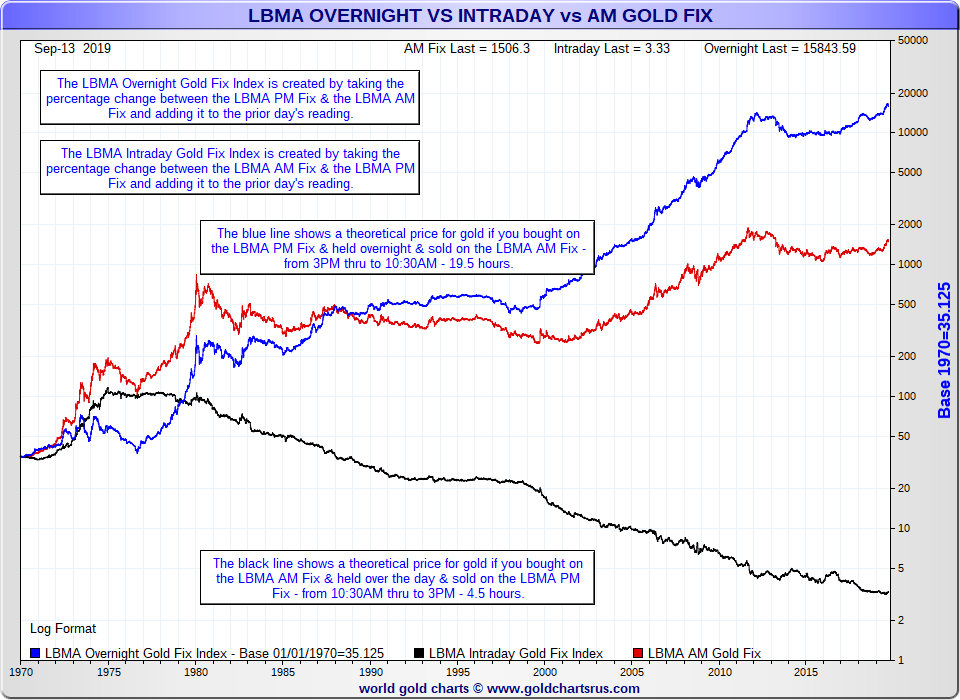
For anyone with doubts about how the London Gold Fixings have suppressed gold prices over time, take a look at the following chart from Nick Laird’s www.goldchartsrus.com website which shows three price lines of gold prices from 1970 when the price was $35 per troy ounce to 2019. In red is the actual US dollar gold price, in blue is the theoretical gold price if you bought at the afternoon London gold fix and held overnight and sold at the next day’s morning gold fix, in black is a theoretical gold price if you bought at the morning gold fix and sold same day at the afternoon gold fix.

The Fix is In – Subduing effects of the London Gold Fixings on gold prices over nearly 50 years. Source: www.goldchartsrus.com

Starting in 1970 when the price of gold was $35 per ounce, if every day you bought at the price of the afternoon Gold Fixing and sold 19.5 hours later at the price of the next day’s morning Gold Fixing price, your $35 would now be worth $15,843. That’s the cumulative value of the Overnight strategy. On the other hand if every trading day since 1970 you bought at the morning Gold Fixing price and sold 4.5 hours later at the afternoon Gold Fixing price, your $35 would now be worth, wait for it, just $3.33. That’s the cumulative value of the Intraday strategy. The key point is the the London Gold Fixings suppress the gold price intraday and that the current gold price of around $1500 is far lower than it should be because of the prices in these Gold Fixes. None of which is mentioned by the LBMA in its commentaries of the 100th anniversary of the Gold Fixing this month in London.

The London Gold Market Fixing Limited

Also not mentioned by the LBMA in its centenary celebrations this month is the fact that the incredibly named The London Gold Market Fixing Limited (LGMFL), a private company comprising the five member banks of the Gold Fixing (Barclays bank Plc, HSBC Bank USA, The Bank of Nova Scotia, Deutsche Bank and Societe Generale), is still an active company on the UK Companies House register. And it does exactly what it says on the tin. Incorporated in January 1994, the company’s accounts are still prepared on a going concern basis because the company can’t be wound up as it is currently being sued in New York courts by class actions suits accusing LGMFL of involvement in gold price manipulation.

For example, the latest activity on the company register, just filed on 4 September 2019, shows the recent appointment of SocGen’s Francois Combes as a LGMFL director on 30 August 2019 , the termination of SocGen’s Vincent Domien, as a LGMFL director on the same date, and the termination of Scotia’s Steven Lowe in August 2018.

In addition to SocGen’s Francois Combes, other current directors of LGMFL are Simon Weeks of Scotia, Xavier Lannegrace of SocGen, Paul Voller of HSBC, and Jerzy Burmicz of Barclays. Deutsche Bank has successfully extracted itself from the LGMFL at this time. Recent filings also show the latest annual accounts for The London Gold Market Fixing Limited to December 2018, with a critical commentary that:

“The London Gold Market Fixing Limited four member banks have been named as defendants in class action lawsuits pending in the United States Federal Court for the Southern District of New York, the first of which was filed on 3 March 2014 in connection with their roles in setting the London benchmark gold price. The complaints allege among other things that The London Gold Market Fixing Limited and its member banks collectively violated provisions of the Sherman Act, the Commodity Exchange Act, the Commodity Futures Trading Commission (CFTC) rule 180.1 (a) and various state laws by manipulating the London benchmark gold price.

The US class actions being referred to by the London Gold Market Fixing Limited above were covered in posts on the BullionStar website such as ”Spoofing Futures and Banging Fixes: Same Banks, Same Trading Desks” and in the detailed and ground-breaking analysis of the class action court papers by Allan Flynn on his blog site here.

And its not only in New York where investors think they have been the victims of gold market fraud. Investor groups are also using Canadian courts to pursue class actions against The London Gold Market Fixing Limited and the five gold fixing banks using the Ontario Superior Court. The above LGMFL accounts state that the Canadian class actions say that:

“London Gold Market Fixing Limited and the member banks conspired, agreed and / or arranged with each other to manipulate the London benchmark gold price, and seek damages of Can$ 1 billion under the Competition Act and for civil conspiracy, unjust enrichment and waiver of tort.”

See here and here for more details. Missing from the LBMA’s momentous occasion centenary update on 12 September were any references to The London Gold Market Fixing Limited still being a very much live and active company, or the fact that London Gold Market Fixing Limited and four of the five fixers are currently defendants in class action suits in New York and Canada.

Its also interesting that a majority of the five gold price fixers of London Gold Market Fixing Limited have now exited the entire precious metals markets in London. This includes Deutsche Bank, Barclays, and more recently SocGen. Another member of the cartel, Scotia Mocatta, tried but failed to sell its precious metals business but did execute a reorganization of that business. That just leaves HSBC still fully active in the London Gold Market As explained in “Curse of the London Gold Fix strikes again as SocGen abandons ship“:

“The casualties of the still active London Gold Market Fixing Limited are now looking so severe that the entire former gold fixing cesspit looks cursed. So is it just a matter of time before the fifth member of the infamous syndicate, HSBC, runs into some type of trouble?”

Bank of England, a ‘moderating influence’ on the gold price

‘The best thing to do was to Pull it’

But what lead to the Gold Fixing being pulled in 2015 (while being replaced with practically the same thing under a new name)? The unraveling of the London Gold Fixing arguably began in late 2013 in the wake of the LIBOR scandal when financial regulatory authorities such as the UK FCA and Germany’s BaFin began investigating the Gold Fixing and scrutinizing the five gold fixing banks. Germany’s financial regulator BaFin appeared particularly efficient in its investigation into Deutsche Bank’s gold fixing activities, and whatever was in the documents that Bafin demanded from Deutsche in late 2013 caused Deutsche Bank to run for the exits of the London gold and silver market in January 2014 and abandon both its Gold Fixing and Silver Fixing seats.

Unable to sell either its Gold Fixing or Silver Fixing seat, as no other banks would touch the fixings given the regulatory investigations, Deutsche Bank gave just two weeks notice and walked away on 13 May 2014, leaving four banks on the Gold Fixing (Barclays, Scotia, HSBC and SocGen), and only two banks on the Silver Fixing (Scotia and HSBC).

This then opened the flood gates for the rest of the fixers to abandon ship, but not before all 10 directors of the London Gold Market Fixing Company at that time were profiled on 15 May 2014 in ZeroHedge’s excellent article “From Rothschild To Koch Industries: Meet The People Who “Fix” The Price Of Gold”, The names of these directors were Matthew Keen and James Vorley of Deutsche Bank, Simon Weeks and Steven Lowe or Scotia, Jonathan Spall and Martyn Whitehead of Barclays, Peter Drabwell and David Rose of HSBC, and Vincent Domien and Xavier Lannegrace of SocGen.

Less than a week later on 20 May 2014, Baclays then announced that its Head Of Gold Trading Marc Booker was leaving the bank. Then three days later on 23 May 2014, the Financial Conduct Authority (FCA), the UK’s financial regulator, announced that Daniel Plunkett, a director on the Barclays precious metals desk in London and a colleague of Booker, Spall and Whitehead on the trading floor in Canary Wharf, had been charged with manipulating gold prices of the afternoon Gold Fixing, and was being levied with a financial penalty and prohibition from trading. This is the same Daniel Plunkett who became infamous for his “I Am Hoping For A Mini Puke” statement, the mini puke being a lower gold price.

At the same time the FCA fined Barclays Bank Plc (Barclays) £26,033,500 for

“failing to adequately manage conflicts of interest between itself and its customers as well as systems and controls failings, in relation to the Gold Fixing. These failures continued from 2004 to 2013.”

Yes, you have read that correctly. Barclays was fined for manipulating the price of gold for a decade from 2004 to 2013, i.e. the entire time that Barclays was in on the fixing. The year 2004 is also interesting because from 2004 onwards the five fixers were no longer meeting face to face each day but meeting remotely using a web based application and electronic chat apps. See the article “The pre-2015 London Gold Fixings – More technologically advanced than reported” for details. These networked and chat apps would make collusion a lot easier but would also leave a trail of evidence.

Conclusion

As the great and the good of the London Gold Market raise a toast to the centenary of the Gold Fixing this September, while lauding the ‘new’ LBMA Gold Price, it would be well to keep in mind the old phrase ‘you can put lipstick on a pig, but its still a pig’.

The LBMA recently asserted that “it took 89 years for the gold price to break through the $1,000 barrier, reaching a new all-time high of $1,023.50 on 17 March 2008“. To which we might well ask, what would the gold price be now in the absence of the infamous London Gold Fixings?

This article is an abridged version of an article which was originally published on the BullionStar.com website under the same title “Rothschild emerges from the shadows for the Centenary of the London Gold Fixing“.

The Judeo-Russian Mafia: From the Gulag to Brooklyn to World Dominion

By M. Raphael Johnson, PH.D.

July 11, 2017 Anno Domini
(Barnes Review May/June 2006)

On April 28, 2002, a military helicopter went down in the southern part of the Krasnoyarsk region of Siberia. On board was a major Russian dignitary, Gen. Alexander Lebed, governor of the region. Lebed was pronounced dead at the scene.

Almost immediately, the international press blamed “heavy fog” for the incident. However, at the time, every member of the Russian military was convinced the death of Lebed was no accident, but rather another hit by the international Jewish mafia, an organization that had long since taken control over much of Russia’s economy. Lebed, likely the most popular man in Russia at the time, was going to build a national socialist empire—possibly with Chinese assistance—based on the massive oil and mineral wealth of the region.

Had he succeeded, world history could have changed, and the 21st century would look very different. Prior to that, dozens of anti-Zionists in Russia had been murdered by car bombs or other devices, while none of the cases was ever solved. Only a handful was even investigated.

The very fact that the Jewish mafia (often misnamed the “Russian” mafia) was capable of completely covering its tracks, being completely left out of all news reports surrounding the incident, while the common people (in Russia) were utterly convinced of their complicity, proves the immense strength of this rather new movement of organized crime. The Jewish mafia is nothing like their Irish or Italian predecessors in its American or European operations. They are richer, more international in scope and far more violent and ruthless. They kill children. They kill policemen and their families. They kill whomever they like. There has been nothing like it before in the history of the globe. And they are just getting started.

The major figure in uncovering the web of secrecy that surrounds the Jewish mafia was a journalist named Robert I. Friedman, who died at an early age from a “tropical disease.” He has interviewed the major figures in this underground and has uncovered their hiding spots and plans. After his book on the subject was published, major mafia leaders put a bounty on his head. The “Russian” mafia knows that it can kill with impunity, and, given their cozy relationship with European and American intelligence agencies, their immunity from real prosecution will only get more pronounced.

Friedman’s work is breathtaking in scope, and this essay will cite him extensively, especially his book Red Mafiya: How the Russian Mob Has Invaded America. Friedman is not afraid to state the obvious, namely, that the entire “Russian” mafia is Jewish, without exception, and that they have used this as a shield to deflect criticism. This shield has permitted them to grow and prosper. Further, Friedman is also not afraid to admit that Jewish organizations throughout the world, led by the Anti-Defamation League, are the beneficiaries of largesse coming from organized crime, and that the organizations in question are aware of it. In other words, Jewish organized crime is considered an acceptable part of Jewish life, and that Jewish organizations have actually lobbied law enforcement to stop investigations into this phenomenon, almost always with success. The confirmation of Zionist Michael Chertoff to the post as chief of Homeland Security guarantees that Jewish organized crime in America will not be at the receiving end of the many stings that have targeted the Italian Mafia.
The roots of Jewish organized crime, it is said, go far back into tsarist times. Organized crime syndicates assisted Lenin’s gangs in bank robberies and the creation of general mayhem. During the so-called revolution, it was difficult, sometimes impossible, to distinguish between Bolshevik ideologues and Jewish organized crime syndicates. They acted in nearly an identical manner.

However, in more modern times, they seem to have had their roots in the waning days of the stagnant USSR under Leonid Brezhnev. By the late 1970s, the Russian economy was driven by the black market, and the early stages of the Jewish mafia were involved in this black underground. In fact, the Russian socialist economy would have collapsed much sooner if it had not been propped up by the extensive black economy. Soon, the rulers of the black market became so powerful they were able to form their own “people’s courts,” which dispensed “justice” completely apart from the Soviet state, and away from its control. Many of these black marketeers had been recently released from the gulag system of prison camps in an earlier era for their black market activities, and the toughness that was required to survive these dungeons served this new criminal elite very well (Friedman, 9).

The black market acted as a safety valve for the Soviet state for decades, making all estimations of the strength of the Soviet economy subject to speculation. The black market provided many goods and services the overextended Soviet system could not provide. In the gulag, they had formed brotherhoods, much like blacks and Hispanics currently do today in prison. They formed Jewish bunds that, upon release, served to create deep bonds that exist today, maintaining a highly secretive organization almost impossible to deal with or penetrate.

Sen. Henry “Scoop” Jackson’s famous bill, the Jackson-Vanick law, linked Soviet trade privileges to the treatment of Soviet Jews. It was a bill lobbied heavily for by American Jewish organizations. And while non-Jews could not emigrate from Russia, Jews could. Quickly, the KGB took this opportunity to dump its hardcore criminals into the United States, many who were Jewish, as conservatives cheered, believing, naively as usual, to have scored a major victory against the USSR. Much of the Jewish mafia’s penetration into the United States came as a result of these Soviet “boatlifts,” which were partially financed by groups such as the ADL or the Hebrew Aid Society. Given the substantial nature of the black market and the Soviet criminal underground, and its exclusively Jewish character, it is difficult to believe that the Jewish groups who were financing the immigration of Russian Jews to America were unaware of the connections of many of the new arrivals. Regardless, much of the money earmarked for immigration to Israel was pocketed by the mafia and redirected to settling Jews in New York—the New Promised Land.

Marat Balagula was one of these. A major Jewish crime figure, he bought a restaurant in Brighton Beach, Brooklyn, named it the Odessa (a major port city in Ukraine), and quickly converted it into a central recruiting base for mobsters. It was also closely linked with Zionist agencies in the area, including the women’s group Hadassah, who used the establishment for meetings and fund raising dinners (Friedman, 17). This restaurant also became the seat of real political power in Brooklyn, for in the upstairs part of the establishment, Balagula and other Jewish mobsters would convene the “People’s Courts,” and their word was (and is) law. Ordinary courts in the area could not hope to compete with the mobsters, well protected by powerful Jewish groups within the city and the municipal government itself.

These courts, controlled by the Jewish mob, were more powerful and acted more quickly than the regular municipal courts of New York City. Balagula had created a state within a state. The Italian gangs in New York didn’t know what hit them. Public executions and torturings were common in Brooklyn, and in broad daylight. Often, public murders would happen for the tiniest offenses, or to prove one’s toughness. While the Italians were very cautious and deliberate, the Jewish mob was flamboyant and gratuitously violent.

Yuri Brokhin, another Jewish mobster who had already made a name for himself in America, and Balagula were heavily into stealing diamonds from jewelry stores and replacing them with cheap fakes. At one incident, narrated by Friedman, the pair pulled such a scam in Chicago, and was caught at the airport with $175,000. As it turns out, the duo was seen by a Jewish security guard in Chicago’s O’Hare Airport wearing their phony Hassidic garb on the eve of Yom Kippur, when Jews are strictly forbidden to travel. This sloppiness got them caught. The duo was convicted, but as proof of the power of the Jewish mafia, they both got off without a jail sentence, having committed major grand larceny, among other crimes. Of course, Friedman does not speculate as to why this would be, since a major felony such as this often carried sentences over 20 years. Both Brokhin and Balagula were criminals in the USSR, and were able to transfer their wealth to America via Zionist and “charitable” organizations of Jewry.

A major connection between the halls of American political power and the Jewish mafia is the rabbi Ronald Greenwald. He knowingly did business with con artists and mafia figures, and used his major political connections to shield them. Greenwald was a major player in CREEP, the re-election campaign for Richard Nixon in 1972. Greenwald was used heavily by Nixon and other Republicans to gain the Jewish vote, which he doubled for Nixon during that election (Friedman, 31) in the state of New York. Soon, the rabbi was given a post as an “advisor” to Nixon on “Jewish poverty programs,” a post which certainly made some snicker at the time, though it was clear that Nixon owed Greenwald, and the rabbi made quick use of his new-found powers. He used his power to protect the mafia’s bilking of Medicaid programs and other crimes that were never investigated by the authorities.

His post as head of the “Jewish poverty” initiative permitted him to shield those involved with such financial scams, as well as call off any and all FBI investigations of his friends. Part of the rise of Jewish mafia groups was the protection afforded it by Greenwald’s political connections.

Greenwald was also instrumental in protecting Marc Rich, a billionaire Jewish investor with mob ties. Rich, a major player in the Clinton administration, swindled investors out of billions. Nothing was done, again, though negative media treatment against Rich was permitted largely because he did do business with Iran, and thus was considered a traitor by his fellow Jews. Eventually, Clinton pardoned Rich in a much-publicized case, and Rich is now free.

Jewish mafia investors all but took over Las Vegas, also with the political protection and patronage of Greenwald. Some years back, a movie was released called Casino, starring Robert DeNiro and Joe Pesci. Concerning itself with the takeover of Las Vegas, the film depicted Mr. Rothstein (played by the Jewish DeNiro) as the suave and successful entrepreneur, and Pesci as the typical Italian wiseguy, brash and insolent. Of course, the purpose of the movie was to absolve Jewish organized crime and transfer all blame to Italian mobsters. The opposite was true.

Balagula, before taking over Jewish mafia interests in the United States, acted as a mob functionary for the KGB. In his very own words, Balagula said that the “KGB gave him visas, no problem” (Friedman, 44) and was instrumental in sending him stolen art and jewels, which he sold to foreign tourists. The KGB also set him up as head of the largest food co-op in Ukraine, a position he quickly turned into a major black market operation with the blessings of the KGB. Near the end of the Cold War, members of the KGB viewed the Jewish crime syndicate as a source of possible new jobs for them after the old system was destroyed. So, not only did they have the patronage of the American political establishment under Greenwald, but also the decaying intelligence apparatus of the USSR as well.

BOOTLEGGING
What needs to be kept in mind about the bootlegging operation is that it was never small time. Nothing the Jewish mob did was ever small. This operation was multinational in scope. They had a fleet of massive oil tankers, tanker trucks and hundreds of gasoline stations and distributorships, all owned by Jews loyal to the mob. Balagula had created a massive mafia empire leading from North Africa to Saudi Arabia to Venezuela to Brooklyn. The Jewish mobsters developed an infrastructure within the oil trade that made them invincible. Mafia influence is substantial in the price of oil, as well as acting as the occasional go-between between the Mossad and Arab oil-producing sheikdoms. No one of substance was ever brought to justice.

With all the power that the Jewish mob has amassed, they are merely a pimple on the back of the master of them all, and a man who truly controls much of the globe. There is no one on Earth more powerful than he, and, as per usual, he remains unknown, left out of all press and television reports on the subject. The CIA considers him a “grave threat” to global security and the “world’s most dangerous man” (Friedman). The fact that he remains almost unknown shows the power of the Zionist-controlled media and their relentless drive to suppress all investigation into Jewish crime. He has created a massive, global communications network and employs hundreds of Ph.D.s in computer science, physics and economics to run his massive financial empire. He has penetrated every stock exchange in the world and controls much of the trading therein.

He was also the mastermind of the largest money-laundering scheme in U.S. history, “washing” $7 billion through the Bank of New York, which is a major branch of the Federal Reserve and his bank of choice. His name is Semion Mogilevich, born in 1946.

Basing his first operations in Israel, where he fleeced Jewish refugees from Russia, Mogilevich acquired Hungarian citizenship after making the comment that the biggest problem with Israel is that there are “too many Jews there.” However, he single-handedly controls the brothels in Israel, where Ukrainian and Russian girls are forced into sexual slavery. This is legal in Israel if the girls are non-Jews. The name of Mogilevich has been left out of every report on the phenomenon in Israel, Ukraine or the United States. Mogilevich also controls the vodka trade in Russia and Central Europe.

Most ominously, Mogilevich has bought Hungary’s armaments industry. In other words, he controls the military equipment being manufactured in Hungary. He has his own army, artillery, mechanized infantry, antiaircraft guns and missiles of all types. NATO has said that he is a “threat to the stability of Europe,” though his name remains little known. This mobster is militarily more powerful than many European countries. He has nuclear weapons from the former Warsaw Pact countries and is presently trading with various governments and providing them with nuclear technology. He has agents in the intelligence agencies of all European countries, which means that he may never be prosecuted, for he is made aware of any pending investigation into his activities, which quickly gets quashed.

German television reported that the German intelligence service, the BND, had entered into secret negotiations with Mogilevich whereby the latter would supply information on his rivals in Russia. He has a similar arrangement with French intelligence. He has close connections to the Mossad, which destroyed his criminal file (Friedman, 245-247). Therefore he is immune to prosecution and travels freely. He controls the black market from Central Europe to Russia. He has a Rockefeller connection as well, as his main economics advisor, Igor Fisherman was a consultant to Chase Manhattan Bank. Friedman writes, concerning the Fed and its relations to Mogilevich: “While the bank has not been charged with any wrongdoing, some investigators believe that the money laundering could not have taken place unless senior bank officials were bought off or otherwise involved” (259). When the Justice Department began a criminal investigation into Mogilevich (which went nowhere), he accused the Department of an “anti-Semitic conspiracy.”

George W. Bush’s professed mentor, Natan Sharansky, has long and deep ties to organized crime. The Congress, State Department and the CIA all have lengthy dossiers on Sharansky, who acted as a bridge between the Republican Party and Jewish thugs in a similar manner to Rabbi Greenwald. Sharansky, knowing his power, simply refused to sever his ties with organized crime, infusing the Jewish mafia into the highest echelons of the Bush administration. A pattern emerges in relation to the Republican Party: Russian Jews usually pose as “anti-Communists.” They did this partially because they had been arrested by security services for their black market activities, but also because this posture would make them valuable to Republican operatives and the Beltway “conservative movement.” Their reputations as “dissidents” protected them almost as much as their religion.

Because of this, George W.’s father also refused to cooperate with several investigations into Russian mob activities in Switzerland. The CIA has commented that there is no “major Russian mob figure that does not carry an Israeli passport,” but the Israeli state refuses to take any action against the gangsters. Yitzhak Rabin was the one exception, and met with Mossad figures, as well as Shin Bet and Israel’s FBI, to combat organized crime, believing that it could destabilize Israel. Within a few days, he was murdered. His successor, Shimon Peres, shelved the recommendations formulated under Rabin, where they collect dust to this day.

CAUSES
It might be worthwhile to delve into some of the causes of this phenomenon. Why the Jews? It is true that many culture groups have engaged in ethnic based organized crime, but it seems only the Italians get frequently mentioned. Today, Chechen, Hispanic and Albanian gangs are growing in power, but none has come close to being even a footnote to the Jewish clans. Few people in the FBI, CIA or DEA speak Hebrew or Yiddish. Some Jewish mobsters go back and forth between languages, including Russian, so as to make themselves more indecipherable.

The power of the Jewish gangs is wielded more ruthlessly than any other criminal gang. Jewish mobsters enjoy inflicting pain, they murder children as well as unarmed men and women. The old code of honor among Irish and Italian gangsters is nonexistent. These old-time mobsters would only kill another mobster. The Jewish gangs have no regard for these rules, and thus are more feared. The sheer arrogance of the Jewish gangsters and their outrageous self-assurance have allowed their “competition” among the Italian gangs to take a very cautious stance toward their Jewish counterparts.

The state of Israel is a major factor in the rise and power of the Jewish mafia. Jewish drug dealers, child porn pushers, and slave traders are free from prosecution in Israel. Israel does not consider these to be crimes, again, so long as the victims are non-Jews. The mafia proved its power in the murder of Yitzhak Rabin. The Israeli state will not extradite its citizens to non-Jewish countries, and, therefore, Jewish murderers can quite easily escape punishment in Israel.

The unique situation in the former USSR, and the fact that Jews predominated in the Soviet bureaucracy, provides another link in the rise of the mafia. Jews predominated in the earlier and more primitive black market in Russia, and thus these groups were physically more ready to take advantage of the crisis in Russia beginning in the mid-1980s.

Jewish organized crime, connected to both the KGB and Mossad, automatically had the skids greased to remain off the radar screen for allied intelligence agencies.

Likely the most important factor is the complete control of the media by Jewish families and the power of the ADL in American culture. The power of the Jews in America is so great that any serious investigation into Jewish crime will see shrill attacks from every major media outlet in America. In terms of public relations, it is just not worth it. Therefore, one will see a television program like The Sopranos about Italian mobsters, but one will never see the same program featuring Jewish mobsters.

WHAT CAN BE DONE?
There is very little that can be done at this time. There is every reason to believe that soon, nationalists and Revisionists will be targeted by Jewish criminals with strong ties to the Mossad. The fate of the West is being decided in Moscow, not in Washington, D.C. or New York. Russian President Vladimir Putin needs to continue to centralize power in his own person. His elimination of provincial governors was meant primarily as a crime fighting campaign, as local governors were making peace with the crime bosses. Putin also needs to continue to reform the military and security services, making them more and more loyal to the new Russian order. Putin should begin publicly drawing attention to the global power of the bosses and the connivance of western powers in their rise and present prosperity.

The ruble should be made non-convertible (so as to prevent its manipulation by crime bosses in the currency markets), and a strong Sino-Slavic trading bloc needs to be solidified. Police work in Russia is now a rough business. Poorly paid policemen need to be supplemented by local militias to begin direct and militant confrontations with organized crime and corruption wherever it might arise. Putin has the popularity and the power to create a major security bloc against organized crime, as well as capitalist imperialism. Russian banks need to come under state control, and be purged of all criminal elements. Furthermore, the church, currently the second most popular institution in Russia after Putin, needs to place its powerful seal on the development of a mob-free Russia, and call on all Russians to repent and begin building a nationalist and communitarian system. Agriculture and the village commune should receive government support to repopulate the countryside, making Russia self-sufficient in food.

And, of course, Russia’s extremely important and strategic oil and natural gas reserves need to be protected by interior ministry troops and placed under government control if need be. Putin, the nationalists and the church have tremendous popularity and influence. This capital should be spent on developing a nationalist system dedicated to purging Russia of Jewish-inspired crime, imperialism, depopulation, and liberalism. He is already moving in this direction, and Russian economic growth and a low inflation and unemployment rate are its fruits.

Hidden in Plain Sight: The Shocking Origins of the Jeffrey Epstein Case

Roy Cohn Jeffrey Epstein Rosen feature photo

Hidden in Plain Sight: The Shocking Origins of the Jeffrey Epstein Case

Epstein is only the latest incarnation of a much older, more extensive and sophisticated operation that offers a frightening window into how deeply tied the U.S. government is to the modern-day equivalents of organized crime.

Despite his “sweetheart” deal and having seemingly evaded justice, billionaire sex offender Jeffrey Epstein was arrested earlier this month on federal charges for sex trafficking minors. Epstein’s arrest has again brought increased media attention to many of his famous friends, the current president among them.

Many questions have since been asked about how much Epstein’s famous friends knew of his activities and exactly what Epstein was up to. The latter arguably received the most attention after it was reported that Alex Acosta — who arranged Epstein’s “sweetheart” deal in 2008 and who recently resigned as Donald Trump’s Labor Secretary following Epstein’s arrest — claimed that the mysterious billionaire had worked for “intelligence.”

Other investigations have made it increasingly clear that Epstein was running a blackmail operation, as he had bugged the venues — whether at his New York mansion or Caribbean island getaway — with microphones and cameras to record the salacious interactions that transpired between his guests and the underage girls that Epstein exploited. Epstein appeared to have stored much of that blackmail in a safe on his private island.

Claims of Epstein’s links and his involvement in a sophisticated, well-funded sexual blackmail operation have, surprisingly, spurred few media outlets to examine the history of intelligence agencies both in the U.S. and abroad conducting similar sexual blackmail operations, many of which also involved underage prostitutes.

In the U.S. alone, the CIA operated numerous sexual blackmail operations throughout the country, employing prostitutes to target foreign diplomats in what the Washington Post once nicknamed the CIA’s “love traps.” If one goes even farther back into the U.S. historical record it becomes apparent that these tactics and their use against powerful political and influential figures significantly predate the CIA and even its precursor, the Office of Strategic Services (OSS). In fact, they were pioneered years earlier by none other than the American Mafia.

In the course of this investigation, MintPress discovered that a handful of figures who were influential in American organized crime during and after Prohibition were directly engaged in sexual blackmail operations that they used for their own, often dark, purposes.

In Part I of this exclusive investigation, MintPress will examine how a mob-linked businessman with deep ties to notorious gangster Meyer Lansky developed close ties with the Federal Bureau of Investigation (FBI) while also running a sexual blackmail operation for decades, which later became a covert part of the anti-communist crusade of the 1950s led by Senator Joseph McCarthy (R-WI), himself known throughout Washington for having a habit of drunkenly groping underage teenaged girls.

Yet, it would be one of McCarthy’s closest aides who would take over the ring in later years, trafficking minors and expanding this sexual blackmail operation at the same time he expanded his own political influence, putting him in close contact with prominent figures including former President Ronald Reagan and a man who would later become president, Donald Trump.

As will be revealed in Part II, after this figure’s death, the blackmail operation continued under various successors in different cities and there is strong evidence that Jeffrey Epstein became one of them.

Samuel Bronfman and the Mob

The Prohibition Era in the United States is often used as an example of how banning recreational substances not only increases their popularity but also causes a boom in criminal activity. Indeed, it was Prohibition that greatly increased the strength of the American Mafia, as the top crime lords of the day grew rich through the clandestine trade and sale of alcohol in addition to gambling and other activities.

It is through the bootlegging trade of the 1920s and the early 1930s that this story begins, as it brought together key figures whose successors and affiliates would eventually create a series of blackmail and sex trafficking rings that would give rise to the likes of Jeffrey Epstein, the “Lolita Express” and “Orgy Island.”

Samuel Bronfman never planned to become a major producer of liquor but true to his family’s last name, which means “brandy man” in Yiddish, he eventually began distributing alcohol as an extension of his family’s hotel business. During Canada’s Prohibition period, which was briefer than and preceded that of its southern neighbor, the Bronfman family business used loopholes to skirt the law and find technically legal ways to sell alcohol in the hotels and stores the family owned. The family relied on its connections with members of the American Mafia to illegally smuggle alcohol from the United States.

Soon after Prohibition ended in Canada, it began in the United States and, by the time the flow of illegal alcohol had turned the other way, the Bronfmans – whose business ventures were then being led by Sam Bronfman and his brothers — were relatively late to an already flourishing bootlegging trade.

“We were late starters in the two most lucrative markets – on the high seas and across the Detroit River. What came out of the border trade in Saskatchewan was insignificant by comparison,” Bronfman once told Canadian journalist Terence Robertson, who was then writing a biography of Bronfman. Nonetheless, “this was when we started to make our real money,” Bronfman recounted. Robertson’s biography on Bronfman was never published, as he died under mysterious circumstances soon after warning his colleagues that he had uncovered unsavory information about the Bronfman family.

Samuel Bronfman mob

Samuel Bronfman pictured in 1937 with his sons Edgar and Charles

Key to Bronfman’s success during American Prohibition were the ties his family had cultivated with organized crime during Canada’s Prohibition, ties that led many prominent members of the mob in the United States to favor Bronfman as a business partner. Bronfman liquor was purchased in massive quantities by many crime lords who still live on in American legend, including Charles “Lucky” Luciano, Moe Dalitz, Abner “Longy” Zwillman and Meyer Lansky.

Most of Bronfman’s mob associates during Prohibition were members of what became known as the National Crime Syndicate, which a 1950s Senate investigative body known as the Kefauver Committee described as a confederation dominated by Italian-American and Jewish-American mobs. During that investigation, some of the biggest names in the American Mafianamed Bronfman as a central figure in their bootlegging operations. The widow of notorious American mob boss Meyer Lansky even recounted how Bronfman had thrown lavish dinner parties for her husband.

Years later, Samuel Bronfman’s children and grandchildren, their family’s ties to the criminal underworld intact, would go on to associate closely with Leslie Wexner, allegedly the source of much of Epstein’s mysterious wealth, and other mob-linked “philanthropists,” and some would even manage their own sexual blackmail operations, including the recently busted blackmail-based “sex cult” NXIVM. The later generations of the Bronfman family, particularly Samuel Bronfman’s sons Edgar and Charles, will be discussed in greater detail in Part II of this report.

Lewis Rosenstiel’s dark secret

Crucial to Bronfman’s Prohibition-era bootlegging operations were two middlemen, one of whom was Lewis “Lew” Rosenstiel. Rosenstiel got his start working at his uncle’s distillery in Kentucky before Prohibition. Once the law banning alcohol was in force, Rosenstiel created the Schenley Products Company, which would later become one of the largest liquor companies in North America.

Though he was a high school drop-out and not particularly well-connected socially at the time, Rosenstiel happened to have a “chance” meeting with Winston Churchill in 1922 while on vacation in the French Riviera. According to the New York Times, Churchill “advised him [Rosenstiel] to prepare for the return of liquor sales in the United States.” Rosenstiel somehow managed to secure the funding of the elite and respected Wall Street firm Lehman Brothers to finance his purchase of shuttered distilleries.

Officially, Rosenstiel is said to have built his company and wealth after Prohibition, by following Churchill’s advice to prepare for Repeal. However, he was clearly involved in bootlegging operations and was even indicted for bootlegging in 1929, though he evaded conviction. Like Bronfman, Rosenstiel was close to organized crime, particularly members of the mostly Jewish-American and Italian-American mob alliance known as the National Crime Syndicate.

Subsequent New York state legislative investigations would allege that Rosenstiel “was part of a ‘consortium’ with underworld figures that bought liquor in Canada [from Samuel Bronfman]”, whose other members were “Meyer Lansky, the reputed organized crime leader; Joseph Fusco, an associate of late Chicago gangster Al Capone and Joseph Linsey, a Boston man Mr. Kelly [the congressional investigator testifying] identified as a convicted bootlegger.” Rosenstiel’s relationship with these men, particularly Lansky, would continue long after Prohibition and Samuel Bronfman, for his part, would also maintain his mob ties.

In addition to his friends in the mob, Rosenstiel also cultivated close ties with the FBI, developing a close relationship with longtime FBI Director J. Edgar Hoover and making Hoover’s right-hand man and longtime assistant at the FBI, Louis Nichols, the Vice President of his Schenley empire in 1957.

Despite their similar backgrounds as bootlegger barons turned “respectable” businessmen, Bronfman’s and Rosenstiel’s personalities were drastically different and their relationship was complicated, at best. One example of the dissimilarities between North America’s top liquor barons was how they treated their staff. Bronfman was not necessarily known for being a cruel boss, whereas Rosenstiel was known for his erratic and “monstrous” behavior towards employees as well as his unusual practice of bugging his offices in order to hear what employees said about him when he wasn’t present.

Lewis Rosenstiel Roy Cohn

Rosenstiel was connected to both the FBI and to organized crime

Such differences between Bronfman and Rosenstiel were also reflected in their personal lives. While Bronfman married only once and was loyal to his wife, Rosenstiel was married five times and was known for his relatively closeted bisexual antics, a part of his life that was well-knownto many of his close associates and employees.

Though for years there were only hints to this other side of the controversial businessman, details emerged years later during a divorce proceeding brought by Rosenstiel’s fourth wife, Susan Kaufman, that would back the claims. Kaufman alleged that Rosenstiel hosted extravagant parties that included “boy prostitutes” that her husband had hired “for the enjoyment” of certain guests, which included important government officials and prominent figures in America’s criminal underworld. Kaufman would later make the same claims under oath during the hearing of the New York’s State Joint Legislative Committee on Crime in the early 1970s.

Not only did Rosenstiel organize these parties, but he also made sure that their venues were bugged with microphones that recorded the antics of his high-profile guests. Those audio recordings, Kaufman alleged, were then kept for the purpose of blackmail. Though Kaufman’s claims are shocking, her testimony was deemed credible and held in high regard by the former chief counsel of the Crime Committee, New York Judge Edward McLaughlin, and committee investigator William Gallinaro and aspects of her testimony were later corroborated by two separate witnesses who were unknown to Kaufman.

These “blackmail parties” offer a window into an operation that would later become more sophisticated and grow dramatically in the 1950s under Rosenstiel’s “field commander” (a nickname given by Rosenstiel to an individual to be named shortly in this report). Many of the people connected to Rosenstiel’s “field commander” during the 70s and 80s have again found their names in the press following the recent arrest of Jeffrey Epstein.

The “Untouchable” Mobster

Bronfman and Rosenstiel became legendary in the North American liquor business, in part due to their fight for supremacy in the industry, which the New York Times described as often erupting “into bitter personal and corporate battles.” Despite their dueling in the corporate world, the one thing that united the two businessmen more than anything else was their close connection to American organized crime, particularly renowned mobster Meyer Lansky.

Lansky is one of the most notorious gangsters in the history of American organized crime and is notable for being the only famous mobster rising to notoriety in the 1920s who managed to die an old man and never serve a day in jail.

Lansky’s long life and ability to avoid prison time was largely the result of his close relationships to powerful businessmen like Bronfman and Rosenstiel (among many others), the Federal Bureau of Investigation (FBI) and the U.S. intelligence community, as well as his role in establishing several blackmail and extortion rings that helped him keep the law at arm’s length. Indeed, when Lansky was finally charged with a crime in the 1970s, it was the Internal Revenue Service that brought the charges, not the FBI, and he was charged with and acquitted of tax evasion.

Lansky was remarkably close to both Bronfman and Rosenstiel. Bronfman regularly threw“lavish dinner parties” in Lansky’s honor both during and after Prohibition. These parties were remembered fondly by Lansky’s wife, and Lansky in turn did favors for Bronfman, ranging from exclusive protection of his shipments during Prohibition to getting him tickets to coveted “fight of the century” boxing matches.

Rosenstiel also threw regular dinner parties honoring Lansky. Susan Kaufman, Rosenstiel’s ex-wife, claimed to have taken numerous pictures of her ex-husband and Lansky socializing and partying together, photos that were also seen by Mary Nichols of The Philadelphia Inquirer. In addition, Lansky, per Kaufman’s recollection, was one of the individuals that Rosenstiel sought to protect from legal scrutiny as part of his child prostitution and blackmail ring targeting high-ranking officials, and he was overheard saying that if the government “ever brings pressure against Lansky or any of us, we’ll use this [a specific recording taken at one of the ‘parties’] as blackmail.”

Lansky was known to address Rosenstiel as “Supreme Commander,” a title that would later be used to refer to Rosenstiel by another individual deeply connected to the mob and sexual blackmail operations, previously referred to in this report as Rosenstiel’s “Field Commander.”

Lansky also had close ties to the CIA and U.S. military intelligence. During World War II, Lansky — along with his associate Benjamin “Bugsy” Siegel — worked with Naval intelligence in what was codenamed “Operation Underworld,” an operation the existence of which the government denied for over 40 years.

Journalist and noted chronicler of CIA covert activities, Douglas Valentine, noted in his book The CIA as Organized Crime: How Illegal Operations Corrupt America and the World that the government’s cooperation with the Mafia during World War II led to its expansion after the war and set the stage for its future collaboration with U.S. intelligence.

According to Valentine:

Top government officials were also aware that the government’s Faustian pact with the Mafia during World War II had allowed the hoods to insinuate themselves into mainstream America. In return for services rendered during the war, Mafia bosses were protected from prosecution for dozens of unsolved murders. […]

The Mafia was a huge problem in 1951 [when the Kefauver Committee was convened], equivalent to terrorism today. But it was also a protected branch of the CIA, which was co-opting criminal organizations around the world and using them in its secret war against the Soviets and Red Chinese. The Mafia had collaborated with Uncle Sam and had emerged from World War II energized and empowered. They controlled cities across the country.”

Indeed, not long after its creation, the CIA forged ties with Lansky at the behest of CIA counterintelligence chief James J. Angleton. The CIA would later turn to the Lansky-linked mobin the early 1960s as part of its consistently fruitless quest to assassinate Cuban leader Fidel Castro, showing that the CIA maintained its contacts with Lansky-controlled elements of the Mafia long after the initial meeting with Lansky took place.

The CIA also had close connections to associates of Lansky, such as Edward Moss, who did public relations work for Lansky and was said to be of “interest” to the CIA by the agency’s then-inspector general J.S. Earman. Harry “Happy” Meltzer was also another Lansky associate that was a CIA asset and the CIA asked Meltzer to join an assassination team in December 1960.

In addition to the CIA, Lansky was also connected to a foreign intelligence agency through Tibor Rosenbaum, an arms procurer and high-ranking official in Israel’s Mossad, whose bank – the International Credit Bank of Geneva – laundered much of Lansky’s ill-gotten gains and recycled them into legitimate American businesses.

Meyer Lansky Roy Cohn Israel

Lansky outside the High Court of Israel where he sought permission to emigrate in 1972. Photo | AP

Journalist Ed Reid, author of the Virginia Hill biography The Mistress and the Mafia, wrote that Lansky was attempting to entrap powerful people through sexual blackmail as far back as 1939. Reid contends that Lansky sent Ms. Hill to Mexico, where his West Coast connections had established a drug ring that later involved the OSS, the forerunner to the CIA, to seduce numerous “top politicians, army officers, diplomats and police officials.”

Eventually, Lansky was credited with obtaining compromising photos of FBI Director J. Edgar Hoover sometime in the 1940s, which showed “Hoover in some kind of gay situation”, according to a former Lansky associate, who also said that Lansky had often claimed, “I fixed that sonofabitch.” The photos showed Hoover engaged in sexual activity with his long-time friend, FBI Deputy Director Clyde Tolson.

At some point, these photos fell into the hands of CIA counterintelligence chief James J. Angleton, who later showed the photos to several other CIA officials, including John Weitz and Gordon Novel. Angleton was in charge of the CIA’s relationship with the FBI and Israel’s Mossad until he left the agency in 1972 and, as was recently mentioned, he was also in contact with Lansky.

Anthony Summers, former BBC journalist and author of Official and Confidential: The Secret Life of J. Edgar Hoover, has argued that it was not Lansky, but William Donovan, the director of the OSS, who obtained the original photos of Hoover and later shared them with Lansky.

Summers also stated that “To [gangster Frank] Costello and Lansky, the ability to corrupt politicians, policemen and judges was fundamental to Mafia operations. The way they found to deal with Hoover, according to several mob sources, involved his homosexuality.” This anecdote shows that Lanksy and the CIA maintained a covert relationship, which included, among other things, the sharing of blackmail material (i.e., “intelligence”).

It is also possible that Hoover was ensnared by the mob during one of Rosenstiel’s “blackmail parties,” at which Hoover sometimes found himself in attendance with prominent figures of the Mafia. Hoover was said to have worn women’s clothing at the some of the events and Meyer Lansky’s wife later said that her husband had photos of the former FBI director in drag. Furthermore, Hoover is on record showing an unusual concern in the FBI’s handling of Rosenstiel’s criminal links as early as 1939, the same year that his close associate Lansky was actively orchestrating the sexual blackmail of powerful political figures.

The blackmail acquired on Hoover and the mob’s possession of the evidence has been cited as a major factor in Hoover’s decades-long denial that nationwide networks of organized crime were a serious issue. Hoover asserted that it was a decentralized, local issue and therefore outside of the bureau’s jurisdiction. By the time Hoover finally acknowledged the existence of national organized crime networks in 1963, they were so entrenched in the U.S. establishment that they were untouchable.

Congressional crime consultant Ralph Salerno told Summers in 1993 that Hoover’s willful ignorance of organized crime for most of his career as FBI director “allowed organized crime to grow very strong in economic and political terms, so that it became a much bigger threat to the wellbeing of this country than it would have been if it had been addressed much sooner.”

J. Edgar Hoover: Blackmail Victim?

Most records place the beginning of Hoover’s relationship with Rosenstiel in the 1950s, the same decade when Susan Kaufman reported that Hoover was attending Rosenstiel’s blackmail parties. Rosenstiel’s FBI file, obtained by Anthony Summers, cites the first Rosenstiel meeting as taking place in 1956, though Summers notes that there is evidence that they had met much earlier. After requesting the meeting, Rosenstiel was granted a personal face-to-face with the director in a matter of hours. The FBI file on Rosenstiel also reveals that the liquor baron heavily lobbied Hoover to aid his business interests.

During that time, the salacious details of Hoover’s sex life were already known to the U.S. intelligence community and to the mob, and Hoover was aware that they knew of his closeted sexuality and penchant for women’s clothing. Yet, Hoover apparently seemed to embrace the very type of sexual blackmail operation that had compromised his private life, given that he was seen at many of Rosenstiel’s “blackmail parties” in the 1950s and 1960s, including at venues such as Rosenstiel’s personal home and later at Manhattan’s Plaza Hotel. Hoover’s penchant for dressing in drag was also described by two witnesses who were not connected to Susan Kaufman.

J Edgar Hoover Roy Cohn

Hoover with Dorothy Lamour on the set of The Greatest Show on Earth in 1951

Soon after their first “official” meeting, the public relationship between the two men quickly flourished, with Hoover even sending Rosenstiel flowers when he fell ill. Summers reported that, in 1957, Rosenstiel was heard telling Hoover during a meeting, “your wish is my command.” Their relationship remained close and intimate throughout the 1960s and beyond.

Like Rosenstiel, Hoover was well-known for amassing blackmail on friend and foe alike. Hoover’s office contained “secret files” on numerous powerful people in Washington and beyond, files he used to gain favors and protect his status as FBI director for as long as he wished.

Hoover’s own propensity for blackmail suggests that he may have associated with Rosenstiel’s sexual blackmail operation more directly, given he already knew he was compromised and his involvement in the operation would have served as a means of procuring the blackmail he coveted for his own purposes. Indeed, if Hoover was merely being blackmailed and extorted by the Lansky-Rosenstiel connected mob, it is unlikely that he would have been so friendly to Rosenstiel, Lansky and the other mobsters at these gatherings and participated in them with such regularity.

According to journalist and author Burton Hersh, Hoover was also tied to Sherman Kaminsky, who ran a sexual blackmail operation in New York involving young male prostitutes. That operation was busted and investigated in a 1966 extortion probe led by Manhattan District Attorney Frank Hogan, though the FBI quickly took over the investigation and photos of Hoover and Kaminsky together soon disappeared from the case file.

Hoover and Rosenstiel’s deep ties would continue to develop over the years, an example of which can be seen in Rosenstiel’s hiring of long-time Hoover aide Louis Nichols as the vice president of his Schenley liquor empire and Rosenstiel’s donation of over $1 million to the J. Edgar Hoover Foundation, which Nichols also ran at the time.

There is also more than one documented occasion wherein Hoover attempted to use blackmail to protect Rosenstiel and his “field commander,” none other than the infamous Roy Cohn, the other key figure in Rosenstiel’s sexual blackmail operation involving minors.

The Making of a Monster

Decades after his death, Roy Cohn remains a controversial figure in large part because of his close, personal relationship with current U.S. President Donald Trump. Yet reports on Cohn, both in recent and in past years, often miss the mark in their characterization of the man who became closely associated with the Reagan White House, the CIA, the FBI, organized crime and, incidentally, many of the figures who would later surround Jeffrey Epstein.

To understand the true nature of the man, it is essential to examine his rise to power in the early 1950s when, at just 23 years of age, he became a key figure in the high-profile trial of Soviet spies Ethel and Julius Rosenberg and later as the right-hand man of Senator Joseph McCarthy (R-WI).

Cohn’s dedication to anti-communist activities in the 1950s is allegedly what first endeared him to J. Edgar Hoover, whom he first met in 1952. During that meeting, as described by Hersh in Bobby and J. Edgar: The Historic Face-Off Between the Kennedys and J. Edgar Hoover That Transformed America, Hoover expressed admiration for Cohn’s aggressive and manipulative tactics and told Cohn to “call me directly” whenever he had information worth sharing. From that point on, Cohn and Hoover “traded favors, effusive compliments, gifts and elaborate private dinners. It quickly became ‘Roy’ and ‘Edgar.’” Hersh also describes Hoover as Cohn’s soon to be “consigliere.”

The date and circumstances around Cohn’s introduction to Rosenstiel are harder to come by. It is possible that the connection was made through Roy Cohn’s father, Albert Cohn, a prominent judge and an influential figure in the New York City Democratic Party apparatus then run by Edward Flynn. It was later revealed that the Democratic organization dominated by Flynn and based in the Bronx had long-standing connections to organized crime, including associates of Meyer Lansky.

Regardless of how or when it began, the relationship between Cohn and Rosenstiel was close and was often likened to that of a father and son. They were said to frequently salute each other in public and remained close until Rosenstiel was near death, at which point Cohn attempted to trick his then-barely conscious and senile “friend” and client into naming him the executor and trustee of the liquor magnate’s estate, valued at $75 million (more than $334 million in today’s dollars).

LIFE magazine reported in 1969 that Cohn and Rosenstiel had for years referred to one another as “Field Commander” and “Supreme Commander,” respectively. Media references to these nicknames appear in other articles from the period.

Though LIFE and other outlets had interpreted this as merely an anecdote about the nicknames shared in jest between close friends, the fact that notorious crime lord Meyer Lansky also calledRosenstiel “Supreme Commander” and the fact that Cohn and Rosenstiel would later become intimately involved in the same pedophile sex ring suggests that there may have been more to these “nicknames.” After all, the mob to which Rosenstiel was connected often used military-themed titles like “soldier” and “lieutenant” to differentiate the rank and importance of its members.

Once he had made his connection with Hoover, Cohn’s star began to rise even higher in Washington. Hoover’s recommendation of Cohn would become the deciding factor in his appointment as Sen. McCarthy’s general counsel over Robert Kennedy, a rival and bitter enemy of Cohn’s.

Joseph McCarthy Roy Cohn

McCarthy covers the mic while having a whispered discussion with Cohn during a 1954 committee hearing. Photo | AP

Though Cohn was ruthless and seemingly untouchable as McCarthy’s counsel and helped the senator destroy many careers during both the red and lavender scares, his antics in relation to his work on the committee would eventually lead to his downfall after he attempted to blackmail the Army in return for preferential treatment for committee consultant and Cohn’s rumored lover, David Schine.

After he was forced to leave McCarthy’s side due to the scandal, Cohn returned to New York to live with his mother and practice law. A few years later New York Judge David Peck, a long-time associate of former CIA Director Alan Dulles, orchestrated Cohn’s hire to the New York law firm Saxe, Bacon and O’Shea — which would later become Saxe, Bacon and Bolan after Tom Bolan, a friend of Cohn’s, became a partner in the firm. Upon his hire, Cohn brought the firm a slew of Mafia-linked clients, including high-ranking members of the Gambino crime family, the Genovese crime family and, of course, Lewis Rosenstiel.

What happened in Suite 233?

The connections Roy Cohn built during the 1950s made him a well-known public figure and translated into great political influence that peaked during the presidency of Ronald Reagan. Yet, as Cohn built his public image, he was also developing a dark private life, which would come to be dominated by the same blackmail pedophile racket that appears to have first begun with Lewis Rosenstiel.

One of the “blackmail parties” Susan Kaufman attended with her then-husband Lewis Rosenstiel was hosted by Cohn in 1958 at Manhattan’s Plaza Hotel, suite 233. Kaufman described Cohn’s suite as a “beautiful suite…all done in light blue.” She described being introduced to Hoover, who was in drag, by Cohn, who told her that Hoover’s name was “Mary” in a fit of barely concealed laughter. Kaufman testified that young boys were present and Kaufman claimed that Cohn, Hoover and her ex-husband engaged in sexual activity with these minors.

New York attorney John Klotz, tasked with investigating Cohn for a case well after Kaufman’s testimony, also found evidence of the “blue suite” at the Plaza Hotel and its role in a sex extortion ring after combing through local government documents and information gathered by private detectives. Klotz later told journalist and author Burton Hersh what he had learned:

Roy Cohn was providing protection. There were a bunch of pedophiles involved. That’s where Cohn got his power from — blackmail.”

Perhaps the most damning confirmation of Cohn’s activities in Suite 233 comes from statements made by Cohn himself to former NYPD detective and ex-head of the department’s Human-Trafficking and Vice-Related Crimes Division, James Rothstein. Rothstein later told John DeCamp — a former Nebraska state senator who investigated a government-connected child sex ring based in Omaha — among other investigators, that Cohn had admitted to being part of a sexual blackmail operation targeting politicians with child prostitutes during a sit-down interview with the former detective.

Plaza Hotel Suite 223

Flags fly over the main entrance of the Plaza Hotel in New York City in 1982. Suzanne Vlamis | AP

Rothstein told DeCamp the following about Cohn:

Cohn’s job was to run the little boys. Say you had an admiral, a general, a congressman, who did not want to go along with the program. Cohn’s job was to set them up, then they would go along. Cohn told me that himself.”

Rothstein later told Paul David Collins, a former journalist turned researcher, that Cohn had also identified this sexual blackmail operation as being part of the anti-communist crusade of the time.

The fact that Cohn, per Rothstein’s recollection, stated that the child sex blackmail ring was part of the government-sponsored anti-communist crusade suggests that elements of the government, including Hoover’s FBI, may have been connected at a much broader level than Hoover’s own personal involvement, as the FBI closely coordinated with McCarthy and Cohn for much of the red scare.

It is also worth noting that among Hoover’s many “secret” blackmail files was a sizeable dossier on Senator McCarthy, the contents of which strongly suggested that the senator himself was interested in underage girls. According to journalist and author David Talbot, Hoover’s file on McCarthy was “filled with disturbing stories about McCarthy’s habit of drunkenly groping young girls’ breasts and buttocks. The stories were so widespread that they became ‘common knowledge’ in the capital, according to one FBI chronicler.”

Talbot, in his book The Devil’s Chessboard, also cites Walter Trohan, Washington Bureau Chief of the Chicago Tribune, as having personally witnessed McCarthy’s habit of molesting young women. “He just couldn’t keep his hands off young girls,” Trohan would later say. “Why the Communist opposition didn’t plant a minor on him and raise the cry of statutory rape, I don’t know.” Perhaps the answer lies in the fact that those “planting” minors on their political foes were McCarthy’s allies and close associates, not his enemies.

The question that necessarily arises from revelations regarding Cohn’s activities in Suite 233 is who else was Cohn “protecting” and servicing with underage prostitutes? One of them could very well have been one of Cohn’s close friends and clients, Cardinal Francis Spellman of the Archdiocese of New York, who was said to have been present at some of these parties Cohn hosted at the Plaza Hotel.

Spellman — one of the most powerful figures in the Catholic Church in North America, who was sometimes referred to as “America’s Pope” — was accused of not only condoning pedophilia in the Catholic church and ordaining known pedophiles including Cardinal Theodore “Uncle Teddy” McCarrick, but also engaging in it himself to such an extent that many New York area priests widely referred to him as “Mary.” Furthermore, J. Edgar Hoover was said to have a filedetailing the cardinal’s sex life, suggesting Spellman’s involvement in the ring and pedophile protection racket in which Cohn and Hoover were personally involved.

Francis Spellman Roy Cohn

Cardinal Francis ‘Franny’ Spellman. Photo | Museum of the City of New York

People close to Cohn often remarked that he was frequently surrounded by groups of young boys, but seemed to think nothing of it. Similar off-handed comments about Epstein’s penchant for minors were made by those close to him prior to his arrest.

Controversial Republican political operative and “dirty trickster” Roger Stone — who, like Donald Trump, was also a protégé of Cohn — said the following about Cohn’s sex life during an interview with The New Yorker in 2008:

Roy was not gay. He was a man who liked having sex with men. Gays were weak, effeminate. He always seemed to have these young blond boys around. It just wasn’t discussed. He was interested in power and access.” (emphasis added)

Compare this quote from Stone to what Donald Trump, who was also close to Cohn, would later say about Jeffrey Epstein, with whom he was also closely associated:

I’ve known Jeff for 15 years. Terrific guy. He’s a lot of fun to be with. It is even said that he likes beautiful women as much as I do, and many of them are on the younger side. No doubt about it — Jeffrey enjoys his social life.” (emphasis added)

Though it is unknown how long the sex ring at the Plaza Hotel continued, and whether it continued after Cohn’s death from AIDS in 1986, it is worth noting that Donald Trump purchased the Plaza Hotel in 1988. It would later be reported and confirmed by then-attendeesthat Trump “used to host parties in suites at the Plaza Hotel when he owned it, where young women and girls were introduced to older, richer men” and “illegal drugs and young women were passed around and used.”

Andy Lucchesi, a male model who had helped organize some of these Plaza Hotel parties for Trump, said the following when asked about the age of the women present: “A lot of girls, 14, look 24. That’s as juicy as I can get. I never asked how old they were; I just partook. I did partake in activities that would be controversial, too.”

The Roy Cohn Machine

Roy Cohn was only at the beginning of his career when he waded his way into the underground sexual blackmail ring apparently led by Lewis Rosenstiel. Indeed, when Cohn first met Hoover, he was only 23 years old. Over the next three decades or so, before his death from AIDS-related complications in 1986 at the age of 56, Cohn built a well-oiled machine, largely through his close friendships with some of the country’s most influential figures.

Among Cohn’s friends were top media personalities like Barbara Walters, former CIA directors, Ronald Reagan and wife Nancy, media moguls Rupert Murdoch and Mort Zuckerman, numerous celebrities, prominent lawyers like Alan Dershowitz, top figures in the Catholic Church and leading Jewish organizations like B’nai B’rith and the World Jewish Congress. Many of the same names that surrounded Cohn until death in the late 1980s would later come to surround Jeffrey Epstein, with their names later appearing in Epstein’s now-infamous “little black book”.

Roy Cohn Reagan Murdoch

Reagan meets with Rupert Murdoch, U.S. Information Agency Director Charles Wick, and Roy Cohn in the Oval Office in 1983. Photo | Reagan presidential library

While President Trump is clearly connected to both Epstein and Cohn, Cohn’s network also extends to former President Bill Clinton, whose friend and longtime political advisor, Richard “Dirty Dick” Morris, was Cohn’s cousin and close associate. Morris was also close to Clinton’s former communications director, George Stephanopoulos, who is also associated with Jeffrey Epstein.

Yet, these were only Cohn’s connections to respectable members of the establishment. He was also known for his deep connections to the mob and gained prominence largely for his ability to connect key figures in the criminal underworld to respected influential figures acceptable to the public sphere. Ultimately, as New York attorney John Klotz stated, Cohn’s most powerful tool was blackmail, which he used against friend and foe, gangster or public official alike. How much of that blackmail he acquired through his sexual blackmail operation will likely never be known.

As Part II of this exclusive investigation will reveal, Cohn and Epstein, and the sexual blackmail operations they ran share many things in common, including not only many of the same famous friends and patrons, but also connections to intelligence agencies and consortiums of mob-linked businessmen, the modern-day equivalents of Samuel Bronfman and Lewis Rosenstiel who have since rebranded as “philanthropists.”

Part II will also reveal that Cohn’s operation was known to have successors, as revealed by a series of scandals in the early 1990s that have since been swept under the rug. The significant amount of overlap between Epstein’s and Cohn’s covert activities in sexual blackmail and their ties to many of the same powerful individuals and circles of influence strongly suggest that Epstein was one of Cohn’s successors.

As will be shown in the final installment of this report, Epstein is only the latest incarnation of a much older, more extensive and sophisticated operation that offers a frightening window into how deeply tied the U.S. government is to the modern-day equivalents of organized crime, making it a racket truly too big to fail.

Feature photo | A composite image shows from left to right, Lewis Rosenstiel, Jeffrey Epstein, and Roy Cohn. Graphic | Emma Fiala

Whitney Webb is a MintPress News journalist based in Chile. She has contributed to several independent media outlets including Global Research, EcoWatch, the Ron Paul Institute and 21st Century Wire, among others. She has made several radio and television appearances and is the 2019 winner of the Serena Shim Award for Uncompromised Integrity in Journalism.

TOO BIG TO FAIL

Hidden in Plain Sight: The Shocking Origins of the Jeffrey Epstein Case

Epstein is only the latest incarnation of a much older, more extensive and sophisticated operation that offers a frightening window into how deeply tied the U.S. government is to the modern-day equivalents of organized crime.

by Whitney Webb

Federal Judges Are Waging War On The Fourth Amendment

Authored by Chris Calton via The Mises Institute,

In 1984, as part of Ronald Reagan’s renewed war on drugs, the Drug Enforcement Administration launched Operation Pipeline. This program was inspired by the strategies employed by state troopers in New Mexico who, after pulling somebody over, asked specific questions designed to determine whether the driver might be a drug trafficker. Combined with the financial incentives of federal grants for drug enforcement and civil asset forfeiture laws, state and local police had strong new incentives to find reasons to stop vehicles and search for drugs. Operation Pipeline was meant, in part, to train officers how to legally harass drivers.

The problem, of course, was the pesky Fourth Amendment, which prohibited warrantless searches without probable cause. The “probable cause” requirement for warrantless searches is conspicuously open to interpretation, but it imposed important constraints on police harassment by placing the burden of proof on the officer to produce specific facts to justify his suspicion. In 1968, however, the Supreme Court granted the first exemption to this constraint by establishing the “stop-and-frisk” rule. In Terry v. Ohio, the Court ruled that as long as a “reasonably prudent man” would believe that a suspect might be armed, the burden of proof to show probable cause is unnecessary.

The ruling was justified out of concern for officer safety, but it paved the way for Operation Pipeline sixteen years later. The shift from “probable cause” to “reasonable suspicion,” a criterion officers could more easily meet in court, was a sufficient precedent for strategically designed traffic-stop questions to establish legally valid suspicion for vehicle drug searches. Theoretically, the courts could still strike the practice down as unconstitutional, but the Terry case proved this unlikely.

Still, there were many constitutional questions for the Supreme Court to work out. Unsurprisingly, the court served as “loyal foot soldiers” in the Drug war, as Justice Stevens put it, by sanctioning virtually every tactic the police invented, no matter how egregiously it violated civil liberties.

The first important ruling on roadway privacy came in 1991. In Florida v. Bostick, two officers boarded a Greyhound bus in Fort Lauderdale and woke up a sleeping passenger named Terrance Bostick. When the officers asked permission to search Bostick’s bags, he complied, despite possessing a pound of cocaine. However, when Bostick went to court, his attorney’s argued that the police officers had neither probable cause nor reasonable suspicion to justify the search of Bostick’s luggage, and therefore the cocaine should be inadmissible in court. Florida’s State Supreme Court ruled in Bostick’s favor, claiming that bus searches are inherently unconstitutional because the police did not allow passengers to leave the bus during the raid. The case went to the US Supreme Court who reversed the decision, claiming that even though the officers were effectively holding Bostick and other passengers hostage, “a reasonable person” would have felt perfectly comfortable denying armed police officers the right to search his luggage.

With this ruling, the loose “reasonable suspicion” requirement expanded officer prerogative in any situation in which they could show that their searches were voluntary. This changed the way officers were trained to give orders. Like contestants on Jeopardy, officers were taught to give their orders in the form of a question— “Will you put your hands against the wall while we search you?” for example. The courts made this easier by interpreting silence as consent, establishing “consent searches” as standard and legal police practices.

Although Florida v. Bostick took place on a bus as part of highway monitoring activities, the ruling did not clarify any legal boundaries for traffic stops. This came five years later in the case Whren v. United States. After pulling Michael Whren over, a police officer arrested him for possession of crack cocaine. By the officer’s own admission, he pulled Whren over because he suspected him of possessing drugs, but officially, the stop was justified because Whren failed to use his turn signal. The defense argued that the Fourth Amendment prohibited the use of a minor traffic violation as a pretext for a drug search, so the drugs should be inadmissible in court.

The Supreme Court unanimously upheld Whren’s conviction, though, establishing two important precedents. First, they declared that the officer’s intentions are irrelevant as long as there is any objective criteria that could justify the traffic stop — and given the endless list of traffic laws, this ruling effectively grants officers unlimited discretion in pulling drivers over. Second, the decision settled the legal debate over “pretext stops,” the use of minor traffic violations as a pretext for vehicle drug searches.

Even after the Whren ruling, civilians still theoretically have the right to refuse searches, based on the absurd notion that a “reasonable person” would feel free to deny an officer’s request, as established by Bostick. A few months after Whren, though, the Ohio court implicitly rejected the Bostick ruling. After Robert Robinette was pulled over for speeding, he consented to a search of his vehicle— illustrating the tactics of both pretext stops and consent searches in the Drug War. When officers discovered a small amount of cannabis and a single amphetamine pill, they arrested Robinette. Because Ohio v. Robinette reached the state court prior to the final Whren ruling, the pretext stop controversy was still an open question, which made the case viable. But what made the Robinette case important was that the Ohio court pushed back against the Bostick argument by stipulating that for a reasonable person to feel comfortable denying consent to a search, the officers had to inform the driver that they had the right to refuse. It was this stipulation that took Robinette to the higher court, at which point SCOTUS overturned the ruling for being “unrealistic.”

According to SCOTUS, it is more realistic for an untrained civilian to know their rights, which are apparently subject to constant change, than it is for professional police officers to inform drivers of their rights to refuse a search. Taking these expectations to a new extreme, the 2001 case Atwater v. Lago Vista ruled that officers had the legal right to arrest drivers who violated misdemeanor traffic stops, even if the punishment for the violation was a fine, rather than jail time. With this ruling, the court’s imaginary “reasonable person” would presumably know that if they refused to consent to a drug search, they faced the risk of being handcuffed for whatever petty infraction got them pulled over. None of this matters in the twisted logic of the criminal justice system, of course.

To complete the remarkable expansion of highway monitoring prerogatives, the 2004 case Illinois v Caballesruled that it did not legally constitute a search, regardless of consent or pretext, for officers to walk drug-sniffing dogs around a person’s vehicle. Given the precedents established in the previous cases, it may seem that this ruling added no discretionary power the police did not already possess, but this is not quite true. Checkpoints are usually justified as searching for drunk drivers, but they have also been established to randomly verify that drivers have valid licenses, vehicle registrations, and car insurance. In some cases, as James Bovard has noted, the police had no qualms admitting that the true reason for the checkpoints was random drug searches. But sobriety checkpoints fail to meet even the loose requirements of pretext stops, and every now and then, police run into civilians who actually know their rights and refuse to consent to searches. In the Cabellas ruling, the court claimed that drug dogs do not violate the Fourth Amendment, and if the dog signals the presence of drugs, the officers have probable cause to search the vehicle without consent. Even after a recent case has demonstrated that drug-sniffing dogs have a roughly fifty percent accuracy rate, the courts have continued to uphold the practice.

The result is that the police now enjoy unlimited reign in harassing, searching, and arresting drivers. Motivated by civil forfeiture laws that empower them to confiscate civilian property without charging the victim with a crime, the police have institutionalized the practice of conducting mass road stops as means of searching civilians for property to confiscate (a practice recently curtailed by a SCOTUS ruling, but not eliminated). Highway robbery has been legally sanctioned and encouraged by all branches of the federal government, so that state and local police forces can only accurately be understood is roadway pirates.

The ‘Special Relationship’ Is Collapsing… and That’s a Good Thing

acjHM66QQR5kCh1rvkLeUXWRoIw.pngMatthew Ehret
4tonPx6ZVVE9r7ECg0qIKaFDElw.png© Photo: Defense.gov

British Ambassador Kim Darroch’s return to London from his failed mission in America is being hailed by many naïve commentators as yet another proof that President Trump is a crazed ego-maniac who cannot take criticism from a seasoned professional diplomat.

During the weeks since the “Darroch memo” scandal erupted, mainstream media has totally mis-diagnosed the nature of the breakdown in US-British relations, and has brushed over the most relevant evidence that has been brought to light by Darroch’s cables. This spinning of the narrative has made it falsely appear that the Ambassador merely criticized the President as “clumsy, diplomatically inept, unpredictable and dysfunctional” and was thus unjustly attacked by the President causing the poor diplomate to resign saying “the current situation is making it impossible for me to carry out my role as I would like.”Former British Foreign Secretary Jeremy Hunt went so far as to say that Darroch was “the best of Britain” and encouraged all diplomats to continue to “speak truth to power.” International press on both sides of the ocean followed suit portraying Darroch as a hero among men.

Hog wash.

The reality is that Darroch’s messages to the British Foreign Office go much deeper and reveal something very ugly that challenges the deepest assumptions about recent history and modern geopolitics.

Sir Darroch and Britain’s Invisible Hand Exposed

Sir Darroch, (Knight Commander of St. Michael and St. George) is not your typical British diplomat. The Knight made a name for himself as a leading agent of Tony Blair while acting as Ambassador to the European Union from 2007-2011 in an effort to win international support for a regime change operation against Iran, Syria and Libya.

Blair and the highest levels of the British oligarchy had managed America as its “dumb giant” throughout the entire post-9/11 regime change program on the Middle East. While many have labelled this policy as “American”, we shall come to see that it was merely the carrying out of the “Blair Doctrine” announced in the 1999 speech in Chicagocalling for a post-nation state (post-Westphalian) world order.

It is important to remind ourselves that the dodgy WMD dossier had been crafted by the British Foreign Office before being used by neo con hawks such as John Bolton and Cheney as justification to blow up Iraq in 2003. It was also the earlier Anglo-Saudi sponsored BAE black operation run by Prince Bandar bin Sultan which funded and directed 9/11 earlier. As US Ambassador beginning in January 2016, Sir Darroch was instrumental in vetting Christopher Steele as “absolutely legit”. Steele’s “dodgy dossier” on Trump was used to justify the greatest witch hunt of a sitting President in history.

When viewed in the same light as the British-directed Russia-gating of the President, these memos shed valuable light upon the Byzantine methods which British intelligence has used to conduct its subtle manipulation of America for a very long time.

Trump Whisperers and Britain’s Other Tools

In his memos, Sir Darroch called for “flooding the zone”with Trump whisperers who can influence the President’s perceptions of the world and push him towards the British agenda on issues such as de-carbonization, Free Trade, and war with Iran.

Sir Darroch said to his superiors that “we have spent years building the relationships; they are the gatekeepers… the individuals we rely upon to ensure the U.K. voice is heard in the West Wing.” Who are these voices who been built up over years? National Security Advisor John Bolton is a long-standing visitor to the British embassy and former Chief of Staff John Kelly has had regular early morning breakfast dates. A Washington Post assessment of July 8thdescribed Darroch’s “coterie- including Kellyanne Conway, Stephen Miller, Mick Mulvaney, Sarah Sanders and Trump ally Chris Ruddy” who have met at the embassy and “share about the President and his decision-making.”

Darroch also revealed that Trump’s resistance to the British position on war with Iran was not acceptable when the President chose to cancel an attack on Iran on June 21st after an America drone was shot down. Moments after Trump’s cancellation of the attack, a Darroch memo complained that Trump was “incoherent and chaotic” and that Trump could fall into line once he was “surrounded by a more hawkish group of advisers… Just one more Iranian attack somewhere in the region could trigger yet another Trump U-turn.”

Only two weeks after sending this cable, Britain orchestrated a crisis by seizing an Iranian ship on July 5thwhich snowballed into an Iranian seizure of a British tanker and greater danger of confrontation amongst the NATO axis and Iran.

The biggest confusion spread by the controllers of “officially accepted narratives” when assessing such things as 9-11, regime change wars, or the current debacle in Iran is located in a sleight of hand that asserts that America leads the British in the Special relationship. This belief in an “American empire” betrays a profound misunderstanding of history.

The Fallacious History of US-British “Friendship”

For much of the 19th century, Americans generally had a better understanding of their anti-colonial origins than many do today. Even though the last official war fought between Britain and America was in 1812-15, the British failure to destroy America militarily caused British foreign policy to re-focus its efforts on undermining America from within… generally through the dual infestation of British-sponsored ideologies contaminating the American school system on the one hand and British banking practices of Wall Street’s ruling class on the other. This attack from within required more patience, but was more successful and led to the near collapse of America in 1860 when Lord Palmerston quickly recognized the Southern slave power’s call for independence from the Union. Britain’s covert military support for the Confederate cause was exposed by the end of that war and led to Britain’s payment of $15 million settlement to America as part of the Alabama Claims in 1872.

As the informative 2010 Lpac documentary “The Special Relationship is for Traitors” showcased, during the early 20th century leading American military figures like Brig. General Billy Mitchell understood Britain’s role in supporting the Confederacy and Britain’s manipulation of global wars. General Mitchell fought against the “special relationship” tooth and nail and led the military to create “War Plan Red and War Plan Orange” to defeat Britain under the context of an eventual war between the English-speaking powers. These plans were made US military doctrine in 1930 and were only taken off the books when America decided it was more important to put down London’s Fascist Frankenstein threat than fight Britain head on in WWII.

The Rhodes Scholars Take Over

Before the “Churchill gang” (that Stalin accused of poisoning FDR) could take control of America, Franklin Roosevelt described his understanding of the British influence over the US State Department when he told his son: “You know, any number of times the men in the State Department have tried to conceal messages to me, delay them, hold them up somehow, just because some of those career diplomats over there aren’t in accord with what they know I think. They should be working for Winston. As a matter of fact, a lot of the time, they are [working for Churchill]. Stop to think of ’em: any number of ’em are convinced that the way for America to conduct its foreign policy is to find out what the British are doing and then copy that!” I was told… six years ago, to clean out that State Department. It’s like the British Foreign Office….”

With FDR’s death, these British operatives took over American foreign policy and wiped out the remaining pro-American forces in the State Department, disbanding the OSS and reconstituting America’s intelligence services as the MI6-modelled CIA in 1948.

In 1951, the Chicago Tribune published a incredible series of exposes by journalist William Fulton documenting the cancerous penetration of hundreds of Oxford Trained Rhodes Scholars who had taken over American foreign policy and were directing America into a third world war. On July 14, 1951 Fulton wrote: “Key positions in the United States department of state are held by a network of American Rhodes scholars. Rhodes scholars are men who obtained supplemental education and indoctrination at Oxford University in England with the bills paid by the estate of Cecil John Rhodes, British empire builder. Rhodes wrote about his ambition to cause “the ultimate recovery of the United States of America as an integral part of the British empire.” The late diamond and gold mining tycoon aimed at a world federation dominated by Anglo-Saxons.”

Sir Kissinger Opens the Floodgates

A star pupil of William Yandall Elliot (a leading Rhodes Scholar based out of Harvard) was a young misanthropic German named Henry Kissinger.

A decade before becoming a Knight of the British Empire, Kissinger gave a remarkable speech at a May 1981 eventon British-American relations at London’s Royal Institute for International Affairs. At this event Kissinger described the opposing world views of Churchill vs. Roosevelt, gushing that he much preferred the post-war view of Churchill. He then described his time working for the British Foreign Office as Secretary of State saying: “The British were so matter-of-factly helpful that they became a participant in internal American deliberations, to a degree probably never practiced between sovereign nations… In my White House incarnation then, I kept the British Foreign Office better informed and more closely engaged than I did the American State Department… It was symptomatic”.

As Kissinger spoke these words, another anglophile traitor was being installed as Vice-President of America. George Bush Sr. was not only the son of a Nazi-funding Wall Street tool and former director of the CIA, but was also made aKnight of the Grand Cross and Order of Bath by Queen Elizabeth in 1993. The most disasterous foreign policies enacted under Reagan’s leadership during the 1980s can be traced directly back to these two figures.

The Potential Revival of the ‘Real’ America

Think what you may of Donald Trump. The fact is, that he has not started any wars which a Jeb or Hillary were happy to launch. He has reversed a regime change program active since 9/11. He has fought to put America into a cooperative position with Russia. He has undone decades of WTO/City of London free trade. He has called for rebuilding productive industries following through by reviving the protective tariff. To top it off, he has been at war with the British-directed deep state for over three years and survived. Now that Bolton has been outed as an ally of Sir Darroch, there is an open acknowledgement that Trump is gearing up to replace the neocon traitor as we speak. Trump has many problems but being a British asset is not one of them.

If you’ve made it this far, you shouldn’t be surprised that the collapse of the special relationship is a very good thing, since America now has a real opportunity to rediscover its true anti-imperial nature by working with Russia, China, India and other nations under the new cooperative framework of space exploration and the Belt and Road Initiative.

When Idiocy Becomes Hardwired

Authored by Jeff Thomas via InternationalMan.com,

At this point, virtually all of us over the age of forty (maybe 50 n.e.) have encountered enough “snowflakes” (those Millennials who have a meltdown if anything they say or believe is challenged) to understand that, increasingly, young people are being systemically coddled to the point that they cannot cope with their “reality” being questioned.

The post-war baby boomers were the first “spoiled” generation, with tens of millions of children raised under the concept that, “I don’t want my children to have to experience the hardships that I faced growing up.”

Those jurisdictions that prospered most (the EU, US, Canada, etc.) were, not coincidentally, the ones where this form of childrearing became most prevalent.

The net result was the ’60s generation – young adults who could be praised for their idealism in pursuing the peace movement, the civil rights movement, and equal rights for women. But those same young adults were spoiled to the degree that many felt that it made perfect sense that they should attend expensive colleges but spend much of their study time pursuing sex, drugs, and rock and roll.

Flunking out or dropping out was not seen as a major issue and very few of them felt any particular guilt about having squandered their parents’ life savings in the process.

The boomer generation then became the yuppies as they hit middle age, and not surprisingly, many coddled their own children even more than they themselves had been coddled.

As a result of ever-greater indulgence with each new generation of children, tens of millions of Millennials now display the result of parents doing all they can to remove every possible hardship from their children’s experience, no matter how small.

Many in their generation never had to do chores, have a paper route, or get good grades in order to be given an exceptional reward, such as a cell phone. They grew to adulthood without any understanding of cause and effect, effort and reward.

Theoretically, the outcome was to be a generation that was free from troubles, free from stress, who would have only happy thoughts. The trouble with this ideal was that, by the time they reached adulthood, many of the critical life’s lessons had been missing from their upbringing. In the years during which their brains were biologically expanding and developing, they had been hardwired to expect continued indulgence throughout their lives. Any thought that they had was treated as valid, even if it was insupportable in logic.

And, today, we’re witnessing the fruits of this upbringing. Tens of millions of Millennials have never learned the concept of humility. They’re often unable to cope with their thoughts and perceptions being questioned and, in fact, often cannot think outside of themselves to understand the thoughts and perceptions of others.

They tend to be offended extremely easily and, worse, don’t know what to do when this occurs. They have such a high perception of their own self-importance that they can’t cope with being confronted, regardless of the validity of the other person’s reasoning. How they feel is far more important than logic or fact.

Hypersensitive vulnerability is a major consequence, but a greater casualty is Truth. Truth has gone from being fundamental to being something “optional” – subjective or relative and of lesser importance than someone being offended or hurt.

Of course, it would be easy to simply fob these young adults off as emotional mutants – spiteful narcissists – who cannot survive school without the school’s provision of safe spaces, cookies, puppies, and hug sessions.

Previous generations of students (my own included) were often intimidated when presented with course books that had titles like Elements of Calculus and Analytic Geometry. But such books had their purpose. They were part of what had to be dealt with in order to be prepared for the adult world of ever-expanding technology.

In addition, it was expected that any student be prepared to learn (at university, if he had not already done so at home), to consider all points of view, including those less palatable. In debating classes, he’d be expected to take any side of any argument and argue it as best he could.

In large measure, these requirements have disappeared from institutions of higher learning, and in their place, colleges provide colouring books, Play-Doh, and cry closets.

At the same time as a generation of “snowflakes” is being created, the same jurisdictions that are most prominently creating them (the above-mentioned EU, US, Canada, etc.) are facing, not just a generation of young adults who have a meltdown when challenged in some small way. They’re facing an international economic and political meltdown of epic proportions.

Several generations of business and political leaders have created the greatest “kick the can” bubble that the world has ever witnessed.

We can’t pinpoint the day on which this bubble will pop, but it would appear that we may now be quite close, as those who have been kicking the can have been running out of the means to continue.

The approach of a crisis is doubly concerning, as, historically, whenever generations of older people destroy their economy from within, it invariably falls to the younger generation to dig the country out of the resultant rubble.

Never in history has a crisis of such great proportions loomed and yet, never in history has the unfortunate generation that will inherit the damage been so unequivocally incapable of coping with that damage.

As unpleasant as it may be to accept, there’s no solution for idiocy. Any society that has hardwired a generation of its children to be unable to cope will find that that generation will be a lost one.

It will, in fact, be the following generation – the one that has grown up during the aftermath of the collapse – that will, of necessity, develop the skills needed to cope with an actual recovery.

So, does that mean that the world will be in chaos for more than a generation before the next batch of people can be raised to cope?

Well, no. Actually, that’s already happening. In Europe, where the Millennial trend exists, western Europeans have been growing up coddled and incapable, whilst eastern Europeans, who have experienced war and hardship, are growing up to be quite capable of handling whatever hardships come their way. Likewise, in Asia, the percentage of young people who are being raised to understand that they must soon shoulder the responsibility of the future is quite high.

And elsewhere in the world – outside the sphere of the EU, US, Canada, etc. – the same is largely true.

As has been forever true throughout history, civilisation does not come to a halt. It’s a “movable feast” that merely changes geographic locations from one era to another.

Always, as one star burns out, another takes its place. What’s of paramount importance is to read the tea leaves – to see the future coming and adjust for it.

* * *

Polls suggest that a majority of Millennials now favor socialism. And a growing number favor outright communism. Sometime this year, Millennials are expected to surpass Baby Boomers as the nation’s largest living adult generation. This is one of the reasons Bernie Sanders and other socialists are soaring in popularity. And when the next crisis hits, the situation will likely reach a tipping point.

France Is Slowly Sinking Into Chaos

Authored by Guy Milliere via The Gatestone Institute,

Paris, Champs-Élysées. July 14. Bastille Day. Just before the military parade begins, President Emmanuel Macron comes down the avenue in an official car to greet the crowd. Thousands of people gathered along the avenue shout “Macron resign”, boo and hurl insults.

At the end of the parade, a few dozen people release yellow balloons into the sky and distribute leaflets saying “The yellow vests are not dead.”The police disperse them, quickly and firmly. Moments later, hundreds of “Antifa” anarchists arrive, throw security barriers on the roadway to erect barricades, start fires and smash the storefronts of several shops. The police have a rough time mastering the situation, but early in the evening, after a few hours, they restore the calm.

A few hours later, thousands of young Arabs from the suburbs gather near the Arc de Triomphe. They have apparently come to “celebrate” in their own way the victory of an Algerian soccer team. More storefronts are smashed, more shops looted. Algerian flags are everywhere. Slogans are belted out: “Long live Algeria”, “France is ours”, “Death to France”. Signs bearing street names are replaced by signs bearing the name of Abd El Kader, the religious and military leader who fought against the French army at the time of the colonization of Algeria. The police limit themselves to stemming the violence in the hope that it will not spread.

Around midnight, three leaders of the “yellow vest” movement come out of a police station and tell a TV reporter that they were arrested early that morning and imprisoned for the rest of the day. Their lawyer states that they did nothing wrong and were just “preventively” arrested. He emphasizes that a law passed in February 2019 allows the French police to arrest any person suspected of going to a demonstration; no authorization from a judge is necessary and no appeal possible.

On Friday, July 19, the Algerian soccer team wins again. More young Arabs gathernear Arc de Triomphe to “celebrate” again. The damage is even greater than eight days before. More police show up; they do almost nothing.

On July 12, two days before Bastille Day, several hundred self-declared African illegal migrants enter the Pantheon, the monument that houses the graves of heroes who played major roles in the history of France. There, the migrants announce the birth of the “Black Vest movement”. They demand the “regularization” of all illegal immigrants on French territory and free housing for each of them. The police show up but decline to intervene. Most of the demonstrators leave peacefully. A few who insult the police are arrested.

France today is a country adrift. Unrest and lawlessness continue to gain ground. Disorder has become part of daily life. Polls show that a large majority for the poor; the way he crushed the “yellow vest” movement, and for his not having paid even the slightest attention to the protesters’ smallest demands, such as the right to hold a citizens’ referendumlike those in Switzerland. Macron can no longer go anywhere in public without risking displays of anger.

The “yellow vests” seem finally to have stopped demonstrating and given up: too many were maimed or hurt. Their discontent, however, is still there. It seems waiting to explode again.

The French police appear ferocious when dealing with peaceful protesters, but barely able to prevent groups such as “Antifa” from causing violence. Therefore, now at the end of each demonstration, “Antifa” show up. The French police seem particularly cautious when having to deal with young Arabs and illegal migrants. The police have been given orders. They know that young Arabs and illegal migrants could create large-scale riots. Three months ago, in Grenoble, the police were pursuing some young Arabs on a stolen motorcycle, who were accused of theft. While fleeing, they had an accident. Five days of mayhem began.

President Macron looks like an authoritarian leader when he faces the disgruntled poor. He never says he is sorry for those who have lost an eye or a hand or suffered irreversible brain damage from extreme police brutality. Instead, he asked the French parliament to pass a law that almost completely abolishes the right to protest, the presumption of innocence and that allows the arrest of anyone, anywhere, even without cause. The law was passed.

In June, the French parliament passed another law, severely punishing anyone who says or writes something that might contain “hate speech”.The law is so vague that an American legal scholar, Jonathan Turley, felt compelled to react. “France has now become one of the biggest international threats to freedom of speech”, he wrote.

Macron does not appear authoritarian, however, with violent anarchists. When facing young Arabs and illegal migrants, he looks positively weak.

He knows what the former interior minister, Gérard Collomb, said in November 2018, while resigning from government:

“Communities in France are engaging in conflict with one another more and more and it is becoming very violent… today we live side by side, I fear that tomorrow it will be face to face”.

Macron also knows what former President François Hollande said after serving his term as president: “France is on the verge of partition”.

Macron knows that the partition of France already exists. Most Arabs and Africans live in no-go zones, apart from the rest of the population, where they accept the presence of non-Arabs and non-Africans less and less. They do that France will belong to them. Reports show that most seem filled with a deep rejection of France and Western civilization. An increasing number seem to place their religion above their citizenship; many seem radicalized and ready to fight.

Macron seems not to want to fight. Instead, he has chosen to appease them. He is single-mindedly pursuing his plans to institutionalize Islam in France. Three months ago, the Muslim Association for Islam of France (AMIF) was created. One branch will handle the cultural expansion of Islam and take charge of “the fight against anti-Muslim racism”. Another branch will be responsible for programs that train imams and build mosques. This autumn, a “Council of Imams of France” will be established. The main leaders of the AMIF are (or were until recently) membersof the Muslim Brotherhood, a movement designated as a terrorist organization in Egypt, Bahrain, Syria, Russia, Saudi Arabia and the United Arab Emirates — but not in France.

Macron is aware of the demographic data. They show that the Muslim population in France will grow significantly in the coming years. (The economist Charles Gave wrote recently that by 2057, France will have a Muslim majority). Macron can see that it will soon be impossible for anyone to be elected President without relying on the Muslim vote, so he acts accordingly.

Macron apparently sees that the discontent that gave birth to the “yellow vest” movement still is there. He appears to think that repression will be enough to prevent any further uprising, and so does nothing to remedy the causes of the discontent.

The “yellow vest” movement was born of a revolt against exorbitantly on most highways — and more speed-detection cameras; a sharp rise in the penalties on tickets, as well as complex and expensive annual motor vehicle controls. French taxes on fuels recently rose again and are now the highest in Europe (70% of the price paid at the pump). Other measures against the use of automobiles and motorists still in force are especially painful for the poor. They were already chased from the suburbs by intolerant newcomers, and now have to live — and drive — even farther from where they work.

Macron has made no decision to remedy the disastrous economic situation in France. When he was elected, taxes, duties and social charges represented almost 50% of GDP. Government spending represented 57% of GDP (the highest among developed countries). The ratio of national debt to GDP was almost 100%.

Taxes, duties, social charges and government spending remain at the same level now as when Macron came in. The debt-to-GDP ratio is 100% and growing. The French economy is not creating jobs. Poverty remains extremely high: 14% of the population earn less than 855 euros ($950) a month.

Macron pays no attention to the growing cultural disaster also seizing the country. The educational system is crumbling. An increasing percentage of students graduate from high school without knowing how to write a sentence free of errors that make incomprehensible anything they write. Christianity is that ravaged the Cathedral of Notre Dame de Paris was officially an “accident,” but it was only one of the many Christian religious buildings in the country that were recently destroyed. Every week, churches are vandalized — to the general indifference of the public. In just the first half of 2019, 22 churches burned down.

The main concern of Macron and the French government seems not to be the risk of riots, the public’s discontent, the disappearance of Christianity, the disastrous economic situation, or Islamization and its consequences. Instead, it is climate change. Although the amount of France’s carbon dioxide emissions is infinitesimal(less than 1% of the global total), combatting “human-induced climate change” appears Macron’s absolute priority.

A Swedish girl, Greta Thunberg, age 16, — nevertheless the guru of the “fight for the climate” in Europe — was recently a speech, promising that the “irreversible destruction” of the planet will begin very soon. She a Prize of Freedom, just created, which will be given each year to people “fighting for the values ​​of those who landed in Normandy in 1944 to liberate Europe”. It is probably reasonable to assume that not one of those who landed in Normandy in 1944 thought he was fighting to save the climate. Such minor details, however, seem beyond Macron and the parliamentarians who support him.

Macron and the French government also seem unconcerned that Jews — driven by the rise of anti-Semitism, and understandably worried about court decisions infused with the spirit of submission to violent Islam — continue to flee from France.

Kobili Traore, the man who murdered Sarah Halimi in 2017 while chanting surasfrom the Qur’an and shouting that the Jews are Sheitan (Arabic for “Satan”) was found not guilty. Traore had apparently smoked cannabis before the murder, so the judges decided that he was not responsible for his acts. Traore will soon be released from prison; what happens if he smokes cannabis again?

A few weeks after the murder of Halimi, three members of a Jewish family were assaulted, tortured and held hostage in their home by a group of five men who said that “Jews have money” and “Jews must pay”. The men were arrested; all were Muslim. The judge who indicted them announced that their actions were “not anti-Semitic”.

On July 25, 2019 when the Israeli soccer team Maccabi Haifa was competing in Strasbourg, the French government limited the number of Israeli supporters in the stadium to 600, not one more. A thousand had bought plane tickets to come to France to attend the match. The French government also banned the waving of Israeli flags at the game or anywhere in the city. Nonetheless, in the name of “free speech”, the French Department of the Interior permitted anti-Israeli demonstrations in front of the stadium, and Palestinian flags and banners saying “Death to Israel” were there. The day before the match, at a restaurant near the stadium, some Israelis were violently attacked. “The demonstrations against Israel are approved in the name of freedom of expression, but the authorities forbid supporters of Maccabi Haifa to raise the Israeli flag, it is unacceptable,” said Aliza Ben Nun, Israel’s ambassador to France.

The other day, a plane full of French Jews leaving France arrived in Israel. More French Jews will soon go. The departure of Jews to Israel entails sacrifices: some French real estate agents take advantage of the wish of many Jewish families to leave, so they buy and sell properties owned by Jews at a price far lower than their market value.

Macron will remain as president until May 2022. Several leaders of the parties of the center-left (such as the Socialist Party) and center-right (The Republicans) joined The Republic on the Move, the party he created two years ago. After that, the Socialist Party and The Republicans electorally collapsed. Macron’s main opponent in 2022 is likely to be the same as in 2017: Marine Le Pen, the leader of the populist National Rally.

Although Macron is widely unpopular and widely hated, he will probably use the same slogans as in 2017: that he is the last bastion of hope against “chaos” and “fascism.” He has a strong chance of being elected again. Anyone who reads the political program of the National Rally can see that Le Pen is not a fascist. Also, anyone who looks at the situation in France may wonder if France has not already begun to sink into chaos.

The sad situation that reigns in France is not all that different from that in many other , “there is a cultural and identity crisis. The West no longer knows what it is, because it does not know and does not want to know what shaped it, what constituted it, what it was and what it is. (…) This self-asphyxiation leads naturally to a decadence that opens the way to new barbaric civilizations.”

That is exactly what is happening in France — and Europe.

How Serbia Bravely And Brilliantly Fought NATO

KOSOVO: How Serbia Bravely And Brilliantly Fought NATO And Why Is The “Independence” Of Europe’s Top Narcoterrorist, Human-Organ Trafficking, Sex Slavery “State” Finally Crumbling

By Drago Bosnic

BELGRADE – Under UN Resolution 1244 Kosovo and Metohija is an autonomous province of Serbia. It is known for its massive reserves of natural resources. The Western countries wanted these resources and they weren’t planning on paying for it and even if they did, Serbia was unwilling to sell its own land to foreigners to exploit it. Hm, sounds very, very familiar. I wonder why? cough Southeast Asia, Africa, Latin America, Afghanistan, Iraq, Lybia, Syria, Venezuela, etc cough. Enter “human rights abuses” followed by American-style “freedom and democracy”.

Prelude and the start of the bombing

In 1998, the Albanian-led al-Qaeda-linked terrorist organization called KLA (Kosovo Liberation Army), supported by NATO, started a terrorist insurgency by attacking Serbian security forces and civilians, officially seeking the status of a constituent republic for Kosovo and Metohija in what was then the Federal Republic of Yugoslavia, with the aim of eventually gaining independence.

NATO, which supported the terrorist KLA, launched an aggression on Yugoslavia (by then dismantled by the West to the point of including only Serbia and Montenegro) from March 1999 to June 1999 under the hypocritical pretext that the Yugoslav authorities were allegedly committing ethnic cleansing against Kosovo Albanians.

Serbian police officer obviously threatening to waterboard this helpless Albanian civilian; thank God, NATO saved him

According to NATO claims, around 100,000 soldiers and policemen (supported by Russian and other volunteers), 100 SAM sites, 1,500 artillery pieces, 240 aircraft, and over 2,000 armored vehicles and tanks were operated by the Yugoslav Army, pitted against around 25,000 Albanian KLA terrorists, supported by around 1,100 NATO aircraft and over 30 warships and submarines.

NATO was notoriously inefficient in trying to destroy Serbian forces as it managed to destroy only 14 tanks, 18 APCs, and 20 artillery pieces. On the other hand, NATO lost a dozen soldiers and over 50 aircraft (mostly UAVs, but 4 jets and 2 Apache helicopters too), while an unknown number of NATO special forces helping the Albanian terrorists were killed by Serbian special forces. Apart from NATO aircraft, Serbian air defenses shot down over 50 Tomahawk cruise missiles, as well as 4 larger missiles fired by the United States Navy.

However, the most spectacular defeat of NATO forces was the famous shootdown of the USAF F-117A Nighthawk stealth bomber (with another F-117A being heavily damaged and later decommissioned). Despite the vaunted NATO’s “vast” technological superiority, an old S-125 Neva/Pechora (NATO reporting name SA-3 Goa) managed to shoot down the brand new jet, damage another one, and according to the commander of the SAM battery which shot down F-117A, Colonel Zoltan Dani, a USAF stealth bomber, Northrop Grumman B-2 Spirit of Missouri has also been shot down, although this has not been confirmed to date. Even if true, NATO would do anything to try to conceal such an embarrassment, just like when they tried to do so when they lost two B-2 bombers due to accidents.

maxresdefault.jpg

In Hollywood

In Serbia. “Oh, it wasn’t supposed to be seen on the radar? Really? Oh, sorry guys, we didn’t know”; the canopy is displayed in Aeronautical Museum in Belgrade

The absolute military failure was a huge embarrassment for NATO. so they started targeting residential areas, schools, hospitals (including maternity wards), bridges, etc.

Serbian residential areas and crucial civilian infrastructure were targeted; the man (top right) was obviously a strategic threat to NATO

NATO thought residential areas were “merely collateral damage”

RevContent InArticle SOLO

In both pictures, banned cluster munitions can be seen; hundreds of thousands of these were later removed by Serbian and Russian sappers, although many are still active and pose a great danger to civilians

These pictures best illustrate the reasons why Serbia will never join NATO, despite the enormous pressure from the West to do so

By the end of the war, Albanian terrorists also failed miserably in trying to defeat even Serbian conscripts in the Yugoslav Army, let alone highly-trained Serbian special forces. Even with NATO support, Albanian terrorists lost around 4000, while the Serbian forces lost no more than 250 soldiers due to Albanian terrorist activity. However, around 750 Serbian soldiers were killed by NATO bombs, along with 2500-4000 civilians, with 7000-10,000 wounded civilians due to indiscriminate use of banned munitions by NATO.

This is what most Serbs think off when they see NATO coats of arms

The best proof of just how ineffective the terrorist formations were, is the Battle of Košare. During this battle, around 2,000 Serbian soldiers, supported by a hundred or so Russians (including Cossacks), and a few dozen volunteers (presumably 40-50) from all over Europe (mostly Scandinavians) managed to defeat an invasion force of 6000-8000 Albanian terrorists, supported by regular Albanian Army artillery units and NATO air force, consisted mostly of B-52 strategic bombers and A-10 CAS (close air support) attack jets. Albanian terrorists lost around 500 troops, 5 tanks, while Serbian forces lost 108 soldiers, mostly 19 and 20 years old conscripts. It should also be noted that NATO special forces, notably those from the US, UK, and France, failed in training the Albanian KLA terrorists into becoming an effective force.

In Hollywood

In Serbia

Serbian military used clever tactics during the war, including building $100 mock-ups of tanks, fighter jets, etc, and putting microwaves in them, which would result in NATO aircraft firing and wasting tens of millions of dollars-worth of precision-guided munitions. Also, due to NATO spying and closely monitoring Serbian communications, one of the Serbian commanders, inspired by the stories of Navajo people helping the US Navy defeat the Japanese by using their language to fool the Japanese, also decided to ask Serbian Romanis (an ethnic minority) who were serving in the Army to fool the Americans in the same way, by using their language.

In the end, the US and NATO, seeing they would not break the spirit of the Serbian resistance, threatened to carpet bomb Belgrade if the Serbian Army were to continue resisting. The Serbian leadership, well-aware of the fact that due to Belgrade’s 1.8 million population there would have been massive casualties, decided to negotiate an unfavorable peace treaty, which saw Kosovo and Metohija occupied by NATO forces, but it stopped the rest of the country from being occupied by NATO, which left a bittersweet feeling to the leadership and most of the population.

Serbian civilians showed solidarity and courage against all odds; President Clinton, it seems war runs in the family

Paris protests against NATO aggression

The disastrous consequences of “freedom and democracy”

The aftermath of the bombing was catastrophic for most of the population. NATO launched 60,000 airstrikes on Serbia (in comparison, 20,000 were launched against ISIS, officially), dropping around 30,000-50,000 metric tons of explosive, which is an equivalent of all bombs US and UK dropped on Germany between 1942-1945. Note that NATO aggression on Yugoslavia lastest 78 days. The result was: 60 bridges, 300 factories, 200 schools, 20 hospitals, and over 600 military premises destroyed or severely damaged. The total damage in US dollars is estimated at $30-100 billion.

However, the aftermath of the withdrawal of the Serbian troops from Kosovo had no less horrible consequences for anyone who wasn’t pro-KLA. Thousands of civilians were subjected to torture, rape, and murder at the hands of Albanian KLA terrorists and were eventually forced out of Kosovo. It is estimated that almost 230,000 Serbs, Romanis, pro-Serbian Albanians, and other minorities were forced out of Kosovo after 1999 withdrawal of the Yugoslav Army.

Left: ethnic map of Kosovo prior to the war – Right: ethnic map of Kosovo after the war; notoriously, Gorani people (shown in green on the map to the left) have been virtually eradicated, while most Serbs and other non-Albanians have been expelled from the central part of Kosovo

During the NATO bombing, a great deal of the weapons used was depleted uranium munitions. These are radioactive and have actually caused an increase in the number of cases of cancer in areas which were heavily bombed by NATO. The alliance has invested a great deal of money in PR campaigns aimed at spreading propaganda on how the depleted uranium was harmless for both the people and the environment. However, at the same time, NATO paid tens of millions of dollars to the families of NATO soldiers who died of cancer after being stationed in areas which were bombed using depleted uranium munitions.

Clockwise: 1) Monument to Milica Rakic and 78 other children killed by NATO bombs; 2) Milica Rakic (3) and Marko Simic (2) were the youngest victims of “freedom and democracy”; 3) as a result of using depleted uranium munitions, tens of thousands of civilians died due to a surge in the number of cases of cancer

CNN, NBC, The New York Times and countless other Western media outlets ran TV shows and articles about alleged “Serbian rape and concentration camps, in which almost a million Albanians were unaccounted for” (being good spin doctors by obviously implying they were all killed), due to which the Western public was manipulated into believing Serbs were some kind of monsters. However, post-war statistics showed that around 8,000 Albanian civilians were killed (incidentally mostly during the NATO bombing), while there were around 3000-5000 Serbian and other non-Albanians killed during the conflict (again, mostly during the NATO aggression). So much for the “genocide targeting Albanians”.

Clockwise: 1) Clearly, vast Serbia was a threat to NATO (only Greece refused to attack Serbia); 2) Serbian areas where depleted uranium and cluster munitions were used; 3&4) areas of Kosovo where these munitions were used the most

The violence against Serbs and other non-Albanians never stopped since 1999 and it culminated in 2004 when the occupying NATO troops failed to protect the Serbs who decided to stay. Albanians killed dozens and expelled thousand more, while also burning and destroying hundreds of Orthodox Christian churches, most of which were built during medieval times, with some being over a 1000 years old.

The Christians in Kosovo have faced the same type of persecution as those under ISIS occupation

Nowadays, Kosovo is a territory under firm NATO and US control, hosting the second largest US military base in Europe and serving as crucial global drugs, arms, and sex slaves smuggling hub, to which the US, NATO, and the EU have been turning a blind eye for over 20 years already. Some would even go as far as to say they’ve been a part of the scheme from the very beginning.

Another notorious and monstrous crime of so-called Kosovo is human organ trafficking. Since 1998, it is estimated that up to 3,000 have been kidnapped, killed and dismembered, after which their organs were harvested and sold on the black markets of Western Europe, the Middle East, and North America. The Hague Tribunal is infamous for stopping and covering up the investigations regarding this despicable crime.

“Independence”

In February 2008, Kosovo unilaterally proclaimed independence from Serbia and has been recognized, as they claim, by over 114 states, mostly under pressure from the United States. Serbia, along with Russia, China and dozens of other truly independent countries have been strongly against the move ever since.

The everyday life of Serbs in Kosovo after the US and NATO took over; “progress” is clearly visible everywhere

So-called Kosovo has recently been losing ground with the falling prices of narcotics, increasingly difficult processes of selling organs of kidnapped and dismembered Serbian victims, as well as forcing girls and women into sex slavery. Trump administration focusing elsewhere and not seeing Kosovo as crucially important to American foreign policy as before contributed too. Also, Kosovo has been a major source of ISIS personnel and one of the most successful recruitment grounds for terrorist organizations worldwide.

foto_vest__1448189134.jpg

Kosovo, despite having a population of only 1.8 million has been the 5th largest terrorist contributor to ISIS and worse so, if we count in Albania and Kosovo together, they reach the 3rd place, ahead of Saudi Arabia

Recent recognition withdrawals

Serbia has been fighting this monster for over 20 years now and the struggle has finally started to bear fruit. By July this year, thanks to Russia’s extensive diplomatic support for Serbia’s cause, 14 countries withdrew their recognition of Kosovo’s “independence”. The most recent country to do so was the Central African Republic (CAR), Serbian First Deputy Prime Minister and Foreign Minister Ivica Dacic said.

“I publicly announce that the CAR became the 14th state to clarify its stance on non-recognition of ‘Kosovo’ as Pristina lists it among states which have recognized the independence”, Dacic said on national TV and showcased a diplomatic note from the CAR.

According to Serbian FM, Serbia’s aim is to reduce the number of countries which recognize Kosovo’s “independence” down to 96, which is half of the UN members. This is important as it would stop Europe’s top narcoterrorist, human-organ trafficking, sex slavery “state” from being able to join any international organization.

Mr. Dacic noted that one more country has confirmed that it would withdraw the recognition, but for now, he preferred to withhold the information on which country was it in order to prevent any pressure from the so-called “international community”.

The countries that have revoked the recognition of the terrorist state so far: Palau, Madagascar, Solomon Islands, Comoro Islands, Dominica, Suriname, Liberia, Sao Tome and Principe, Guinea-Bissau, Burundi, Papua New Guinea, Lesotho, and Grenada.

The struggle continues!